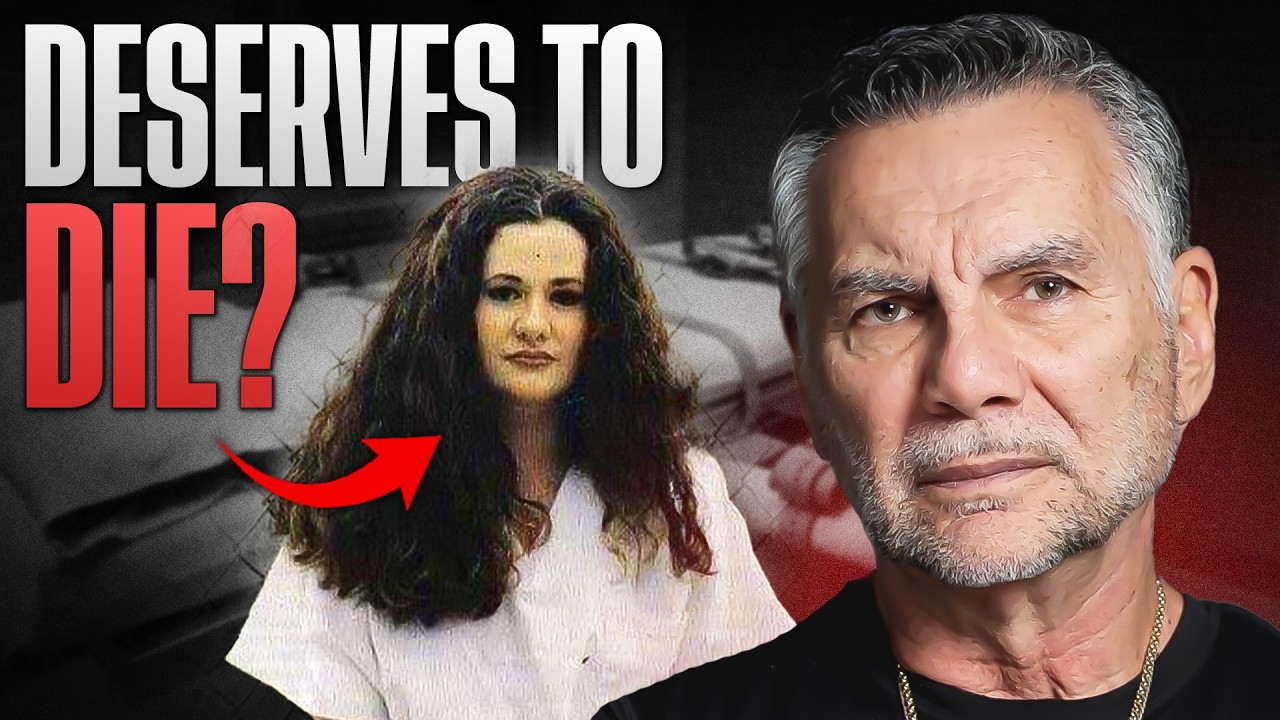
Christa Pike was supposed to die on September 30.
Tennessee strapped her to an execution gurney.
The state administered pentobarbital.
Then it administered another round.
She survived both.
Instead of leaving the chamber in a body bag, Pike left in an ambulance.
Days later, she woke up.
By October 8, her attorneys said she could walk with assistance, eat ordinary food, and communicate, although she continued to experience pain, memory problems, difficulty concentrating, and uncertainty about the long-term consequences of what happened to her.
Now Tennessee faces a question it did not expect to answer.
Should the state try again?
For commentator Michael Franzese, whose discussion of the case forms the basis of this story, the answer is no.
But his argument is unusual.
He does not reach that position because he believes Pike is innocent.
He does not minimize the murder of 19-year-old Colleen Slemmer.
He does not claim Pike should be released.
In fact, Franzese repeatedly describes the crime in extraordinarily harsh terms.
His argument is broader.
A death-penalty system cannot be designed around the one defendant whose guilt seems obvious, he says.
It must be designed for everyone who enters it.
And once the government possesses an irreversible power, every mistake becomes permanent.
That is the twist at the center of his argument.
Christa Pike may be one of the least sympathetic defendants imaginable.
But constitutional protections are tested most seriously when society is dealing with people it does not sympathize with.
First, What Pike Did Cannot Be Erased
Any serious discussion of whether Tennessee should attempt another execution has to begin with Colleen Slemmer.
Pike was convicted of murdering the 19-year-old in Knoxville in 1995.
The killing was prolonged and exceptionally brutal.
Pike was 18 at the time.
She was convicted and sentenced to death, eventually becoming Tennessee’s only woman on death row.
Franzese spends a substantial portion of his discussion describing the crime because he wants to remove what he sees as the easiest response to his argument.
He is not asking audiences to decide whether the murder was horrific.
It was.
He is asking whether a government should possess the authority to deliberately kill a prisoner even when guilt appears overwhelming.
Those are different questions.
And that distinction becomes more important after what happened on September 30.
The State Already Tried
This was not a scheduled execution canceled before the drugs began.
Pike received the execution chemicals.
Twice.
The Associated Press reports that she is the only known U.S. prisoner in the modern era to survive after lethal execution drugs were actually administered and the execution was then stopped.
That makes her case different from many notorious failed executions.
In several previous cases, technicians could not establish usable IV access.
The execution was abandoned before the lethal drugs entered the prisoner.
Pike’s case moved beyond that point.
Her attorneys say the IV lines failed and pentobarbital infiltrated surrounding tissue, causing burns and severe swelling.
A judge has now ordered Tennessee to preserve syringes, drug packaging, catheters, IV lines, restraints and other evidence so that what happened can be reconstructed.
Tennessee has not yet received judicial permission to perform another execution.
Nor has a court ruled that another attempt is permanently forbidden.
The case is in the space between those two answers.
Franzese’s Position Begins With Government Power
In the source discussion, Franzese makes a distinction between personal moral judgment and government authority.
Personally, he repeatedly says Pike’s crime merits the harshest possible accountability.
But he says that does not answer whether the state should possess an irreversible punishment applicable to everyone.
His reasoning is straightforward.
Criminal justice systems make mistakes.
Witnesses make mistakes.
Forensic evidence can be wrong.
Police officers can engage in misconduct.
Prosecutors can conceal evidence.
Defense lawyers can fail.
Jurors can convict innocent defendants.
And once an execution has occurred, none of those errors can be corrected.
“You’re dead,” he says in the discussion.
“There’s no appeal” after that.
That is the foundation of his opposition to another attempt at Pike’s execution.
His 203-Person Figure Is Grounded in Real Death-Row Data
Franzese cites the Death Penalty Information Center and says more than 200 people have been exonerated after receiving death sentences in the United States since 1973.
That underlying point is supported by the organization’s current innocence database.
The Death Penalty Information Center currently says at least 203 people wrongly convicted and sentenced to death have been exonerated since 1973.
The organization also identifies official misconduct as one of the major causes of wrongful capital convictions.
Its research says official misconduct was present in roughly 69% of death-row exoneration cases in one major analysis, while separate recent research has identified hundreds of capital convictions or death sentences overturned or tied to exonerations involving prosecutorial misconduct.
Those statistics do not establish that Pike herself was wrongly convicted.
They do not.
The relevance is systemic.
Franzese’s argument is that society cannot write one death-penalty rule for defendants whose guilt appears certain and another for everyone else.
The same machinery applies to both.
The Problem With Irreversible Punishment
Almost every criminal punishment allows some form of correction.
A wrongful conviction can be overturned.
A prisoner can be released.
A sentence can be vacated.
Compensation can sometimes be paid.
None of those remedies can restore twenty lost years, but the state can at least stop the continuing injustice.
Execution eliminates even that possibility.
That is why the innocence issue sits at the center of modern death-penalty debate.
The question is not whether every person on death row is innocent.
Obviously not.
It is whether any criminal system operated by fallible human beings can guarantee that it will never execute someone who is.
The Death Penalty Information Center’s exoneration figures show that death sentences have repeatedly been imposed on people later cleared.
Franzese uses Pike as the extreme example.
He essentially asks:
If you build the rule around her because her crime is horrifying, what happens when that same rule reaches somebody whose conviction later collapses?
But Pike’s Case Now Raises a Second Problem
Even if the innocence debate did not exist, Tennessee now has a separate issue.
The state already attempted to carry out Pike’s punishment.
And according to her lawyers, the procedure inflicted extensive injuries before failing to accomplish its purpose.
Her attorneys say at least seven needles were used while execution staff attempted to establish IV access.
Reuters reports that Pike’s lawyers say she suffered severe swelling, burns and other injuries to her arms after the pentobarbital was administered.
She later developed additional medical complications while hospitalized.
The state’s execution process therefore no longer exists only as a theoretical risk.
Pike has already experienced it.
A second attempt would force courts to confront whether the Constitution permits the state to expose the same prisoner to another round of execution after a first attempt produced significant suffering.
The Eighth Amendment May Become More Important Than Double Jeopardy
One common question is whether executing Pike again would constitute “double jeopardy.”
Legally, that is not an easy argument.
The Supreme Court allowed Louisiana to execute Willie Francis in 1947 after he survived a failed electrocution the previous year.
Historically, a malfunctioning execution does not automatically extinguish the underlying death sentence.
But Pike’s circumstances are unusual.
She allegedly received the intended lethal drug.
Twice.
She suffered serious injuries.
She required emergency medical treatment.
That means a future constitutional challenge may focus more heavily on the Eighth Amendment prohibition against cruel and unusual punishment than on conventional double-jeopardy doctrine.
Her lawyers could argue that another attempt creates an unacceptable risk of repeating the suffering she already endured.
A court may agree.
Or it may not.
No final ruling exists yet.
Tennessee Has Already Stopped the Machinery
For now, the immediate question is not whether Pike is being returned to the execution chamber tomorrow.
She is not.
Governor Bill Lee has paused Tennessee executions for the remainder of 2026 and ordered an outside review after the Pike failure.
The state had already experienced another failed execution attempt earlier in the year involving Tony Carruthers and problems establishing IV access.
The Pike case therefore landed inside an execution system already facing questions.
Afterward, Tennessee’s prison commissioner resigned.
A judge ordered evidence from Pike’s execution preserved.
Her lawyers renewed their request that the governor commute her sentence to life without parole.
That last option may ultimately become the clearest compromise available.
Pike would never leave prison.
The death sentence would be replaced with life imprisonment without parole.
The state would not have to attempt another execution.
And Colleen Slemmer’s murder conviction would remain intact.
Life Without Parole Is Not Freedom
This distinction matters because debate around Pike can quickly become distorted into two choices:
Execute her.
Or release her.
Those are not the only options.
Pike’s attorneys are currently seeking commutation to life without parole, not a declaration that she should simply return to society.
Franzese’s own argument similarly emphasizes severe incarceration as an alternative.
He describes permanent imprisonment as punishment.
Loss of freedom.
Isolation.
Years inside a cell.
A prisoner serving life without parole may wake every day knowing there is no scheduled return to ordinary life.
That is fundamentally different from saying there should be no accountability.
The debate is about what punishment the government should be allowed to impose.
Pike’s Survival Has Turned an Abstract Debate Into Something Physical
Arguments over execution methods often sound technical.
Protocols.
Dosages.
IV lines.
Drug purity.
Backup procedures.
Medical personnel.
Then Pike survived.
Suddenly those words had physical consequences.
Her arms swelled.
Her lawyers say she suffered burns and blistering.
She became unconscious.
She required ventilation.
She later woke confused and angry, according to her attorneys.
She is now recovering, but medical professionals have not yet been able to guarantee that every effect will disappear.
The abstract question — whether lethal injection can malfunction — has already been answered.
It can.
The harder question is what Tennessee does after that answer arrives in a hospital bed.
The State Also Has Obligations to the Victim’s Family
Opposition to a second attempt should not pretend that only Pike experienced September 30.
Colleen Slemmer’s family had waited decades for the sentence to be carried out.
Instead, witnesses watched an execution become an emergency.
The procedure failed.
An ambulance arrived.
And the entire case moved back into litigation.
That prolongs the process for the victim’s relatives as well.
Another execution attempt could theoretically promise finality.
It could also fail again and produce another round of trauma.
That is part of the difficult policy question Tennessee now faces.
There is no outcome that rewrites 1995.
There is no sentence that restores Colleen Slemmer.
The question is what kind of punishment the state can administer now without creating another constitutional and institutional disaster.
Franzese’s Broader Argument Is Not Really About Pike
That becomes obvious as the source continues.
He repeatedly moves away from Pike herself and toward wrongful convictions.
Government misconduct.
Prosecutorial power.
DNA exonerations.
False accusations.
Mistaken witnesses.
Bad forensic evidence.
Inadequate defense counsel.
His central principle is that criminal law cannot be built around the defendant who makes the hardest case for mercy.
It must survive the defendant who later turns out to be innocent.
The Death Penalty Information Center identifies official misconduct, false testimony or accusations, misleading forensic evidence, inadequate legal defense and mistaken identification among recurring factors in death-row wrongful convictions.
The irreversible nature of execution turns every one of those failures into something different.
Prison can wrongly take years.
Execution takes the possibility of correction itself.
Pike Is Not an Innocence Case
This point cannot be repeated strongly enough.
Nothing about those statistics means Pike belongs among the exonerated.
Her current legal battle is not primarily an innocence claim.
It concerns execution procedure.
Medical injury.
Constitutional punishment.
Evidence preservation.
Potential clemency.
And whether another execution can lawfully occur.
Conflating Pike with innocent death-row exonerees would be misleading.
Franzese uses those exonerations to explain why he opposes the institution of capital punishment as a general matter.
They are evidence for his policy argument.
They are not evidence that Pike did not kill Slemmer.
And That Is Why Her Case Has Become So Difficult
If Pike were innocent, public debate would be easier.
Stop the execution.
Investigate the conviction.
Release her if exonerated.
If the execution had succeeded cleanly, the legal case would also largely be over.
Instead, Tennessee is dealing with the hardest combination possible.
A prisoner convicted of an extraordinarily brutal murder.
A decades-old death sentence.
A failed modern execution.
Serious medical injuries.
A second failed Tennessee execution in the same year.
Evidence now under court preservation.
And a prisoner who survived long enough to become a witness to her own attempted execution.
That combination forces the state to confront questions that punishment rhetoric usually avoids.
How many times may a government try?
How much suffering may occur before punishment becomes unconstitutional?
What does the state owe a prisoner after an execution injures rather than kills her?
What does it owe the victim’s family after promising finality and delivering another legal crisis?
And how much confidence should the public place in an irreversible punishment administered by a system capable of irreversible mistakes?
Why Tennessee Should Not Try Again
The argument against another execution attempt does not require anyone to minimize Pike’s crime.
It requires separating two questions.
What punishment does her crime deserve?
And what punishment can a constitutional government reliably and lawfully administer?
Those are not identical.
Tennessee already tried to execute Christa Pike.
The first attempt did not produce the controlled death the state intended.
It produced a hospitalized survivor.
The state is now investigating why.
The evidence has been ordered preserved.
Executions have been paused.
Pike’s attorneys are asking for life without parole.
And one of the strongest arguments against a second attempt is painfully simple:
A punishment designed to be irreversible failed in a way that cannot simply be undone.
Trying again may eventually be declared lawful.
Courts have not resolved that.
But lawful does not necessarily answer whether it is wise.
Tennessee can keep Pike imprisoned.
It can ensure she never returns to society.
It can preserve Colleen Slemmer’s conviction and acknowledge the horror of her murder.
It can impose permanent punishment without recreating the September 30 chamber.
Because the strongest argument against another attempt is not that Pike deserves no punishment.
It is that government power must be judged by what happens when government itself fails.
On September 30, Tennessee exercised the most irreversible power it possesses.
Christa Pike survived it.
Perhaps the lesson should not be that the state needs a better needle.
Perhaps the lesson is that when punishment leaves no room for human error, human beings may not be capable of administering it without eventually producing an error that cannot be repaired.


