How John Gotti’s Queens Block Parties Became an Unexpected Gift to the FBI’s Surveillance Machine
Every summer, the streets around John Gotti’s Queens headquarters transformed into something that looked less like the territory of America’s most closely watched Mafia boss and more like a neighborhood carnival.
Children lined the sidewalks.
Families crowded beneath summer skies.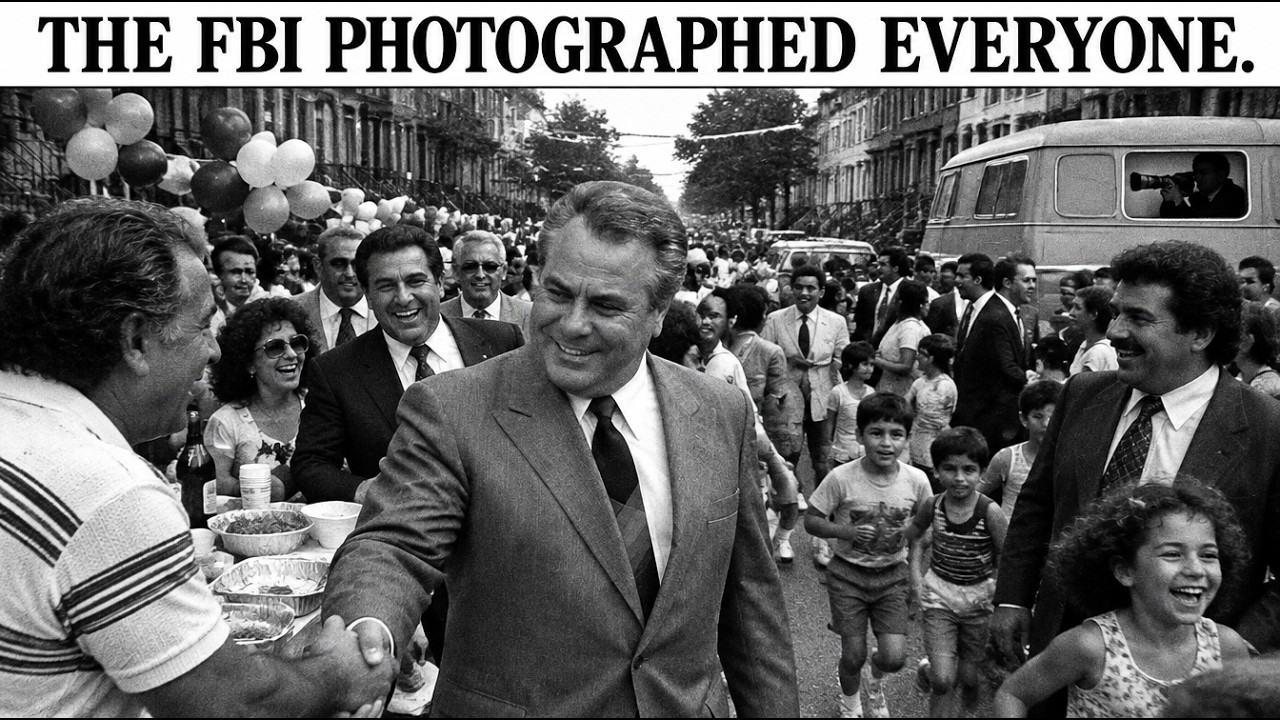
Food appeared in extraordinary quantities.
Music carried across Ozone Park.
Fireworks exploded above rooftops.
And thousands of people sometimes gathered around a man federal investigators considered one of the most dangerous organized-crime figures in the United States.
Gotti appeared to love it.
Federal investigators had another reason to pay attention.
Years later, Gotti’s daughter Victoria recalled that FBI agents were often among the spectators, sitting inside unmarked vehicles, taking notes and photographing people arriving at the celebrations.
That detail captures the contradiction at the center of John Gotti’s public life.
Few modern Mafia bosses worked harder to become visible.
Few simultaneously attracted more determined federal surveillance.
The neighborhood celebrations helped create the image Gotti wanted America to see.
They presented him as generous.
Accessible.
Patriotic.
Popular.
Almost mayoral.
Yet every public gathering also presented investigators with opportunities.
Who arrived?
Who greeted whom?
Which reputed Gambino members appeared together?
Who entered the nearby social club?
Who behaved as though Gotti possessed authority?
A photograph alone might not prove a racketeering conspiracy.
But organized-crime investigations are built from relationships.
And Gotti repeatedly placed those relationships in public view.
The parties were centered around Ozone Park, particularly near the Bergin Hunt and Fish Club on 101st Avenue, the Queens social club closely associated with Gotti and his Gambino crew.
The Washington Post later described Gotti as something resembling the unofficial mayor of the neighborhood.
Residents remembered the Bergin club sponsoring elaborate Fourth of July parties containing attractions for children and enormous fireworks displays.
The festivities continued for years.
Gotti’s reputation in the neighborhood was complicated.
Federal authorities viewed him as a violent racketeer.
Some neighbors saw something entirely different.
They remembered generosity.
Free food.
Entertainment.
Fireworks.
A man who appeared willing to spend money on the people around him.
This local support became one of the strangest features of the Gotti phenomenon.
His fame did not begin only with courtroom victories or expensive suits.
It also grew through carefully visible neighborhood loyalty.
The annual July Fourth celebrations were perfect theater.
In 1989, The New Yorker described one of Gotti’s Independence Day spectacles as his nineteenth annual party.
Thousands of people were reported in the streets.
Authorities had attempted to stop the illegal fireworks.
More than one hundred police officers were reportedly present.
The fireworks still went off.
Crowds responded by chanting Gotti’s name.
The scene said almost everything about Gotti’s relationship with public authority.
Police could surround the neighborhood.
Federal investigators could monitor him.
Prosecutors could indict him.
Journalists could call him a Mafia boss.
Yet in the streets around his club, Gotti could still appear triumphant.
That public image became increasingly important after he rose to lead the Gambino crime family.
Paul Castellano, the previous Gambino boss, was murdered outside Sparks Steak House in Manhattan on December 16, 1985.
Federal investigators later concluded that Gotti had orchestrated the killing.
With Castellano eliminated, Gotti became the dominant figure in the organization.
Unlike some Mafia leaders who attempted to minimize publicity, Gotti seemed to embrace it.
His expensive suits helped produce the nickname “Dapper Don.”
Repeated courtroom acquittals produced another nickname.
“Teflon Don.”
The implication was simple.
Charges did not stick.
But law enforcement never stopped watching.
The FBI says investigators were already gaining deeper insight into New York Mafia structures by the early 1980s through Title III wiretaps, informants, undercover agents, and other investigative techniques.
As Gotti’s importance increased, so did federal attention.
The Bergin Hunt and Fish Club itself had become a surveillance target.
History reports that federal agents installed surveillance equipment there as early as 1981 while examining Gotti’s activities.
That reality changes how the neighborhood parties should be understood.
To local families, the event could look like entertainment.
To Gotti, it could demonstrate prestige.
To investigators, it was a gathering around a known organized-crime location.
Victoria Gotti’s memoir later offered one of the clearest descriptions of federal attention during those celebrations.
She wrote that enormous crowds gathered and that FBI agents were often present in unmarked cars, taking notes and snapping photographs.
That is stronger evidence than later legends about secret rooftop snipers armed with telephoto cameras.
Federal agents absolutely photographed and filmed Gotti and his associates during the period.
The FBI itself has publicly released surveillance photographs and video of Gotti walking New York streets with reputed mob associates between 1988 and 1990.
But the precise claim that agents specifically occupied neighboring rooftops during every block party and photographed every handshake as part of one decisive evidentiary operation is harder to establish.
The documented surveillance apparatus was broader.
And, in many ways, more sophisticated.
Federal agents were attempting to map a criminal organization.
That required understanding hierarchy.
It required identifying soldiers, captains, underbosses, advisers, and associates.
It required proving who met whom.
It required matching voices on secret recordings to actual people.
Visual surveillance could help.
One revealing example emerged during Gotti’s 1992 trial.
Prosecutors showed jurors an FBI surveillance videotape recorded outside the Ravenite Social Club, Gotti’s Manhattan headquarters.
The purpose of that footage was not simply cinematic.
Agents used it to record who entered and exited the club so investigators could identify speakers heard on secretly recorded conversations inside.
That illustrates why seemingly ordinary photographs of gatherings could matter.
A camera might establish presence.
A wiretap might capture conversation.
An informant might explain hierarchy.
A surveillance report might connect dates.
Combined, those pieces could transform a vague suspicion into an organized-crime case.
Law enforcement used similar photographic techniques after Castellano’s killing.
At Gotti’s 1992 trial, investigators introduced color photographs taken outside the Ravenite on Christmas Eve 1985, only eight days after Castellano was murdered.
An investigator testified that known Gambino members arrived until what appeared to be a large meeting developed.
Jurors were allowed to examine some of those photographs.
Again, the image alone did not prove murder.
But it helped establish associations.
That distinction matters when evaluating the legend surrounding Gotti’s Fourth of July parties.
The celebrations almost certainly provided investigators opportunities to observe people.
Agents reportedly photographed attendees.
But describing those photographs as the single “ultimate indictment goldmine” exaggerates their documented importance.
The case that finally destroyed Gotti came primarily from something he could not explain away.
His own voice.
Federal agents found ways to record Gotti discussing Gambino business inside and around the Ravenite.
Some recordings were made in an apartment and hallway above the club.
The conversations revealed leadership structure and criminal activity.
At trial, prosecutors played them for jurors.
One recording captured Gotti discussing who would control the organization if he went to prison.
The tapes were devastating because they allowed jurors to hear the Mafia boss himself.
The government then added another weapon.
Salvatore “Sammy the Bull” Gravano.
Gravano had been Gotti’s underboss.
His cooperation gave prosecutors an insider capable of explaining what recorded conversations meant and how the Gambino hierarchy operated.
The FBI later summarized the final case as the product of extensive court-authorized electronic surveillance, traditional investigative work, NYPD cooperation, and Gravano’s testimony.
On April 2, 1992, the strategy finally worked.
Gotti was convicted on all 13 counts against him.
The charges included racketeering and responsibility for murders, including the killings of Castellano and Thomas Bilotti.
The nickname “Teflon Don” ceased to mean very much.
Federal authorities had finally built a case that stuck.
The neighborhood celebrations nevertheless remain important to understanding how investigators came to know Gotti’s world.
They were public displays of social power.
A Mafia organization depends partly on reputation.
Fear matters.
Loyalty matters.
Hierarchy matters.
The perception that a boss can reward allies and command respect matters.
Gotti projected all of those things.
The block parties turned abstract power into something residents could physically see.
Thousands gathering outside his headquarters reinforced the idea that Gotti was not simply another man living in Queens.
He was somebody.
That symbolism also helped explain why he became such an unusual celebrity.
TIME later observed that Gotti’s neighborhood parties helped turn him into a local folk hero.
He looked like the glamorous gangster many Americans recognized from movies.
He dressed like one.
He behaved like one.
And he understood spectacle.
The Fourth of July was especially useful.
Patriotism and criminal celebrity became strangely intertwined.
There were American flags.
Fireworks.
Neighborhood children.
Food.
Music.
And a reputed Mafia boss functioning as the central benefactor.
CBS later noted that Gotti continued staging large Independence Day fireworks events in Queens for years.
The events sometimes became dangerous.
In 1991, while Gotti was already jailed awaiting trial, roughly 1,000 people gathered for the annual celebration.
A box of fireworks accidentally ignited on a rooftop.
Three people were injured.
Police also seized approximately 500 pounds of fireworks from a nearby railroad trestle.
The party continued to demonstrate Gotti’s cultural hold over the neighborhood even while he was physically absent.
“Free John” clothing appeared among attendees.
A banner declared that the neighborhood missed him.
Free food was distributed outside the Bergin club.
That level of loyalty fascinated journalists and undoubtedly interested investigators.
Yet the FBI did not need to interpret cheering crowds as evidence of racketeering.
The agency needed something far more precise.
Names.
Relationships.
Conversations.
Money.
Orders.
Criminal acts.
Gotti’s visibility made the first two categories easier.
His carelessness eventually helped supply the rest.
The irony was enormous.
Gotti’s celebrity was designed to demonstrate invulnerability.
Each acquittal reinforced the image.
Each public appearance seemed to mock prosecutors.
Every Fourth of July celebration told the neighborhood that John Gotti remained powerful despite federal scrutiny.
But visibility carries a cost.
When a criminal organization operates around a leader who enjoys crowds, cameras, social clubs, and public recognition, surveillance becomes easier.
Investigators do not need to guess who approaches the boss.
They can watch.
They can photograph.
They can compare faces.
They can follow vehicles.
They can identify patterns.
They can later match visual evidence against intercepted conversations.
The FBI’s released surveillance footage demonstrates how systematic this process became.
Previously released footage shows Gotti moving through New York with associates during the late 1980s and 1990.
Federal agents were documenting not merely isolated crimes but an ongoing criminal network.
That is why the block-party photographs matter historically even if they were not the decisive evidence of the final prosecution.
They belonged to a larger surveillance ecosystem.
Gotti’s world was being recorded from multiple angles.
Electronic bugs captured conversations.
Cameras documented meetings.
Agents created reports.
Investigators mapped hierarchy.
Informants provided context.
Eventually, insiders cooperated.
The famous neighborhood parties fit naturally into that operation.
They presented unusually dense concentrations of people connected socially, politically, commercially, or criminally to Gotti’s environment.
Not everyone photographed at such an event was a mobster.
That is another important caution.
Thousands of ordinary residents attended.
Families wanted fireworks.
Children wanted rides.
Neighbors wanted food.
People could admire Gotti without belonging to organized crime.
A photograph of someone shaking his hand would not prove Mafia membership.
Federal prosecutors still had to distinguish community supporters from criminal associates.
That is precisely why visual surveillance worked best when combined with other evidence.
The same photograph could mean almost nothing by itself.
Paired with an intercepted conversation and an informant’s testimony, it could mean much more.
Gotti appears to have understood that investigators were constantly watching him.
What he underestimated was how effectively separate pieces could eventually be assembled.
For years, the government’s cases failed.
Witness intimidation and jury manipulation contributed to his apparent legal invulnerability, according to the FBI’s historical account.
That probably reinforced his confidence.
By the late 1980s, the very traits that made Gotti famous had become vulnerabilities.
He talked.
He met people openly.
He surrounded himself with identifiable associates.
He continued visiting heavily monitored clubs.
And he maintained a public persona that made disappearing into anonymity impossible.
The block parties represented that personality perfectly.
They were enormous.
Defiant.
Public.
Generous.
Chaotic.
And impossible for law enforcement to ignore.
The strongest historical conclusion is therefore subtler than the viral legend.
There is evidence that FBI agents attended or watched Gotti’s Fourth of July celebrations from unmarked vehicles, recording observations and taking photographs.
There is abundant evidence that the FBI conducted extensive photographic, video, and electronic surveillance of Gotti and his associates.
There is also courtroom evidence showing that surveillance photographs and videos were used to identify organized-crime figures and document meetings.
But there is no strong public evidence that secret rooftop photographs from Gotti’s block parties alone became the central evidence responsible for his conviction.
His downfall was more methodical.
The FBI watched.
It listened.
It photographed.
It mapped.
It waited.
Then one of Gotti’s highest-ranking men turned against him.
By the time Gotti entered the Brooklyn federal courtroom in 1992, prosecutors were no longer trying to convince a jury with reputation or neighborhood photographs alone.
They had his conversations.
They had witnesses.
They had surveillance.
They had the organizational structure.
And they had Sammy Gravano.
The fireworks outside the Bergin club may therefore have represented Gotti’s power to his neighbors.
To federal investigators, they represented something else.
Another gathering.
Another notebook.
Another roll of photographs.
Another chance to see who moved toward the boss when the entire neighborhood was watching the sky.


