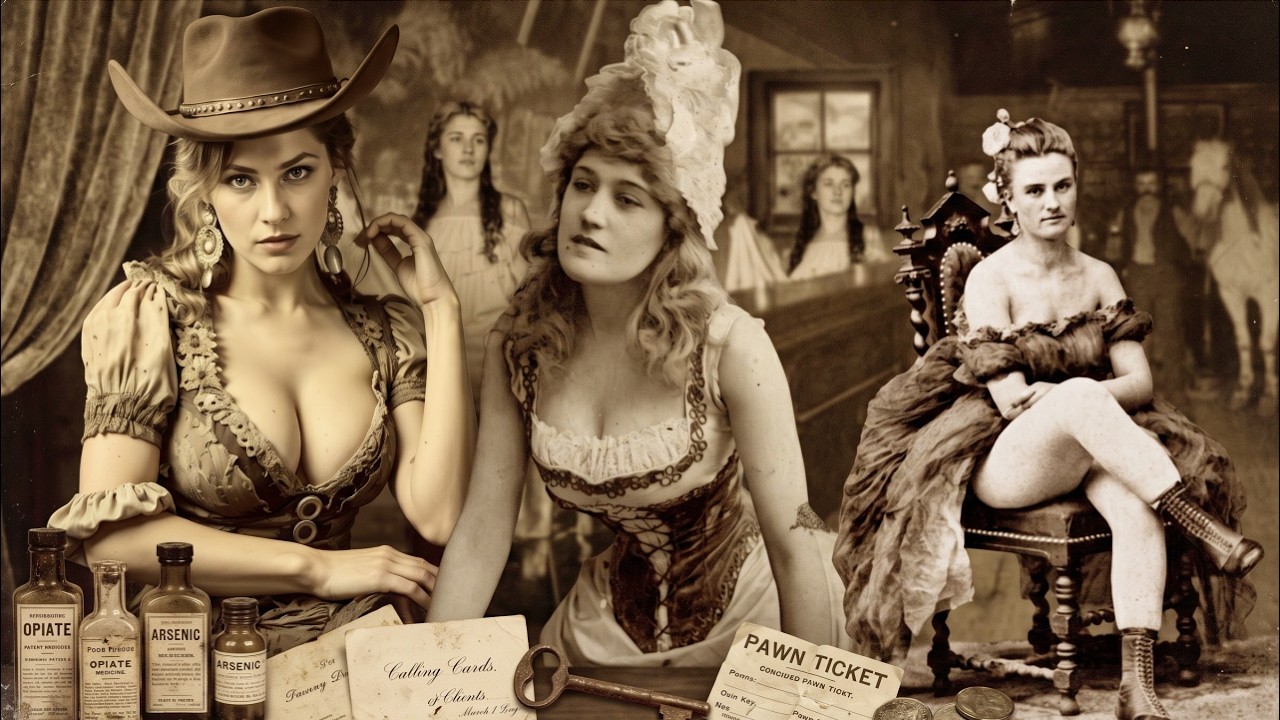
You have seen the scene a hundred times.
The piano is playing.
Whiskey glasses shine under yellow lamps.
Then a woman in a bright red dress appears at the top of the staircase.
Hollywood has trained audiences to think they already know exactly who she is.
But according to the source behind this story, almost everything about that image is misleading.
The dress is wrong.
The drink in her glass may not even be whiskey.
Her job was often not what the movies imply.
And the way she made money looked less like a romantic Western fantasy and more like a commission-based sales job built around keeping customers at the bar.
Saloon girls worked long shifts, used aliases, faced social exclusion, and could sometimes earn more than teachers or domestic servants.
Some married and left.
Some became owners.
Others aged out of the business with nothing.
Here are twenty-four bizarre facts about saloon girls Hollywood almost never showed.
24. Saloon Girls Were Not Automatically Prostitutes
This is the first myth the source attacks.
“Saloon girl,” “dance-hall girl,” and prostitute were not necessarily interchangeable occupations.
A saloon girl might be employed primarily to dance, talk, entertain customers, and encourage them to purchase drinks.
Her money came from the bar.
Not necessarily from private rooms.
Hollywood collapsed these categories because it made storytelling easier.
The historical workplace could be more specialized.
The woman beside a cowboy at the table might simply be an employee whose job was to keep him ordering another round.
23. She Was Basically a Commissioned Salesperson
Her job could be remarkably modern.
Sit with customers.
Talk.
Laugh.
Dance.
Keep them interested.
Then encourage another drink.
According to the source, women could receive a commission for beverages sold while they were entertaining a customer.
At the end of the night, tokens or tally systems could track what each woman had sold.
That makes the saloon girl less like a decorative character and more like a nineteenth-century salesperson with a quota.
More drinks sold meant more money earned.
22. The “Whiskey” in Her Glass Might Be Tea
One of the strangest claims in the source is that the saloon girl herself often did not drink the same alcohol as the customer.
Her glass might contain iced tea or colored water.
The customer still paid as if it were whiskey.
The house collected the difference.
She collected commission.
And most importantly, she stayed sober enough to keep working.
The customer woke with a hangover.
She woke knowing how much she had sold.
Sobriety was not necessarily morality.
It was productivity.
21. Brass Tokens Could Measure Her Night
The source describes a simple accounting system.
Every drink sold through a woman could generate a brass token or tally mark.
At the end of the shift, the owner counted them.
That made her performance measurable.
Sell more.
Earn more.
Fail to hit expectations.
Risk losing the job.
The saloon was not a chaotic party for everyone inside.
For the woman working the room, it could be closely managed labor.
Her smile had a financial value.
20. She Could Make More Than a Teacher
Women on the frontier had limited employment options.
Domestic service.
Laundry.
Sewing.
Teaching.
Cooking.
Many paid poorly.
The source argues that a successful saloon girl could earn considerably more because she combined a fixed wage with drink commissions.
That made the job financially attractive despite the stigma.
For some women, it was not adventure.
It was mathematics.
The saloon paid more.
So that was where she worked.
19. Her Shift Could Last Twelve to Fourteen Hours
The glamorous Western scene lasts a few minutes.
The actual shift lasted all night.
The source describes women starting in the late afternoon and working until the last customers left in the early morning.
Most of that time was spent standing.
Walking between tables.
Dancing.
Talking.
Selling.
On busy nights, there could be little meaningful rest.
The body absorbed the cost.
Leg pain.
Back pain.
Foot problems.
Exhaustion.
There was no ergonomic workplace.
No mandated break.
No overtime law.
18. Some Saloons Forbade Women From Leaving With Customers
This directly contradicts the standard movie implication.
The source says some establishments had written rules preventing saloon women from leaving with customers.
Why?
Not morality.
Profit.
Her economic value existed inside the saloon.
If she left, she stopped generating drink sales.
Public scandal could also damage the house’s reputation.
So the owner wanted her working the room.
Her job was conversation and consumption.
The bar wanted the customer’s money to stay inside.
17. Drinking Real Alcohol on the Job Could Get Her Fined
The customer was expected to become intoxicated.
The worker was not.
According to the source, some saloon operators fined female employees caught drinking actual alcohol during shifts.
A drunk worker sold fewer drinks.
Made mistakes.
Created arguments.
Possibly damaged the establishment.
The house could deduct the fine directly from her wages.
The famous image of a saloon girl drinking whiskey all night may therefore have been backwards.
She might have been the soberest person in the room.
16. Many Used Working Names
Timberline.
Rowdy Kate.
Contrary Mary.
Nicknames could sound theatrical.
But the source says they also served practical purposes.
A working name separated the saloon identity from the woman’s family identity.
Some women sent money home.
Relatives might believe the income came from respectable work.
An alias could also make it easier to leave one town and begin again in another.
The name was not only branding.
It was protection.
15. Many Were Widows, Orphans, or Women With Few Alternatives
The independent saloon woman of legend appears to choose the frontier because she loves freedom.
The source presents harsher motives.
Widowhood.
Loss of family income.
Orphanhood.
Immigration.
Lack of credit.
Few well-paying jobs.
A husband or father could die and the household economy could collapse overnight.
There was no modern welfare state.
No unemployment insurance.
No easy business loan for a poor woman alone.
The saloon offered something other workplaces often did not.
Cash.
14. Most Were Young
Hollywood loves the seasoned saloon woman who seems to have been behind the bar forever.
The source says many actual workers were in their early twenties and often left before thirty.
Why?
Marriage.
Physical wear.
Changing opportunities.
Replacement by younger workers.
The career itself could be short.
The owner did not need to provide retirement.
When one woman left, another could take her place.
The famous older saloon woman may have existed.
But she was not necessarily typical.
13. Marriage Was a Common Exit
The source challenges another dramatic stereotype.
Not every saloon girl ended in tragedy.
Some married.
Mining and cattle towns often had heavily male populations.
A woman working in a saloon might receive frequent proposals.
Marriage could offer a different kind of economic security.
A home.
A family name.
A new social position.
The source portrays this less as rescue than negotiation.
The woman exchanged one economic arrangement for another.
12. Some Became Saloon Owners Themselves
A few women moved from employee to owner.
That mattered enormously in a period when female economic opportunities were restricted.
An unmarried woman could, depending on jurisdiction, own property and operate a business.
A successful saloon worker could save money.
Buy an establishment.
Hire employees.
Keep profits rather than commissions.
The source emphasizes the irony.
A woman denied political power could still become an employer.
She might not have the vote.
But she could sign payroll.
11. The Tight Red Dress Is Mostly Hollywood
The classic bright red, tightly fitted Western saloon costume is one of the genre’s most persistent inventions.
The source says photographs from the era show far more conventional clothing.
Longer skirts.
Long sleeves.
Ordinary fabrics.
Practical garments.
The exaggerated costume evolved later through stage performance and Hollywood design.
Why?
Because a realistic nineteenth-century dress was less visually provocative.
The movie costume sold tickets.
The actual woman had to work an entire shift in smoke, dust, crowded rooms, and constant movement.
She dressed for that reality.
10. Showing an Ankle Could Be Enough to Cause Scandal
Victorian standards were different.
A modern audience may find this almost impossible to understand.
But the source emphasizes that a slightly raised hemline could be considered provocative.
Saloons could exploit that boundary.
A slightly shorter working dress made the woman visually distinctive without looking anything like the revealing costumes modern viewers associate with Western films.
What seems tame today could be commercially useful then.
The owner understood exactly how much suggestion was necessary.
9. The Town Wanted Her Money but Not Her Company
This is one of the ugliest contradictions.
The town packed the saloon at night.
Then respectable society might reject the woman during the day.
According to the source, saloon women could face exclusion from churches, businesses, credit networks, and respectable homes.
Men who spent money in the saloon returned to ordinary society.
The woman working there carried the stigma.
She generated income for others.
Then society demanded that she disappear once the doors closed.
8. Monthly Fines Could Function Like Taxes
Some western towns repeatedly fined women connected to vice districts.
The source argues that predictable monthly fines effectively became a licensing system.
On paper:
Punishment.
In practice:
Revenue.
Municipal authorities could collect the same amount on the same schedule.
The money flowed into city accounts.
The town therefore had a financial relationship with businesses it publicly condemned.
This pattern appears throughout frontier vice history.
Moral outrage and municipal income could exist side by side.
7. Her Word Could Carry Less Weight in Court
The source describes women associated with saloons or prostitution facing severe credibility problems in court.
Claims about legal exclusion varied by jurisdiction, so this should not be treated as one universal law across the West.
But social prejudice was real.
A defense lawyer could attack a woman’s “character.”
A jury might distrust her.
An assault victim could discover that her occupation mattered more to observers than what had happened to her.
The customer participated in the same environment.
Yet she could carry the moral burden alone.
6. Laudanum Could Become Both Medicine and Trap
Laudanum was an opium tincture widely sold in the nineteenth century.
The source connects its use among saloon women with pain, insomnia, and emotional distress.
It was legal.
Accessible.
And highly addictive.
A woman exhausted after long shifts could use it to sleep.
Use it for pain.
Use it to numb anxiety.
Then dependence developed.
The same product that made tomorrow’s shift possible could eventually make leaving the job much harder.
The bottle solved tonight.
It complicated everything after.
5. Growing Old Could Mean Disappearing
There was no pension.
No retirement account.
No worker protection.
No formal safety net tied to saloon employment.
The source describes older women becoming increasingly invisible once they stopped generating income.
Some married.
Some saved enough to become owners.
Others did neither.
Youth had been profitable to the business.
Age was not.
Once a woman stopped being useful to the establishment, the system had little reason to care what happened next.
The town remembered famous gunfighters.
Working women often vanished from records.
4. Madams Could Be Serious Businesswomen
The source distinguishes ordinary workers from successful female proprietors.
Established madams could manage:
Payroll.
Credit.
Bookkeeping.
Property.
Employees.
Relationships with law enforcement.
Local politicians.
Suppliers.
Some paid significant municipal fees and taxes.
Some lent money.
Some donated during fires or epidemics.
That does not make their businesses benign.
They still profited from other women’s labor.
But describing them only as colorful characters misses the economic reality.
Some were major frontier entrepreneurs.
3. Authentic Photographs Are Rarer Than You Think
The popular visual archive of “Old West saloon girls” is complicated.
The source argues that many real workers avoided photography.
A portrait cost money.
Public identification could damage future marriage prospects or employment.
Owners did not necessarily have any reason to document employees.
As a result, some images circulating today under generic labels may be staged, misidentified, or from later eras.
That should make us cautious.
The real woman may never have left us a face.
Only a name in a ledger.
Perhaps not even her real name.
2. The Piano Could Be Worth a Cowboy’s Annual Pay
The saloon piano was more than atmosphere.
It was expensive equipment.
Transporting one into a remote town could require rail shipment followed by wagon or mule transport.
The source compares the cost of some pianos with approximately a year of cowboy wages.
That made music an investment.
A piano signaled quality.
It encouraged customers to stay.
Staying meant drinking.
Drinking meant revenue.
Even the background music was part of the business model.
The saloon girl sold conversation.
The pianist sold atmosphere.
The owner sold both.
1. The Job Did Not Simply Fade Away — Law Helped Kill It
The source ends with Prohibition and changing moral regulation.
By the early twentieth century, reform movements had already targeted saloon culture.
Towns restricted female bar workers.
Vice districts faced increasing pressure.
Then national Prohibition dramatically reshaped the entire saloon economy beginning in 1920.
The workplace itself disappeared or moved underground.
The women lost jobs with it.
No severance.
No union.
No historical preservation program.
Most left no memoirs.
And that is where Hollywood entered.
Decades later, filmmakers recreated the saloon woman from fragments.
They gave her a red dress.
A whiskey glass.
A flirtatious smile.
A staircase.
Sometimes they implied she sold sex.
Sometimes they made her the gunfighter’s love interest.
But the worker described in the source looks very different.
She worked twelve-hour shifts.
Tracked commissions.
Stayed sober so customers would keep drinking.
Used a nickname.
Might earn more than a schoolteacher.
Might be rejected from church on Sunday after serving the same churchgoing men on Saturday.
Might marry and leave.
Might buy the bar.
Might grow old with nothing.
And in many cases, she may never have sold sex at all.
That is perhaps the biggest distortion.
Hollywood turned several different categories of women into one fantasy.
The prostitute.
The dance-hall girl.
The waitress.
The saloon entertainer.
The female business owner.
They all became the woman in the red dress.
But the economic system beneath her was much less romantic.
The saloon did not hire her because she looked good on a staircase.
It hired her because men spent more money when she sat beside them.
That is the detail that changes the entire scene.
Look again at the familiar Western.
The cowboy raises his glass.
She raises hers.
He believes they are sharing whiskey.
Perhaps her glass contains tea.
He orders another.
She earns another token.
The owner makes another sale.
And suddenly the scene stops being romantic.
It becomes retail.
The saloon girl was not necessarily partying.
She was working.
Not drinking.
Selling.
Not simply flirting.
Performing customer retention.
Not a fantasy.
An employee.
Hollywood remembered the dress.
History remembered the ledger.


