On April 22, 1961, a military helicopter approached Camp David carrying Dwight D. Eisenhower, the former president of the United States and the five-star general who had commanded Allied forces during World War II. Waiting for him was John F. Kennedy, a forty-three-year-old president whose administration had just suffered one of the most humiliating foreign policy disasters in modern American history.
Only three months earlier, Kennedy had entered the White House promising renewed American leadership. His inaugural address had inspired millions, and his administration had assembled an extraordinary collection of diplomats, military officers, intelligence officials, and intellectuals. Yet within his first hundred days, an American-backed invasion of Cuba had collapsed, leaving dead soldiers, captured exiles, and a government struggling to explain how an operation supported by the world’s most powerful country had failed so completely.
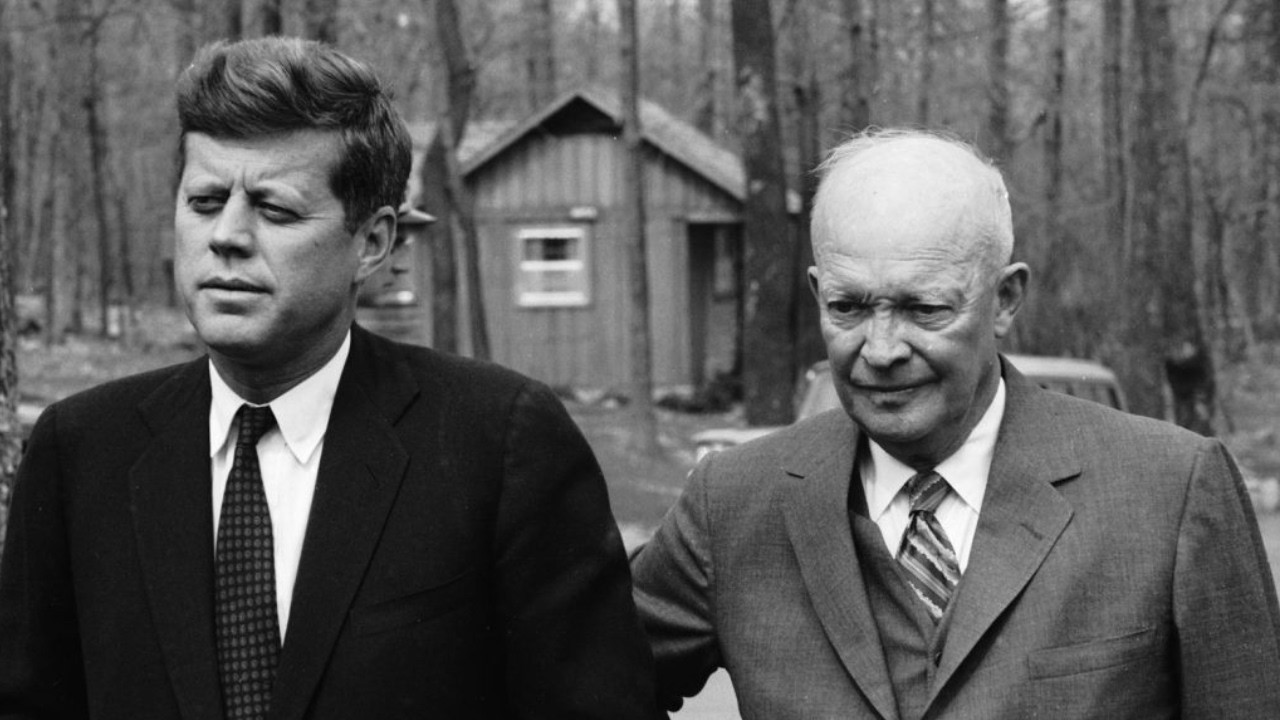
Kennedy had invited Eisenhower to Camp David for advice.
The decision was remarkable because the two men had never enjoyed a particularly warm relationship. Kennedy had campaigned against Eisenhower’s record, criticizing the outgoing Republican administration for allowing American power and international prestige to decline. Eisenhower, meanwhile, had questioned Kennedy’s experience and strongly disliked the Democratic campaign’s allegations about a supposed missile gap between the United States and the Soviet Union.
Now the younger president needed the judgment of the older man he had spent months criticizing.
Their private conversation would expose fundamental disagreements about military planning, intelligence assessments, presidential leadership, and the dangers of allowing political considerations to interfere with operational objectives.
It would also reveal a striking contrast between Eisenhower’s private assessment of the disaster and the public solidarity he displayed afterward.
The meeting became an important episode in Kennedy’s political education. Its lessons would resonate during the Cuban Missile Crisis eighteen months later, when the president confronted an even more dangerous confrontation with the Soviet Union.
To understand the significance of that afternoon, it is necessary to return to the origins of the failed invasion.
Fidel Castro had seized power in Cuba in January 1959, overthrowing the government of Fulgencio Batista. His revolutionary movement initially attracted considerable international attention, but relations between Havana and Washington deteriorated as Castro consolidated power, nationalized property, and moved closer to the Soviet Union.
American officials increasingly viewed Cuba as a strategic challenge.
The island’s proximity to the United States made the possibility of a Soviet-aligned government particularly troubling to national security planners. Washington feared that Castro’s revolution might encourage similar movements throughout Latin America, undermining American influence across the region.
During Eisenhower’s administration, the Central Intelligence Agency began developing plans to support Cuban opposition groups.
On March 17, 1960, Eisenhower approved a covert action program intended to weaken and ultimately replace Castro’s government.
The original concept emphasized organizing, training, propaganda, intelligence operations, and support for Cuban opposition forces. As planning continued, however, the operation expanded into a more ambitious military undertaking.
CIA officials, including Director Allen Dulles and Deputy Director for Plans Richard Bissell, became central figures in developing the project.
The agency recruited and trained Cuban exiles who opposed Castro.
Training facilities were established outside Cuba, including in Guatemala, while planners considered how an armed force might establish a foothold on the island and encourage broader resistance.
The strategy rested on several assumptions.
CIA officials believed Castro’s government was vulnerable to internal opposition. They anticipated that a successful landing might stimulate resistance among Cubans dissatisfied with the revolution.
They also expected that air operations could weaken Castro’s military sufficiently to allow the exile brigade to establish a defensible position.
Those assumptions would prove dangerously optimistic.
By the time Kennedy won the presidential election in November 1960, the operation had become a major inherited national security problem.
The president-elect faced a difficult choice.
Canceling the operation risked abandoning Cuban exiles who had already been recruited and trained. Proceeding meant authorizing a covert military intervention whose political and military consequences were uncertain.
Kennedy also wanted to avoid openly involving American combat forces.
He believed a direct United States invasion of Cuba could provoke international condemnation and intensify tensions with Moscow.
The administration therefore attempted to preserve plausible deniability while supporting an operation large enough to challenge Castro’s government.
That contradiction became one of the central weaknesses of the entire plan.
A substantial military landing required reliable air support, effective logistics, accurate intelligence, and a coherent strategy for dealing with Cuban government forces.
A covert political operation, meanwhile, depended on concealing the extent of American involvement.
The more ambitious the military objective became, the more difficult it was to maintain secrecy.
Kennedy inherited a plan that had evolved under Eisenhower, but the final operation was authorized during Kennedy’s presidency.
The distinction matters because responsibility for the invasion cannot be assigned entirely to either administration.
Eisenhower approved the original covert program.
CIA planners developed the operational assumptions and military arrangements.
Kennedy reviewed, modified, and ultimately approved the invasion that took place.
Each stage introduced decisions that shaped the outcome.
The final landing site was the Bay of Pigs, on Cuba’s southern coast.
The surrounding terrain included extensive swamps, limited road access, and difficult conditions for moving troops and supplies.
Planners believed the geography offered defensive advantages because Cuban government forces would have relatively few routes for approaching the beachhead.
Yet the same terrain could become a trap if the exile brigade lost control of the surrounding roads or failed to receive essential supplies.
The operation required coordination between aircraft, ships, ground forces, and intelligence networks.
It also depended on assumptions about Castro’s military capabilities and the likelihood of domestic resistance.
As the invasion approached, the Kennedy administration became increasingly concerned about the international consequences of visible American involvement.
Air operations emerged as a particularly sensitive issue.
CIA planners wanted to neutralize Castro’s air force before the exile brigade landed.
Without effective air superiority, the invasion fleet and troops ashore would remain vulnerable to Cuban aircraft.
But extensive bombing would make it more difficult to maintain the claim that the operation was an internal Cuban uprising rather than an American-supported intervention.
On April 15, 1961, aircraft associated with the exile operation attacked Cuban airfields.
The strikes failed to destroy Castro’s entire operational air capability.
The appearance of aircraft disguised to suggest Cuban origins also generated immediate controversy.
International observers questioned American explanations of the attacks.
At the United Nations, the administration faced growing scrutiny.
Kennedy subsequently restricted additional planned air operations.
The decision reflected the administration’s desire to limit visible American involvement, but it also weakened the invasion’s military prospects.
The resulting disagreement over air support became one of the most heavily debated aspects of the Bay of Pigs disaster.
Critics later argued that canceling or restricting air attacks deprived the exile brigade of a necessary advantage.
Others emphasized that the invasion suffered from deeper strategic weaknesses that air support alone might not have overcome.
The force was relatively small.
The assumption of widespread popular resistance against Castro was questionable.
Intelligence estimates had underestimated the Cuban government’s capacity to respond.
The operation also lacked a convincing contingency plan if the initial landing failed to produce the expected political results.
On April 17, 1961, Brigade 2506 began landing at the Bay of Pigs.
The invasion immediately encountered serious difficulties.
Cuban government forces responded rapidly.
The exile brigade struggled to establish and maintain control of the beachhead.
Aircraft attacked vessels carrying essential supplies.
Communication and logistical problems compounded the military difficulties.
The hoped-for uprising against Castro did not materialize on the scale planners had anticipated.
Within approximately three days, the invasion had collapsed.
More than a thousand members of the exile force were captured, while over one hundred were killed.
The precise human toll was devastating for the families and communities connected to the operation.
For Kennedy, the political consequences were immediate.
The invasion demonstrated that the administration had supported an operation it could neither successfully execute nor credibly conceal.
The United States had attempted to overthrow a foreign government while avoiding the appearance of direct involvement.
Instead, the operation failed publicly, and American responsibility became widely recognized.
Castro emerged politically strengthened.
The Soviet Union gained an opportunity to portray Washington as an aggressor.
Kennedy’s administration faced questions about its competence, judgment, and understanding of revolutionary politics.
The young president had suffered a major international humiliation.
He accepted public responsibility.
But privately, he began examining how the decision had been made and why the assumptions behind it had gone unchallenged.
The failure exposed weaknesses in the relationship between the White House and the intelligence establishment.
It also raised questions about Kennedy’s preferred method of managing advisers.
Eisenhower had relied on a relatively formal national security decision-making system.
His administration used structured meetings, established channels of communication, and detailed staff procedures to examine competing policy recommendations.
Kennedy preferred a more flexible style.
He favored smaller discussions, informal consultations, and direct access to individual advisers.
The approach reflected his impatience with bureaucratic procedures and his confidence in the intellectual abilities of the people around him.
Yet the Bay of Pigs demonstrated that informality could create serious problems.
Advisers might hesitate to challenge assumptions shared by influential colleagues.
Important disagreements could remain unresolved.
A president consulting officials separately might receive polished recommendations without witnessing the arguments that produced them.
The result could be an illusion of agreement.
Kennedy began recognizing that the quality of his advisers did not automatically guarantee the quality of their collective judgment.
That realization formed the background to his meeting with Eisenhower.
On April 22, the former president arrived at Camp David.
The location carried personal significance for Eisenhower.
He had used the presidential retreat frequently during his administration and had named it after his grandson, David.
The secluded Maryland setting provided an opportunity for confidential discussion away from the immediate pressures of Washington.
Kennedy met Eisenhower and began explaining the failed Cuban operation.
According to Eisenhower’s written account of their conversation, Kennedy reviewed the planning, objectives, and developments that had led to the invasion’s collapse.
Eisenhower was already familiar with much of the background.
At Kennedy’s suggestion, Allen Dulles had briefed him before the meeting.
The former president therefore arrived prepared to examine the operation rather than simply receive a general explanation.
The conversation quickly moved toward the decisions that had shaped the failure.
Eisenhower wanted to understand the air operations.
The question was fundamental.
An amphibious landing against an organized government required protection from hostile aircraft.
Without control of the air, troops and supply ships could be exposed to devastating attacks.
Eisenhower’s military background made the issue particularly important to him.
He had spent years planning and commanding large-scale operations in which air superiority, logistical preparation, and coordination among military forces were essential.
The Normandy invasion in June 1944 had required extraordinary cooperation between air, sea, and ground forces.
Eisenhower understood that even a carefully prepared landing could fail if critical supporting operations were inadequate.
The Bay of Pigs was vastly smaller than Normandy, but the basic military principles remained relevant.
The landing force needed sufficient protection and supplies to accomplish its objective.
Eisenhower questioned the decisions surrounding air support.
Kennedy’s administration had restricted additional strikes partly because officials wanted to preserve the appearance that the United States was not directly involved.
To Eisenhower, the tension between secrecy and military effectiveness was difficult to reconcile.
An operation involving trained exiles, aircraft, ships, and extensive preparation was unlikely to remain completely hidden.
If the military objective required air superiority, restricting the necessary support could undermine the entire operation.
The former president’s concerns reflected a basic principle of strategic planning: political objectives and military means must be compatible.
If an operation cannot be carried out without exposing the sponsor, the sponsor must reconsider either the operation or the requirement for secrecy.
Attempting to satisfy incompatible objectives can create a plan that accomplishes neither.
The Bay of Pigs had become an example of precisely that danger.
American involvement was exposed.
The invasion failed.
And the political damage was intensified by the contradiction between the administration’s public explanations and the operation’s actual origins.
Yet Eisenhower’s questions extended beyond air support.
He also examined the mechanics of the landing.
The geography surrounding the Bay of Pigs offered limited access routes through the swamps.
A successful defense depended partly on controlling those routes.
Eisenhower wanted to know whether the exile brigade had received the equipment necessary to establish roadblocks and prevent Cuban forces from rapidly penetrating the beachhead.
The question reflected his attention to tactical detail.
He was not merely offering broad political criticism.
He wanted to understand how the operation had been organized at the level of individual units.
Were weapons and supplies distributed effectively?
Could troops defend the approaches to their positions?
Had commanders anticipated how government forces might exploit the terrain?
Kennedy explained his understanding of the brigade’s preparation.
But the speed of the Cuban response suggested that the defensive arrangements had not worked as expected.
The former president’s notes reflected uncertainty about exactly why the beachhead had been penetrated so quickly.
That uncertainty is important.
Even after the invasion failed, some operational details remained unclear.
The participants were reconstructing events from incomplete reports.
They did not yet possess the full body of evidence that later investigations would examine.
Eisenhower also questioned the handling of supplies.
The invasion force depended on ships carrying weapons, ammunition, communications equipment, and other essential materials.
When vessels were damaged or lost, the troops ashore suffered immediate consequences.
Concentrating important supplies in vulnerable locations increased the danger.
Eisenhower’s attention to logistics reflected decades of military experience.
He understood that an army could not fight effectively without a reliable system for delivering and distributing equipment.
Even courageous soldiers could be defeated if their ammunition, weapons, or communications systems failed.
The Bay of Pigs exposed weaknesses in that essential foundation.
Some of those problems originated in CIA planning conducted before Kennedy took office.
Others were connected to decisions made during the final preparations.
The meeting therefore did not establish a simple division between an experienced former president who had been entirely correct and an inexperienced successor who had made every mistake.
The reality was more complicated.
Eisenhower had authorized the original covert program.
The CIA had developed plans containing serious assumptions about Cuban political conditions and military resistance.
Kennedy had approved the final operation while imposing restrictions intended to limit American visibility.
The disaster emerged from the interaction of those decisions.
Eisenhower’s private analysis identified problems without eliminating the responsibility of his own administration for the program’s origins.
His questions nevertheless revealed how differently he approached military decision-making.
One of the most significant subjects involved Kennedy’s consultations with advisers.
Eisenhower wanted to know whether the president had assembled the relevant officials together and required them to debate the proposal directly.
The distinction mattered deeply to him.
A president could receive advice from military officers, intelligence officials, diplomats, and political advisers without ever hearing those officials challenge one another.
Each adviser might present a recommendation that appeared reasonable in isolation.
But the weaknesses of one recommendation might become obvious when confronted by someone with different expertise.
A military officer might question whether diplomatic restrictions made an operation impossible.
A diplomat might challenge assumptions about international reactions.
An intelligence official might be forced to defend estimates of popular support.
A logistical specialist might identify weaknesses that strategic planners had overlooked.
Eisenhower believed the president needed to witness those disagreements.
The purpose was not to create conflict for its own sake.
It was to expose uncertainty before a decision became irreversible.
His approach reflected experience commanding large organizations.
During World War II, Eisenhower had managed powerful military leaders whose views frequently differed.
He understood that disagreement could be uncomfortable.
But suppressing disagreement could be far more dangerous.
The Bay of Pigs suggested that Kennedy’s advisers had not sufficiently challenged the assumptions underlying the operation.
The president had been presented with a plan that appeared more feasible than events would demonstrate.
The decision-making process had failed to reveal the full extent of the risks.
Eisenhower’s criticism therefore reached beyond the details of Cuba.
It addressed the structure of presidential authority.
A president must make final decisions, but those decisions depend on the information and arguments brought before him.
If advisers are not required to confront competing assessments, the president may mistake institutional confidence for genuine agreement.
Kennedy had assembled a distinguished national security team.
Yet the invasion demonstrated that expertise could become dangerous when reinforced by shared assumptions.
The former president’s advice offered a different model.
Bring the relevant officials together.
Encourage disagreement.
Demand clear explanations.
Examine practical consequences.
And make the final decision only after the competing arguments have been tested.
The lesson was simple in principle but difficult in practice.
Presidents operate under enormous pressure.
They face limited time, incomplete information, and advisers who may possess conflicting institutional interests.
Formal meetings can become bureaucratic and inefficient.
Informal discussions can encourage candor but also conceal disagreement.
The challenge is to establish a process that combines flexibility with disciplined scrutiny.
Eisenhower believed Kennedy had not yet achieved that balance.
The conversation at Camp David exposed the difference between their governing styles.
The former president favored institutional structure.
The younger president had initially trusted a more personal approach.
The Bay of Pigs demonstrated the dangers of relying too heavily on the latter.
Kennedy did not immediately abandon informal consultation.
But the failure prompted changes in how his administration examined major national security questions.
The lessons would become especially important during the Cuban Missile Crisis.
Before that confrontation, however, Eisenhower had another concern.
He worried that the failed invasion had damaged American credibility.
Cold War diplomacy depended partly on perceptions of strength and resolve.
The Soviet Union constantly evaluated American intentions and capabilities.
A failed operation could encourage adversaries to believe that Washington lacked the determination to defend its interests.
Eisenhower had spent eight years managing that strategic competition.
He understood the importance of avoiding unnecessary military conflict.
But he also believed that deterrence required convincing opponents that the United States possessed the will to act when essential interests were threatened.
The Bay of Pigs presented a troubling image.
The United States had supported an operation against Castro but had not provided the resources necessary to ensure its success.
From Eisenhower’s perspective, that combination risked appearing both aggressive and ineffective.
It could damage American prestige without achieving the intended strategic objective.
His concern was not limited to Cuba.
He feared that Soviet leaders might interpret the failure as evidence of weakness in the new administration.
Such an interpretation could influence future confrontations over Berlin and other disputed areas.
The danger was that a failed regional operation might encourage wider challenges to American power.
The subsequent months provided reasons for concern.
In June 1961, Kennedy met Soviet leader Nikita Khrushchev in Vienna.
The summit proved difficult.
Khrushchev pressed the American president on Berlin and other Cold War disputes.
Kennedy later acknowledged the intensity of the encounter.
In August, East German authorities began constructing the Berlin Wall.
The division of the city became an enduring symbol of the Cold War.
The following year, the Soviet deployment of nuclear missiles to Cuba brought the superpowers to the brink of confrontation.
These events cannot all be attributed directly to the Bay of Pigs.
They emerged from broader strategic tensions that had developed over many years.
But the failed invasion influenced perceptions of Kennedy’s administration and formed part of the political environment in which subsequent crises unfolded.
Eisenhower’s warning therefore reflected a legitimate strategic concern.
A president’s decisions could affect not only immediate military objectives but also the expectations of foreign governments.
The consequences of failure could extend far beyond the original operation.
Despite his private criticism, Eisenhower behaved very differently when reporters questioned him after the Camp David meeting.
He did not publicly humiliate Kennedy.
He did not attempt to exploit the disaster for partisan advantage during their appearance together.
Instead, he emphasized the importance of supporting the constitutional authority of the sitting president in matters of foreign policy.
The distinction between private criticism and public conduct was significant.
Eisenhower believed the invasion had been badly handled.
His written reflections contained severe judgments about the embarrassment suffered by the United States.
Yet he understood that openly undermining Kennedy during an international crisis could damage the country’s position.
His public restraint reflected an institutional principle.
The presidency belonged to the officeholder, regardless of political party.
Former presidents could disagree with decisions and offer criticism.
But during moments of national danger, they also had responsibilities to the country.
Eisenhower’s public statement demonstrated that distinction.
He could challenge Kennedy privately while refusing to turn the meeting into a public confrontation.
The approach also protected Eisenhower’s own position.
Because the operation had originated during his administration, a public dispute over responsibility might have exposed disagreements about the CIA’s planning and the decisions made before January 1961.
Both presidents had reasons to avoid a destructive argument.
But the former president’s public solidarity remained notable.
The meeting had been arranged after a major foreign policy failure.
Kennedy was politically vulnerable.
Eisenhower possessed enormous national prestige.
He could have used the moment to emphasize his successor’s inexperience.
Instead, he presented himself as a former president willing to offer advice.
The public saw two leaders discussing national security.
The private record revealed a far more searching examination of failure.
Eisenhower’s notes described a conversation that continued through lunch and afterward as the two men walked around the retreat.
The meeting did not produce a dramatic agreement.
It did not settle every question about responsibility.
Nor did it immediately transform Kennedy’s foreign policy.
Its importance lay in the analysis it encouraged.
Eisenhower asked questions that exposed weaknesses in the operation and the process that had approved it.
Kennedy confronted the consequences of decisions made under his authority.
The encounter illustrated the value of experience at a moment when the younger president needed to reconsider his assumptions.
A photograph of the two men walking together at Camp David captured the symbolic significance of the occasion.
The former commander and the young president appeared side by side.
One had spent decades exercising military and political authority.
The other had entered the White House promising a new style of leadership.
Between them stood a failed invasion that neither could entirely separate from his own administration.
The photograph suggested reflection rather than celebration.
It became an enduring image of the complicated relationship between experience and ambition.
For Kennedy, the meeting was part of a broader effort to understand what had gone wrong.
The administration established investigations and reviews of the failed operation.
The president reassessed the performance of the CIA and the relationship between intelligence officials and the White House.
He became more skeptical of recommendations presented with excessive confidence.
The failure also influenced his willingness to question military advice.
Kennedy recognized that senior officials could possess great expertise while still disagreeing about the consequences of a proposed action.
The president needed to understand those disagreements rather than simply choose among recommendations.
This realization became especially important in October 1962.
When American reconnaissance discovered Soviet nuclear missiles in Cuba, Kennedy faced a crisis far more dangerous than the failed invasion.
The missiles threatened to alter the strategic balance and created intense pressure for an immediate response.
Some military advisers favored airstrikes or invasion.
Others warned that military action could provoke Soviet retaliation.
Diplomatic options carried their own risks.
The president had to decide how to respond without triggering nuclear war.
This time, Kennedy established a more structured advisory process.
The Executive Committee of the National Security Council, commonly known as ExComm, became the principal forum for examining options.
Senior officials debated military, diplomatic, and political alternatives.
Arguments were challenged.
Assumptions were questioned.
The president allowed advisers to explore disagreements rather than requiring immediate consensus.
The process was not flawless.
Participants still faced uncertainty, institutional pressures, and incomplete intelligence.
But it represented a more deliberate examination of alternatives than the decision-making process associated with the Bay of Pigs.
Kennedy also resisted pressure for immediate military action.
He chose a naval quarantine while continuing diplomatic efforts to secure the removal of the missiles.
The decision created space for negotiation.
After thirteen days of extraordinary tension, the crisis ended through an agreement involving Soviet withdrawal of the missiles and American commitments concerning Cuba and, confidentially, missiles in Turkey.
The outcome did not eliminate Cold War competition.
But it avoided direct military confrontation between the United States and the Soviet Union.
Historians have frequently connected Kennedy’s handling of the missile crisis to lessons learned from the Bay of Pigs.
The president had become more cautious about accepting expert consensus.
He placed greater emphasis on examining alternatives.
He recognized the danger of allowing military momentum to determine political outcomes.
These changes cannot be attributed exclusively to Eisenhower’s advice at Camp David.
Kennedy learned from many sources, including his own mistakes, advisers’ later reflections, and the changing international environment.
Nevertheless, Eisenhower’s emphasis on open debate and disciplined decision-making closely anticipated the approach Kennedy used during the missile crisis.
The contrast between the two episodes is striking.
At the Bay of Pigs, an operation built on optimistic assumptions collapsed under the pressure of reality.
During the missile crisis, Kennedy subjected competing options to extended scrutiny and resisted demands for immediate escalation.
The difference reflected growth in presidential judgment.
It also demonstrated the importance of institutional learning.
A government that fails to examine its mistakes risks repeating them.
Kennedy’s administration had suffered a humiliating defeat.
The president could have responded by assigning blame and defending every earlier decision.
Instead, he began reconsidering how decisions were made.
That willingness to learn became one of the most consequential developments of his presidency.
Eisenhower’s private criticism contributed to the broader process.
His questions were not designed merely to embarrass Kennedy.
They reflected principles developed through decades of military command.
He believed successful operations required clear objectives, adequate resources, reliable logistics, and disciplined coordination.
He also believed leaders needed to hear disagreement before making irreversible commitments.
Those principles were not uniquely military.
They applied to presidential leadership more broadly.
The Bay of Pigs demonstrated what could happen when political ambitions, intelligence assumptions, and military requirements were insufficiently reconciled.
The administration wanted Castro removed.
It wanted Cuban exiles to accomplish the task.
It wanted to avoid direct American military involvement.
And it wanted the operation to remain plausibly deniable.
Those objectives proved difficult to combine.
The invasion failed partly because the resources and political constraints did not match the intended outcome.
The problem was not simply that Kennedy canceled an airstrike.
Nor was it simply that CIA planners underestimated Castro.
The deeper failure involved a plan whose political assumptions and military requirements had not been adequately tested together.
Eisenhower’s questions exposed that weakness.
His attention to air support addressed operational feasibility.
His questions about roadblocks examined tactical preparation.
His concern about supplies highlighted logistical vulnerability.
His criticism of the decision-making process challenged the institutional assumptions behind the entire operation.
Taken together, these questions formed a comprehensive examination of military and political failure.
They also demonstrated why Eisenhower’s experience mattered.
He had spent much of his career managing complex operations in which small errors could produce enormous consequences.
He understood that successful leadership required more than confidence.
It required systems capable of detecting mistakes before they became disasters.
Kennedy had entered office with great confidence in his ability to make decisions quickly.
The Bay of Pigs forced him to recognize the limits of that approach.
The former president’s advice offered a method for reducing those risks.
The meeting also revealed the importance of distinguishing private candor from public loyalty.
Eisenhower did not conceal his concerns when speaking with Kennedy.
He asked difficult questions and expressed serious reservations.
But he did not use the public appearance to undermine the sitting president.
That combination reflected an understanding of institutional responsibility.
Effective advice sometimes requires blunt criticism.
National leadership sometimes requires restraint in public.
The two obligations are not necessarily contradictory.
Eisenhower believed he could serve the country by helping Kennedy understand the failure while avoiding statements that might weaken American credibility.
The distinction remains relevant to relationships between presidents and their predecessors.
Former leaders possess valuable experience.
They also retain political influence.
Their advice can help successors confront unfamiliar challenges.
But public disagreements can become politically destructive, especially during international emergencies.
The Camp David meeting demonstrated a way to navigate that tension.
Eisenhower offered his assessment privately.
Kennedy listened.
Both men then appeared before reporters without staging a partisan confrontation.
The conversation did not erase their political differences.
Eisenhower remained skeptical of aspects of Kennedy’s foreign policy.
Kennedy continued pursuing an approach distinct from the previous administration.
Yet the meeting established a moment of practical cooperation.
The older president’s experience became relevant to the younger president’s responsibilities.
That development was particularly significant because Kennedy had campaigned against Eisenhower’s leadership.
He had argued that the country needed new energy and a more flexible response to communist expansion.
The Bay of Pigs did not invalidate every criticism Kennedy had made.
But it demonstrated that experience and institutional discipline could be essential even to an administration committed to change.
The episode therefore complicates the familiar contrast between Eisenhower’s caution and Kennedy’s dynamism.
Eisenhower was not simply a cautious figure who avoided action.
He had authorized the original covert program against Castro.
Kennedy was not simply an aggressive leader who ignored consequences.
He restricted military operations partly because he feared the international consequences of overt American intervention.
Both presidents struggled to balance political objectives against strategic risks.
Their disagreements reflected different judgments about how that balance should be achieved.
The Bay of Pigs revealed weaknesses in both administrations’ approaches.
Eisenhower’s government had supported the development of a covert operation built on uncertain assumptions.
Kennedy’s government had approved the final invasion while imposing restrictions that complicated its execution.
The CIA had contributed flawed planning and optimistic intelligence assessments.
The result was a failure that emerged from multiple decisions across two presidencies.
Recognizing that complexity is essential to understanding the historical record.
It would be misleading to portray Eisenhower as possessing a flawless plan that Kennedy alone destroyed.
It would be equally misleading to suggest Kennedy had merely inherited an unavoidable disaster.
The invasion was the product of institutional decisions, strategic assumptions, and political judgments made over time.
The Camp David conversation exposed those layers of responsibility.
Eisenhower’s questions revealed the importance of air power, logistics, and command arrangements.
Kennedy’s explanations reflected the political constraints under which he had approved the operation.
Their exchange demonstrated how military feasibility and diplomatic objectives could come into conflict.
It also showed that even highly experienced leaders could disagree about how such conflicts should be resolved.
The meeting did not produce a definitive answer to every question.
But it provided Kennedy with a more demanding framework for evaluating future decisions.
That framework would become especially valuable during the nuclear confrontation of October 1962.
The historical significance of April 22, 1961, therefore extends beyond the immediate aftermath of the Bay of Pigs.
It represents a moment when presidential leadership was examined through the experience of failure.
Kennedy had been in office for approximately three months.
He had already discovered that international affairs were far less manageable than campaign speeches suggested.
His advisers had failed to anticipate the consequences of a major operation.
His administration had suffered public humiliation.
And he now faced the task of restoring confidence without repeating the same mistakes.
Eisenhower arrived with decades of experience in command.
He understood the danger of weak assumptions, poor coordination, and inadequate logistical preparation.
He also understood that the consequences of military failure could extend into diplomacy.
Their conversation brought those perspectives together.
The older president did not offer a magical solution.
He could not reverse the invasion.
He could not recover the lives lost or immediately secure the release of captured soldiers.
He could not restore American prestige through a single conversation.
What he could do was ask questions that forced Kennedy to examine the operation more carefully.
Those questions became the lasting significance of the meeting.
Why had the air support been restricted?
Were the troops properly equipped?
Had planners understood the terrain?
Were essential supplies distributed effectively?
Had advisers debated the plan openly?
Had the president received a realistic assessment of the risks?
Each question addressed a different dimension of leadership.
Together, they challenged the assumption that a plan was sound merely because experienced officials supported it.
Kennedy’s later presidency demonstrated a growing awareness of that danger.
He became more willing to question intelligence estimates and military recommendations.
He recognized the importance of preserving alternatives.
He understood that an operation could be tactically impressive yet strategically disastrous.
And he learned that the president must accept responsibility for decisions even when the underlying recommendations come from respected experts.
The Bay of Pigs became an expensive education.
Eisenhower’s advice helped illuminate the lessons.
The relationship between the two men remained complicated.
Their political philosophies differed.
Their personal backgrounds encouraged mutual suspicion.
Their assessments of Cold War strategy were not identical.
Yet the meeting demonstrated that national responsibility could create opportunities for cooperation across those differences.
Kennedy invited Eisenhower because he needed experience.
Eisenhower came because the failure concerned American security and credibility.
Their conversation reflected the seriousness of the situation.
The public photographs showed two presidents walking together.
The private notes revealed a discussion of military mistakes, institutional weaknesses, and strategic consequences.
The contrast between those records is what makes the episode so revealing.
The meeting was neither a ceremonial visit nor a dramatic confrontation.
It was a difficult conversation between a young president confronting failure and an experienced predecessor examining what had gone wrong.
Its consequences unfolded gradually.
Kennedy reconsidered his decision-making process.
The administration altered its approach to national security deliberations.
The lessons of Cuba influenced the handling of later crises.
And the relationship between Kennedy and Eisenhower acquired a measure of practical respect that political rivalry had previously obscured.
The former president’s most important contribution may not have been any single criticism of the invasion.
It was his insistence that a president must hear the strongest competing arguments before committing the country to action.
That principle remains one of the most enduring lessons of the Bay of Pigs.
Presidential decisions often involve uncertainty that cannot be eliminated.
Intelligence may be incomplete.
Military plans may depend on assumptions that prove false.
Political constraints may undermine operational effectiveness.
Advisers may disagree about risks.
No decision-making system can guarantee success.
But a disciplined process can make weaknesses more visible before consequences become irreversible.
Eisenhower understood that from military command.
Kennedy learned it through presidential failure.
Their meeting at Camp David brought those experiences into direct contact.
The older man had spent years balancing military force against political objectives.
The younger man was beginning to understand how difficult that balance could be.
The conversation did not erase the disaster.
But it helped define the questions Kennedy would need to ask in the future.
That is why the meeting remains historically significant.
It was not simply an encounter between two famous presidents.
It was an examination of the responsibilities of power.
Eisenhower’s private assessment was severe because he believed the United States had damaged its credibility through an operation that failed to achieve its objective.
His public conduct was restrained because he understood the importance of supporting the presidency during an international crisis.
Kennedy’s willingness to seek advice reflected his recognition that the failure demanded serious examination.
Both men demonstrated aspects of leadership that were less visible during their political rivalry.
The older president offered criticism without publicly exploiting the disaster.
The younger president sought counsel from someone whose record he had recently attacked.
Their interaction illustrated the value of experience, institutional loyalty, and intellectual humility.
In the end, the most important image from April 22, 1961, may be the two men walking together at Camp David.
The former Supreme Allied Commander and the young president moved through the quiet Maryland retreat after discussing a military catastrophe.
Neither could undo what had happened in Cuba.
Neither possessed all the answers.
But the conversation had forced the central questions into the open.
For Kennedy, those questions would remain relevant throughout the rest of his presidency.
When the Cuban Missile Crisis arrived, he would confront another set of advisers, another collection of military options, and consequences vastly greater than those of the failed invasion.
This time, he would insist on more extensive debate and examine alternatives with greater caution.
The connection between the two crises reveals the enduring importance of learning from failure.
The Bay of Pigs demonstrated how dangerous untested assumptions could become.
Camp David offered an opportunity to confront those assumptions.
The Cuban Missile Crisis showed the value of a president willing to reconsider how decisions were made.
Eisenhower’s private conversation with Kennedy did not single-handedly transform American foreign policy.
But it became part of the education of a president who had discovered that confidence was not a substitute for judgment.
The lesson was simple and demanding.
Before committing the nation to a dangerous course, a president must ensure that the strongest arguments against it have been heard.
On April 22, 1961, Dwight D. Eisenhower brought that principle to John F. Kennedy at Camp David.
The younger president had already paid a painful price for learning it.
The next time he faced a crisis involving Cuba, the stakes would be nothing less than the possibility of nuclear war.


