John Gotti’s Reputation for Ruthless Retribution Was Real, but the “Seated Rival” Story Remains Unverified
John Gotti built a reputation in New York’s underworld where perceived disrespect could carry consequences far beyond an angry conversation.
That reputation was not invented by Hollywood.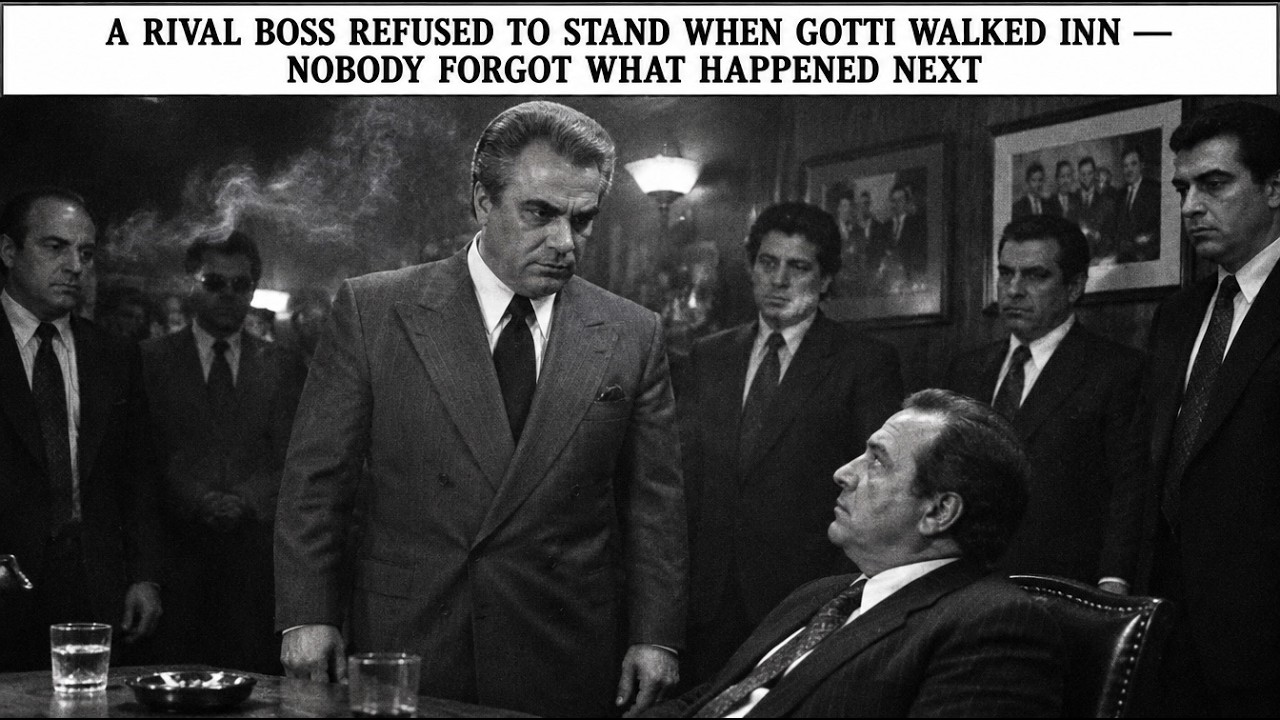
Federal investigators described Gotti as violent, ruthless, deeply involved in organized crime, and ultimately responsible for ordering murders while leading the Gambino crime family.
But one particularly dramatic story now circulating online requires much more caution.
According to the viral version, an unnamed rival Mafia boss committed an almost suicidal act of disrespect by remaining seated when Gotti entered a room.
The story claims everyone around him immediately understood what that gesture meant.
It says Gotti silently ordered retaliation.
It says hit teams moved into the night.
And it promises secret FBI wiretaps revealing how the disrespectful rival was eventually erased.
The problem is that the central scene cannot currently be tied to a reliable FBI record, court transcript, identified cooperating witness, or established historical account.
The FBI’s extensive John Gotti files are real.
The surveillance is real.
The wiretaps are real.
The murders are real.
And the atmosphere of fear surrounding Gotti was real.
But that does not automatically authenticate every story later attached to his name.
The verified history is already extraordinary.
John Joseph Gotti rose through the Gambino crime family during an era when New York’s Five Families remained enormously influential.
The FBI says Gotti became involved in gambling, loansharking, narcotics trafficking, theft and other organized criminal activity while climbing through the Gambino hierarchy.
By the early 1980s, federal investigators were using court-authorized electronic surveillance, informants and undercover agents to understand the internal structure of the Gambino organization.
Those investigations gave authorities increasingly detailed insight into conversations that Mafia leaders believed were private.
Gotti was not yet the family boss.
Paul Castellano occupied that position.
Aniello Dellacroce, an influential underboss and Gotti mentor, represented another powerful faction within the family.
The relationship between Gotti and Castellano became increasingly strained.
One major source of tension involved narcotics investigations surrounding members of Gotti’s crew.
Castellano opposed unauthorized drug trafficking and feared the legal consequences it brought to the organization.
According to historical accounts, Gotti understood that evidence connecting his crew to heroin trafficking could threaten his own position and potentially his life.
Then Dellacroce died of cancer in December 1985.
Castellano did not attend his funeral.
Accounts of Gotti’s rise repeatedly identify that absence as an act Gotti interpreted as profound disrespect.
The importance of that moment helps explain why stories about Gotti punishing insults remain so believable decades later.
Two weeks after Dellacroce’s death, Castellano and his underboss Thomas Bilotti arrived at Sparks Steak House in Manhattan.
They never made it inside.
Gunmen approached and opened fire.
Both men were killed on December 16, 1985.
The FBI says Gotti watched the attack from a nearby vehicle and afterward had his driver pass the scene so he could verify that his orders had been carried out.
That murder changed the American Mafia.
Castellano had been the leader of one of New York’s most powerful organized-crime families.
Gotti had effectively eliminated the man standing between himself and control of the Gambino organization.
Soon afterward, Gotti emerged as the new boss.
This is the documented foundation behind his later reputation.
He was not merely someone who talked about vengeance.
Federal prosecutors eventually proved his connection to murders.
The FBI describes him directly as a ruthless criminal who used violence, intimidation and corruption to maintain power.
His public image grew almost as rapidly as his criminal authority.
Gotti wore expensive suits.
He appeared frequently outside Manhattan social clubs.
He became unusually accessible to photographers.
Tabloids followed him.
The press called him the “Dapper Don.”
Then, after several high-profile prosecutions failed to convict him, another nickname became famous.
The “Teflon Don.”
Charges appeared unable to stick.
Federal investigators later concluded that some of those apparent courtroom victories had been assisted by witness intimidation and jury tampering.
That combination of style and violence created a powerful mythology.
Gotti could smile outside a courthouse in front of cameras while simultaneously commanding an organization built on extortion, intimidation and murder.
It became easy to imagine that even a minor gesture of disrespect could become fatal.
But imagining something is not evidence that a particular incident happened.
The “seated rival” story has several problems.
First, the rival boss is usually not identified.
That is unusual when discussing a supposed confrontation among senior members of New York’s Five Families.
If another recognized boss openly insulted Gotti in a room filled with Mafia figures, historians would expect some trace of the event.
There might be testimony.
There might be a memoir from a cooperating witness.
There might be an FBI surveillance report.
There might be a trial transcript.
There might be references in organized-crime histories.
Yet the viral version typically offers none.
It relies instead on anonymous “eyewitness accounts.”
Second, the alleged retaliation is similarly vague.
The caption says “hit squads were quietly deployed.”
But it does not identify who was killed.
It does not give a date.
It does not name the location.
It does not identify shooters.
It does not connect the supposed murder to a known prosecution.
That vagueness matters.
Gotti’s documented murder cases contain names.
Paul Castellano.
Thomas Bilotti.
Specific dates.
Specific locations.
Specific evidence.
The anonymous seated rival provides none of those things.
Third, real FBI files involving Gotti are publicly available.
The FBI Vault contains thousands of pages of released material concerning surveillance, associates, investigations and organized-crime activity.
Those records demonstrate just how intensely law enforcement watched Gotti.
One FBI surveillance report from the Ravenite Social Club, for example, describes individuals arriving at the club, conducting guarded street conversations, passing slips of paper and attempting to conceal their discussions by covering their mouths.
That is genuine surveillance material.
It shows investigators documenting movements and interactions in extraordinary detail.
But the existence of such records does not authenticate a separate story simply because someone labels it an “FBI wiretap.”
A real FBI document should be identifiable.
It should have a file reference.
A report date.
Pages.
Agents.
Or enough contextual information to connect the claim to the historical record.
The viral caption provides none of that.
There is another reason the story feels believable.
Respect, hierarchy and public recognition mattered intensely within traditional Mafia culture.
A boss expected deference.
Rank mattered.
Introductions mattered.
Who could summon whom mattered.
Who could speak first mattered.
Meetings were political performances as much as conversations.
Someone deliberately refusing to recognize a boss could certainly be interpreted as an insult.
But there is a major gap between saying such behavior could be dangerous and asserting that one specific insult triggered an execution.
That second claim requires evidence.
Gotti’s own career demonstrates how dangerous Mafia disrespect could become without needing to invent an anonymous victim.
Castellano’s failure to attend Dellacroce’s funeral became part of the hostility surrounding his eventual murder.
Historical accounts specifically note that Gotti regarded the absence as disrespectful.
But even there, the funeral insult was not the sole reason Castellano was killed.
The power struggle was much larger.
Gotti’s crew faced narcotics exposure.
Relations with Castellano had deteriorated.
Dellacroce, who had often acted as a stabilizing influence, was dead.
Gotti was maneuvering for power.
Reducing the assassination to one insult would erase the larger criminal and organizational context.
The same caution should apply to the seated-rival legend.
Mob history often gets compressed into simple moral formulas.
Disrespect the boss.
Die.
Insult the family.
Disappear.
Refuse to stand.
Hit squad arrives.
Those formulas work extremely well in movies and social-media storytelling.
Real organized crime was usually more complicated.
Murders required political calculation.
A killing could provoke retaliation.
Other families might object.
Participants could expose themselves to prosecution.
Senior figures had to consider alliances.
Even Gotti’s murder of Castellano was politically dangerous because Castellano was a sitting family boss.
Gotti did not simply act because he was personally offended.
He had to navigate the consequences of killing the head of his own organization.
The murder ultimately elevated him, but it also intensified law-enforcement attention.
The FBI and NYPD continued expanding their surveillance.
Agents gathered evidence around Gotti’s clubs and associates.
Investigators recorded conversations.
And eventually, they gained the cooperation of one of the most damaging possible witnesses.
Salvatore “Sammy the Bull” Gravano.
Gravano had served as Gotti’s underboss.
His decision to cooperate with federal prosecutors devastated Gotti’s defense.
With extensive electronic surveillance and Gravano’s testimony, prosecutors built the case that previous investigations had failed to deliver.
Gotti was arrested in December 1990.
He faced charges including racketeering, murder, extortion and jury tampering.
Federal authorities also took extraordinary precautions during the trial.
Jurors were kept anonymous to reduce the possibility of intimidation.
This time, the “Teflon Don” mythology collapsed.
On April 2, 1992, Gotti was convicted on 13 counts.
Those included responsibility for ordering the murders of Castellano and Bilotti.
One FBI official famously joked afterward that Gotti was no longer coated in Teflon.
Everything had stuck.
He was sentenced to life imprisonment.
He never regained his old power.
Gotti died in federal prison in June 2002.
That ending is important when considering the mythology surrounding him.
For years, Gotti’s public image suggested invincibility.
He defeated prosecutions.
He appeared before television cameras.
Crowds sometimes treated him like a celebrity.
His suits and swagger created an image almost completely unlike the secretive bosses who had traditionally led Mafia families.
But law enforcement was quietly documenting him.
The same surveillance culture that strengthened Gotti’s mythology ultimately destroyed it.
That is why genuine FBI recordings are historically important.
They can reveal how organized-crime figures actually spoke when they believed outsiders could not hear them.
They can establish hierarchy.
They can establish motive.
They can corroborate criminal activity.
But precisely because authentic Gotti recordings are so valuable, fabricated or misidentified “wiretaps” should be treated carefully.
A dramatic audio clip uploaded decades later does not become authentic merely because the title says FBI.
The original source matters.
The chain of custody matters.
The context matters.
And the people speaking need to be identified.
The viral “REVENGE” story provides none of those foundations.
Its strongest underlying claim is broader.
Gotti was dangerous.
Verified.
He ordered murders.
Verified.
He used intimidation.
Verified.
He became boss after Castellano was assassinated.
Verified.
Gotti viewed Castellano’s absence from Dellacroce’s funeral as disrespectful.
Supported by established historical accounts.
The FBI used extensive wiretaps and electronic surveillance against Gotti and the Gambino family.
Verified.
The FBI maintains publicly accessible files documenting surveillance and investigations involving Gotti.
Verified.
Gotti’s organization operated within a culture where status, hierarchy and respect mattered.
Strongly supported by the historical structure of organized crime.
But an unnamed rival boss deliberately remained seated when Gotti entered a room.
Not established by the sources reviewed.
Everyone in the room immediately believed the rival had signed his own death warrant.
Not verified.
Gotti ordered hit teams deployed that night.
Not verified.
The rival was murdered specifically because he refused to stand.
Not verified.
An FBI wiretap captures the retaliation order.
No authenticated recording matching that description was identified.
An “unredacted” federal file reveals the mob’s most ruthless execution arising from that encounter.
No specific FBI document matching that claim has been established.
That does not make John Gotti less dangerous.
If anything, the documented history is more revealing than the legend.
Gotti participated in a criminal world where murder was not metaphorical.
Castellano and Bilotti were shot dead on a Manhattan street because Gotti wanted control of the Gambino family.
Witness intimidation and jury corruption helped him evade accountability for years.
Federal agents spent enormous resources penetrating his organization.
His own underboss eventually helped prosecutors dismantle the image of invincibility around him.
The man did not need invented assassinations to become notorious.
His verified record already explains why so many stories about instant Mafia revenge continue to attach themselves to his name.
That is also why those stories should be tested against evidence.
John Gotti’s reputation for punishing enemies was real.
His organization used violence.
His rise involved murder.
His power depended partly on fear.
But the specific image of a rival boss remaining seated, silently humiliating the “Teflon Don,” and immediately triggering secret hit squads remains a compelling Mafia legend rather than an authenticated episode in the evidence reviewed here.
The real FBI files tell a darker and ultimately more consequential story.
Gotti spent years making others fear the consequences of crossing him.
Meanwhile, investigators were watching him from cars, photographing his meetings, recording conversations, following associates and building a case page by page.
The boss who seemed untouchable was surrounded by surveillance he could not see.
And when the evidence finally came together, the feared “Teflon Don” did not disappear an anonymous rival.
The government disappeared his freedom instead.
He entered prison for life.
And unlike the unnamed victim in the viral revenge story, that ending is fully documented.


