Federal investigators are dismantling portions of a Philadelphia property at the center of a disturbing criminal investigation, removing sections of walls, examining a multiroom basement laboratory, and preparing for another phase of excavation as they search for physical evidence that could help explain what happened to several missing women.
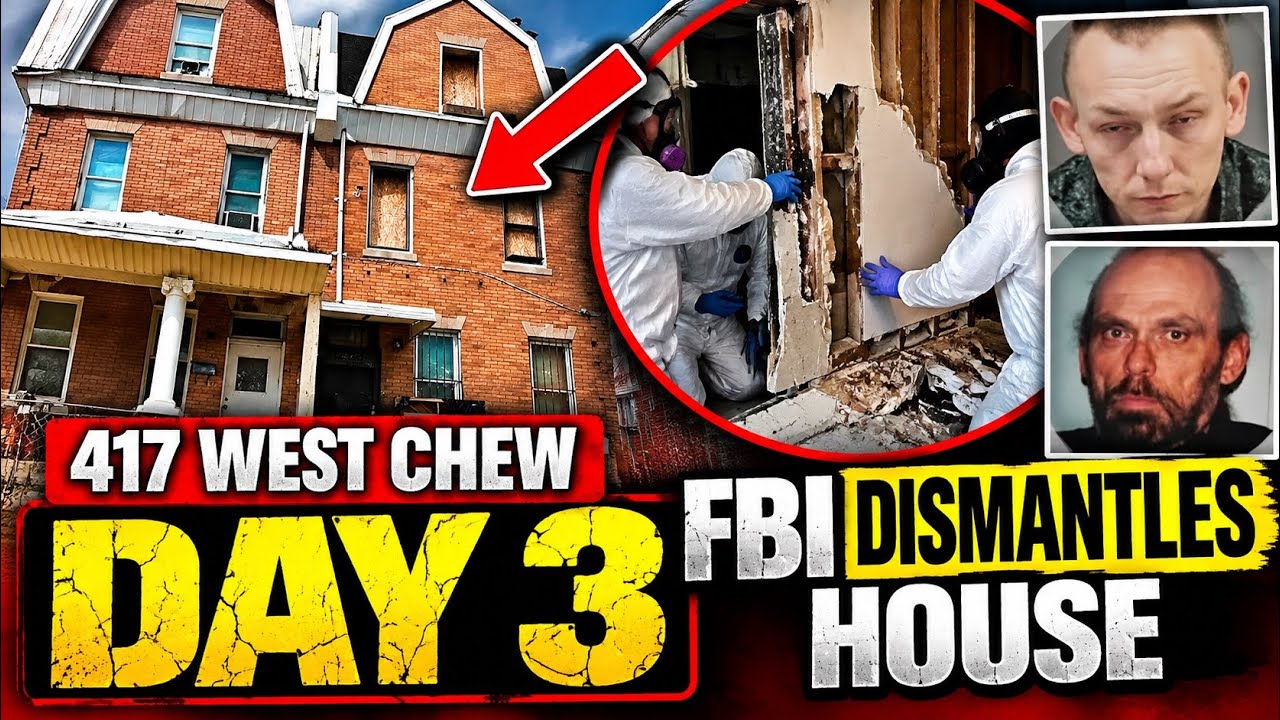
The latest developments at 417 West Chew Avenue mark a significant escalation in the forensic examination of the property. According to reporting discussed in an October 7 episode of Tear Talk, investigators have moved beyond collecting ordinary household objects and are now systematically examining the physical structure of the building.
Sections of drywall, electronic equipment, furniture, and other materials have reportedly been removed for further analysis. Investigators are also focusing on a basement area described by a source as resembling an old high school science laboratory.
The search is part of a broader investigation involving a substantial collection of digital photographs and videos, some of which reportedly depict women who may have died.
Authorities are attempting to determine whether biological evidence inside the property can corroborate what appears in those recordings.
Despite the intensive search, investigators have not publicly announced the discovery of human remains, a confirmed DNA match to the women depicted in the material, or forensic findings establishing that a homicide occurred inside the house.
That distinction remains essential as the investigation attracts national attention.
Investigators Begin Removing Sections of the House
One of the most striking developments occurred late Tuesday, October 6, when investigators reportedly began removing structural materials from the property.
According to Fox 29 coverage discussed in the transcript, investigators carried an entire section of wall out of the house.
The section appeared to have a dark panel or possibly part of an appliance attached.
Members of the FBI’s evidence response team were also observed examining and tagging another wall section outside the property.
The removal of structural materials suggests that investigators are interested in more than the objects ordinarily found inside a residence.
Walls, flooring, fixtures, and other permanent features can become relevant when investigators seek traces of biological material or attempt to reconstruct events depicted in photographs or recordings.
However, the removal of a wall does not establish that investigators discovered blood, DNA, or other incriminating evidence on it.
No such finding was announced in the source material.
The significance lies in the methodical nature of the search.
Rather than limiting their examination to portable objects, investigators are preserving sections of the building itself for closer forensic inspection.
FBI Evidence Team Examines Structural Materials
The involvement of the FBI’s evidence response team has added another dimension to the investigation.
Federal forensic personnel reportedly examined and labeled structural materials removed from the property.
That process may allow investigators to document precisely where evidence originated and preserve it for additional examination.
The physical location of a potential trace can be as important as the trace itself.
For example, biological material recovered from a particular surface may carry different evidentiary significance depending on its location, surrounding objects, and relationship to other evidence.
Investigators may also compare the arrangement of rooms and fixtures with the visual material already recovered.
The transcript describes more than one million photographs and videos associated with the broader investigation.
According to the report, investigators are using that digital collection to help guide the physical search.
The recordings may help identify specific locations or objects requiring examination.
But the existence of a photograph or video does not automatically establish when an event occurred, whether the image is authentic, or whether a crime took place at the property.
Those questions require independent corroboration.
Basement Laboratory Becomes a Major Focus
By Wednesday, October 7, investigators had reportedly shifted substantial attention toward the basement.
CBS Philadelphia coverage cited in the transcript described investigators dismantling portions of a laboratory-like area.
A source familiar with the investigation characterized the basement as containing multiple rooms.
The source compared its appearance to an old high school science laboratory.
That description offers a more specific picture of the area than the term laboratory alone.
It suggests a space with multiple work areas rather than a single table or collection of containers.
Investigators may need to remove equipment or structural materials to examine locations that are otherwise difficult to access.
The process could also help document the configuration of the basement before further dismantling occurs.
However, the report does not establish that the laboratory was used to kill anyone or dispose of human remains.
Those possibilities remain subjects of investigation rather than confirmed findings.
The immediate development is that forensic teams have begun physically examining and dismantling the area.
Investigators Search for Biological Evidence
The stated objective of the latest search is to identify physical evidence that could connect women depicted in recovered digital material to the property.
According to CBS reporting summarized in the transcript, investigators are looking for blood, tissue, hair, fibers, and DNA.
These categories of evidence could potentially help establish whether particular individuals were present in specific parts of the house.
But finding biological material would not necessarily prove a violent crime.
Investigators would need to determine its source, location, significance, and relationship to other evidence.
A DNA match might establish contact with an object or environment.
Additional evidence would be needed to determine what occurred.
The distinction is particularly important because investigators reportedly already possess digital material showing women inside the broader setting.
The new search appears intended to connect that material to verifiable physical evidence.
As of the October 7 report, no confirmed DNA match or identified biological evidence had been publicly announced.
Five Women Remain Central to the Investigation
The case has attracted attention because of recovered images and recordings involving several women.
According to the transcript, Philadelphia police previously reported that five women depicted in the material appeared to be deceased.
The medical examiner’s assessment was qualified.
The conclusion depended on the images being authentic and unaltered.
That means the assessment was not equivalent to confirming five deaths through recovered remains and completed autopsies.
The report identified Gabriella Morando, Marabel Fries, and Nicole Facero among the women discussed in the investigation.
It also referred to two other women whose identities remained unresolved or had not been publicly clarified.
The transcript did not provide sufficient independent documentation to establish the full identities or circumstances of every person depicted.
Most importantly, no human remains associated with the five women had been publicly recovered, according to the report.
The search is therefore attempting to address a significant evidentiary gap.
Investigators must determine whether the visual material can be corroborated by physical evidence and whether that evidence supports criminal charges.
More Than One Million Images and Videos Guide the Search
The digital archive is one of the most consequential aspects of the investigation.
The transcript describes a collection exceeding one million photographs and videos.
Investigators are reportedly examining the material to identify potential evidence and guide searches of the property.
The scale presents a substantial challenge.
A large digital collection may contain duplicate files, unrelated material, images from different locations, and recordings created over extended periods.
Investigators must establish authenticity, dates, locations, and the identities of people appearing in relevant material.
They may also need to determine whether a recording depicts an actual event or something staged or altered.
The physical search can help address some of those questions.
If a particular room or object appears in a recording, forensic examination may reveal whether the physical environment corresponds to the image.
But even a visual match does not independently establish a crime.
Investigators would still need evidence connecting the relevant people, actions, and circumstances.
The source does not disclose how much of the archive has been fully reviewed.
More Than 100 Search Warrants Remain Sealed
Another major development concerns the number of search warrants associated with the investigation.
Earlier reporting cited approximately 95 warrants.
The latest CBS account discussed in the transcript said more than 100 search warrants remained sealed.
That figure indicates the investigation has generated extensive legal activity.
However, it should not be interpreted as evidence of 100 victims or 100 separate properties.
Search warrants can authorize examinations of electronic devices, online accounts, vehicles, records, residences, and other forms of evidence.
Multiple warrants may concern different aspects of the same investigation.
The fact that they remain sealed also limits what the public can know about investigators’ findings and suspicions.
Affidavits supporting warrants may contain information about the evidence investigators believe justifies further searches.
But the public cannot reliably infer the contents of those affidavits merely from the number of warrants.
The expanding warrant count demonstrates the investigation’s complexity without establishing its ultimate outcome.
Homicide Prosecutors Are Assisting Investigators
The Philadelphia District Attorney’s Office is also involved in the ongoing investigative process.
According to the report, Jeff Hunnowski, chief of the office’s Homicide and Non-Fatal Shooting Unit, confirmed continuing communication with Philadelphia Police homicide supervisors.
The office is reportedly assisting with search warrants and legal questions.
That involvement is significant because prosecutors can help investigators ensure that evidence is obtained and preserved in ways consistent with legal requirements.
They may also advise on what additional evidence would be necessary to support particular charges.
However, involvement by homicide prosecutors does not establish that homicide charges are imminent.
Nor does it prove that investigators have confirmed a homicide at the property.
The report specifically cautioned against drawing that conclusion.
At this stage, the prosecutors’ involvement reflects the seriousness and potential legal complexity of the investigation.
Investigators Remove Electronics and Household Objects
In addition to structural materials, investigators have reportedly removed a variety of household items.
The transcript describes a large television, mirrors, electronic equipment, boxes, and bags of evidence.
NBC10 also reportedly observed investigators swabbing what appeared to be a wooden pallet.
The report previously mentioned the removal of a vacuum cleaner.
Such objects may be examined because investigators believe they could contain relevant traces or information.
Electronics can also contain digital records that help establish timelines or connections between people and locations.
But the significance of each item remains unknown.
Removing a television does not establish that it contains incriminating recordings.
Swabbing a wooden pallet does not establish that investigators found biological evidence.
And collecting a vacuum cleaner does not prove that it contains material linked to a victim.
The investigative value of these items will depend on subsequent examination.
The public has not been told what, if anything, those examinations have revealed.
Luminol Testing May Follow the Removal of Household Items
The report also described plans to use luminol during the forensic examination.
Luminol is a chemical reagent commonly used to help identify possible traces of blood that may not be visible under ordinary lighting.
Its use can be helpful when investigators are examining surfaces where biological material may have been cleaned or otherwise obscured.
However, a luminol reaction is presumptive.
It does not conclusively establish that blood is present.
Other substances can produce reactions, and additional testing is necessary to determine whether a trace is blood and, if so, whether it is human.
Further analysis would also be needed to identify the source.
The report indicated that investigators were removing household objects before carrying out additional examinations.
That sequence may allow forensic personnel to inspect areas that had previously been covered.
No positive luminol result was announced in the transcript.
Underground Pipes Removed During an Earlier Search
The latest developments have renewed attention on an earlier search involving underground plumbing.
According to the report, investigators excavated an area in front of the property on July 22.
Philadelphia police, the FBI, and the Philadelphia Water Department reportedly participated.
Sections of underground pipe were removed and preserved for forensic examination.
The timing is important.
The pipe removal occurred months before the October 7 developments.
It was not a newly announced excavation conducted that day.
The earlier operation has become relevant again because investigators are now dismantling the basement laboratory.
The transcript suggests that investigators may be examining connections between the laboratory environment and the property’s drainage system.
But the report does not establish that biological material was recovered from the pipes.
It also does not establish that the plumbing was used to dispose of human remains.
Those possibilities remain unconfirmed.
Questions About Chemicals and Possible Wet Cremation
The investigation has also generated discussion about the possibility of chemical disposal of biological material.
CBS reporting cited in the transcript referred to chemicals and pipes being examined as investigators considered a possible wet-cremation scenario.
The term generally refers to a chemical process associated with the breakdown of organic tissue.
In this case, however, the source does not establish that such a process occurred.
The presence of chemicals or laboratory equipment would not, by itself, prove that human remains were processed inside the property.
The transcript also mentions the possibility of other chemical activities.
That uncertainty makes it especially important to distinguish between investigative theories and confirmed findings.
Authorities have not publicly announced the discovery of human tissue in the plumbing.
They have not confirmed that a chemical disposal process occurred.
And they have not established a direct forensic connection between the laboratory and the women depicted in the recovered digital material.
Those questions remain part of the ongoing inquiry.
Heavy Equipment Expected for Another Excavation Phase
Investigators are reportedly preparing for another major stage of the search.
According to CBS Philadelphia coverage discussed in the transcript, heavy equipment was expected to arrive the following week.
The equipment would support further excavation of the property.
That development suggests the investigation is expanding beyond the interior examination.
However, the report does not specify exactly where investigators plan to dig.
It also does not establish that authorities expect to recover bodies.
Excavation can serve multiple forensic purposes, depending on the evidence investigators are seeking.
The important point is that the search is continuing and may involve substantial additional work.
Until investigators explain the objective and findings of the excavation, its significance remains uncertain.
Authorities Decline to Announce Search Results
Despite the visible activity at the property, authorities have released relatively little information about what the latest searches have produced.
According to the transcript, federal prosecutors, the FBI, and Philadelphia police were questioned during an unrelated news conference.
They declined to provide a substantive update on the investigation.
That silence has created a contrast between the extensive work visible at the property and the limited information available to the public.
Investigators have been seen removing materials and dismantling parts of the house.
But no major forensic breakthrough was announced in the October 7 account.
The absence of an announcement does not establish that investigators have found nothing.
It simply means the public has not received confirmation of specific results.
That distinction matters because evidence may require laboratory examination before investigators can assess its significance.
Authorities may also withhold details to protect the integrity of an active investigation.
No New Human Remains or DNA Matches Announced
The report repeatedly emphasized what had not been established.
As of the latest update, authorities had not announced the recovery of human remains associated with the women depicted in the digital archive.
They had not publicly confirmed a DNA match placing a particular woman at a relevant location inside the house.
They had not announced identified human tissue or a conclusive chemical-testing result.
They also had not publicly resolved the identities of the remaining unknown women.
The transcript mentioned Blair Tenzelli and Amy McKill as additional cases or individuals discussed in connection with the broader investigation, but it did not establish new findings resolving their circumstances.
These limits are essential to understanding the state of the investigation.
A major search can be justified by substantial evidence without immediately producing publicly confirmed results.
Likewise, the discovery of potentially relevant material does not automatically establish criminal responsibility.
The forensic process must distinguish suspicion from proof.
Eugene Horse’s Legal Position Remains Unchanged in the Report
The investigation has also focused public attention on Eugene Horse, whose name was associated with the property in the source material.
The transcript described him as being held in federal detention.
However, the report did not establish his precise housing arrangements or provide verified details about his day-to-day custody conditions.
The host speculated about how Horse might be reacting to the search, but those comments were not supported by direct evidence.
They should not be treated as factual descriptions of his behavior or mental state.
More importantly, the transcript said current CBS reporting had not identified additional criminal conduct charged against Horse beyond his existing federal cases.
The search of the property does not itself establish that he committed additional crimes.
Any new allegations would require evidence and appropriate legal proceedings.
That principle remains important regardless of the disturbing nature of the material under investigation.
The Difference Between Digital Suspicion and Physical Proof
The central challenge in the Philadelphia investigation is the relationship between digital material and physical evidence.
According to the report, investigators possess photographs and videos that have raised serious concerns about the fate of several women.
But the medical examiner’s assessment of the images was conditional.
The women appeared deceased if the material was authentic and unaltered.
That is not the same as confirming their deaths through independent medical evidence.
Investigators must therefore determine what the recordings show and whether physical evidence supports the apparent events.
Biological material, if recovered and identified, could help establish that a particular person was present.
Structural examination could help confirm the location shown in a recording.
Digital forensic analysis could help establish dates and authenticity.
Witness testimony and other records might provide additional context.
Only by combining such evidence can investigators begin to establish what happened and who, if anyone, may be criminally responsible.
Why the Search Could Continue for Weeks
The scale of the evidence suggests that the investigation may require considerable time.
The digital archive alone presents an enormous analytical task.
The physical search now involves multiple rooms, structural materials, electronic devices, and potentially underground infrastructure.
Each recovered item may require documentation, preservation, examination, and laboratory analysis.
Investigators must also maintain records showing how evidence was collected and handled.
Those procedures can become important if the evidence is later introduced in court.
A rushed investigation could create questions about reliability or chain of custody.
For that reason, the absence of immediate public findings should not be interpreted as a lack of progress.
The source describes an investigation still in an active evidence-gathering phase.
What Happens Next at 417 West Chew Avenue?
The next developments are likely to concern the continuing forensic examination and the planned excavation.
Investigators may complete additional work inside the basement laboratory.
They may examine surfaces exposed by the removal of furniture, walls, and flooring.
Previously recovered electronics and structural materials may undergo further analysis.
The underground pipe evidence collected in July may also remain relevant to the broader investigation.
But the source does not establish what tests have been completed or what results are expected.
Authorities have not publicly confirmed that the latest search has produced a breakthrough.
The investigation therefore remains open, with important questions unanswered.
A House Under Examination, a Digital Archive Under Scrutiny and Five Women Still at the Center
The latest search activity at 417 West Chew Avenue represents a significant development in the Philadelphia investigation.
Federal and local investigators are no longer examining only household objects.
They are removing structural materials, dismantling a basement laboratory, reviewing electronic evidence, and preparing for further excavation.
More than 100 search warrants reportedly remain sealed.
A vast digital archive continues to guide the inquiry.
And homicide prosecutors are assisting with the legal process.
Yet the central questions remain unresolved.
Were the women depicted in the recovered material actually deceased?
Can investigators identify every person shown?
Can physical evidence connect the recordings to the property?
What was the basement laboratory used for?
What significance, if any, do the removed pipes and chemical materials have?
And will the evidence support additional criminal charges?
The October 7 update provides a clearer picture of the scope and methods of the investigation, but not a definitive answer to those questions.
For now, investigators are continuing to examine the house piece by piece.
The most consequential discovery may still be ahead.
Or the forensic examination may ultimately fail to support some of the disturbing theories that prompted the search.
Either outcome must be determined by evidence rather than speculation.
Until authorities release confirmed findings, the Philadelphia House of Horrors investigation remains a developing case defined by extensive forensic work, troubling unanswered questions, and the unresolved circumstances of the women at its center.


