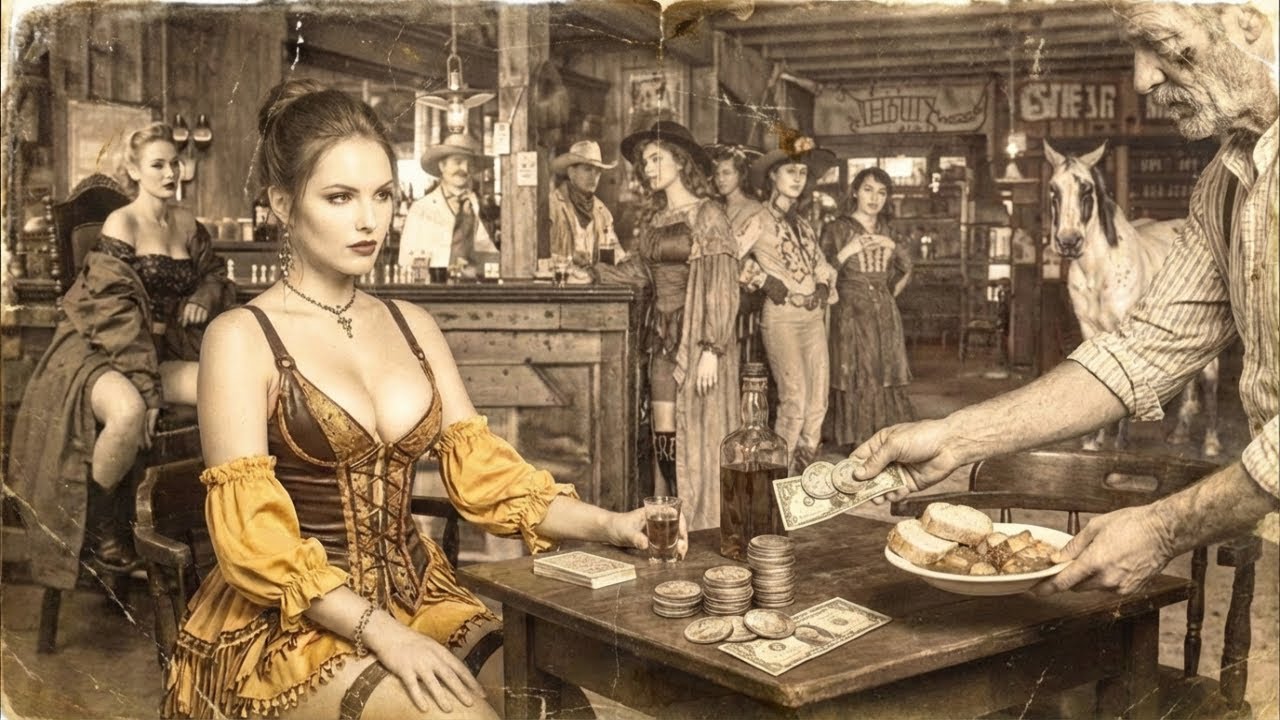
The year is 1880.
You ride into town exhausted after days on the trail.
Your clothes are covered in dust.
Your throat is dry.
Your horse needs rest.
Then you push through the swinging doors of a frontier saloon.
Smoke hangs beneath the ceiling.
Cards slap against wooden tables.
Someone is laughing too loudly near the bar.
A piano is fighting to be heard over the room.
And in your pocket is one crumpled dollar.
Today, that sounds like almost nothing.
In the Old West, it could represent an entire day of hard labor.
Inside a saloon economy, that dollar could buy whiskey, beer, gambling, dances, tobacco, food, medicine, a bath, ammunition, and even temporary protection.
The movies show the cowboy casually tossing coins onto the counter.
They rarely explain how many hours of sun, cattle, dust, and danger were packed into every one of those coins.
Here are twenty things the source says a single dollar could buy in the Old West.
20. Ten to Twenty Shots of Cheap Whiskey
Frontier whiskey did not always resemble the carefully distilled bottles lined up behind modern bars.
The source describes some saloons selling cheap alcohol mixed or flavored with harsh ingredients.
“Rotgut” became a fitting nickname for the worst of it.
A shot could cost between five and ten cents.
That meant a dollar might purchase ten to twenty shots.
Think about that in relation to wages.
If a cowboy earned roughly one dollar for a full day of work, he could transform an entire day beneath the sun into alcohol before midnight.
The real price of the drink was not ten cents.
It was part of his life.
19. Twenty Glasses of Beer
At roughly five cents a glass, a dollar could theoretically buy twenty beers.
But do not picture refrigerated lager.
Many frontier towns had no reliable refrigeration.
Beer could arrive warm.
Storage conditions varied.
Quality varied.
The source even describes isolated saloons stretching supplies by diluting beer.
Still, men drank it.
Because the saloon was not simply a bar.
It was a social center.
Business deals happened there.
Gambling happened there.
Arguments happened there.
A five-cent beer purchased entry into the town’s public life.
18. Ten Bets at a Faro or Poker Table
The source gives roughly ten cents as a low-stakes wager at gambling tables.
That meant a dollar could keep a man playing for several hands.
Faro was especially popular in the nineteenth-century West.
Poker later became the game Hollywood remembered.
Both offered the same temptation.
Turn one dollar into five.
Maybe ten.
Maybe more.
Most players instead walked away with nothing.
And because that original dollar could represent a day’s pay, accusations of cheating were not trivial.
A marked card could mean stolen labor.
That helped turn gambling disputes into personal confrontations.
17. Four Dances With a Hurdy-Gurdy Girl
Dance halls created another saloon economy.
The source describes “hurdy-gurdy girls” charging around twenty-five cents per dance.
One dollar bought four dances.
For cowboys and miners who had spent weeks or months isolated from ordinary social life, those few minutes mattered.
Conversation.
Music.
Human contact.
But the house profited twice.
The woman earned part of the dance fee.
Then she often brought the customer back toward the bar, where more drinks were sold.
The dance was entertainment.
The whiskey was the business.
16. Six to Ten Cigars
A common cigar could cost ten to fifteen cents.
That put several within reach of one dollar.
Smoking was part of frontier social ritual.
Offer a cigar.
Seal a deal.
Sit down after a long day.
Talk cattle.
Talk land.
Talk politics.
Imported cigars cost considerably more.
Local tobacco served ordinary workers.
To a tired cowboy, a ten-cent cigar could be one of the few affordable luxuries available after work.
15. Ten Packs of Chewing Tobacco
Chewing tobacco was even more practical.
No match required.
No flame.
That mattered during cattle drives, where fire and frightened animals were a dangerous combination.
The source gives roughly ten cents for a packet.
A dollar could therefore mean ten.
Saloons kept spittoons on the floor.
Chewing became so common that spitting itself became part of saloon culture.
Tobacco was not merely a vice.
It was social currency.
14. Access to the Famous “Free Lunch”
Some saloons offered food with the purchase of drinks.
Bread.
Eggs.
Pickles.
Sausage.
Salted meat.
It looked generous.
The source presents it as business strategy.
The food was salty.
Salt increased thirst.
Thirst increased drinking.
A man could walk inside because he was hungry and leave hours later having spent far more than the meal was worth.
The lunch was free only in the same way modern promotions are free.
The real product was the next purchase.
13. Four Hot Baths
A bath could cost around twenty-five cents.
One dollar could theoretically purchase four.
For a cowboy arriving after weeks on the trail, a tub of hot water might feel almost sacred.
But frontier hygiene had limits.
Water had to be carried.
Heated over a stove.
And sometimes reused between customers.
The first person might get relatively clean water.
The last might not.
A bath was luxury.
Sanitation was another matter entirely.
12. Two Nights in a Shared Bed or Bunk Room
The source gives about fifty cents for cheap frontier lodging.
One dollar bought two nights.
But not two modern hotel rooms.
A crowded bunkhouse.
Beds pressed close together.
Dirty sheets.
Strangers nearby.
Theft was common enough that travelers could sleep with boots or valuables tucked against them.
And during busy periods, even a mattress might be shared.
The dollar bought a roof.
Not comfort.
Not security.
11. Four Small Favors From a Bartender
The source paints the bartender as one of the most informed men in town.
He knew debts.
Arguments.
Strangers.
Weapons.
Rumors.
A small tip might buy better service or discretion.
Perhaps the bartender remembered your tab differently.
Perhaps he poured from the better bottle.
Perhaps he warned you that someone across the room was asking about you.
Exact “prices” for such favors are difficult to treat as standardized historical fact.
But the underlying truth is believable.
Information had value.
And the bartender possessed plenty of it.
10. Ten Lottery Tickets
Some saloons ran informal drawings or lotteries.
A ticket might cost ten cents.
That gave a man with one dollar ten chances.
The prize could be cash.
A horse.
Land.
Or another valuable object.
The source also describes allegations of rigged results.
That makes sense in an environment with little oversight.
The owner controlled the tickets.
The drawing.
The crowd.
And often the money.
The lottery sold something more valuable than the prize.
Hope.
9. Four Bottles of Patent Medicine
Nineteenth-century medicine could be extraordinarily dangerous.
The source describes patent remedies containing alcohol, opium, mercury, or other ingredients without modern labeling standards.
A dollar might buy several bottles.
The medicine could promise relief from toothache.
Fever.
Nerves.
Sleeplessness.
Even baldness.
But patients often had no reliable way to know what they were consuming.
The brightly colored bottle might contain something closer to liquor or narcotics than medicine.
Regulation would not begin seriously changing that world until the early twentieth century.
8. Twenty Newspapers
At five cents each, one dollar could theoretically buy twenty newspapers.
That sounds insignificant until you consider what newspapers meant.
No radio.
No television.
No internet.
In many towns, limited telegraph access.
The newspaper was the connection to everything beyond the local street.
Politics.
Wars.
Prices.
Elections.
Crime.
Gossip.
An editor could build or destroy reputations with a few lines of type.
One dollar therefore purchased not just paper.
It bought access to information.
7. Ten Revolver Cartridges
The source estimates roughly ten cents per cartridge in some settings.
One dollar could buy around ten.
That is important because Western films treat ammunition as limitless.
Real bullets cost money.
Every trigger pull consumed part of a worker’s wage.
For someone earning around a dollar a day, shooting recklessly meant literally firing away his pay.
A revolver might hold six cartridges.
One dollar bought less than two complete reloads.
The real West had more arithmetic and fewer endless gunfights.
6. Two Used Hats
A quality new hat could cost several dollars.
Used or patched hats were cheaper.
The source gives around fifty cents for some secondhand examples.
One dollar bought two.
This was not simply fashion.
A hat protected a worker from sun.
Dust.
Rain.
Heat.
Hours beneath open sky.
Hollywood turned the cowboy hat into identity.
Frontier laborers treated it as equipment.
5. Four Pairs of Used Boots — According to the Source
New boots could cost several days’ wages.
Used boots and repairs were much cheaper.
The source gives extremely low prices for patched pairs and basic cobbler work.
Those exact amounts would have varied by town and condition, but the underlying economy is clear.
Leather was reused.
Soles were repaired.
Boots changed hands.
Nothing useful was discarded easily.
Some secondhand goods may even have come from the estates of dead men.
On the frontier, practicality outranked sentiment.
4. Several Basic Pocketknives
A simple knife was one of the most useful tools a cowboy owned.
Cut rope.
Prepare food.
Work hides.
Repair equipment.
Open packages.
The source gives prices low enough that a dollar could buy several inexpensive knives.
That does not mean every knife cost exactly fifteen cents everywhere.
But cheap mass-produced folding knives were widely available.
The important point is that the ordinary cowboy knife was usually a tool.
Not the enormous fighting blade Hollywood prefers.
3. Five Ropes
The source gives roughly twenty cents for some lasso ropes.
One dollar therefore bought several.
A rope was indispensable.
Catch cattle.
Tie a horse.
Secure cargo.
Repair equipment.
A worker without rope could not do basic ranch work effectively.
Some ranches even deducted equipment costs from wages.
So the cheap rope still represented money taken from a man who might be earning only one dollar each day.
2. A Brief Visit With a “Soiled Dove”
The source gives a broad price range of roughly twenty-five cents to one dollar for sexual services, depending on place and establishment.
That means the same dollar earned through a full day’s labor might disappear in minutes.
But focusing only on what the customer received hides the darker half of the transaction.
The women often lived with disease.
Debt.
Addiction.
Violence.
And very limited legal protection.
Some became successful business owners.
Most did not.
The dollar paid by the cowboy could simply mean another day of survival for the woman receiving only part of it.
1. Four Bottles of Cheap Perfume
Perhaps the strangest item on the list is perfume.
The source gives about twenty-five cents for inexpensive bottles.
A dollar could therefore purchase four.
But forget French luxury fragrance.
This was often simple alcohol mixed with floral oils.
And the practical purpose could be less romantic than Hollywood suggests.
People worked all day in heat.
Bathing could be expensive and inconvenient.
Clothing was washed less frequently.
Animals, smoke, dust, sweat, and crowded buildings created powerful smells.
Cheap perfume masked what soap and hot water could not always remove.
That makes the final item strangely revealing.
The saloon West smelled nothing like the movies looked.
And that brings us back to the dollar.
A single dollar could buy:
Whiskey.
Beer.
Gambling.
Tobacco.
Dances.
Food.
A bath.
Two nights indoors.
Medicine.
A newspaper stack.
Ammunition.
Tools.
Clothing.
Company.
Or perfume to disguise the fact that the nearest proper bath might be days away.
But the most important thing that dollar represented was not what it bought.
It was what it cost to earn.
For many cowboys and laborers, roughly one dollar could represent a full day of physically demanding work.
That meant twenty five-cent beers were not cheap.
They were one day of a man’s life.
Ten gambling bets were not small.
They were hours beneath the sun.
Four dances were not just entertainment.
They were a quarter of a day’s labor each.
This is where Hollywood gets the saloon wrong.
It shows money moving constantly.
Coins on tables.
Bills thrown toward bartenders.
Men buying rounds without hesitation.
The real frontier economy made every coin heavier.
The saloon succeeded because it understood exhaustion.
A cowboy might spend weeks away from town.
Sleeping outdoors.
Eating repetitive food.
Working from dawn to dark.
Then suddenly he reached civilization.
Music.
Alcohol.
Food.
Cards.
Smoke.
Women.
A bed.
A bath.
Everything he had been denied on the trail was now available within a few wooden walls.
And every one of those comforts had a price.
The saloon did not simply sell whiskey.
It sold relief.
That is why a man could work for days or weeks and lose much of it in a single night.
The dollar became a conversion device.
Labor into alcohol.
Loneliness into a dance.
Hunger into salty food.
Fear into ammunition.
Exhaustion into a bed.
Dust into a bath.
Boredom into gambling.
And that is the real meaning of the crumpled bill in the cowboy’s pocket.
It was not “just a dollar.”
It was time.
Work.
Risk.
And sometimes everything he had left.
Hollywood showed the cowboy walking through the saloon doors.
The real story begins when you ask what it cost him to walk back out.


