On November 9, 1960, the Kennedy family gathered at Hyannis Port, Massachusetts, to celebrate an extraordinary political victory.
John F. Kennedy had just won the presidential election, bringing America’s most ambitious political dynasty to national power.
The photographs captured a smiling family united around a president-elect whose victory seemed to fulfill decades of preparation.
Jacqueline Kennedy appeared alongside relatives who had devoted enormous energy to building her husband’s political career.
Robert Kennedy had directed the presidential campaign, while Edward Kennedy and their sisters had supported crucial organizing efforts.
Their mother, Rose Kennedy, represented the family’s religious traditions and its carefully maintained public image of stability.
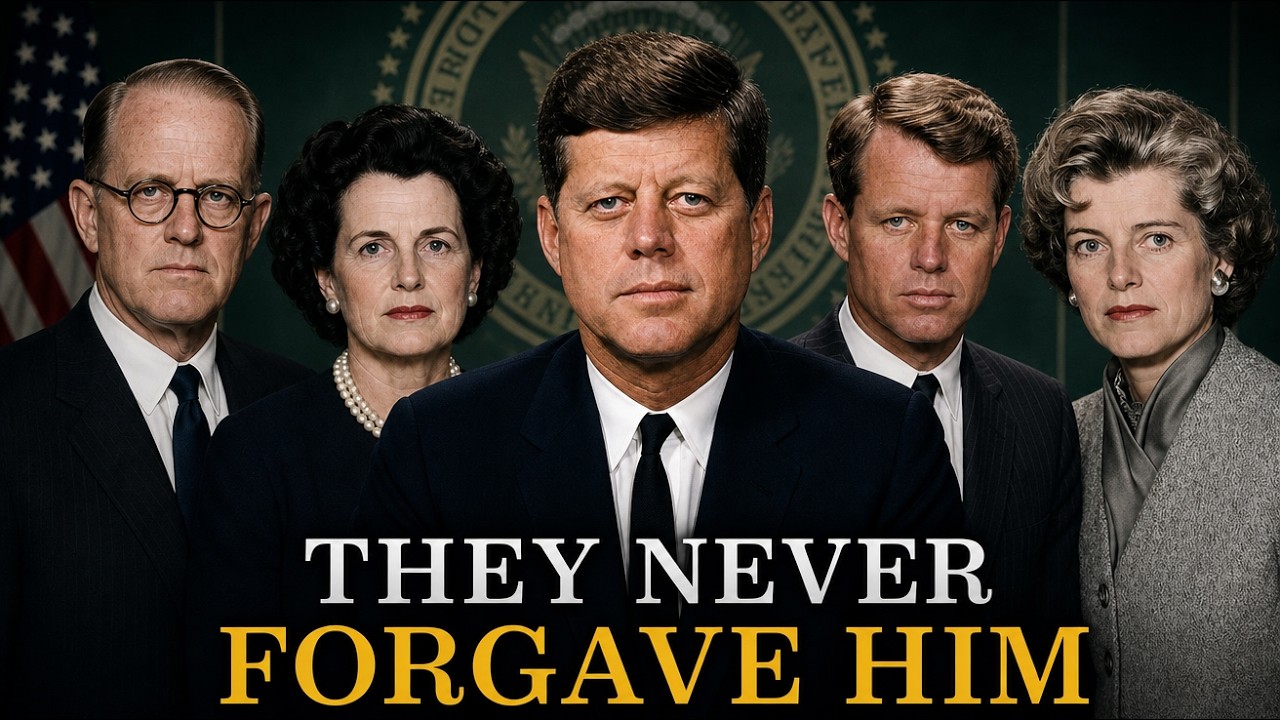
Joseph P. Kennedy Sr., the wealthy patriarch, stood among the relatives celebrating his son’s historic achievement.
Yet the photograph could not tell the complete story of the family whose political influence fascinated America.
Behind the carefully presented unity were sibling rivalries, devastating losses, private conflicts, and complicated expectations surrounding personal achievement.
Two important members of the family were missing from the triumphant image, each representing a different tragedy.
Joseph P. Kennedy Jr., once expected to become the family’s first president, had died during World War II.
Rosemary Kennedy, the eldest daughter, was living in an institution after undergoing a devastating medical procedure in 1941.
Their experiences revealed dimensions of family life rarely visible within the glamorous photographs accompanying John Kennedy’s presidential campaign.
The Kennedys were undeniably close, but affection existed alongside extraordinary competition and expectations imposed by their parents.
Their story raises difficult questions about how wealth, ambition, loyalty, and public reputation influenced individual family members.
It also demonstrates how later generations and historians have struggled to separate documented events from family mythology.
The dynasty’s modern political story began with Joseph Patrick Kennedy Sr., a businessman whose ambitions extended beyond personal wealth.
Born in Boston in 1888, Joseph developed interests in finance, banking, investment, entertainment, and national political influence.
He built substantial wealth through business activities and became an influential figure within Democratic political circles.
His marriage to Rose Fitzgerald connected him with another prominent Irish American political family in Massachusetts.
Rose was the daughter of John Francis Fitzgerald, a former Boston mayor known widely as Honey Fitz.
Together, Joseph and Rose raised nine children in an environment shaped by Catholicism, wealth, and intense expectations.
Their children were Joseph Jr., John, Rosemary, Kathleen, Eunice, Patricia, Robert, Jean, and Edward Kennedy.
Each grew up surrounded by political discussions, athletic competitions, prominent visitors, and the expectation of meaningful accomplishment.
Joseph believed that competition encouraged achievement, and family recollections frequently describe his intolerance of second place.
His children participated in sports and intellectual discussions where success became an important measure of personal performance.
The household’s competitive culture influenced how later biographers interpreted the relationships among the Kennedy brothers and sisters.
However, family competition should not automatically be equated with an absence of affection or genuine mutual support.
The siblings maintained close relationships and repeatedly assisted one another during demanding campaigns and personal emergencies.
Joseph also established financial arrangements intended to provide his children with substantial long-term economic security.
Family trusts created during the 1920s and 1930s helped separate their financial circumstances from those of ordinary Americans.
These resources provided educational opportunities, social access, and professional flexibility unavailable to most families during that period.
They also supported a political organization capable of funding campaigns, travel, publicity, and extensive personal networks.
Yet financial independence did not necessarily eliminate the influence of a father deeply invested in his children’s futures.
Joseph remained involved in their education, careers, correspondence, and the development of their public reputations.
Rose contributed another form of structure through religious expectations, household routines, and meticulous attention to family records.
She maintained detailed information about her children’s health and development, reflecting an organized approach to family responsibilities.
Her Catholic faith remained central to the household and influenced important decisions concerning education and marriage.
The resulting environment combined extraordinary privilege with pressures that shaped the children in markedly different ways.
John Fitzgerald Kennedy, born on May 29, 1917, did not initially resemble the family’s strongest potential political candidate.
He experienced serious health difficulties from childhood, including recurring illnesses and persistent gastrointestinal problems.
Scarlet fever threatened his life during early childhood, while other medical complications continued throughout his adolescence.
His health required repeated examinations, hospital visits, and periods away from ordinary school activities.
These experiences contrasted with the athletic accomplishments and apparent physical confidence of his older brother, Joseph Jr.
John developed humor and intellectual curiosity while learning to navigate physical difficulties that remained significant throughout adulthood.
His correspondence with friends frequently demonstrated a willingness to joke about his medical experiences and personal circumstances.
He attended Choate, where his academic performance was uneven but his personality attracted attention from classmates.
During the 1930s, Kennedy and several friends participated in the school’s informal group known as the Muckers.
Their activities reflected youthful rebellion and occasionally brought them into conflict with school authorities.
Kennedy graduated in 1935 without establishing the academic reputation associated with the family’s more conventional expectations.
Nevertheless, his later experiences demonstrated that school performance did not fully predict his professional or political development.
Joseph Kennedy Jr., by comparison, appeared better positioned to fulfill his father’s early political ambitions.
Born in 1915, the eldest son developed interests in athletics, public affairs, and political leadership.
He attended Harvard University and participated in activities that strengthened his reputation as a promising young public figure.
Joseph Sr. reportedly envisioned his eldest son eventually becoming president of the United States.
That expectation created a recognizable family succession narrative before John Kennedy became a serious political contender.
The brothers’ relationship involved affection and competition, although historians differ over the intensity of their private rivalry.
Both understood that their father’s political ambitions could influence the opportunities available to them.
Their contrasting experiences became especially visible during the period immediately preceding America’s entry into World War II.
John entered Harvard and developed a growing interest in international politics and the European security crisis.
His father served as American ambassador to the United Kingdom, placing the family close to important diplomatic developments.
Joseph Sr.’s views concerning European conflict and British resistance to Nazi Germany later became controversial.
His pessimistic public statements damaged his diplomatic reputation and contributed to the end of his ambassadorial career.
Meanwhile, John studied British foreign policy and developed an undergraduate thesis examining the country’s response to German rearmament.
The work became Why England Slept, published in 1940 after editorial assistance and support from influential connections.
Its publication gave the younger Kennedy national visibility beyond his family’s established political and financial reputation.
The book achieved commercial success and helped establish John as an informed commentator on international affairs.
Later biographers examined whether family purchases and publicity efforts contributed to the book’s sales figures.
Claims about the precise scale of such purchases remain difficult to verify conclusively from surviving evidence.
What is established is that the book introduced John Kennedy to a wider American reading audience.
It also arrived during a period when his older brother was developing his own political interests.
Joseph Jr. participated in the 1940 Democratic National Convention, demonstrating a willingness to engage directly in national politics.
His political activities reinforced expectations that he might eventually seek elected office in Massachusetts.
The brothers therefore entered wartime adulthood with different reputations and potentially competing opportunities.
But the most consequential developments occurred outside politics, through military service and family tragedy.
Before those events, another Kennedy child had already experienced a profoundly different form of family pressure.
Rosemary Kennedy was born on September 13, 1918, the third child and eldest daughter of Joseph and Rose.
Her development differed from that of her siblings, and she experienced significant intellectual and educational difficulties.
The family sought specialized instruction while attempting to maintain her participation in social and family activities.
During Joseph Sr.’s ambassadorship, Rosemary appeared publicly with relatives at important events in Britain.
In 1938, she and her sister Kathleen were presented at the British royal court.
Photographs from the period show Rosemary participating in the ceremonial world surrounding her father’s diplomatic appointment.
Her public appearances demonstrate that she was not completely excluded from family life before her later institutionalization.
However, her parents and caregivers increasingly struggled with concerns about her behavior and personal safety.
Accounts from relatives and biographers describe difficulties that became more serious during her early adulthood.
Joseph Sr. consulted physicians during a period when psychiatric treatments often lacked adequate evidence of safety.
In November 1941, Rosemary underwent a prefrontal lobotomy authorized by her father.
The procedure was performed by physicians Walter Freeman and James Watts, prominent figures in the early history of psychosurgery.
Lobotomy was an invasive treatment whose risks and long-term consequences were poorly understood during that period.
For Rosemary, the results were catastrophic, leaving her with profound impairments affecting communication and physical functioning.
She was twenty-three years old when the operation permanently altered the course of her life.
Later accounts indicate that Rose Kennedy had not been informed in advance of the procedure.
The precise circumstances surrounding family discussions remain dependent upon correspondence and retrospective testimony.
What is clear is that Rosemary subsequently required extensive support and long-term residential care.
She eventually lived at St. Coletta in Wisconsin, where caregivers provided assistance throughout much of her adulthood.
The family initially disclosed relatively little about her condition, contributing to decades of public misunderstanding.
Rosemary’s experience became one of the most troubling episodes in the Kennedy family’s documented history.
It also exposed the consequences of medical decisions made before modern standards of informed consent and disability rights.
Later generations would connect her experiences to broader efforts supporting people with intellectual disabilities.
Her sister Eunice Kennedy Shriver became especially important in transforming those concerns into sustained public advocacy.
But Rosemary’s story remained largely outside the national narrative as the family pursued political influence.
During World War II, John Kennedy sought military service despite his longstanding health problems.
His medical history complicated enlistment, but he eventually entered the United States Navy.
He later received command of a patrol torpedo boat operating in the Pacific theater.
On August 2, 1943, the Japanese destroyer Amagiri struck PT-109 near the Solomon Islands.
The collision destroyed the vessel and killed two crew members, leaving Kennedy responsible for surviving sailors.
Despite his injuries and chronic back problems, Kennedy helped organize efforts to reach safety.
He assisted an injured crewman during a difficult swim and helped sustain the survivors while awaiting rescue.
The crew eventually received assistance through local islanders and Allied personnel after several days.
Kennedy’s conduct attracted official recognition and became a significant part of his developing public biography.
Journalist John Hersey later described the incident in an influential account published in The New Yorker.
The story was subsequently distributed more widely, helping establish Kennedy’s reputation as a courageous wartime officer.
His father and political associates recognized the account’s potential importance for future public life.
The PT-109 episode would later feature prominently in Kennedy’s congressional and presidential campaigns.
It offered a compelling narrative of leadership under pressure and personal courage during military service.
Meanwhile, Joseph Kennedy Jr. pursued his own dangerous wartime responsibilities as a naval aviator.
He served in Europe and completed combat missions before volunteering for an experimental operation in 1944.
The mission formed part of Operation Aphrodite, an effort involving aircraft carrying enormous explosive payloads.
Pilots were expected to launch modified bombers, activate the explosives, and parachute before remote guidance continued.
The procedure carried substantial risks, particularly because the technology remained experimental and operationally unreliable.
On August 12, 1944, Joseph Jr.’s aircraft exploded over England before its crew could escape.
Both he and fellow officer Wilford Willy were killed, leaving their families without recoverable remains.
Joseph Jr. was twenty-nine years old, and his death profoundly affected the Kennedy household.
His loss ended the political future that his father had long imagined for the eldest son.
Some later biographies suggested sibling rivalry influenced his decision to volunteer for the dangerous assignment.
However, no definitive evidence establishes that he accepted the mission specifically to surpass John’s wartime achievements.
His service and death should therefore be understood through documented military circumstances rather than unverified psychological explanations.
The family nevertheless faced a dramatic change in its political expectations following the eldest son’s death.
John Kennedy became the most visible surviving son with the credentials and connections necessary for public office.
He later suggested that his political career emerged partly from family expectations after Joseph Jr.’s death.
Those remarks reflected the importance of his brother’s absence within the family’s developing political narrative.
In 1945, John helped assemble a memorial volume honoring Joseph Jr. through recollections from relatives and friends.
The project demonstrated affection and the desire to preserve his brother’s memory after the devastating wartime loss.
The following year, John entered electoral politics by seeking a congressional seat in Massachusetts.
His campaign benefited from substantial family resources, extensive publicity, and coordinated efforts by relatives.
Rose hosted gatherings, while his sisters participated in voter outreach and campaign activities.
Joseph Sr. provided financial support and strategic assistance, helping his son compete in a crowded political environment.
John won the 1946 election and entered the House of Representatives in January 1947.
His victory marked the beginning of a political career that would eventually reach the White House.
But the family’s wartime losses were not finished with Joseph Jr.’s death.
Kathleen Kennedy, known affectionately as Kick, had developed strong relationships within British society during her father’s ambassadorship.
Her personality and social confidence made her popular among influential young people in Britain.
During the war, she fell in love with William Cavendish, Marquess of Hartington.
Their relationship created religious tensions because Kathleen was Catholic while Cavendish belonged to a prominent Protestant aristocratic family.
The couple married in May 1944 despite objections associated with their different religious backgrounds.
Joseph Kennedy Jr. attended the wedding, while most other family members were absent.
Kathleen’s marriage demonstrated her willingness to make personal choices that challenged established family expectations.
But happiness was brief because her husband was killed during military service only months afterward.
Widowed at a young age, Kathleen remained in Britain and maintained relationships within its social circles.
She later became involved with Peter Fitzwilliam, an aristocrat whose existing marriage complicated their relationship.
The circumstances generated further family tensions, although surviving accounts differ regarding individual reactions and private conversations.
In May 1948, Kathleen and Fitzwilliam died when their aircraft crashed during severe weather in France.
She was twenty-eight years old, and her death added another tragedy to the family’s wartime generation.
Joseph Sr. attended her funeral in England, while other relatives did not participate.
Later family accounts sometimes emphasized Kathleen’s marriage and early death without fully discussing her final relationship.
That selective emphasis illustrates how private family histories can change through memoirs, interviews, and public commemoration.
However, omissions in later accounts do not establish a coordinated effort to suppress every uncomfortable detail.
They demonstrate the need to compare family recollections with independent records and contemporary reporting.
By the early 1950s, John Kennedy had developed enough political experience to seek a Senate seat.
In 1952, he challenged Republican incumbent Henry Cabot Lodge Jr. in Massachusetts.
The campaign became an important demonstration of the Kennedy family’s extraordinary organizational capacity.
Robert Kennedy assumed a central management role, coordinating political operations while developing his reputation as a demanding strategist.
The sisters organized receptions and gatherings that brought the candidate into direct contact with large numbers of voters.
Rose Kennedy participated in public events emphasizing the family’s background and her experiences raising nine children.
These activities complemented conventional campaigning through advertising, local organizations, and direct voter contact.
The family’s outreach proved particularly important because Dwight Eisenhower carried Massachusetts during the presidential election.
Nevertheless, John Kennedy defeated Lodge, demonstrating that his campaign had attracted voters beyond the Democratic presidential coalition.
The victory elevated him to the Senate and strengthened his reputation as a rising national political figure.
It also established Robert Kennedy as an increasingly important figure within the family’s political operations.
The brothers’ partnership would become central to the campaigns and administration that followed.
Yet the family’s organization was not a simple arrangement in which every member held equal authority.
John occupied the public leadership position, while relatives contributed specialized work supporting his political objectives.
Robert developed campaign strategy and enforcement responsibilities, sometimes attracting criticism for his aggressive approach.
Edward Kennedy, the youngest brother, began gaining experience through assignments within the expanding family political network.
Their sisters continued providing organizational assistance, fundraising support, and access to important social and community relationships.
The family structure therefore combined genuine cooperation with a hierarchy shaped by political roles and generational expectations.
By 1960, John Kennedy was ready to seek the Democratic presidential nomination.
His campaign confronted concerns about his youth, Catholic identity, political experience, and family wealth.
The religious issue became especially important because no Catholic had previously won the American presidency.
Kennedy addressed these concerns publicly while presenting himself as independent from ecclesiastical political authority.
The campaign also worked to manage the reputation of Joseph Sr., whose earlier diplomatic record remained controversial.
His statements during the European crisis had damaged his standing among political figures and commentators.
Allegations concerning his business practices also circulated, including longstanding rumors of involvement in illegal liquor operations.
Such allegations should not be treated as established fact without reliable evidence supporting specific criminal activities.
The campaign emphasized the candidate’s wartime service, congressional experience, family appeal, and message of national renewal.
Robert Kennedy directed much of the presidential campaign, coordinating staff, fundraising, scheduling, and political strategy.
Edward Kennedy also participated in regional campaign activities, gaining further exposure to national electoral politics.
The sisters and their spouses contributed to fundraising, outreach, logistics, and relationships with influential supporters.
The resulting organization demonstrated the advantages of a politically experienced family possessing substantial financial resources.
Kennedy ultimately defeated Richard Nixon in one of the closest presidential elections in modern American history.
His victory represented an extraordinary achievement for the family and fulfilled Joseph Sr.’s longstanding presidential ambitions.
Yet the transition to government introduced new disagreements concerning appointments, qualifications, and the proper boundaries of family influence.
One particularly controversial decision involved Robert Kennedy’s appointment as attorney general.
Robert had extensive campaign and investigative experience but comparatively limited courtroom practice.
His appointment raised concerns about nepotism because the president selected his younger brother to lead the Justice Department.
Contemporary accounts describe disagreement over the appointment, including questions about Robert’s willingness to accept the position.
Joseph Sr.’s influence has frequently been cited in explanations of how the decision emerged.
However, the precise balance of responsibility among the family members remains difficult to establish conclusively.
John Kennedy publicly responded to criticism with humor, joking about giving his brother legal experience.
The remark became famous because it acknowledged the appointment’s unusual circumstances while attempting to reduce political controversy.
Robert ultimately became an influential attorney general, developing a close working relationship with the president.
His responsibilities included organized crime investigations, civil rights enforcement, and participation in major administration decisions.
The brothers’ partnership proved especially important during the Cuban Missile Crisis and other difficult national security episodes.
Robert’s position demonstrated both the advantages and controversies associated with family relationships inside presidential government.
Meanwhile, Edward Kennedy pursued his own opportunity for elected office in Massachusetts.
His earlier education had included a serious disciplinary episode involving an examination at Harvard University.
In 1951, he was expelled after arranging for another student to take a Spanish examination.
He later returned to Harvard, completed his education, and continued preparing for a professional career.
In 1962, Edward entered the race for the Massachusetts Senate seat previously held by John.
The seat had been occupied temporarily by Benjamin A. Smith II following John’s presidential election.
Edward’s candidacy generated criticism because his family connections provided unusual advantages for a young politician.
He faced Edward McCormack Jr. during a contentious Democratic primary involving questions of experience and entitlement.
Despite the controversy, Edward won the primary and subsequently secured the Senate seat.
His election extended the family’s representation in Washington and established a career lasting nearly five decades.
The youngest Kennedy brother would eventually become associated with extensive legislative work and major national policy debates.
His achievements, however, would coexist with controversies that complicated his public reputation.
The most consequential involved the 1969 Chappaquiddick incident, when his vehicle went off a bridge in Massachusetts.
Passenger Mary Jo Kopechne died, and Kennedy’s delayed reporting of the accident generated widespread criticism.
The episode became a lasting part of assessments of his conduct and political career.
It also demonstrated that family prominence could intensify public scrutiny rather than protect politicians from controversy.
Yet another Kennedy sibling developed a different relationship with the family’s resources and political influence.
Eunice Kennedy Shriver pursued sustained advocacy for people with intellectual disabilities, influenced partly by her sister Rosemary’s experiences.
Born in 1921, Eunice demonstrated strong interests in public service and the treatment of vulnerable individuals.
Her professional activities included work involving social services, rehabilitation, and programs supporting children and adults with disabilities.
During the early 1960s, she helped bring disability policy into national political discussions.
President Kennedy established the President’s Panel on Mental Retardation in 1961, reflecting growing attention to these issues.
The terminology used by the panel reflected contemporary language that is no longer considered appropriate today.
Its work contributed to policy discussions concerning research, education, community services, and the treatment of people with disabilities.
In 1962, Eunice published an article in The Saturday Evening Post discussing Rosemary’s intellectual disability.
The publication represented an important public acknowledgment of a family experience previously surrounded by considerable privacy.
However, the article did not fully disclose the lobotomy that had permanently impaired Rosemary’s functioning.
That information became more widely understood through later reporting and historical research.
Eunice also organized a summer camp for children with intellectual disabilities at her Maryland home.
The initiative emphasized physical activity, participation, and opportunities often denied to children with developmental differences.
Her work eventually contributed to the creation of Special Olympics, founded internationally in 1968.
The organization developed into a global movement providing athletic opportunities for people with intellectual disabilities.
Eunice’s achievements demonstrated how family resources could support institutions extending beyond electoral politics.
Her advocacy also challenged social assumptions that had contributed to the exclusion and mistreatment of people with disabilities.
Rosemary’s experiences therefore became connected to an enduring movement for inclusion, recognition, and community participation.
The relationship between these developments is historically significant, although Eunice’s advocacy involved broader influences and professional commitments.
By 1963, the Kennedy family had achieved political influence that Joseph Sr. could scarcely have imagined decades earlier.
John occupied the presidency, Robert led the Justice Department, and Edward represented Massachusetts in the Senate.
Other relatives supported charitable initiatives, diplomatic relationships, political organizations, and emerging public policy programs.
But the family’s apparent success would soon be transformed by another national tragedy.
On November 22, 1963, President Kennedy was assassinated while traveling through Dallas, Texas.
His death devastated the country and permanently changed the lives of his surviving relatives.
Jacqueline Kennedy played a central role in arranging the funeral and shaping the public memory of his presidency.
Robert Kennedy experienced the loss of a brother with whom he had shared extraordinary professional and personal responsibilities.
He subsequently pursued a political career that included election to the United States Senate from New York.
In 1968, Robert entered the Democratic presidential contest, attracting supporters through appeals involving poverty, racial justice, and reconciliation.
His campaign developed amid intense political conflict surrounding the Vietnam War and American civil rights.
On June 5, 1968, Robert was shot in Los Angeles after winning California’s Democratic presidential primary.
He died the following day, leaving another generation of Kennedy children without their father.
The assassination intensified the family’s association with national tragedy and interrupted another potentially significant political career.
The youngest brother, Edward, became the most prominent surviving Kennedy politician of his generation.
He remained in the Senate for decades, participating in major legislative debates involving health care, education, and civil rights.
His career extended far beyond the period when the family first achieved presidential power.
At the same time, the deaths of John and Robert contributed to the enduring mythology surrounding Kennedy family destiny.
Popular accounts increasingly portrayed the dynasty through a combination of glamour, ambition, assassination, and personal tragedy.
The phrase Kennedy curse became familiar, although it describes a cultural interpretation rather than an established historical mechanism.
The family’s prominence ensured that its losses received extraordinary public attention and became part of national memory.
Yet the mythology sometimes obscured the individual experiences of relatives whose lives did not fit the dominant narrative.
Rosemary remained in Wisconsin for decades, largely outside the political spotlight surrounding her brothers.
She died in 2005 at the age of eighty-six, after a lifetime shaped by disability and institutional care.
Kathleen’s life continued attracting historical interest because her independence and relationships challenged family expectations concerning religion.
Joseph Jr.’s wartime death remained central to accounts of the family’s changing political ambitions.
Eunice’s advocacy demonstrated that Kennedy influence could produce lasting institutions outside electoral office.
Each story complicates the idea of a family defined solely by the presidency of John F. Kennedy.
The family’s public image also depended upon memoirs, archives, interviews, and decisions concerning the release of personal records.
Rose Kennedy published Times to Remember in 1974, offering her account of family life and historical events.
Her memoir emphasized faith, perseverance, personal relationships, and the experiences of raising a large family.
Like many autobiographical works, it reflected the author’s perspective and choices concerning which details deserved attention.
Researchers therefore compare such recollections with contemporary correspondence, government documents, and accounts from other witnesses.
The John F. Kennedy Presidential Library opened in 1979, becoming an important institution preserving records of the administration.
Its collections have supported extensive research into presidential policy, political relationships, personal correspondence, and historical memory.
However, access to certain personal materials has been subject to restrictions and changing arrangements over time.
Those limitations have contributed to debates concerning privacy, family influence, and the responsibilities of presidential archives.
Jacqueline Kennedy participated in recorded interviews with historian Arthur M. Schlesinger Jr. during 1964.
The conversations remained restricted for decades before their release in 2011 with the involvement of Caroline Kennedy.
Their publication provided additional evidence concerning Jacqueline’s experiences and perceptions of the Kennedy presidency.
It also demonstrated how historical understanding can change when previously unavailable primary materials become accessible.
Biographers have continued examining the family through letters, medical records, interviews, and documents released across successive decades.
Some interpretations emphasize Joseph Sr.’s determination to create a political dynasty through financial and organizational power.
Others focus upon the siblings’ affection, public service, personal ambitions, and responses to extraordinary loss.
These perspectives are not necessarily mutually exclusive because complicated family relationships can contain competing motivations.
Joseph Sr. undoubtedly exercised considerable influence, but individual children also made decisions that diverged from his expectations.
Kathleen’s marriage demonstrated independence concerning religion and personal relationships despite strong family objections.
Eunice’s advocacy transformed a painful family experience into an influential international movement.
John developed his own political identity through military service, writing, campaigning, and presidential leadership.
Robert established an independent political reputation that continued evolving after his brother’s assassination.
Edward’s lengthy Senate career produced a legislative record extending well beyond the original family’s presidential ambitions.
The Kennedy family’s history therefore cannot be understood exclusively through a model of obedience to one patriarch.
Its members participated in shared projects while also pursuing individual priorities and sometimes challenging established expectations.
Their political campaigns demonstrated the effectiveness of coordinated family effort supported by resources, organization, and personal commitment.
Their private experiences revealed the costs of public prominence and the difficulty of protecting family members from tragedy.
The treatment of Rosemary remains particularly important because it exposes medical practices and social attitudes now widely condemned.
Her lobotomy caused lasting harm, and the secrecy surrounding her condition delayed public understanding of her experiences.
Eunice’s later work provided a contrasting example of advocacy emphasizing participation and recognition for people with disabilities.
Together, those stories illustrate profound changes in American approaches to disability during the twentieth century.
The family’s political achievements also invite examination of how wealth and personal networks influence democratic participation.
Financial resources supported campaigns and public communication, but electoral victories still depended upon voter decisions.
John’s successful campaigns required appealing to constituencies beyond his family’s immediate social and political circles.
The 1960 election demonstrated that organizational advantages operated within a closely contested national democratic process.
His administration subsequently confronted challenges that could not be resolved through family loyalty or inherited resources alone.
The Cuban Missile Crisis, civil rights struggles, and Cold War tensions demanded decisions with international consequences.
Robert’s participation reflected the advantages of personal trust but also raised questions about institutional accountability and nepotism.
Edward’s Senate career demonstrated that inherited prominence did not eliminate the need for sustained legislative relationships and negotiation.
These developments place the Kennedy family within broader debates about political dynasties and democratic institutions.
The photograph taken at Hyannis Port in November 1960 consequently represents more than a moment of celebration.
It captures a family whose public success depended upon decades of financial preparation, personal effort, and political organization.
It also conceals losses and private experiences that photographs could never adequately communicate.
Joseph Jr.’s absence reflected the sacrifice of a military officer killed during a dangerous wartime operation.
Rosemary’s absence reflected a medical tragedy whose consequences were intensified by limited public understanding and family secrecy.
Kathleen’s absence recalled a young woman whose personal choices and early death complicated conventional family narratives.
The relatives present in the photograph carried their own ambitions, responsibilities, and relationships into the coming administration.
Their apparent unity was real in important respects, but it did not eliminate disagreements or competing expectations.
The family’s later history would demonstrate both the strength and limitations of its extraordinary political organization.
John’s assassination ended his presidency, while Robert’s death interrupted another major national political campaign.
Edward continued the family’s Senate presence, and Eunice developed institutions supporting people with intellectual disabilities worldwide.
Later generations pursued politics, journalism, charitable work, law, business, and other professional opportunities.
The Kennedy legacy thus became larger and more varied than the presidential ambition originally associated with Joseph Sr.
Its history includes achievement and privilege, but also difficult ethical questions and deeply personal losses.
The surviving record does not support reducing every tragedy to a father’s ambition or every success to inherited wealth.
Instead, it reveals a family shaped by overlapping forces that included affection, competition, religion, opportunity, and public expectation.
Understanding those forces requires attention to the experiences of relatives whose stories were once less widely discussed.
Rosemary’s life deserves consideration beyond the medical procedure that permanently changed her circumstances.
Kathleen’s story includes independent choices and relationships that cannot be reduced to her untimely death.
Joseph Jr.’s service deserves recognition without unsupported claims concerning his private motivations for accepting dangerous assignments.
Eunice’s achievements demonstrate how personal conviction and institutional resources can combine to produce lasting social change.
John Kennedy’s rise to the presidency reflected family support alongside his own experiences, abilities, and political decisions.
Robert and Edward followed paths influenced by their brother’s presidency but not entirely defined by it.
The family’s memoirs and archives continue providing material for historians seeking more complete accounts of these lives.
As additional documents emerge, interpretations may change, particularly concerning private relationships and contested recollections.
Responsible historical analysis must therefore distinguish established evidence from speculation, family legend, and retrospective psychological explanation.
The Kennedy story remains compelling without assuming that every personal decision followed a predetermined dynastic strategy.
Its contradictions are significant precisely because extraordinary privilege existed alongside vulnerability, loss, and genuine individual achievement.
The Hyannis Port photograph remains an enduring symbol of the moment when the family’s political ambitions reached the presidency.
But the complete history extends far beyond the smiling faces gathered around John F. Kennedy that morning.
It includes the siblings who were absent, the conflicts that remained private, and the institutions later generations created.
It also includes the enduring question of how families balance collective ambition with the dignity of individual members.
The Kennedys shaped American political history, but their own history was shaped by forces they could not control.
That distinction remains essential to understanding the people behind one of the country’s most recognizable political family photographs.


