America remembers Jacqueline Kennedy as the elegant first lady who transformed tragedy into one of the most enduring legends in presidential history.
But behind the glamorous White House photographs stood a complicated marriage marked by infidelity, family pressure, personal sacrifice, and devastating loss.
When President John F. Kennedy was assassinated in Dallas on November 22, 1963, Jacqueline made a decision that shocked those around her.
She refused to remove her bloodstained pink suit, preserving the visible evidence of a tragedy the entire nation was struggling to comprehend.
That choice became one of the most unforgettable images in American political history, representing grief, defiance, and the brutality of presidential assassination.
Yet it was only the beginning of Jacqueline Kennedy’s extraordinary influence over how her husband’s presidency would be remembered.
Within days, the newly widowed first lady began shaping a historical narrative that would eventually become known throughout the world as Camelot.
Her efforts reflected a remarkable understanding of publicity, political symbolism, historical memory, and the power of carefully chosen words.
To understand that transformation, however, the story must begin long before Jacqueline Bouvier entered the Kennedy family’s influential political world.
Jacqueline Lee Bouvier was born on July 28, 1929, into a socially prominent American family with considerable cultural aspirations.
Her father, John Vernou Bouvier III, was a Wall Street stockbroker whose charm and extravagant lifestyle became legendary.
Known as Black Jack, he cultivated an image of sophistication, confidence, and wealth that sometimes exceeded his financial circumstances.
His marriage to Janet Lee Bouvier deteriorated amid financial disagreements and allegations of infidelity, eventually ending in divorce.
Jacqueline was still a child when the separation exposed her to the painful realities behind an apparently privileged marriage.
Her mother’s subsequent marriage to Hugh D. Auchincloss introduced Jacqueline to another world of established wealth and prestigious estates.
The family divided time among properties including Merrywood near Washington and Hammersmith Farm in Newport, Rhode Island.
These surroundings provided extraordinary social opportunities while reinforcing the importance of status, financial security, and family reputation.
Jacqueline developed an appreciation for literature, languages, history, art, and European culture that would remain central throughout her life.
She also became an accomplished equestrian, demonstrating the discipline and competitiveness expected within her privileged social environment.
Her education included studies at Vassar College and time abroad in France, where she deepened her cultural interests.
Unlike many young women encouraged to focus exclusively on marriage, Jacqueline also demonstrated serious ambitions in journalism and writing.
In 1951, she won Vogue magazine’s prestigious Prix de Paris competition, recognizing her literary talent and intellectual promise.
The prize offered professional opportunities, but Jacqueline ultimately pursued another route into the demanding world of American journalism.
She joined the Washington Times-Herald as an Inquiring Camera Girl, interviewing ordinary citizens and photographing their responses to topical questions.
The position paid modestly compared with her social surroundings, but it provided valuable experience in communication and public presentation.
Her assignments introduced her to politicians, workers, government employees, and residents whose opinions became part of Washington’s daily conversation.
The job also taught her how photographs, captions, and carefully selected questions could influence public perceptions of important events.
Those lessons would become extraordinarily useful when she entered the White House and later confronted a national political catastrophe.
Before meeting John F. Kennedy, Jacqueline briefly became engaged to New York stockbroker John Husted Jr. in 1952.
The engagement ended after several months, with later accounts offering differing explanations involving compatibility, expectations, and financial circumstances.
Her eventual introduction to Kennedy occurred through mutual friends within Washington’s influential political and journalistic social circles.
Journalist Charles Bartlett and his wife Martha helped bring Jacqueline and the ambitious Massachusetts politician into closer contact.
Kennedy was already attracting attention as a charismatic young congressman with substantial family resources and growing national ambitions.
He also possessed a reputation for romantic relationships that would become an enduring subject of historical investigation and controversy.
Jacqueline understood that marrying him would involve far more than joining the household of an ordinary elected official.
The Kennedy family operated within a closely connected political network guided by patriarch Joseph P. Kennedy’s formidable ambitions.
Joseph Kennedy had invested enormous energy into developing his sons’ political careers and strengthening the family’s national influence.
John’s marriage therefore carried implications for his public image, social standing, and future political opportunities beyond personal affection.
Jacqueline’s refinement, education, Catholic background, and cultural sophistication complemented the image Kennedy supporters hoped to project nationally.
The couple announced their engagement in June 1953, attracting considerable attention from newspapers and society publications across America.
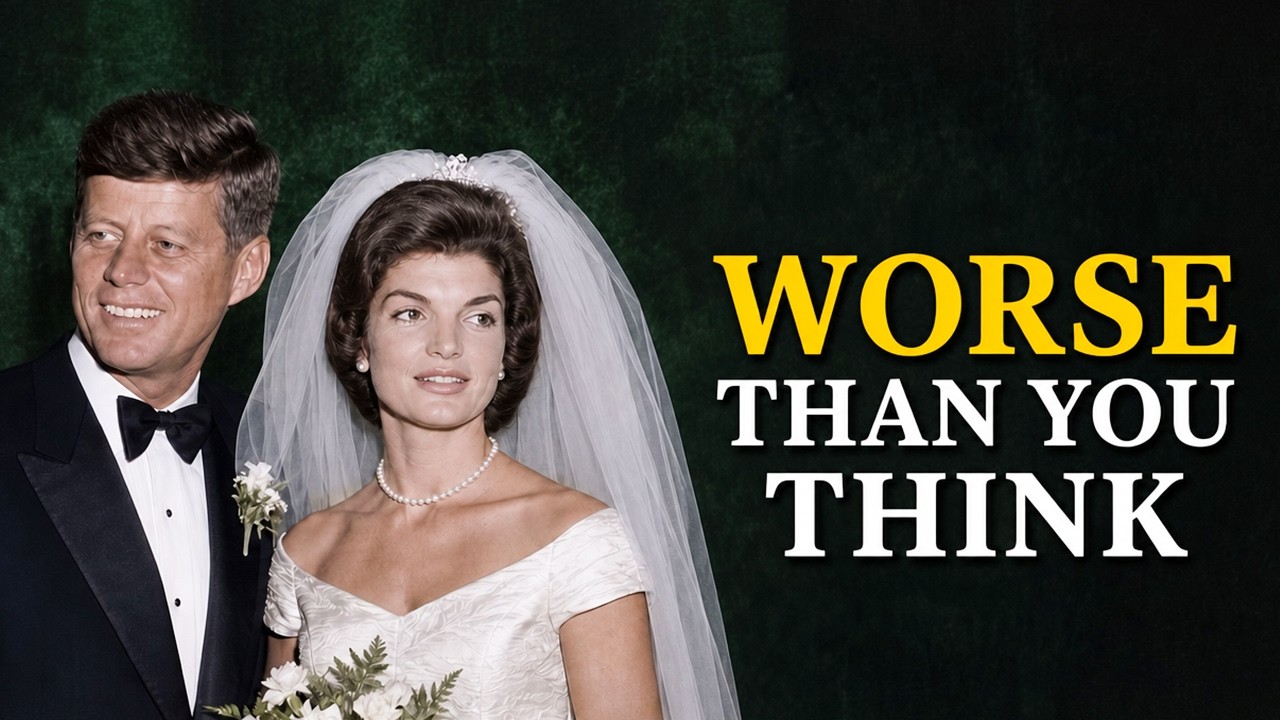
Their wedding took place on September 12, 1953, at St. Mary’s Church in Newport, Rhode Island, before prominent guests.
Approximately 750 people attended the ceremony, while a much larger gathering celebrated afterward at the Auchincloss family’s Hammersmith Farm.
The event became a major society spectacle, attracting crowds and extensive coverage that anticipated the couple’s later political celebrity.
Yet even this glamorous occasion contained painful personal complications that were largely invisible within the carefully composed wedding photographs.
Jacqueline’s father did not escort her down the aisle, and her stepfather Hugh Auchincloss assumed that ceremonial role.
Accounts differ about the circumstances, although reports describe concerns about her father’s drinking and tensions surrounding wedding arrangements.
For Jacqueline, the absence represented another painful reminder of the complicated relationship between public appearances and private family realities.
Her wedding gown was created by Ann Lowe, a remarkably talented Black American designer whose contribution received insufficient recognition.
Shortly before the ceremony, flooding damaged gowns in Lowe’s workshop, forcing her team to recreate important pieces rapidly.
Despite substantial obstacles and financial losses, Lowe completed the garments, helping create one of America’s most recognizable bridal images.
The dress became famous, although Jacqueline reportedly preferred simpler styles than the elaborate design selected for her wedding.
The episode illustrated how expectations from family and society could influence decisions even during intensely personal occasions.
After the wedding, Jacqueline entered a family environment defined by political competition, athletic activities, close relationships, and relentless attention.
The Kennedy compound at Hyannis Port operated as a gathering place where relatives regularly discussed politics, sports, and family affairs.
Jacqueline’s quieter interests in literature, history, and art sometimes contrasted with the family’s energetic and highly competitive atmosphere.
Nevertheless, she developed relationships within the household while maintaining an individual identity that distinguished her from other Kennedy relatives.
Joseph Kennedy reportedly admired his daughter-in-law and recognized the sophistication she brought to his son’s public political presentation.
His influence also reflected the family’s financial structure, which gave him considerable authority over resources and political strategy.
That arrangement created opportunities for Jacqueline while reinforcing the broader family’s influence over the couple’s early married life.
The first years of the marriage were complicated by John F. Kennedy’s serious and often concealed medical difficulties.
He suffered chronic back problems and Addison’s disease, conditions that complicated treatment and occasionally placed his life in danger.
In 1954, Kennedy underwent dangerous back surgery and developed complications that required extensive medical attention and prolonged recovery.
Jacqueline supported him during this difficult period, helping manage correspondence and assisting with research related to his writing projects.
His book Profiles in Courage eventually won the Pulitzer Prize for Biography in 1957, strengthening his national political reputation.
The precise contributions of Kennedy’s associates to the manuscript have remained subjects of historical debate and scholarly examination.
Jacqueline’s assistance during his recovery nevertheless demonstrated the substantial personal demands accompanying her husband’s ambitious political career.
Their marriage also confronted repeated pregnancy complications, bringing private grief into a household increasingly visible to American voters.
Jacqueline experienced a miscarriage in 1955, an early loss that preceded an even more devastating tragedy the following year.
In August 1956, she delivered a stillborn daughter while Kennedy was traveling in the Mediterranean with friends.
The baby was later privately known as Arabella, although contemporary records and memorial arrangements did not consistently use that name.
Kennedy’s absence during the emergency became a source of criticism in subsequent accounts of the couple’s troubled early marriage.
Some biographers describe a serious marital crisis following the loss, including speculation about whether Jacqueline considered separation or divorce.
Those accounts differ concerning private conversations and alleged financial arrangements, making definitive conclusions about negotiations difficult to establish.
What is clear is that the stillbirth caused profound grief during an already demanding period of Kennedy’s political ascent.
The couple eventually resumed their life together, although the experience remained an important part of Jacqueline’s personal history.
In 1957, their daughter Caroline Kennedy was born, bringing renewed happiness after the family’s earlier pregnancy losses and uncertainty.
Caroline’s arrival coincided with Kennedy’s growing political prominence and preparations for a possible national presidential campaign in 1960.
The family established a residence in Georgetown, where Jacqueline continued balancing motherhood with responsibilities accompanying her husband’s Senate career.
Kennedy’s political ambitions expanded rapidly as Democratic leaders considered potential candidates capable of challenging Republican dominance in Washington.
His youth, television presence, wartime biography, and political connections made him increasingly attractive to voters seeking generational change.
Jacqueline became an important part of that presentation, offering sophistication and warmth without surrendering her distinctive cultural interests.
During the 1960 presidential campaign, she was pregnant and participated through appearances, correspondence, and carefully managed public communications.
Kennedy defeated Vice President Richard Nixon in a closely contested election that demonstrated television’s growing influence over political campaigning.
Their son John F. Kennedy Jr. was born in November 1960, shortly after his father’s historic presidential victory.
The family entered the White House in January 1961 with two young children and unprecedented public attention surrounding them.
Jacqueline was only thirty-one when she became first lady, representing a new generation within America’s most visible residence.
Her appearance, clothing, and cultural interests quickly attracted international attention, making her an influential figure beyond conventional ceremonial responsibilities.
Rather than simply accepting the White House as an official residence, Jacqueline began transforming its historical and cultural presentation.
She organized efforts to restore important rooms, acquire historically significant furnishings, and preserve objects connected to earlier administrations.
Her restoration initiative involved specialists, private donors, historians, and supporters who believed the presidential residence deserved museum-level stewardship.
The project also reflected Jacqueline’s belief that American political history should be represented through authentic objects and carefully researched interiors.
On February 14, 1962, CBS broadcast her televised tour of the restored White House to an enormous national audience.
Approximately eighty million viewers watched as Jacqueline explained the history of rooms, furnishings, and objects associated with previous presidents.
The program demonstrated her remarkable ability to combine historical knowledge, elegant presentation, and effective communication through modern television.
It also transformed public expectations concerning the cultural responsibilities and influence of an American first lady in office.
The broadcast earned widespread acclaim and an honorary Emmy, confirming the extraordinary success of Jacqueline’s historical restoration campaign.
Her international popularity continued growing through diplomatic appearances, including a celebrated 1962 visit to India and Pakistan.
Foreign audiences responded enthusiastically to her sophistication, linguistic abilities, and distinctive style, strengthening America’s cultural diplomacy abroad significantly.
Yet her expanding public influence existed alongside continuing difficulties within her marriage to the president of the United States.
John F. Kennedy’s alleged extramarital relationships have been examined extensively through biographies, testimony, interviews, and government records.
The historical record includes allegations involving women within Washington’s social circles and others connected to entertainment and politics.
Some relationships remain disputed, while others have received substantial attention through memoirs, investigative reporting, and official historical inquiries.
One particularly controversial figure was Judith Campbell Exner, whose associations raised questions extending beyond ordinary presidential marital misconduct.
Exner described relationships involving Kennedy and individuals connected to organized crime, generating later concern about potential security vulnerabilities.
Investigations and historical accounts have differed over the extent of Kennedy’s knowledge and the significance of those associations.
The controversy nevertheless illustrates how a president’s private relationships can become matters of institutional concern and national security.
Other allegations involved women who moved within the administration’s broader social environment, further complicating Jacqueline’s private circumstances there.
Accounts from friends suggest she was aware of aspects of her husband’s reputation, although her precise knowledge remains uncertain.
Some recollections describe her responding through humor, emotional distance, and efforts to maintain personal independence within the marriage.
These accounts require careful interpretation because private conversations were frequently reconstructed years after the events they purportedly describe.
The couple’s relationship cannot be reduced entirely to allegations of infidelity, however significant those allegations remain historically today.
They also shared political ambitions, family responsibilities, cultural interests, and experiences of grief that shaped their emotional relationship.
Jacqueline increasingly developed independent activities, including travel and the creation of private spaces away from Washington’s constant scrutiny.
Her interests in equestrian activities, literature, and historical preservation continued providing an identity distinct from her husband’s presidency.
The couple nevertheless remained closely linked through their children and the extraordinary responsibilities of life in the White House.
In August 1963, another devastating family tragedy changed the emotional circumstances surrounding the president and first lady dramatically.
Jacqueline went into premature labor and delivered Patrick Bouvier Kennedy, whose severe respiratory difficulties required specialized medical treatment.
The infant was transferred for intensive care, while doctors struggled to address complications associated with his premature birth.
Patrick died approximately thirty-nine hours after delivery, leaving his parents confronting another profound loss during their presidential years.
Accounts from people close to the family describe Kennedy as visibly devastated by the death of his newborn son.
Witnesses recalled emotional scenes that contrasted with the president’s ordinarily controlled public demeanor and confident political presentation style.
Some later observers believed the shared grief brought John and Jacqueline closer during the final months of his life.
That interpretation cannot fully describe their private relationship, but it reflects a recurring theme in accounts of 1963.
The couple had experienced another heartbreaking loss, and both appeared deeply affected by the death of their child.
During the autumn, Jacqueline traveled abroad, including a widely discussed Mediterranean vacation aboard Aristotle Onassis’s luxury yacht Christina.
The trip generated political concern because Onassis was a controversial international businessman whose activities attracted government scrutiny in America.
The president’s advisers reportedly worried about the public implications of the first lady’s association with the wealthy shipping magnate.
Jacqueline nevertheless completed the trip, reflecting her determination to preserve some independence within the constraints of presidential life.
She later agreed to accompany Kennedy on a political visit to Texas during November 1963, joining several scheduled appearances.
The trip was intended to strengthen Democratic political relationships and prepare for the president’s anticipated reelection campaign.
On November 22, 1963, the couple traveled through Dallas in an open presidential limousine before crowds of spectators.
Jacqueline sat beside her husband wearing a pink suit that would become permanently associated with one of America’s darkest days.
As the motorcade passed through Dealey Plaza, gunfire struck President Kennedy, causing fatal injuries that shocked the nation.
Jacqueline accompanied him to Parkland Memorial Hospital, where doctors attempted emergency treatment before the president was pronounced dead.
The assassination abruptly ended a presidency and transformed the thirty-four-year-old first lady into a widow under unprecedented public scrutiny.
During the return flight to Washington, Jacqueline remained in her bloodstained clothing despite suggestions that she change her outfit.
Her refusal became an enduring symbol of the violence she had witnessed and her determination not to conceal it.
The widely reported explanation reflected her desire for the public to understand the brutality inflicted upon her husband.
The pink suit appeared in photographs surrounding Lyndon B. Johnson’s presidential oath aboard Air Force One that afternoon.
Those images captured the constitutional transfer of power while making the assassination’s human consequences impossible for viewers to ignore.
Jacqueline subsequently took a leading role in planning the funeral, drawing inspiration from ceremonies honoring President Abraham Lincoln.
Her decisions helped establish a solemn national ritual involving military honors, religious symbolism, and carefully organized public mourning.
The funeral procession and burial at Arlington National Cemetery became defining images of America’s response to Kennedy’s assassination.
Yet Jacqueline’s influence over historical memory extended beyond the immediate ceremonies honoring her husband and his presidential service.
On November 29, 1963, she spoke extensively with journalist Theodore H. White about the meaning of Kennedy’s presidency.
White was preparing an article for Life magazine, and Jacqueline offered a memorable cultural framework for understanding the administration.
She referenced the Broadway musical Camelot, connecting its imagery of a fleeting golden age with her husband’s presidency.
The comparison transformed a brief political administration into an enduring symbol of youthful idealism, elegance, and unrealized national possibility.
Life published White’s article in December 1963, helping establish Camelot as a defining expression of the Kennedy legacy.
The metaphor did not emerge as an established description during Kennedy’s lifetime but gained extraordinary influence after his death.
Jacqueline’s involvement in shaping the article demonstrated her understanding of how powerful narratives could influence historical interpretation permanently.
Materials associated with White’s reporting were later preserved, allowing researchers to examine the creation of this influential presidential image.
The surviving documents illuminate a moment when private grief intersected with an urgent desire to preserve public meaning.
They also demonstrate Jacqueline’s editorial instincts, developed through education, journalism, and years of managing intense media attention herself.
Her efforts should not be interpreted as proof that her grief was insincere or merely a political calculation.
Grief and deliberate public communication can coexist, particularly when a widow faces responsibilities extending beyond her private mourning.
Jacqueline believed her husband’s presidency represented ideals worth preserving, even as historians would later examine its shortcomings critically.
The Camelot image helped sustain popular fascination with the Kennedy administration through decades of political change and historical reassessment.
It also created challenges for historians seeking to distinguish documented accomplishments from romanticized interpretations of the administration’s legacy.
Kennedy’s presidency included consequential decisions involving civil rights, the Cold War, Cuba, and America’s growing involvement in Vietnam.
Its achievements and failures cannot be fully understood through a metaphor emphasizing glamour, youth, and interrupted national promise.
Nevertheless, the metaphor remains influential because it captures emotions surrounding an administration ended suddenly through political violence.
Jacqueline continued influencing the public record through decisions concerning interviews, documents, authorized biographies, and access to private materials.
In 1964, she participated in recorded interviews with historian Arthur M. Schlesinger Jr. about her husband and presidency.
The recordings remained restricted for decades before their eventual release in 2011 with the involvement of daughter Caroline Kennedy.
Those interviews provided valuable insights into Jacqueline’s experiences while demonstrating her continuing concern about the timing of disclosure.
Another controversy developed around William Manchester’s authorized account of the assassination, which Jacqueline had initially supported through interviews.
Disagreements emerged over sensitive passages and publication arrangements, producing legal conflict and extensive national discussion during the 1960s.
The dispute reflected tensions between historical disclosure, journalistic independence, and a family’s desire to protect intimate personal experiences.
Jacqueline sought changes to material she considered excessively private or inconsistent with the boundaries established for cooperation initially.
The controversy eventually produced negotiated revisions, although the broader debate about controlling presidential history continued for years afterward.
Her involvement reinforced her reputation as a determined guardian of family privacy and the Kennedy administration’s historical image.
Yet her personal life was also changing as she confronted security concerns and the pressures of continued public fascination.
Robert F. Kennedy’s assassination in June 1968 intensified fears about violence directed toward members of the extended family.
Later that year, Jacqueline married Aristotle Onassis, the wealthy Greek shipping businessman she had known for several years.
Their October 1968 wedding generated extraordinary media attention and surprised Americans who continued associating her with President Kennedy’s memory.
Jacqueline explained her concern for her children’s safety, although the marriage also offered significant changes in personal circumstances.
Onassis possessed enormous financial resources, and their relationship created a different environment from the intensely political Kennedy family network.
The marriage became controversial among observers who regarded Jacqueline primarily through the symbolic role she occupied after Dallas.
Such reactions illustrated the extraordinary difficulty she faced in establishing an independent identity beyond the assassinated president’s widow.
Onassis died in 1975, leaving Jacqueline to navigate another major personal transition under continuing public and media attention.
She subsequently developed a substantial professional career in publishing, working first at Viking Press and later at Doubleday.
Her editorial work involved evaluating manuscripts, collaborating with authors, and helping bring literary and historical projects to publication.
The career reflected interests she had pursued long before marriage transformed her into an internationally recognized political figure.
It also provided a professional identity increasingly independent of the ceremonial roles that had dominated her earlier public life.
Jacqueline became respected for her literary judgment, discretion, and ability to work with writers across different publishing genres.
She remained protective of her privacy while continuing to influence cultural life through her choices as a book editor.
Despite extraordinary public interest, she never published a conventional personal memoir revealing the complete history of her marriages.
That decision preserved significant boundaries around her private experiences and left historians dependent upon other documentary sources instead.
Her reluctance to publish a memoir also contrasted with the widespread commercial demand for intimate Kennedy family revelations.
Throughout her later life, Jacqueline maintained close relationships with her children while pursuing interests in literature and historic preservation.
She died on May 19, 1994, at the age of sixty-four, after a battle with non-Hodgkin lymphoma.
Her death prompted renewed appreciation of her contributions to the White House, American culture, and presidential historical preservation.
It also reopened discussions about the complexities of her marriage and the decisions shaping the Kennedy family’s public image.
Documents and interviews released after her death provided additional perspectives on her private experiences and historical influence afterward.
Among the most symbolically important surviving objects was the pink suit she wore during the assassination in Dallas.
The garment became part of the National Archives collection through arrangements involving Caroline Kennedy and the federal government.
Access restrictions were established to protect the object and address the family’s concerns about sensationalized public exhibition afterward.
Those restrictions reflected the continuing tension between public historical interest and the privacy surrounding a traumatic family experience.
The suit’s preservation ensured that a central artifact of American political history would remain available for future generations.
Its absence from public exhibition also demonstrated that historical significance does not automatically eliminate legitimate concerns about dignity.
For historians, Jacqueline Kennedy’s legacy extends far beyond her appearance, clothing, or carefully cultivated image of elegance and refinement.
Her White House restoration fundamentally changed how Americans understood the presidential residence as a repository of national history.
Her televised tour demonstrated the power of cultural education delivered through a medium increasingly central to American life.
Her international appearances strengthened diplomatic relationships through personal charm and a sophisticated appreciation of foreign cultures and traditions.
Her publishing career later established a separate professional identity that reflected her enduring intellectual interests and editorial abilities.
At the same time, her marriage to John F. Kennedy remains an essential part of understanding her public role.
The relationship involved genuine affection, political partnership, serious health challenges, allegations of infidelity, and repeated personal tragedies together.
Their experiences cannot be reduced to either a perfect romance or a purely strategic alliance serving political ambition.
Both interpretations overlook the complicated ways personal relationships develop under extraordinary public pressure and changing private circumstances.
Jacqueline’s actions after the assassination demonstrated remarkable composure, but they also reflected the responsibilities imposed upon her suddenly.
She confronted personal devastation while making decisions that influenced national mourning and the preservation of presidential historical memory.
Her choice of the Camelot metaphor remains especially revealing because it illustrates how individuals participate in constructing history.
Public memory does not emerge solely from official records, political achievements, or the conclusions of professional historians working afterward.
It also develops through images, ceremonies, interviews, personal recollections, and narratives that connect complicated events with collective emotions.
Jacqueline understood these mechanisms unusually well, partly because she had experienced journalism and public scrutiny from an early age.
Her ability to communicate through visual symbolism became particularly influential during the immediate aftermath of the assassination itself.
The bloodstained suit, solemn funeral procession, and Camelot narrative created interconnected images that shaped American remembrance for generations.
Yet recognizing her role in shaping those images should not diminish the authenticity of her grief or suffering.
Her actions can be understood simultaneously as expressions of mourning and deliberate efforts to preserve her husband’s legacy.
That dual interpretation provides a more historically responsible account than portraying her decisions as entirely spontaneous or calculated.
The Kennedy administration itself deserves similarly nuanced examination, balancing its public aspirations against its political controversies and limitations.
The Camelot legend emphasized optimism and elegance, but the presidency confronted significant challenges involving national security and equality.
Its historical importance depends upon those substantive issues as much as the emotional power surrounding Kennedy’s sudden death.
Jacqueline’s enduring influence lies partly in the tension between those realities and the idealized memory she helped create.
Her marriage offered access to extraordinary power while exposing her to pressures that few American women experienced personally.
Her later career demonstrated an ability to reclaim professional independence without abandoning her commitment to preserving important cultural institutions.
Her refusal to publish a comprehensive memoir ensured that some aspects of her life remained beyond public examination permanently.
That silence has encouraged speculation, but responsible historical analysis must distinguish documented evidence from interpretations lacking adequate support.
Stories about alleged financial bargains, private confrontations, and intimate marital conversations often depend upon conflicting recollections or secondary accounts.
Such material can illuminate contemporary perceptions without necessarily establishing precisely what happened behind closed doors during the marriage.
The surviving historical record supports a complicated portrait of a woman balancing personal vulnerability with unusual cultural influence.
Jacqueline Kennedy experienced childhood family instability, demanding marital expectations, repeated bereavement, and the violent loss of her husband.
She also demonstrated intellectual independence, professional skill, artistic judgment, and an extraordinary capacity to influence American historical remembrance.
Those qualities became especially visible when she confronted the responsibility of interpreting a presidency abruptly ended by assassination.
The resulting Camelot legend shaped political culture while ensuring that Jacqueline herself remained central to the Kennedy historical narrative.
Her influence over that narrative was substantial, although it never granted her complete control over subsequent historical interpretation.
Biographers, journalists, archivists, and scholars continued examining the presidency through records that complicated its romanticized public image afterward.
The coexistence of idealism and contradiction remains essential to understanding both the Kennedy marriage and its historical significance.
Jacqueline’s life illustrates how public figures can shape collective memory while remaining unable to escape their private experiences.
She became a symbol of elegance, resilience, and national mourning, but her personal history contained considerably greater complexity.
The woman remembered through White House photographs was also a journalist, editor, mother, widow, and determined historical preservationist.
Her decisions influenced how Americans remembered John F. Kennedy and how future generations encountered the nation’s presidential past.
More than six decades after Dallas, the Camelot metaphor continues appearing whenever historians revisit Kennedy’s unfinished political ambitions.
Its persistence demonstrates the extraordinary power of a narrative introduced during one of America’s most traumatic historical moments.
But the full story behind that narrative includes a marriage shaped by pressures rarely visible in official photographs.
It includes personal sacrifice, complicated loyalties, political calculation, emotional attachment, and devastating losses that altered the couple’s relationship.
Understanding those experiences does not destroy the historical importance of Camelot; it provides the context necessary to evaluate it.
Jacqueline Kennedy’s greatest contribution may have been recognizing that preserving history requires choices about what future generations encounter.
Those choices can protect meaningful memories while also encouraging simplified interpretations of complicated people and consequential historical events.
Her life remains compelling precisely because it resists the easy categories of political romance, tragedy, or calculated ambition.
She was capable of profound grief and deliberate judgment, personal loyalty and independence, cultural refinement and professional determination.
The young journalist who once photographed Washington residents eventually helped shape the most enduring image of a modern presidency.
That transformation reveals an extraordinary continuity between her early ambitions and the responsibilities she assumed after November 1963.
Jacqueline Kennedy did not create every element of the Camelot legend, but she gave it its defining language.
She also left a historical legacy extending beyond that metaphor through restoration, publishing, diplomacy, and cultural preservation work.
Her marriage to John F. Kennedy remains inseparable from American political history, yet it cannot fully define her.
The pink suit, the funeral, and the Camelot interview represent only a few moments within a much larger life.
Behind those famous images stood a woman whose decisions shaped public memory while protecting parts of her private experience.
That combination of influence, restraint, vulnerability, and determination explains why Jacqueline Kennedy continues fascinating historians and readers today.
Her legacy ultimately belongs not only to the presidency she helped memorialize, but to the independent life she built.


