On January 20, 1953, Dwight Eisenhower arrived at the White House but conspicuously remained inside his waiting automobile.
Harry Truman waited inside with coffee prepared, expecting the traditional meeting between an outgoing president and his successor.
Instead, Truman eventually walked outside, beginning an inauguration journey remembered for extraordinary tension between two former political allies.
The symbolism was unmistakable because presidential transitions traditionally demanded public courtesy regardless of whatever private bitterness existed between leaders.
Reporters noticed Eisenhower’s refusal to enter, transforming an awkward scheduling dispute into an enduring symbol of presidential hostility.
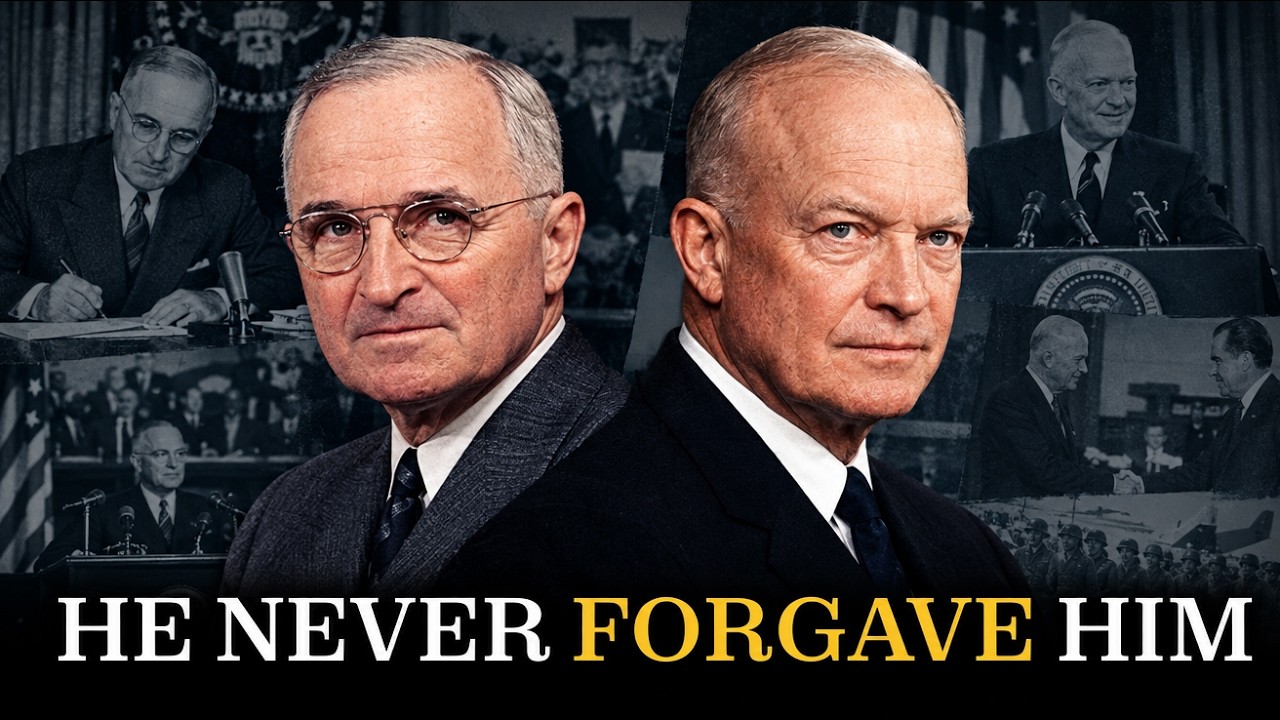
Yet their relationship had not always contained bitterness, suspicion, resentment, or the personal accusations eventually surrounding both powerful men.
Only several years earlier, Truman admired Eisenhower deeply and considered the celebrated wartime commander exceptionally capable and trustworthy.
Eisenhower likewise treated Truman respectfully, creating a working relationship strengthened by national emergencies following Franklin Roosevelt’s sudden death.
Understanding their eventual feud requires examining something deeper than partisan politics, presidential ambition, or disagreements over American foreign policy.
At its core stood radically different beliefs about loyalty, obligation, political debt, personal honor, and how favors should be repaid.
Truman’s understanding of loyalty emerged long before he reached Washington, developing through financial failure and Missouri machine politics.
Before becoming president, Truman endured business disappointments that shaped his unusually strict understanding of debts and personal obligations.
His Kansas City haberdashery collapsed during the 1920s recession, leaving debts he spent more than a decade repaying.
Rather than declare bankruptcy, Truman treated repayment as a question of character, reinforcing his lifelong mental accounting of obligations.
The same philosophy shaped his relationships with people who helped him when his political future appeared uncertain or nonexistent.
Kansas City political boss Tom Pendergast became perhaps the clearest example of Truman’s intensely personal interpretation of loyalty.
Pendergast’s organization helped launch Truman’s political career, supporting his rise from county government toward the United States Senate.
When Pendergast later became politically toxic, Truman refused to pretend their relationship had never existed simply for political convenience.
After Pendergast died, advisers warned Truman against attending his funeral because association with the disgraced boss threatened Truman’s reputation.
Truman attended anyway, demonstrating that abandoning someone who had once supported him violated his personal definition of honorable behavior.
That philosophy became critically important when Truman encountered another figure he admired enormously, General George C. Marshall.
Truman considered Marshall one of America’s greatest public servants and credited him with extraordinary contributions to Allied victory.
Marshall represented professional military excellence, integrity, discipline, sacrifice, and institutional loyalty in almost idealized form for Truman.
He also played the decisive role in transforming Dwight Eisenhower from an obscure officer into America’s most celebrated commander.
Before America’s entry into World War II, Eisenhower remained a lieutenant colonel without the battlefield reputation later associated with him.
Marshall recognized Eisenhower’s organizational abilities and promoted him dramatically over hundreds of officers possessing greater seniority within the Army.
That decision ultimately positioned Eisenhower to command Allied forces in Europe and oversee the enormous operation culminating in Normandy.
For Truman, this history created an obvious obligation between Marshall and Eisenhower that transcended ordinary professional courtesy or political calculation.
Marshall had invested enormous institutional capital in Eisenhower, making loyalty toward his mentor an obligation Truman considered nearly sacred.
This belief would eventually collide spectacularly with the brutal electoral calculations surrounding Eisenhower’s campaign for president in 1952.
Before that rupture, however, Truman and Eisenhower developed a relationship built upon genuine admiration and considerable mutual usefulness.
Their important political connection emerged during the summer of 1945, shortly after Truman unexpectedly inherited Roosevelt’s presidency.
Truman arrived at Potsdam carrying enormous responsibilities despite possessing limited experience with the international decisions suddenly confronting his administration.
He faced Joseph Stalin and Winston Churchill while simultaneously learning secrets Roosevelt’s administration had previously withheld from him.
Eisenhower, meanwhile, possessed immense prestige after Allied victory and represented military competence recognized throughout the United States and Europe.
During their time in Germany, Truman reportedly offered Eisenhower remarkable assistance regarding whatever future position the general might desire.
That offer explicitly included support for the presidency, according to recollections subsequently recorded by both men regarding their discussions.
Eisenhower did not deny Truman’s presidential offer, although their later recollections differed regarding other politically sensitive conversations.
At this stage, however, their interests aligned naturally because each possessed something valuable the other man urgently needed.
Truman needed credibility while navigating a presidency inherited suddenly from Roosevelt without having built an independent national political mandate.
Eisenhower needed civilian political support as America’s massive wartime military establishment confronted demobilization and fierce institutional battles afterward.
Their partnership therefore combined genuine warmth with strategic usefulness, a combination common among powerful figures operating during national emergencies.
Truman soon appointed Eisenhower Army Chief of Staff, placing tremendous institutional responsibility upon the recently victorious European commander.
The assignment proved frustrating because Eisenhower inherited the politically painful task of dismantling the enormous wartime American military establishment.
Congressional pressure demanded rapid demobilization while military leaders worried that excessive reductions could leave America strategically vulnerable abroad.
Truman nevertheless gave Eisenhower considerable latitude and treated him with unusual respect throughout these difficult postwar institutional disputes.
Their relationship became even more consequential as Truman’s political position deteriorated dramatically before the presidential election of 1948.
Republicans captured Congress in 1946 while inflation, labor unrest, shortages, and public dissatisfaction damaged Truman’s standing with voters.
Many Democrats became convinced Truman could not win another term and began searching desperately for a stronger presidential candidate.
Eisenhower’s enormous popularity made him particularly attractive despite uncertainty about whether he actually belonged to either major political party.
Some prominent Democrats actively explored replacing Truman with Eisenhower, creating an extraordinary challenge for an already unpopular incumbent president.
Eisenhower repeatedly rejected attempts to draft him, publicly insisting that he would not participate in partisan political contests then.
Historical disagreement nevertheless surrounds whether Truman personally offered Eisenhower another opportunity to become the Democratic presidential nominee in 1948.
Eisenhower’s records suggested Truman contemplated stepping aside, while Truman later denied making such an extraordinary political proposal entirely.
Whatever happened privately, Truman ultimately produced one of American political history’s greatest electoral surprises by defeating Thomas Dewey.
His unexpected victory fundamentally altered the balance between Truman and Eisenhower, although their professional relationship remained outwardly cooperative.
Eisenhower subsequently became president of Columbia University, a position that never entirely satisfied his military temperament or political interests.
Political leaders continued visiting him, increasingly viewing the celebrated general as a potentially formidable future presidential candidate for either party.
Meanwhile, international developments rapidly worsened, forcing Truman to reconsider Eisenhower’s usefulness within America’s emerging Cold War architecture.
The Soviet Union tested an atomic weapon, communist forces triumphed in China, and war erupted across Korea.
Washington simultaneously needed to transform the North Atlantic Treaty Organization from diplomatic commitment into credible military deterrence.
Truman believed only one American possessed enough international prestige to persuade skeptical Europeans that Washington’s security commitment remained permanent.
In December 1950, he returned Eisenhower to military service and appointed him Supreme Allied Commander Europe for NATO.
The appointment reinforced Eisenhower’s international stature while ironically providing an extraordinary platform from which presidential momentum could quietly develop.
Stationed in Europe, Eisenhower appeared above partisan conflict while supporters back home organized increasingly serious efforts around his candidacy.
Republican leaders traveled across the Atlantic seeking assurances about Eisenhower’s willingness to challenge conservative Senator Robert Taft for nomination.
Eisenhower increasingly worried that Republican isolationists might weaken America’s European commitments if they gained control of national foreign policy.
That concern became central to his later explanation for entering politics, allowing him to frame candidacy as national duty.
By late 1951, Truman understood that political organizations were actively preparing an Eisenhower presidential campaign despite Eisenhower’s official military status.
The president therefore wrote Eisenhower directly, seeking clarity about the general’s intentions regarding the rapidly approaching 1952 election.
Eisenhower replied that he was not seeking political nomination while leaving open the possibility of answering national political duty.
Within days, Senator Henry Cabot Lodge announced Eisenhower’s entry into the New Hampshire Republican presidential primary campaign.
Eisenhower confirmed his Republican affiliation and refused to prevent supporters from voting for him, despite his earlier carefully worded denial.
Truman interpreted this sequence as fundamentally deceptive, believing Eisenhower had technically avoided falsehood while concealing his real political intentions.
That distinction mattered enormously because Truman valued straightforward declarations of loyalty and considered calculated ambiguity deeply dishonorable behavior.
Eisenhower’s supporters could reasonably argue that he had never personally sought nomination and therefore had technically broken no promise.
But technical accuracy could not satisfy Truman’s moral framework, which judged loyalty according to intention rather than carefully constructed language.
Their relationship deteriorated further as Truman’s presidency entered its politically weakest period during the increasingly bitter 1952 campaign.
Korea remained locked in bloody stalemate while corruption investigations damaged public confidence in Truman’s administration and Democratic leadership.
Although accusations never established personal corruption by Truman, scandals surrounding officials provided Republicans with devastating campaign material.
Truman announced he would not seek another term, leaving Democrats to nominate Illinois Governor Adlai Stevenson against Eisenhower.
The Republican campaign centered relentlessly upon Korea, communism, corruption, and broader criticism of Truman’s entire presidential record.
For Truman, the attacks carried additional personal sting because Eisenhower had participated prominently within the very administration he criticized.
Eisenhower had served as Army Chief of Staff and NATO commander under Truman while supporting crucial postwar security institutions.
Now he campaigned alongside Republicans who had opposed policies including NATO and other pillars of Truman’s international strategy.
Truman responded aggressively, accusing Eisenhower of surrendering political independence to conservative Republican politicians who had previously opposed him.
Yet one episode transformed their political disagreement into something Truman regarded as an unforgivable personal betrayal of loyalty.
That confrontation involved Wisconsin Senator Joseph McCarthy, General George Marshall, and a deleted paragraph from Eisenhower’s campaign speech.
McCarthy had attacked Marshall viciously, portraying the revered general as connected with disastrous policies supposedly benefiting international communism.
Eisenhower privately disliked McCarthy and had publicly defended Marshall’s patriotism before campaigning inside McCarthy’s politically important home state.
His planned Milwaukee speech originally contained another direct defense of Marshall against accusations questioning the general’s loyalty and patriotism.
Reporters received advance copies containing the paragraph, making Eisenhower’s intention to defend his former mentor publicly known beforehand.
Wisconsin Republican leaders worried that attacking McCarthy on his home territory could damage the party’s statewide electoral prospects.
After advisers raised those concerns, Eisenhower agreed to remove the Marshall paragraph before delivering his Milwaukee campaign address.
Because journalists possessed the earlier version, the deletion immediately became visible and politically significant rather than remaining private editing.
To Eisenhower’s defenders, the change represented pragmatic campaigning rather than an endorsement of McCarthy’s attacks against Marshall.
They emphasized that Eisenhower had defended Marshall previously and later opposed McCarthy’s excesses after entering the White House.
Truman saw something completely different: a protégé refusing to defend the mentor responsible for creating his extraordinary military career.
Within Truman’s moral universe, political expediency could never justify failing someone who had previously invested profoundly in your success.
Marshall had elevated Eisenhower above hundreds of senior officers and entrusted him with command opportunities defining his historical reputation.
For Truman, deleting Marshall’s defense therefore represented not merely political caution but an unmistakable failure of personal courage.
He publicly attacked Eisenhower’s character afterward and continued returning to the Milwaukee episode long after the election ended.
Eisenhower won overwhelmingly in November, capturing thirty-nine states and decisively ending two decades of Democratic presidential control.
Remarkably, Truman still attempted to conduct a serious institutional transition despite the extraordinary bitterness surrounding their personal relationship.
During their November transition meeting, Truman offered to return a globe Eisenhower had previously given him after wartime service.
Eisenhower declined, reportedly explaining that the globe now belonged with the White House rather than personally with him.
The seemingly minor exchange captured their widening emotional distance because Truman apparently regarded the object as representing their earlier relationship.
Eisenhower treated it institutionally, reflecting his determination to separate personal obligation from the responsibilities of presidential transition.
Their interpretations of the meeting subsequently differed, with Truman describing Eisenhower as remarkably cold and unwilling to listen.
Eisenhower considered aspects of Truman’s presentation unnecessary and resisted appearing subordinate to the outgoing administration he had defeated.
Despite personal hostility, the actual governmental transition remained functional, including arrangements involving intelligence briefings and national security information.
That distinction demonstrates how two bitter political enemies could preserve institutional continuity while allowing their personal relationship to collapse.
The bitterness culminated publicly on inauguration morning when Eisenhower remained inside his vehicle rather than entering Truman’s White House.
Their subsequent automobile journey toward the Capitol reportedly contained little conversation, reinforcing perceptions that reconciliation had become impossible.
Another dispute involved Eisenhower’s son John, then serving in Korea before receiving orders allowing attendance at his father’s inauguration.
Eisenhower suspected political motives behind those orders, while Truman insisted he personally wanted a son present for his father’s inauguration.
Both men remembered the exchange differently, demonstrating how thoroughly distrust had begun shaping their interpretation of ordinary actions.
After Eisenhower took office, Truman disappeared from the White House social and political world for the entire administration.
For eight years, the former president received no invitation to return while Eisenhower occupied the building Truman had surrendered.
Truman finally returned under John F. Kennedy in 1961, emphasizing the extraordinary durability of the earlier presidential estrangement.
Retirement gave Truman another weapon in his struggle over historical reputation because he possessed memories, correspondence, and extensive public access.
He wrote memoirs, built his presidential library, gave interviews, and repeatedly discussed Eisenhower with characteristic sharpness and lingering resentment.
During these years, an especially sensational story emerged involving Eisenhower, wartime aide Kay Summersby, Marshall, and supposedly destroyed correspondence.
The story claimed Eisenhower considered divorcing Mamie Eisenhower and marrying Summersby before Marshall forcefully threatened his military career.
It further claimed Truman later discovered the correspondence inside government files and personally ordered the damaging evidence destroyed.
The transcript emphasizes that archival evidence does not substantiate this dramatic account and raises serious problems regarding its provenance.
The allegation became famous through Merle Miller’s posthumously published Plain Speaking, supposedly based upon interviews conducted with Truman.
Later scholars examining Miller’s recordings concluded portions of the published material were altered, sharpened, combined, or otherwise unreliable.
No verified archival copy of the alleged Marshall correspondence has emerged despite extensive examination of relevant presidential and military records.
The Summersby episode therefore illustrates how memorable historical anecdotes can outlive stronger evidence when perfectly matching existing public narratives.
More importantly, the story’s structure reflected Truman’s fundamental grievance regardless of whether he actually told its strongest version.
Marshall again appeared as moral authority while Eisenhower appeared as the protégé failing to honor obligations toward his benefactor.
That pattern mirrored Truman’s interpretation of Milwaukee, where electoral convenience supposedly overwhelmed the loyalty Eisenhower owed his wartime mentor.
The two former presidents remained largely separated through the 1950s despite occasional correspondence and opportunities for symbolic reconciliation.
Eisenhower did not attend the dedication of Truman’s presidential library, although other major political figures traveled to Independence.
Their estrangement softened only after national tragedy brought them together following President Kennedy’s assassination in November 1963.
Both attended Kennedy’s funeral, and Truman subsequently invited Eisenhower for a private conversation at Blair House afterward.
Accounts suggest no dramatic apology occurred, but the two aging statesmen spent considerable time talking together without renewed confrontation.
Eisenhower later visited Truman’s library in Independence, where Truman personally guided him through exhibits documenting his presidential years.
Among those artifacts was the globe Eisenhower had once given Truman and later declined to reclaim during transition.
The object had transformed from personal gift into historical evidence, symbolizing a relationship increasingly contested through archives and memoirs.
Both men eventually built presidential libraries presenting their respective interpretations of overlapping wars, alliances, administrations, and political decisions.
Their argument therefore continued institutionally even after direct personal confrontation largely disappeared from their remaining years.
Eisenhower died in March 1969, and Truman, too frail to attend, issued a notably generous public statement.
He described Eisenhower as a great general and president, language considerably warmer than his comments during their bitterest years.
Truman died three years later, leaving historians to untangle a relationship far more complicated than ordinary partisan rivalry.
Their feud was ultimately rooted in incompatible moral frameworks as much as competing political interests or presidential ambitions.
Truman believed advancement created permanent obligations toward people who supplied opportunities, protection, confidence, and institutional support during difficult moments.
Eisenhower approached political relationships more pragmatically, separating personal gratitude from what he believed national responsibility required at different moments.
Neither interpretation automatically made one man honorable and the other dishonorable, but their incompatibility made eventual conflict extraordinarily likely.
Truman had promoted Eisenhower, protected him, returned him to international command, and repeatedly treated his abilities with exceptional respect.
Eisenhower supplied Truman with military credibility while helping construct institutions central to America’s emerging Cold War international strategy.
Each man’s historical achievements therefore became partially dependent upon decisions, appointments, and opportunities created by the other.
That mutual dependence made their eventual rupture more painful because political disagreement could easily be interpreted as personal betrayal.
The 1952 campaign provided the circumstances, but Milwaukee provided the symbol that Truman could never emotionally move beyond.
For Eisenhower, Truman’s relentless personal attacks likewise demonstrated that their former working relationship could no longer survive electoral politics.
The inauguration snub therefore represented the conclusion of a long deterioration rather than the spontaneous beginning of presidential hostility.
Behind the untouched coffee stood years of appointments, political offers, military commands, disputed letters, campaign attacks, and accumulated resentment.
Their story demonstrates how alliances among powerful figures often depend upon assumptions neither participant explicitly recognizes until circumstances change.
Truman assumed favors established durable obligations, while Eisenhower apparently believed public duty eventually superseded the personal ledger Truman maintained.
Once Eisenhower became president-elect, the former subordinate had become the principal, fundamentally changing the balance between both men’s expectations.
Truman could accept electoral defeat, but he struggled to accept what he regarded as repudiation by someone he had supported.
Eisenhower could acknowledge Truman’s earlier assistance while rejecting the proposition that gratitude should determine his political affiliations or campaign choices.
Their feud therefore survived because both men believed themselves fundamentally justified, leaving little emotional space for apology or compromise.
Ultimately, neither the Republican victory nor Democratic defeat fully explains why their hostility endured for nearly an entire decade.
The deeper explanation lies in loyalty, memory, ambition, gratitude, and radically different understandings of what powerful men owe benefactors.
Truman saw a debt betrayed; Eisenhower saw independence achieved, and those competing interpretations followed both men into presidential history.
That is why the silent inauguration ride still resonates decades later as more than another episode of Washington political theater.
It marked the collapse of an alliance forged after world war and destroyed by politics, pride, memory, and obligation.
Two men who once admired each other ultimately became custodians of competing histories, each determined to preserve his version.
Their libraries became the final battleground, replacing speeches and campaigns with archives designed to influence generations still debating their feud.
And the untouched coffee in January 1953 remains the perfect image: ordinary, ceremonial, waiting, and ultimately rejected by history.


