Joseph P. Kennedy Sr. built his family around ambition and a belief that one son would reach the White House.
The claim that he simply despised John F. Kennedy collapses under the weight of a far more complicated record.
Inside the Kennedy household, children were evaluated, compared, challenged, and assigned roles within a larger family project.
That project centered on political power, social vindication, and a belief that a Kennedy presidency could transform the family’s standing.
For most of John Kennedy’s early life, he was not the chosen heir or expected to carry that burden.
His older brother, Joseph P. Kennedy Jr., occupied that role from birth, receiving expectations reserved for a future national leader.
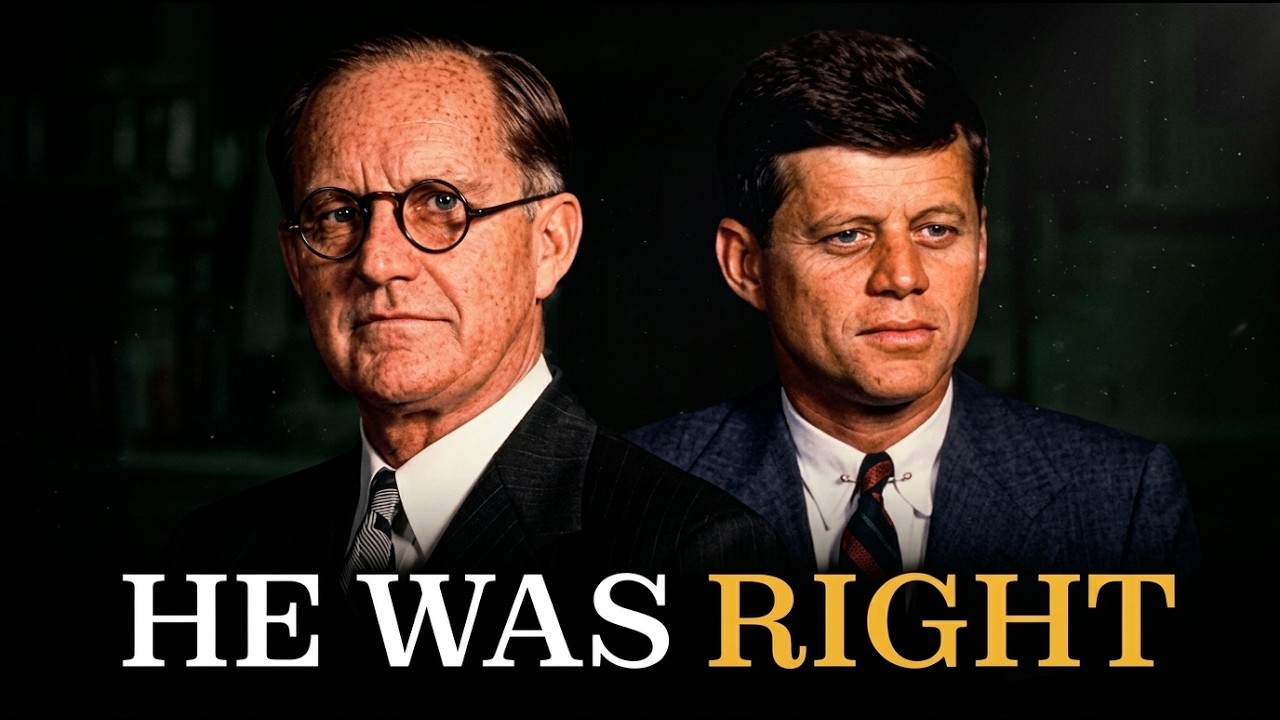
The family hierarchy was clear enough that everyone, including John, understood who represented the first plan and who followed.
That distinction shaped John’s childhood, his relationship with his father, and ultimately the improbable political journey that followed family tragedy.
Joseph Kennedy Sr. had risen from Boston’s Irish Catholic political world into banking, finance, Hollywood, diplomacy, and national prominence.
He viewed wealth less as an endpoint than as leverage, capable of opening doors still closed by class and prejudice.
The presidency became the ultimate symbol of that ambition, offering personal triumph and vindication for a family once socially excluded.
Joe Jr. therefore became more than an eldest son; he became the designated vehicle for his father’s grandest political aspiration.
From sports to academics, he was groomed for leadership, confidence, toughness, and the public image Joseph Sr. considered presidential material.
John, born two years later, grew up inside that arrangement while carrying burdens that made comparison especially punishing and persistent.
He was frequently ill, physically fragile, and forced through repeated medical crises in a household that equated vigor with character.
Those health problems included severe childhood illness, chronic digestive troubles, back pain, and adrenal disease later identified as Addison’s disease.
In another family, such vulnerability might have produced protective attention; inside the Kennedy system, it often reinforced perceptions of weakness.
Joseph Sr. prized physical resilience because he believed public life demanded endurance, toughness, confidence, and dominance under difficult circumstances.
John’s recurring illnesses therefore became more than medical setbacks; they threatened the masculine and political ideal his father had constructed.
Yet the evidence does not support a simple story of hatred, neglect, or a father wishing failure upon his son.
Letters and family accounts reveal affection, humor, concern, and investment, even when disappointment and comparison remained visible beneath those relationships.
That contradiction matters because Joseph Kennedy’s failure was not emotional absence so much as the narrowness of his expectations.
He could care deeply for John while simultaneously believing another son was better suited to carry the dynasty’s central mission.
The result was a subtler rejection, rooted in hierarchy rather than hostility and ambition rather than personal contempt.
John was encouraged to succeed, but for years he was steered outside the family’s most important political role.
That distinction shaped his emotional development as he read widely and pursued intellectual interests beyond campaigning or officeholding.
At Harvard, his fascination with history and foreign affairs produced a senior thesis later published as Why England Slept.
The book showed seriousness that contrasted sharply with the image of John drifting behind a more formidable older brother.
Joseph Sr. helped promote the book through his extensive connections, further complicating claims that he wanted John marginalized or diminished.
He wanted his second son respected, successful, and useful to the family, even if presidential expectations belonged elsewhere.
That arrangement may even have given John freedoms unavailable to Joe Jr., whose future had been scripted long before adulthood.
John briefly appeared headed toward journalism or law, professions consistent with his interests and far removed from predetermined presidential ambition.
Then World War II shattered the family hierarchy with an abruptness that no political strategy or parental planning could control.
John entered the Navy despite medical problems and eventually commanded PT-109 in the Pacific theater during a dangerous combat assignment.
When a Japanese destroyer struck his boat, Kennedy saved injured crewmates and endured an ordeal that transformed his public identity.
For a son judged physically fragile, the PT-109 episode offered unmistakable evidence of courage, endurance, and leadership under pressure.
That wartime heroism later became central to Kennedy’s political mythology, but its personal significance inside the family was equally important.
Joe Jr., meanwhile, pursued his own dangerous wartime mission, volunteering for an operation involving an aircraft packed with explosives.
On August 12, 1944, the aircraft detonated prematurely over England, killing him and destroying Joseph Sr.’s carefully constructed succession plan.
The death devastated the family patriarch, who had invested years of expectation, identity, and political purpose in his eldest son.
Grief did not extinguish Joseph Sr.’s ambition; instead, it transformed the presidency from aspiration into something resembling a family obligation.
With Joe Jr. gone, John became the available son onto whom decades of preparation, money, and political machinery could transfer.
That transfer appears to have been remarkably swift, underscoring how deeply Joseph Sr. viewed politics as a dynastic undertaking.
John later described entering politics with a tone suggesting recruitment rather than revelation, as though he had been drafted.
The phrase captures the emotional reality better than any claim that he had always dreamed of seeking elected office.
He ran for Congress in 1946, entering a Massachusetts political world where his father’s money and organization created formidable advantages.
Joseph Sr. invested heavily in staff, advertising, networks, publicity, and the wartime hero narrative built around the PT-109 rescue.
Those resources mattered, but they did not eliminate the challenge facing a candidate initially uncomfortable with retail politics and performance.
Kennedy had to learn campaigning, handshaking, speechmaking, constituency work, and the discipline required to turn family expectations into personal credibility.
He won a congressional seat at twenty-nine, beginning a career that quickly exceeded the supporting role once assigned him.
Still, his early victories could not fully separate him from the memory of the brother his father had originally chosen.
Joe Jr. remained a powerful presence in family memory, representing lost potential and Joseph Sr.’s first political blueprint.
John advanced under dual pressure, proving himself to voters while measuring against an idealized brother who could no longer compete.
That psychological burden may help explain why the father-son relationship cannot be reduced to approval, resentment, affection, or rivalry alone.
It was political, personal, transactional, and deeply shaped by bereavement, all while unfolding beneath the spotlight of public ambition.
Kennedy’s Senate victory in 1952 became especially important because it showed he could outperform expectations in a difficult statewide contest.
He defeated Republican incumbent Henry Cabot Lodge Jr., despite Dwight Eisenhower carrying Massachusetts decisively in the presidential race that year.
The result strengthened Kennedy’s legitimacy and demonstrated that organization, instinct, personality, and electoral skill had become assets of his own.
His siblings, especially Robert Kennedy, played crucial roles in building a disciplined campaign operation that expanded the family’s political capability.
By the mid-1950s, Joseph Sr. no longer dealt with John merely as a substitute filling an unexpected vacancy.
He increasingly recognized his second son as a formidable politician whose strengths differed from those celebrated in Joe Jr.
John was intellectually agile, comfortable with journalists, effective in debate, and increasingly suited to the emerging television age.
Those qualities eventually made him not simply an acceptable heir, but arguably the family’s strongest available national candidate.
That evolution is essential because it reveals Joseph Sr. as calculating enough to revise his judgment when evidence changed.
He did not begin by seeing John as future president, but success forced him to reassess the hierarchy he created.
By then, father and son had become political partners, bound together by shared objectives even if old emotional wounds remained.
Joseph Sr. managed image and risk with the same intensity he had previously brought to finance, business, and family strategy.
He worked to keep John’s serious health problems away from damaging public scrutiny, understanding how voters might interpret chronic illness.
Such concealment reflected both paternal protectiveness and political calculation, another example of affection operating through the machinery of ambition.
John became the asset the family could not afford to lose, especially after the devastating death of its original heir.
That reality created a cruel paradox at the heart of the relationship between father and son during Kennedy’s rise.
John finally received the full force of his father’s confidence after tragedy had removed the brother favored before him.
The attention he inherited resembled a transferred obligation as much as a reward for qualities newly recognized by his father.
Yet John did not remain merely a beneficiary of dynastic machinery; he steadily transformed those resources into independent political authority.
His growing command of policy, television, rhetoric, and coalition building distinguished him from the passive substitute imagined by later caricatures.
By 1960, Joseph Sr.’s financial resources and political contacts became major behind-the-scenes assets in his son’s presidential campaign.
The elder Kennedy understood that his own controversial public reputation could damage the candidate, so he largely avoided prominent appearances.
Behind closed doors, however, his influence remained substantial across fundraising, party relationships, media contacts, and the broader campaign organization.
The West Virginia primary became a crucial test because Kennedy faced skepticism as a wealthy Catholic from Massachusetts.
Hubert Humphrey lacked comparable resources, while Kennedy’s organization spent heavily on advertising, field operations, and local political outreach.
Kennedy’s victory weakened arguments that a Catholic nominee could not compete effectively in heavily Protestant regions of the country.
It also demonstrated how deeply Joseph Sr.’s wealth and networks remained embedded within his son’s path toward national power.
Still, money alone cannot explain Kennedy’s rise because political capital requires a candidate capable of converting advantages into votes.
John became that candidate, combining family resources with discipline, intelligence, charm, resilience, and a sophisticated understanding of modern campaigning.
In November 1960, he narrowly defeated Richard Nixon and became the thirty-fifth president of the United States.
For Joseph Sr., the result fulfilled the ambition he had pursued for decades, though through a different son than planned.
Accounts of inauguration day describe an emotional patriarch watching the family dream become reality before a global audience.
The moment was triumphant, but Joe Jr.’s memory never disappeared from the family story or from Joseph Sr.’s private reflections.
That lingering grief complicated victory because the presidency represented both fulfillment and permanent evidence of an altered future.
John’s own response to his brother’s memory appears notably free from the bitterness sensational retellings often project onto him.
He spoke warmly about Joe Jr. and continued to treat his brother’s life as part of the family’s defining history.
That absence of visible resentment does not mean childhood comparisons caused no pain, but it complicates claims of lifelong hostility.
Families often contain injuries that coexist with loyalty, affection, admiration, competition, and a determination to preserve shared memory.
The Kennedys embodied that complexity on an unusually public scale, turning private dynamics into forces with national political consequences.
In December 1961, Joseph Sr. suffered a massive stroke that left him partially paralyzed and severely limited his speech.
The man who directed nearly every strategic detail of the dynasty suddenly became dependent on the family he had managed.
He lived through the Cuban Missile Crisis, the civil rights struggle, and his son’s presidency largely unable to shape events.
Then, in November 1963, John F. Kennedy was assassinated, confronting Joseph Sr. with another catastrophic loss within the dynasty.
Five years later, Robert Kennedy was assassinated during his presidential campaign, deepening a sequence of tragedies almost impossible to comprehend.
By Joseph Sr.’s death in 1969, the family story had become inseparable from ambition, achievement, grief, violence, and public myth.
That history makes the phrase “Joseph Kennedy despised JFK” attractive for headlines but inadequate as serious historical interpretation.
The record instead suggests favoritism, conditional approval, hierarchy, strategic thinking, and a father whose emotional investments followed his political expectations.
That pattern could damage a child repeatedly told through comparison that someone else mattered more, even without explicit hatred.
John’s experience was not simply paternal rejection, but assignment to a lesser role within an intensely demanding family system.
His eventual rise demonstrated how unstable such family roles can become when history intervenes and private assumptions collapse.
It also showed that abilities overlooked in one environment can become decisive advantages when circumstances redefine what leadership requires.
John’s intellectual curiosity, verbal skill, resilience, and media presence became more politically valuable than qualities once favored in Joe Jr.
That reversal exposes the danger of parents defining children too early according to narrow standards of strength, success, or usefulness.
Joseph Sr. believed he understood which son carried presidential potential, yet the son initially ranked second reached the office.
The irony is powerful because the outcome emerged not from careful foresight, but from catastrophe followed by pragmatic redirection.
Still, reducing John’s presidency to his father’s money would ignore the political growth required to survive increasingly demanding national contests.
Resources opened doors, but Kennedy still had to persuade voters, withstand scrutiny, master television, and perform under extraordinary pressure.
Likewise, portraying Joseph Sr. as merely ruthless overlooks the genuine grief, pride, concern, and attachment visible throughout the family record.
The more accurate portrait is uncomfortable precisely because it mixes recognizable parental love with ambition strong enough to distort relationships.
He loved his children, but he also evaluated them according to a broader project that often overshadowed their individual identities.
For John, that meant growing up behind a brother who embodied the version of success their father valued most.
After 1944, the same system abruptly elevated him, proving how contingent even seemingly permanent family hierarchies can be.
What followed was not merely obedience to a father’s demand, but the gradual creation of an independent political identity.
John Kennedy absorbed the machinery built for someone else and then reshaped it around talents his father had initially undervalued.
His presidency therefore reflected both inheritance and self-invention, combining family ambition with abilities forged through illness, war, grief, and competition.
The emotional tension between father and son came from that mixture, not from a simple story of hatred and revenge.
Joseph Sr. had once treated John as secondary, but eventually relied on him as the dynasty’s central political instrument.
John, meanwhile, accepted a role he had not originally sought and ultimately made it inseparable from his own historical legacy.
The story resonates because many families quietly assign children identities long before those children understand the consequences of those labels.
One becomes the achiever, another the fragile one, another the backup, and those roles can persist long after circumstances change.
In the Kennedy family, history violently disrupted those assignments and forced a reassessment with consequences reaching far beyond private life.
Joseph Sr. did not foresee that the son once considered physically weak would become the family’s most important political figure.
Nor could he foresee that the dynasty’s greatest triumph would be followed so quickly by devastating national and personal tragedy.
The relationship therefore stands as a cautionary study in ambition, favoritism, resilience, and the unpredictable ways families construct their futures.
It also reveals why sensational claims about private hatred often obscure the more revealing truth contained in complicated relationships.
Joseph Kennedy did not need to despise John for his choices to leave lasting scars and shape his son’s development.
He only needed to believe, for many years, that another child mattered more to the family’s grandest purpose.
That belief influenced how resources, expectations, admiration, and attention were distributed throughout John’s youth and early adulthood.
Yet history overturned the hierarchy, and John proved capable of carrying responsibilities originally designed for someone else entirely.
In doing so, he did more than fulfill his father’s ambition; he surpassed the role of replacement that tragedy assigned.
The Kennedy story therefore ends not with a rejected son defeating an unloving father, but with something far more complex.
It is the story of a backup plan becoming history, while exposing the emotional cost of treating children as instruments.
Joseph Sr.’s ambition helped create a presidency, but John’s resilience transformed inherited expectations into a legacy unmistakably his own.


