FBI Files Expose Lufthansa Heist’s Bloody Aftermath, Burke’s Killings, and Decades-Old Basement Secrets in Queens
The Lufthansa heist has been transformed by books and movies into one of the most glamorous criminal legends in American history.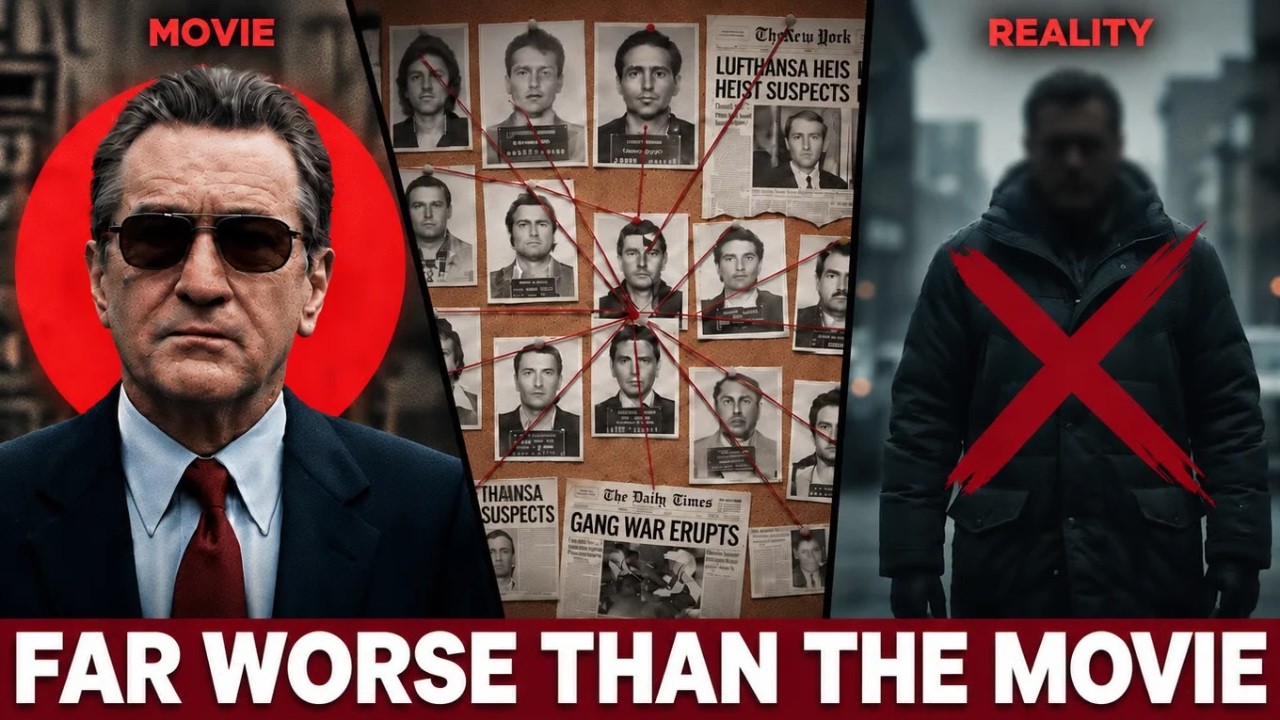
The real story was far darker.
On December 11, 1978, armed robbers entered Lufthansa’s cargo terminal at John F. Kennedy International Airport and stole more than $5 million in cash and roughly $1 million in jewelry.
At the time, it was among the largest cash robberies ever committed in the United States.
The robbery later became permanently embedded in popular culture through Nicholas Pileggi’s book Wiseguy and Martin Scorsese’s Goodfellas.
Yet the famous airport robbery itself lasted only a small fraction of the larger story.
What followed was a trail of murders, disappearances, suspected betrayals and bodies that continued haunting investigators for decades.
Federal records now available through the FBI Vault include three separate Lufthansa Heist files, adding another documentary layer to a case investigators pursued for generations. The Bureau’s online FOIA library publicly lists Lufthansa Heist Parts 1, 2 and 3 among its released records.
But claims that newly declassified documents have suddenly exposed every dark secret surrounding the robbery should be treated carefully.
Many of the most disturbing facts about the Lufthansa aftermath have actually been publicly known for years.
The real historical record is nevertheless brutal enough.
At the center of it was James “Jimmy the Gent” Burke, the Lucchese crime family associate widely regarded by investigators as one of the principal architects of the robbery.
Burke was never convicted for the Lufthansa theft itself.
He nevertheless became one of the most feared figures associated with its aftermath.
Federal prosecutors later described Burke as a central participant in the heist alongside Bonanno family captain Vincent Asaro and other organized-crime associates.
A 2014 Justice Department prosecution alleged that more than $5 million in cash and approximately $1 million in jewelry were stolen from the Lufthansa terminal and that Burke and other conspirators expected enormous individual shares.
Almost none of the stolen fortune was ever recovered.
Instead, people connected to Burke began dying.
The killings helped turn the Lufthansa robbery from a spectacular theft into one of organized crime’s most infamous bloodlettings.
One of the first victims was Parnell “Stacks” Edwards, the getaway driver who reportedly failed to dispose of the van used in the robbery.
The abandoned vehicle became an obvious investigative lead.
Edwards was killed only days after the heist.
From there, the body count grew.
Joseph Manri and Robert McMahon were found murdered inside a car.
Paolo LiCastri’s bullet-riddled body was discovered on a burning pile of garbage.
Theresa Ferrara was later identified after portions of her dismembered remains washed ashore in New Jersey.
Contemporary reporting from 1981 was already documenting the frightening pattern surrounding the robbery.
That makes one popular modern claim misleading.
The murders were not hidden from the public until a recent FBI document release.
Investigators and journalists were connecting the bodies to the Lufthansa circle within a few years of the robbery.
What newer releases can provide is more documentation, investigative context and insight into how federal authorities built their cases.
One of the most gruesome deaths connected indirectly to the stolen money involved Richard Eaton.
The viral version of the story sometimes describes Eaton as an “innocent con man” mistakenly killed in the purge.
That characterization is too simple.
Eaton was indeed a con artist rather than one of the armed men who carried out the airport robbery.
Historical accounts indicate he was not part of the actual Lufthansa robbery crew.
But he was connected to Burke’s criminal world.
Authorities believed Eaton became involved in disputes over money, including funds associated with criminal ventures and allegedly some of the Lufthansa proceeds being laundered through Florida businesses.
Eaton eventually suffered a horrific death.
His body was found hogtied and frozen inside a refrigerated meat truck.
History’s account of the Lufthansa aftermath says children discovered Eaton’s frozen body in the vehicle.
Burke was later convicted of murdering him.
So the sensational description contains a kernel of truth.
Eaton was not an airport robber.
He was found frozen in a refrigerated truck.
Burke was convicted for his murder.
But describing Eaton simply as an innocent outsider erases his connections to Burke’s criminal operations and the financial disputes surrounding them.
The mythology becomes even murkier when discussions turn to meat hooks.
Some retellings portray Eaton literally hanging from a frozen meat hook.
Reliable historical summaries consistently describe him as hogtied and found in a refrigerated meat truck.
Descriptions involving a meat hook appear in various crime retellings, but the strongest mainstream sources reviewed here support the refrigerated-truck discovery without establishing every grotesque detail attached to later legend.
That distinction matters.
The Lufthansa story has accumulated decades of embellishment.
Real murders were horrific enough without adding unverified details.
Another central figure was Marty Krugman.
Krugman was a Queens bookmaker and business owner who helped transmit information that eventually led Burke’s crew to the Lufthansa opportunity.
He reportedly expected a substantial share of the proceeds.
His demands for payment became increasingly dangerous.
Krugman vanished.
His body was never officially recovered.
Organized-crime accounts have long alleged Burke and associates murdered and dismembered him.
Krugman was eventually declared legally dead.
His disappearance helped fuel one of the most enduring pieces of Lufthansa folklore: that Burke buried victims underneath properties he controlled.
The most notorious location was Robert’s Lounge in South Ozone Park, Queens.
Burke used the bar as a headquarters.
Members of his criminal circle gathered there.
Truck hijackings, gambling schemes and other criminal activity were associated with the location.
Henry Hill later described it as something resembling Burke’s private cemetery.
That description was not entirely metaphorical.
In June 1980, investigators excavated human remains from beneath Robert’s Lounge.
Reports say a human leg bone and part of a shoulder bone were recovered from the basement.
However, another popular viral claim mixes two different excavation stories together.
Federal agents really did return decades later with jackhammers.
But the famous 2013 excavation did not occur at Robert’s Lounge.
It occurred at Burke’s former Queens home.
Agents descended on the South Ozone Park property in June 2013.
Witnesses could hear jackhammers.
FBI evidence teams excavated areas beneath the property.
The operation lasted several days.
And investigators ultimately recovered human remains.
Those remains were eventually identified as belonging to Paul Katz.
Katz’s murder predated the Lufthansa robbery by nearly a decade.
According to the Justice Department, Katz disappeared in 1969.
Federal prosecutors alleged that Vincent Asaro and Burke strangled Katz with a dog chain because they believed he was cooperating with law enforcement.
His body was buried beneath a vacant Queens home.
Years later, when organized-crime investigators began looking into the disappearance, prosecutors alleged that Asaro ordered Katz’s remains moved.
Despite that effort, FBI agents returned to the property in 2013.
They recovered human bones, teeth, hair, possible soft tissue and clothing.
DNA testing identified the remains as Katz.
The medical examiner listed his cause of death as homicidal violence.
That discovery became enormously important.
It showed that the folklore about Burke’s properties concealing murder victims was not simply gangster mythology.
Federal agents had literally broken through concrete decades later and recovered human remains.
Yet it is inaccurate to say that the basement discovery finally exposed a hidden Lufthansa victim.
Katz was not a victim of the 1978 Lufthansa purge.
His murder occurred in 1969.
The connection is Burke.
The excavation revealed the broader pattern of violence surrounding Burke’s criminal organization, not a previously unidentified airport-heist participant.
That distinction is exactly where Hollywood legend and historical record often collide.
Goodfellas compresses people, timelines and motives.
Real organized crime did not operate with clean narrative boundaries.
Burke’s murders were not all committed because of Lufthansa.
Some victims were killed over money.
Some were believed to be informants.
Some were eliminated because of unrelated criminal disputes.
Some had information Burke considered dangerous.
Others disappeared in circumstances still contested decades later.
The Lufthansa robbery became the center of the mythology because so many people around it died afterward.
But not every corpse connected to Burke can accurately be labeled a Lufthansa victim.
There is also the story of Louis and Joanna Cafora.
Louis Cafora was involved in Burke’s circle and reportedly helped launder money.
According to longstanding accounts, Cafora attracted dangerous attention by spending conspicuously after the robbery.
He bought his wife a pink Cadillac, behavior said to have infuriated Burke because investigators were watching the crew closely.
Louis and Joanna disappeared.
Their bodies were never found.
Their disappearance remains one of the Lufthansa story’s most haunting chapters.
Yet the viral reference to “missing wives with no graves” risks blending multiple stories.
Joanna Cafora disappeared with her husband and was presumed murdered.
Theresa Ferrara was murdered and dismembered, but portions of her body were recovered.
Other spouses and girlfriends appear throughout Lufthansa accounts, but there is no verified newly released federal file establishing a previously unknown group of missing wives secretly buried by Burke.
The known record is frightening without turning every woman connected to the crew into an undiscovered victim.
The killings served several possible purposes.
Burke feared informants.
He distrusted anyone demanding money.
He wanted to control the stolen proceeds.
And he knew the FBI was applying enormous pressure.
The getaway van had already provided investigators with a major lead.
The robbery attracted national attention.
The thieves suddenly possessed enormous quantities of cash that were difficult to spend without attracting suspicion.
In that environment, every associate represented a potential liability.
Henry Hill later described realizing that people were disappearing one by one.
Hill eventually became convinced he might be next.
He entered witness protection and became one of the government’s most famous organized-crime cooperators.
His testimony helped prosecutors pursue crimes far beyond Lufthansa.
Burke himself ultimately went to prison not for the Lufthansa robbery, but for other crimes.
He was convicted in connection with the Boston College basketball point-shaving scandal.
He was also convicted for Eaton’s murder.
Burke died in federal custody in 1996.
The Lufthansa case nevertheless continued.
Decades after the robbery, investigators pursued Vincent Asaro.
In 2014, federal prosecutors charged him with participating in the Lufthansa robbery and with racketeering crimes stretching back decades.
The government’s detention memorandum said its evidence included cooperating witnesses from multiple organized-crime families, Lufthansa business records, crime-scene photographs and recordings discussing how Burke handled the robbery proceeds.
That case demonstrated how long the Lufthansa investigation remained active.
Authorities were still litigating events from 1978 more than thirty-five years later.
The robbery itself has therefore never been just a story about stolen money.
It became a study in how organized crime protects itself.
Witnesses disappear.
Associates become liabilities.
Money creates suspicion.
Criminal partnerships turn into death sentences.
The most famous cinematic version emphasizes Burke’s decision to eliminate people after the robbery.
That broad theme reflects reality.
But films inevitably simplify motives and chronology.
The federal record is messier.
Some victims were indisputably connected to Lufthansa.
Others were peripheral.
Some were killed for unrelated disputes.
Some disappearances remain unresolved.
And some dramatic details repeated online cannot be traced to reliable evidence.
The FBI’s release of Lufthansa files is still important.
The FBI Vault exists specifically to make historically significant records available through the Freedom of Information Act.
The Bureau says the Vault contains thousands of scanned documents, including previously unreleased and frequently requested material.
Those files allow researchers to examine how federal investigators tracked organized crime.
They can reveal surveillance references.
Names of persons of interest.
Interview summaries.
Redactions.
Investigative leads.
Cross-references to other cases.
But an FBI file is not automatically proof that every allegation inside it is true.
Law-enforcement files often include raw intelligence.
Informant claims.
Suspicions.
Unverified leads.
Statements later contradicted by other evidence.
That is why declassification does not transform every sentence into a judicial finding.
The same caution applies to supposed “leaked FBI bug tapes.”
Federal investigators certainly recorded mob figures.
The Justice Department’s later Asaro litigation explicitly referenced consensual recordings and other electronic evidence.
One recording reportedly captured Asaro discussing how Burke retained much of the robbery proceeds.
But there is no evidence in the material reviewed here that a newly leaked set of shocking Lufthansa bug tapes has suddenly appeared in 2026 containing the complete hidden truth promised by viral posts.
There are authentic recordings.
There are released federal records.
There are decades of testimony.
That is different from an exclusive modern leak.
The darkest truth about Lufthansa is therefore less cinematic than the viral mythology and more disturbing because it is documented.
The robbery succeeded spectacularly.
The criminals took millions.
Almost none of it was recovered.
But success created paranoia.
People connected to the operation began dying.
Edwards was killed.
Manri and McMahon were killed.
LiCastri was killed.
Ferrara was killed.
Eaton was tortured and murdered.
Krugman vanished.
The Caforas vanished.
Other associates died in separate mob disputes.
The money that was supposed to make everyone rich became a reason to distrust everyone who knew where it came from.
Burke survived the immediate purge.
He never faced trial for the robbery.
But investigators kept pulling at the network around him.
Years later, jackhammers broke through a Queens basement.
Bones emerged.
DNA gave one victim his name back.
That victim was Paul Katz, murdered years before Lufthansa, proving something broader about the criminal world surrounding Burke.
Burke’s reputation for making people disappear was rooted in more than underworld storytelling.
Federal prosecutors eventually had physical remains.
They had DNA.
They had recordings.
They had cooperating witnesses.
And they had decades of accumulated evidence linking one generation of mob violence to another.
The Lufthansa heist remains legendary because the robbery itself was extraordinary.
But the fortune is only half the story.
The other half is fear.
A getaway driver murdered within days.
Associates found shot in cars.
A frozen corpse inside a refrigerated truck.
A dismembered woman washing ashore.
Men who vanished without graves.
A bar whose basement yielded human bones.
A family property that FBI agents eventually attacked with jackhammers.
And an investigation still producing prosecutions decades after the money disappeared.
That is the real darkness behind the legend.
Some details have been exaggerated.
Richard Eaton was not simply an innocent stranger randomly selected for murder.
The 2013 basement excavation was not the discovery of a secret Lufthansa mastermind.
Paul Katz’s killing happened years before the heist.
Not every missing person associated with Burke was necessarily murdered because of Lufthansa.
And no newly authenticated 2026 bug tape has emerged proving every lurid claim attached to the story.
But stripping away those exaggerations does not make the history less shocking.
It makes it clearer.
The Lufthansa robbery was not followed by one clean, coordinated purge exactly as Hollywood depicts.
It was followed by a chaotic constellation of murder, greed, paranoia and organized-crime violence.
That violence stretched across years.
Some victims were found.
Others were never recovered.
Some murders produced convictions.
Others survive mostly through testimony and investigative records.
And decades later, federal agents were still digging into concrete to find what Burke’s world had tried to bury.
Hollywood made the Lufthansa heist famous.
The federal record shows why its aftermath remains far more disturbing than the movie.


