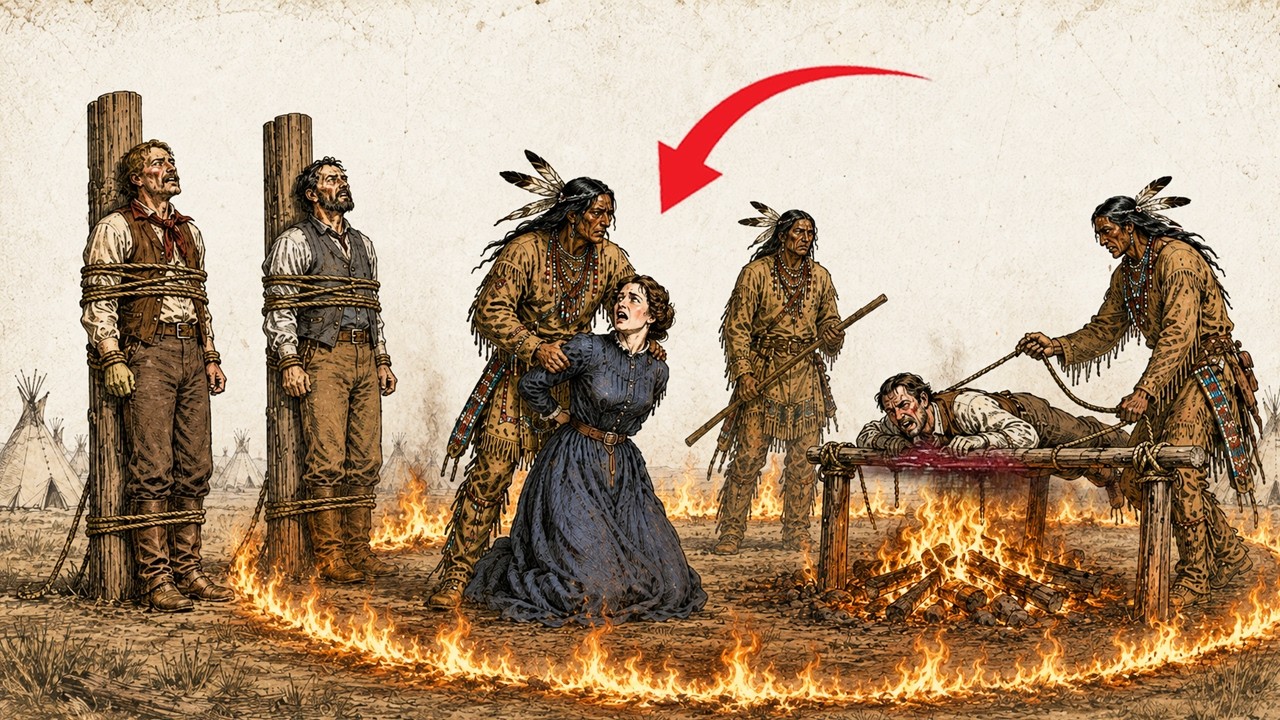
On July 12, 1864, nineteen-year-old Fanny Kelly stood beside a wagon near Little Box Elder Creek in what is now central Wyoming.
The oxen were drinking.
The wheels were muddy.
Her family still believed they were traveling toward a new life.
Within minutes, the wagon party would be destroyed.
Several men would be dead.
Women and children would be taken.
And Fanny Kelly would begin a captivity lasting roughly five months.
That was not the ending of the horror.
It was the beginning.
The Journey Started With Hope
Two months earlier, Fanny had left Kansas with her husband, Josiah Kelly.
They were heading toward the Idaho gold country.
Like thousands of overland emigrants, they imagined land, opportunity, and a future larger than the one they had left behind.
Fanny later remembered beginning the journey with what she called high hopes and expectations of prosperity.
She was young.
Recently married.
And traveling with a child named Mary, her sister’s daughter, whom the Kellys had adopted.
Two Black hired men, Frank and Andy, also traveled with the party.
Their names survived only faintly in the record.
By July, another family had joined them.
Sarah Larimer.
Her husband, Noah.
Their young son, Frank.
Two wagons.
A small number of adults.
Two children.
And thousands of miles of unsettled country around them.
They Were Crossing a Landscape Already at War
To the emigrants, the trail was a road west.
To Lakota communities, it was an invasion corridor.
Wagons crossed hunting grounds.
Buffalo herds were disrupted.
Military expeditions burned Native camps.
Treaties had repeatedly failed to stop American expansion.
By 1864, tensions were extreme.
General Alfred Sully’s military campaigns were already pushing through the northern Plains.
Lakota families knew exactly what expanding roads and forts meant.
The source emphasizes this context for a reason.
The men who approached Fanny’s wagon party did not see themselves as random villains emerging from nowhere.
They understood themselves as defending land, people, and survival.
That does not erase what happened to the captives.
But it explains why the encounter cannot be reduced to a simple Western movie attack.
The Wagon Party Was Dangerously Small
Trail guides warned emigrants to travel in large, well-armed groups.
Fanny’s combined party was tiny.
They had only a handful of men capable of defending the wagons.
The wagons carried household goods.
Beds.
Flour.
Cooking equipment.
Clothes.
Tools.
Everything needed to begin again.
They were not soldiers.
They were families transporting their lives across a continent.
Then riders appeared on the bluffs.
Fanny later estimated their number at roughly 250.
That figure comes from her own later account and should be treated as an estimate, not an exact battlefield count.
Whatever the precise number, the imbalance was overwhelming.
Josiah Kelly Chose To Talk
When the riders approached, the settlers faced an impossible choice.
Fight.
Or attempt negotiation.
Josiah Kelly chose negotiation.
Tobacco was offered.
Food was offered.
Gestures replaced language.
For several tense minutes, both groups stood among the wagons.
Fanny later remembered trying to appear calm.
She believed friendliness might prevent violence.
That belief would haunt the story afterward.
The settlers relaxed.
Some men moved away from their firearms.
Josiah and Andy walked toward nearby timber looking for firewood.
Then the atmosphere changed.
The Attack Took Only Minutes
According to Fanny’s later narrative, the transition from uneasy parley to violence was sudden.
Weapons came up.
Shots were fired.
Several men fell before they could react.
Noah Larimer died.
A minister traveling with the party died.
Frank, one of the hired men, died.
Another rider or traveler was also reportedly killed.
Josiah and Andy survived largely because they were away from the wagons.
From the timber, Josiah reportedly watched the attack unfold.
Two armed men could do nothing against such overwhelming numbers.
Intervening would almost certainly have added two more bodies.
He remained hidden.
And watched his wife being taken away.
The Wagons Were Stripped Apart
The attack did not stop with the killings.
The wagons were dismantled.
Trunks were broken open.
Flour sacks were cut.
Feather beds were emptied.
Clothing, metal goods, food, rope, tools, and useful supplies were taken.
What could not be carried was damaged or abandoned.
To Fanny, these were possessions representing home and future.
To the Lakota, they were valuable materials crossing their territory.
The same object had two meanings.
A cooking pot was a household possession to one side.
A useful metal container to the other.
The wagons were not merely robbed.
They were unmade.
Four Captives Were Taken
Fanny.
Sarah Larimer.
Sarah’s young son Frank.
And Mary.
Two women.
Two children.
The word “capture” sounds simple.
The reality was not.
The captives were placed on horses and taken away from the destroyed wagons.
The direction of travel changed.
West had represented opportunity.
Now they were being taken north into country Fanny did not know.
She could not speak the language.
She did not understand the conversations around her.
She could only recognize one thing.
Other people were making decisions about whether she would live.
Sarah Larimer Escaped
Not every person in the attacking group agreed about the captives.
That detail complicates almost every simplified version of the story.
According to Fanny’s later narrative, Sarah Larimer and her son escaped after roughly two nights.
Fanny believed someone within the Native group assisted them.
The individual was never clearly identified.
Perhaps a rope was loosened.
Perhaps someone deliberately looked away.
The exact mechanism is uncertain.
The significance is not.
The group holding the captives was not a single mind.
One person’s decision helped a white mother and child escape.
That matters because later captivity narratives often portrayed Native people as acting with perfect collective brutality.
Fanny’s own story does not support that simplification.
Fanny Did Not Escape
Sarah’s captivity lasted days.
Fanny’s lasted months.
The source describes a transition in her status during that time.
She was no longer simply a temporary hostage traveling with a raiding party.
She came under the authority of an older leader.
Later retellings sometimes describe her as being treated as a wife or “trophy bride.”
That phrase is loaded and comes from later interpretations rather than a neutral legal category.
What is clearer is that Fanny had no meaningful freedom to choose the arrangement.
She performed domestic labor.
She lived under threat.
She depended on the people holding her for food, movement, and survival.
Her own published account uses cautious language shaped by nineteenth-century conventions.
It does not provide a complete description of every private experience.
That gap should not be filled with invention.
The Record Becomes Deliberately Vague
This is one of the most important parts of Fanny Kelly’s story.
Later readers often assume they know exactly what happened to women in frontier captivity.
But Fanny’s own text does not confirm every allegation later attached to her captivity.
She described coercion.
Fear.
Threat.
Forced dependence.
And domestic expectations imposed upon her.
She did not provide a detailed verified account of sexual assault.
Victorian publishing norms certainly affected what women could print.
That makes silence meaningful.
But meaningful silence is still not proof of a specific event.
A responsible retelling can acknowledge the possibility without converting it into fact.
Her captivity was already a profound violation of autonomy.
There is no need to fabricate additional suffering.
She Was Moving Through an Active War Zone
The Lakota bands themselves were constantly moving.
American military pressure forced camps to relocate.
Fanny traveled with them through heat, cold, open plains, and repeated danger.
General Sully’s forces were campaigning in the region.
At one point, the American military knew a white captive was somewhere among the Native communities it was pursuing.
That created another terrifying paradox.
The army represented rescue.
But an army attack on the wrong camp could also kill Fanny.
She was trapped physically between the people holding her and the people trying to defeat them.
She Began Seeing Individuals, Not a Faceless Enemy
Fanny never forgot that members of the group had killed people she knew.
She never pretended the captivity was voluntary.
But five months among Lakota people also forced her to observe them as individuals.
Families argued.
Children played.
Men disagreed.
Some treated her harshly.
Others protected her.
That complexity entered her later writing.
Even when she used the racial language typical of nineteenth-century captivity narratives, she repeatedly recorded specific acts that contradicted the simple image her audience expected.
One name became especially important.
Jumping Bear.
Jumping Bear Saved Her Life
Fanny described one moment with unusual clarity.
A man in camp became enraged over a lost horse.
According to her account, he blamed Fanny.
He raised a bow and prepared to shoot her.
Then another young man intervened.
Fanny identified him as Jumping Bear.
She described him as a young Sihasapa Lakota warrior.
He seized the bow and threw it down.
The action was public.
That matters.
He was not quietly slipping food to a prisoner.
He openly stopped another man from killing her.
Fanny never fully explained why he did it.
Perhaps she never knew.
But she remembered his name.
And years later, she made sure her readers knew it too.
Mary Never Came Home
The most painful part of the story centers on Mary.
She was Fanny’s adopted daughter.
Still a child.
At some point during captivity, Mary apparently attempted to escape.
The surviving accounts do not give a perfectly reliable date.
But they agree on the outcome.
She was caught.
And killed.
Fanny had promised her sister she would protect the girl.
That promise became impossible to keep.
Her later writing treats Mary’s death briefly.
Almost indirectly.
Grief sometimes appears that way in old documents.
The writer does not explain everything.
She simply moves around the wound.
Fanny survived for decades afterward.
Mary did not.
Five Months Is Hard To Imagine
Fanny was captured in July.
She returned to American custody in December.
Roughly 150 days.
It is easy to write that number.
It is harder to understand it.
One hundred fifty mornings waking without knowing whether release would ever come.
One hundred fifty nights depending on people she had not chosen to live among.
Months of movement.
Fear.
Cold.
Hunger.
Military uncertainty.
Grief over Mary.
Grief over the dead at Little Box Elder Creek.
And uncertainty about Josiah.
She did not know for most of that time whether her husband was alive.
He did not know whether she was.
Her Release Came Through Diplomacy
No cavalry charged into a village to rescue her.
Fanny’s captivity ended through negotiation.
The source describes Native intermediaries arranging her transfer.
At different points she had apparently passed between different bands.
Eventually emissaries sought to return her to United States authorities.
The details vary among sources.
Even the exact fort associated with her release differs in some retellings.
That uncertainty matters.
Captivity narratives were repeatedly rewritten, republished, and edited.
Names shifted.
Band identities shifted.
Locations were simplified.
The basic fact remains.
Negotiation brought her out.
Not a gunfight.
Native Diplomacy Accomplished What the Army Had Not
This creates another uncomfortable contradiction.
American newspapers routinely described Native people in dehumanizing terms.
Yet Native intermediaries ultimately helped secure Fanny’s freedom.
Some had protected captives.
One had reportedly helped Sarah Larimer escape.
Jumping Bear saved Fanny from being killed.
Other Native emissaries later negotiated her return.
The story contains murder and mercy inside the same broad cultural landscape.
That is exactly why simplified versions fail.
No population involved was a single moral character.
Fanny May Have Carried Valuable Intelligence Back
The source also describes Fanny learning about a planned attack on an American post during the final period of her captivity.
After returning to U.S. lines, she reportedly passed on information that helped defenders prepare.
Congress later awarded her money in recognition of services associated with her captivity and intelligence.
The exact details of these later claims are sometimes difficult to disentangle from promotional retellings.
But the larger point is significant.
Fanny returned not simply as a passive survivor.
She had watched.
Remembered.
And carried information out with her.
Josiah Was Still Alive
For months, Josiah Kelly had no certainty about his wife’s fate.
He had escaped the Little Box Elder attack by remaining hidden with Andy.
He eventually reached safety.
Then he waited.
Fanny later returned alive.
The source notes something important about their reunion.
No surviving account preserves exactly what husband and wife said to one another.
That absence may be appropriate.
Not every historical moment belongs to the public.
Some experiences existed before there was anyone interested in turning them into a story.
Then Fanny Wrote the Story Herself
In 1871, seven years after the attack, Fanny published Narrative of My Captivity Among the Sioux Indians.
The book became widely read.
It joined an existing American tradition of captivity narratives.
Those books were popular partly because they promised readers fear, danger, cultural difference, and survival.
They were also political documents.
Readers brought their own racial assumptions.
Publishers knew what sold.
Editors shaped tone.
Fanny’s story therefore cannot be read as a transparent transcript of five months in 1864.
It is memory shaped by trauma, time, audience, and nineteenth-century publishing.
Yet it remains indispensable.
Without her book, far less would be known.
Her Account Also Helped Build a Myth
There is another uncomfortable truth.
Fanny’s narrative contributed to popular stereotypes about Native Americans.
Some passages portray Lakota people through the hostile language expected by her white audience.
Those descriptions influenced readers.
At the same time, her book repeatedly undermined its own simplest stereotypes.
She named Jumping Bear.
She acknowledged assistance given to other captives.
She described disagreements among Native people.
She showed individuals making different moral choices.
The book therefore does two things at once.
It reinforces parts of the nineteenth-century captivity genre.
And it preserves details that complicate that genre.
Even the Tribal Identities Are Difficult To Reconstruct
Modern historians have noted inconsistencies in the Native identities named in Fanny’s account.
Different Lakota divisions appear at different stages.
Oglala.
Miniconjou.
Hunkpapa.
Sihasapa.
Some names may reflect movement between bands.
Others may reflect Fanny’s limited understanding at the time.
Still others may come from later editorial interpretation.
That is why the story should not pretend to possess certainty where the record does not.
Fanny knew individuals.
She did not necessarily understand every political or kinship identity around her.
The surviving Lakota perspective is also mostly filtered through her writing.
That limitation cannot be repaired simply by guessing.
The Attack Was Real
Four men lay dead near Little Box Elder Creek.
Families were shattered.
Women and children were taken.
Mary never returned.
Those facts should not be softened.
But neither should the larger context disappear.
American military forces were simultaneously attacking Native communities.
Settler roads were expanding through contested lands.
Buffalo country was being transformed.
Violence did not begin on July 12 because riders suddenly descended from a ridge.
The creek was one moment inside a much larger war over land and survival.
Understanding that context does not excuse killing civilians.
It explains why the frontier had become so violent.
Fanny’s Captivity Was Not a Simple Story of Victim and Villain
That may be the most unsettling truth.
The men who attacked the wagons killed people Fanny loved.
A child in her care was killed during captivity.
She lived for months without freedom.
Those realities cannot be minimized.
Yet members of the same wider Native world also helped captives escape.
Protected Fanny.
Saved her from death.
Negotiated her return.
That contradiction was difficult for nineteenth-century readers.
It is still difficult now.
People prefer stories with permanent heroes and permanent villains.
History rarely cooperates.
The Horrifying Truth Is What Survival Required
Fanny Kelly survived because she learned to observe.
She learned when to speak.
When to remain silent.
Whom she could trust temporarily.
How to move with people she feared.
How to recognize danger before words were spoken.
How to live inside uncertainty.
She could not save everyone.
That may have been the wound she carried longest.
Mary’s death remained part of her story until the end.
But Fanny survived.
And survival allowed her to do something many frontier captives never could.
She wrote back.
She placed her version into the permanent record.
She named the dead.
She named the fear.
She named the people who frightened her.
And she named Jumping Bear, the young Lakota man who prevented an arrow from ending her life.
That name matters.
Because it prevents the story from becoming simple.
Fanny Kelly’s captivity was not merely five months among “enemies.”
It was five months inside a war where individuals repeatedly refused to behave according to the roles later mythology assigned them.
Killers existed.
Rescuers existed.
Sometimes inside the same community.
Victims survived.
Some did not.
A young woman who left Kansas expecting a romantic journey reached the other side carrying a story she would spend years trying to explain.
And the real horror was not simply that her wagon party was attacked.
It was that after the shooting stopped, Fanny Kelly still had roughly 150 days left to survive.


