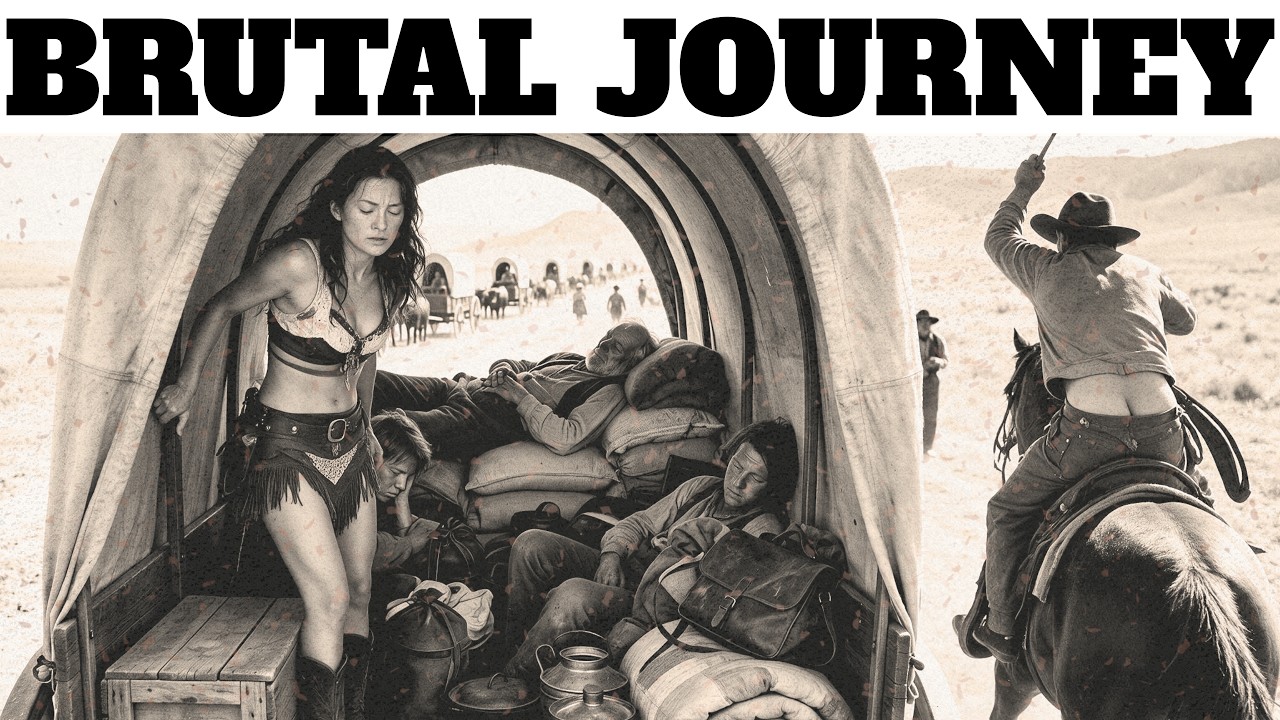
They called it one of the greatest adventures in American history
Families packed nearly everything they owned into wooden wagons and headed west across roughly two thousand miles of open country.
Hollywood turned that journey into sunlight, campfires, songs, horses, heroic fathers, brave mothers, and children waving from wagon seats.
The diaries tell another story.
Women walked until their shoes failed.
Children disappeared beneath wagon wheels.
Families buried loved ones beside the trail and left before sunrise.
Between 1840 and 1860, hundreds of thousands of migrants traveled routes later remembered as the Oregon, California, and Mormon Trails.
Their destinations differed.
Their suffering often did not.
These are twenty-five brutal truths about wagon-train life that the polished Western myth rarely showed.
25. Most People Walked Almost the Entire Way
The wagon was not primarily transportation for people.
It was a moving warehouse.
Every available inch carried food, tools, seed, blankets, cookware, ammunition, and supplies needed for survival.
That meant adults and children usually walked beside it.
Day after day.
Mile after mile.
A good day might cover fifteen miles.
A bad one barely moved at all.
Shoes wore through.
Feet cracked.
Some migrants eventually walked barefoot over stones, dust, and alkaline ground.
Hollywood put families comfortably riding west.
Reality often put them underneath a cloud of dust beside the wheels.
24. Privacy Disappeared Almost Immediately
There were no bathrooms.
No private rooms.
No doors.
Women still menstruated.
People still became sick.
Pregnancies continued.
Bodies still required ordinary functions.
The source describes women standing together and using their skirts as makeshift screens while another woman crouched nearby.
Embarrassment became a luxury.
The trail stripped privacy away quickly.
People lived, slept, washed, relieved themselves, became ill, and sometimes gave birth within sight of dozens of strangers.
Dignity survived only through cooperation.
23. The Food Became Miserably Repetitive
Bacon.
Beans.
Coffee.
Flour.
Biscuits cooked over open fire.
That could become the daily menu for months.
Families began with dried fruit, sugar, rice, and preserves.
Then wagon weight became a problem.
Anything unnecessary was discarded.
Fresh meat depended on hunting.
Fresh produce became increasingly rare.
Nutritional deficiencies followed.
Bleeding gums, exhaustion, and other symptoms of poor diet appeared as the journey stretched westward.
Adventure looked very different after the hundredth meal of rancid bacon.
22. The Dust Could Temporarily Blind Travelers
Wagons followed the same narrow corridors across dry plains.
Every wheel pulverized the ground further.
A train of dozens of wagons could create a moving wall of dust.
People inhaled it.
Food collected it.
Water collected it.
Open wounds collected it.
Eyes suffered badly.
The source describes travelers unable to see the wagon only a few feet ahead.
Some experienced severe eye inflammation and temporary loss of vision.
Imagine walking across unfamiliar country while barely able to see.
Now imagine doing it without clean water to rinse your eyes.
21. Families Threw Their Old Lives Into the Dirt
The road west became littered with abandoned belongings.
Furniture.
Clocks.
China.
Trunks.
Stoves.
Books.
Clothing.
Objects carried across hundreds of miles suddenly became threats when oxen weakened.
Wagon captains demanded lighter loads.
Families had a choice.
Discard possessions or fall behind.
Some burned what they abandoned rather than let strangers take it.
Others simply watched generations of household memory disappear beside the trail.
The West was not reached by carrying your whole life forward.
Often, it required throwing your old life away.
20. River Crossings Were Terrifying
Western films often make river crossings beautiful.
Sunlight glitters.
Horses splash.
Music rises.
The diaries describe fear.
Wagons were not boats.
Families sealed wagon beds with pitch and hoped they would float.
Livestock swam beside them.
Currents could overturn everything within seconds.
Children were swept away.
Oxen panicked.
Men holding lead ropes could be dragged underwater.
Some of the most dreaded moments on the entire trail happened at rivers, not during gunfights.
Water could be both the route forward and the thing that killed everyone inside the wagon.
19. Women and Children Collected Buffalo Dung for Fuel
Across treeless plains, there was often no firewood.
Cooking still had to happen.
Migrants burned dried buffalo dung.
They called it “chips.”
Women and children gathered it by hand into aprons and baskets.
At first, many found the work humiliating.
Then hunger made humiliation irrelevant.
Dry chips burned surprisingly well.
Damp ones smelled terrible.
The lesson came quickly.
Frontier survival did not care what respectable people considered disgusting.
If it boiled the coffee and cooked the beans, you picked it up.
18. Wagons Broke Constantly
The machines themselves were fragile.
Axles snapped.
Iron tires slipped from wheels.
Wooden tongues cracked.
Rocks damaged frames.
Mountain descents destroyed poorly maintained equipment.
There were no repair shops after major frontier outposts.
Travelers improvised with rawhide, green wood, spare iron, and luck.
A family whose wagon failed completely might divide its possessions among neighbors.
Then they walked.
Everything they could not carry was abandoned.
A broken axle could erase years of accumulated property in one afternoon.
17. Wagon Wheels Killed Children
Children walked beside heavy wagons for thousands of miles.
They climbed onto tongues.
They stumbled near wheels.
One mistake could be fatal.
Iron-rimmed wheels weighed hundreds of pounds and moved behind teams that could not stop instantly.
The source identifies wagon accidents as a major danger to children.
Many victims disappeared almost entirely from the historical record.
A shallow grave.
Perhaps a board with a name.
Then rain.
Wind.
Grass.
Within a season, the prairie could hide everything.
Hollywood made the wagon a symbol of family.
For some families, it became the machine that killed a child.
16. Women Gave Birth and Kept Moving
Pregnancy did not stop the wagon company.
Labor could happen inside a wagon or beside the trail.
There might be no doctor.
No proper bed.
No clean room.
No extended recovery.
The source describes Amelia Stewart Knight recording the birth of a child during her 1853 journey with striking calm.
She was moving again shortly afterward.
Other women reportedly walked the next day.
Infants faced enormous risks.
Mothers had little time to recover.
The trail demanded forward motion regardless of what the body had just endured.
15. Water Could Be Poison
A clear spring did not mean safe water.
Alkali and mineral-heavy sources could cause violent illness.
Migrants learned to examine waterholes for dead livestock.
Bones scattered nearby could serve as a warning.
But thirst overruled caution.
Adults drank.
Children drank.
Animals drank.
Some became violently ill within hours.
Dehydration could then accelerate the danger.
The irony was cruel.
After walking desperately toward water, people sometimes discovered that drinking it was more dangerous than continuing thirsty.
14. Graves Became Trail Markers
By the peak migration years, some routes were lined with burial mounds.
Families encountered death almost daily.
Bodies were wrapped in blankets.
Shallow graves were dug.
Rocks were piled on top to discourage scavengers.
Sometimes wagons were driven over the burial site to flatten and disguise it.
Wooden markers disappeared quickly.
Names vanished.
Later wagon trains could pass hundreds of graves without knowing who lay beneath them.
The road west was not merely a transportation corridor.
It became an enormous informal cemetery stretching across the continent.
13. Firearms Often Threatened Their Owners More Than Enemies
Many migrants carried weapons.
Not all knew how to use them safely.
Loaded rifles leaned against wagons.
Guns hung inside moving wagon beds.
People climbed, mounted horses, and crossed rough terrain with firearms ready to discharge.
Accidents happened constantly.
People shot themselves.
Children handled weapons.
Companions were killed during careless unloading.
The popular image suggests guns protected emigrants from danger.
In reality, an exhausted family carrying loaded weapons without training could become its own greatest threat.
12. A Wagon Train Could Vote You Out
Many wagon companies governed themselves through written agreements.
Leadership was elected.
Rules were established.
Disputes were decided collectively.
But that democracy could become brutal.
A troublesome member could be expelled.
Someone blamed for delays could be pushed out.
Someone involved in violence might be banished.
James Reed of the Donner Party was famously expelled after killing a teamster during an altercation.
Being abandoned hundreds of miles from settlement was not simply social rejection.
It could be a death sentence delivered by majority vote.
11. Stampedes Could Destroy a Camp in Seconds
Cattle and oxen could panic without warning.
Thunder.
A wolf.
A sudden movement.
A noise in darkness.
Then hundreds of animals ran blindly.
Wagons overturned.
People sleeping on the ground were trampled.
Livestock disappeared.
Supplies were destroyed.
There were no walls.
No barriers.
No time to prepare.
A family could fall asleep beside a peaceful herd and wake beneath thousands of pounds of terrified animals.
Some never woke at all.
10. “Shortcuts” Could Kill Entire Companies
Travelers were desperate to save time.
One week could determine whether mountain passes remained open.
Guidebooks therefore carried enormous power.
Lansford Hastings promoted a shortcut toward California.
The Donner-Reed Party followed it.
The route cost them precious time and animals.
They reached the Sierra Nevada late.
Snow trapped them.
Of the eighty-seven people who entered the mountains with the group, only forty-six survived according to the source.
The tragedy became legendary.
But its beginning was painfully ordinary.
Someone promised a faster road.
Exhausted travelers believed him.
9. A Few Days of Delay Could Mean Death in Snow
Mountain passes imposed a deadline.
Arrive early enough and you crossed.
Arrive too late and winter closed the world.
A broken axle could cost days.
A sick child could cost days.
A wrong route could cost weeks.
By October, the Sierra Nevada and other high passes could become lethal.
Snow buried roads.
Wagons were abandoned.
People walked through drifts.
The difference between survival and disaster could be a single week.
That made every earlier delay terrifying in retrospect.
8. Disease Could Quietly Erase People From the Company
Illness often arrived without drama.
Dysentery.
Measles.
Scurvy.
Fevers.
Contaminated water weakened people gradually.
At first they rode.
Then wagon space ran out.
Then they walked.
Then they could no longer walk.
The source describes diary entries where a person’s name appears repeatedly and then suddenly disappears.
No dramatic farewell.
No long explanation.
Just silence.
That absence says something terrible.
The journey continued.
The missing person did not.
7. The Forty-Mile Desert Was a Nightmare
Between water sources in Nevada lay an infamous stretch of desert.
Migrants attempted to cross it in one continuous push.
They started near evening.
They walked overnight.
Animals collapsed.
Wagons were abandoned.
People dumped supplies in the sand.
Dead oxen lined the route.
Broken wagons became navigation markers for those coming behind.
The smell of decomposing animals carried across still air.
Sarah Royce described a landscape littered with the dead and dying.
She was not speaking only about livestock.
6. Wagon Trains Damaged the Land They Crossed
The migration was also an ecological event.
Hundreds of thousands of animals grazed the same corridors.
Grass disappeared.
Creekside timber was cut for fuel and repairs.
Game animals were hunted or driven away.
Water sources became contaminated.
Later wagon trains encountered landscapes already stripped by earlier ones.
And Indigenous communities watched resources they depended on disappear.
The migration did not simply pass across empty land.
It transformed occupied ecosystems and placed enormous pressure on the people already living there.
That context matters for understanding the conflicts that followed.
5. Tens of Thousands Never Reached the Destination
The source estimates twenty to thirty thousand migrant deaths on the overland trails between 1840 and 1860.
That would represent a staggering share of those attempting the crossing.
The number does not include everyone who turned back.
It does not include animals.
It does not measure permanent injuries.
It does not measure grief.
It does not measure psychological trauma.
People arrived alive but changed.
Modern language might describe that scale as a humanitarian catastrophe.
Nineteenth-century promoters called it the cost of opportunity.
The following spring, another wave still left Missouri.
4. Cholera Could Kill Before Nightfall
Few dangers inspired as much fear as cholera.
The epidemic years beginning around 1849 devastated wagon companies.
Contaminated water allowed the disease to spread rapidly among families using the same streams and springs.
A healthy person could become violently ill within hours.
Death might follow the same day.
Entire families could be struck in succession.
Burials happened quickly because the train could not stop.
No enemy was visible.
No gunshot announced danger.
A shared cup of water could begin the final hours of someone’s life.
Cholera killed on a scale that frontier warfare never approached.
3. Children Paid an Enormous Price
Children were physically vulnerable to almost every trail danger.
Disease hit them harder.
Dehydration came faster.
Wagon wheels crushed them.
Rivers carried them away.
Some wandered into tall grass and vanished.
Others arrived in Oregon or California without parents.
Katherine Sager lost both parents during the journey.
She and her siblings became symbols of orphaned children on the trail.
They were not alone.
The West received children who had buried mothers, fathers, brothers, and sisters before reaching their destination.
There was rarely anyone waiting to explain what came next.
2. Indigenous Attacks Were Not the Great Killer Hollywood Made Them
Ask many people what threatened wagon trains most, and they imagine Indigenous warriors attacking circled wagons.
The mortality record looks very different.
Disease, accidents, drownings, exposure, and wagon injuries killed vastly more migrants.
The source cites historical mortality research showing deaths from conflict with Native peoples represented only a small fraction of total trail deaths.
It also states that migrants killed Native people in significant numbers during the same period.
That does not mean violence never occurred.
It means Hollywood distorted its scale.
A minority cause of death became the defining image of the entire migration.
Meanwhile, cholera and accidents almost disappeared from popular memory.
1. Native Peoples Often Helped Wagon Trains Survive
This is the truth the source presents as Hollywood’s deepest erasure.
Early interactions between migrants and Indigenous communities were frequently based on trade, guidance, ferries, food, horses, and rescue.
Shoshone and Bannock communities operated river crossings.
Pawnee guides helped lost companies.
Other groups traded animals and food.
Indigenous knowledge helped migrants navigate country they did not understand.
The source highlights Truckee, a Paiute leader who assisted the Stephens-Townsend-Murphy Party through the Sierra Nevada.
A river and town later carried his name.
Interactions changed as migration exploded.
Gold-rush traffic damaged grazing lands.
Game disappeared.
Water became fouled.
Diseases carried by migrants devastated Native communities.
Conflict increased.
But the earlier record complicates the cinematic myth.
Hollywood often showed Native people appearing from nowhere to attack innocent families.
It removed everything that came before.
Trade disappeared.
Guidance disappeared.
Environmental destruction disappeared.
Disease disappeared.
The causes of later conflict disappeared.
Only the attack remained.
Even the famous circled-wagon image became misleading.
Wagons were indeed arranged in circles.
But the source emphasizes that this was commonly done to contain livestock, not because travelers expected nightly attacks.
The defensive circle became one of cinema’s most enduring visual inventions.
A practical livestock arrangement was transformed into a battlefield.
That image was repeated so often that it became historical memory.
And once that happened, the real dangers faded.
Cholera became background.
Drowning became background.
Crushed children became background.
Women giving birth beside the trail disappeared.
Barefoot walking disappeared.
Poison water disappeared.
The shallow graves disappeared.
The Native ferryman disappeared.
The guide disappeared.
The woman trading food to starving migrants disappeared.
What remained was the rifle.
That choice changed how generations understood the West.
It made the journey look like a battle against people rather than a battle against distance, disease, weather, exhaustion, geography, mechanical failure, and scarcity.
The deadliest thing on the trail was rarely an arrow.
It was the mile.
Two thousand miles of walking.
Two thousand miles of dust.
Two thousand miles of rivers.
Two thousand miles of broken wheels.
Two thousand miles of uncertainty.
A family could begin with furniture, porcelain, extra clothes, books, tools, and dreams.
By the end, everything unnecessary had been discarded.
Sometimes the unnecessary thing was furniture.
Sometimes it was food.
Sometimes it was a wagon.
Sometimes it was a grave marker because the company could not wait.
The survivors were not necessarily the strongest fighters.
They were often simply the people who kept moving after exhaustion told them to stop.
That is where the Hollywood version fails most dramatically.
The real wagon-train story was less about heroic gunfights than ordinary endurance.
A mother walked barefoot beside a wagon.
She carried a child.
She cooked over buffalo dung.
She crossed rivers terrified of losing another child.
She watched belongings disappear beside the road.
She gave birth without a doctor.
She buried family members beneath shallow earth.
Then, because the wagon company was already moving, she stood up and followed.
That woman is closer to the true story of westward migration than almost any gunfighter ever placed on a movie poster.
The wagon train was not a rolling adventure.
It was a moving test of how much human beings could lose without stopping.
Hollywood remembered the circled wagons.
History should remember the people still walking outside them.


