On April 22, 1961, a military helicopter descended toward Camp David carrying one of the most experienced commanders ever to occupy the White House.
Dwight D. Eisenhower was seventy years old, a five-star general, former Supreme Allied Commander in Europe and former president of the United States.
Waiting for him was John F. Kennedy.
Kennedy was forty-three.
He had been president for barely three months.
And his administration had just suffered a catastrophic foreign-policy failure.
Only days earlier, a CIA-trained force of Cuban exiles had landed at the Bay of Pigs in an attempt to challenge Fidel Castro’s government.
The operation collapsed.
Men were killed.
Large numbers of exile fighters were captured.
The United States was humiliated internationally.
Kennedy now wanted advice from the man whose administration had originally authorized the covert program against Castro.
So he invited Eisenhower to Camp David.
The resulting conversation was private.
But Eisenhower wrote detailed notes afterward, preserving an extraordinary record of what one president told another when the cameras were gone.
The meeting was not simply about Cuba.
It became a lesson about presidential power, military planning and how the person sitting in the Oval Office should make decisions when advisers disagree.
Most importantly, Eisenhower asked Kennedy a question that went directly to the structure of his young presidency.
Had Kennedy actually forced his advisers to argue with one another in front of him before he approved the operation?
Or had he heard their recommendations separately?
The distinction may have changed Kennedy’s presidency.
To understand why, it is necessary to understand the relationship between the two men.
Eisenhower and Kennedy were not close.
They came from dramatically different generations and professional worlds.
Eisenhower had spent much of his adult life inside military institutions.
His experience taught him to value chains of command, formal procedures, structured staff work and arguments tested by competing experts.
Kennedy came from politics.
He was younger, intellectually confident and comfortable with informal conversations and personal networks.
Their political history also contained tension.
During the 1960 presidential campaign, Kennedy had attacked the Eisenhower administration over what he described as a dangerous “missile gap” with the Soviet Union.
Eisenhower considered that accusation wrong and deeply irritating.
Kennedy had also defeated Eisenhower’s vice president, Richard Nixon, in an exceptionally close election.
Their transition meetings remained professional.
Warmth was another matter.
Yet Cuba connected the outgoing and incoming administrations.
In March 1960, Eisenhower had authorized a CIA program intended to train Cuban exiles who could potentially be used against Castro.
The CIA, particularly under Director Allen Dulles and senior official Richard Bissell, developed the operation.
Kennedy inherited it.
But the operation Kennedy eventually approved was not simply an untouched Eisenhower plan.
The assumptions evolved.
The details changed.
The political circumstances changed.
And Kennedy made decisions of his own that affected how the invasion would unfold.
One of the most consequential involved air power.
The invasion force needed protection from Castro’s aircraft.
The operational concept had depended heavily upon neutralizing the Cuban air force before the exile brigade became exposed on the beaches.
An initial strike occurred.
But the operation was already losing its supposedly covert character.
Aircraft involved in the attack were presented in ways intended to obscure direct American responsibility.
That effort quickly became difficult to sustain.
Photographs appeared publicly.
Questions multiplied.
Kennedy and his advisers faced a dilemma.
Continuing the planned air attacks could make American involvement even more obvious.
Canceling or reducing them could leave the invasion force dangerously exposed.
Kennedy chose restraint.
The planned second strike was canceled.
The consequences became one of the central subjects Eisenhower wanted to discuss at Camp David.
Kennedy personally met the former president when his helicopter arrived.
The two went to the terrace at Aspen Cottage.
Kennedy began explaining what had happened.
Eisenhower noted afterward that Kennedy’s description corresponded with information Allen Dulles had already provided him.
That was intentional.
Kennedy had arranged for Dulles to brief Eisenhower beforehand, allowing the former president to arrive already familiar with the operational background.
Now the discussion could move directly toward the failure.
Kennedy described the planning, objectives and anticipated outcome.
Then he explained where everything had gone wrong.
The disaster was still fresh enough that Washington did not yet possess a perfect picture of events.
Some fighters were believed to remain at large.
Prisoner figures remained uncertain.
The scale of the defeat was still being established.
Eisenhower began asking questions.
He wanted to know about the air strikes.
Why had the exile brigade been sent into combat without the level of air protection the operation originally assumed?
Kennedy’s reasoning centered partly on plausible deniability.
He wanted to limit how visibly the United States appeared to be directing the invasion.
Secretary of State Dean Rusk and others had worried that further strikes would make American responsibility impossible to deny.
For Eisenhower, that logic contained a fundamental contradiction.
An operation involving this many trained fighters, aircraft, ships, CIA planning and American support was already extraordinarily difficult to conceal.
If Washington was going to undertake such an operation, Eisenhower’s reasoning suggested, success had to take precedence over preserving an increasingly implausible appearance of non-involvement.
Otherwise, the United States risked achieving the worst possible combination.
Everyone would know America was involved.
And America would still lose.
That was essentially what happened.
Castro survived.
The exile brigade was defeated.
American involvement became widely understood.
Washington suffered international embarrassment without achieving the operation’s objective.
But Eisenhower did not stop at air power.
He asked Kennedy something more fundamental.
Before approving the plan, had the president brought the major participants together and forced them to debate the operation directly in front of him?
Or had he dealt with them individually?
The question went beyond Cuba.
It concerned how presidents learn the truth.
Kennedy said he had held a meeting involving the relevant people.
But Eisenhower pressed the underlying distinction.
For a decision of enormous consequence, simply collecting opinions was not enough.
The president needed to hear advisers challenge one another.
The military needed to hear the diplomats’ objections.
The diplomats needed to confront the operational assumptions.
Intelligence officials needed their predictions questioned.
Optimists needed pessimists sitting across the table.
Arguments needed opposition.
Only then could the president see which assumptions survived pressure.
Eisenhower understood this from decades of command.
During World War II, he had coordinated enormous military coalitions filled with strong personalities and conflicting national interests.
As president, he had developed an elaborate national-security decision-making system.
Formal National Security Council meetings mattered to him.
Staff procedures mattered.
Written alternatives mattered.
Debate mattered.
Kennedy disliked much of that structure.
He considered Eisenhower’s system cumbersome.
Large meetings could be slow.
Formal bureaucracy could suppress flexibility.
Kennedy preferred smaller groups and individual conversations.
He liked gathering information personally and reaching judgments through a more informal process.
During his first months as president, he had reduced the central role of the formal National Security Council machinery Eisenhower had relied upon.
To Eisenhower, the Bay of Pigs demonstrated the danger.
When a president speaks separately with advisers, everyone can present the strongest version of his own argument.
But nobody is forced to defend that argument against another expert in real time.
The president receives conclusions.
He may not witness the intellectual combat that produced—or should have produced—them.
That was the deeper failure Eisenhower was identifying.
The Bay of Pigs was not only an operational disaster.
It was potentially a decision-making disaster.
And Eisenhower’s own notes show that he also investigated the military details rather than reducing everything to Kennedy’s cancellation of additional air strikes.
He asked about the terrain.
The Bay of Pigs landing zone presented difficult geography.
Swamps surrounded much of the area.
Access routes were limited.
That should theoretically have provided the exile force opportunities to block Castro’s troops from reaching the beachhead quickly.
Eisenhower wanted to know whether equipment had been distributed properly among smaller units capable of establishing roadblocks.
Kennedy believed the brigade had been trained and equipped appropriately.
The rapid penetration of the defensive area suggested serious problems somewhere in execution or planning.
Eisenhower also identified a major logistical weakness.
Too much specialized equipment had apparently been concentrated aboard a single ship.
When that vessel was damaged, essential supplies became unavailable to troops fighting ashore.
That failure could not simply be blamed on Kennedy.
It reflected operational weaknesses within CIA planning.
This point is crucial because later retellings of the Bay of Pigs sometimes search for one person whose single decision supposedly explains everything.
Eisenhower’s own analysis was more complicated.
The plan Kennedy inherited already contained serious weaknesses.
CIA planners had made questionable assumptions.
The operation depended partly upon expectations of broader resistance to Castro that failed to materialize.
Intelligence concerning Castro’s military capabilities and reaction was inadequate.
Logistics were flawed.
The landing site presented serious operational difficulties.
Kennedy then added his own consequential decisions, including restrictions involving air support.
Responsibility therefore crossed administrations and institutions.
Eisenhower did not write as though the original operation developed under his presidency had been perfect.
But he clearly believed Kennedy’s handling of the air strikes had worsened the situation.
His private judgment of the entire episode was severe.
He compared the embarrassment with the U-2 crisis that had damaged his own presidency.
In 1960, an American U-2 reconnaissance aircraft piloted by Francis Gary Powers had been shot down over the Soviet Union.
The incident wrecked a planned Paris summit and created an international humiliation for Eisenhower.
Yet after the Bay of Pigs, Eisenhower privately regarded the Cuban disaster as even worse.
The U-2 flights, whatever their political consequences, had produced valuable intelligence.
The Bay of Pigs had produced almost nothing useful.
Instead, he believed, it made the United States appear incompetent.
That was the private Eisenhower.
The public Eisenhower behaved very differently.
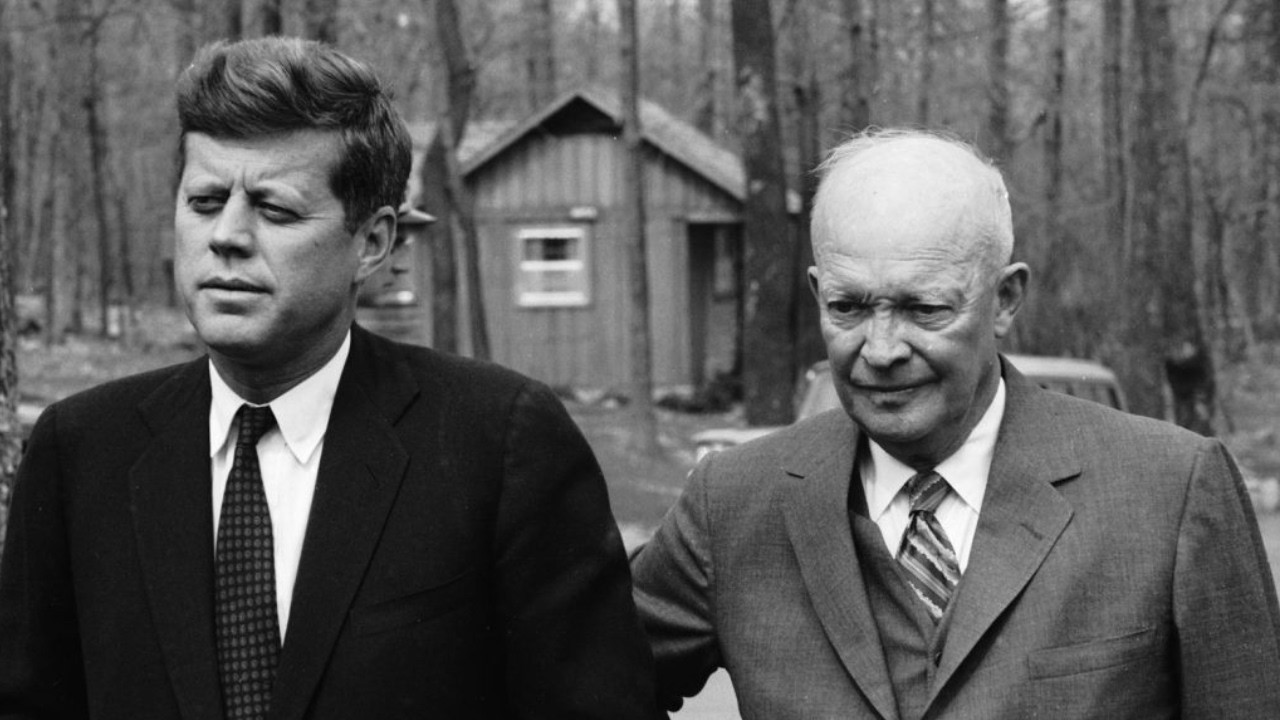
After their discussion, reporters encountered Kennedy and Eisenhower together at Camp David.
Kennedy explained briefly that he had discussed current problems with the former president and requested his counsel.
Reporters naturally wanted Eisenhower’s judgment.
Would he criticize Kennedy?
Would he distance himself from the disaster?
Would he remind Americans that Kennedy had inherited the anti-Castro operation from the previous administration?
He did none of those things.
Eisenhower essentially refused to conduct the argument publicly.
When asked whether he supported Kennedy, he invoked a traditional principle.
On matters involving foreign affairs, Americans should stand behind the constitutional president.
It was a remarkable act of political discipline.
Privately, Eisenhower had serious questions.
Publicly, he gave Kennedy cover.
That contrast makes the surviving notes particularly valuable.
Without them, Americans might remember only the photograph of two presidents walking together and the carefully restrained comments offered afterward.
The notes reveal what the cameras could not.
Eisenhower questioned the planning.
He questioned the logistics.
He questioned the air-support decision.
And most significantly, he questioned Kennedy’s method of reaching presidential decisions.
Yet the meeting did not end with a dramatic confrontation.
There was no theatrical lecture from the old general.
There was no documented moment in which Kennedy suddenly admitted that Eisenhower had been right about everything.
The source is more restrained than that.
The men continued talking through lunch.
They walked around Camp David.
They discussed different aspects of the situation.
Eisenhower later wrote, with characteristic understatement, that a conversation like theirs naturally produced no definite conclusion.
That understated ending may make the meeting more historically revealing.
Presidential learning rarely occurs through cinematic moments.
There is usually no instant when a leader announces that he has changed.
The evidence appears later in how he behaves during the next crisis.
A photograph from that day captured Kennedy and Eisenhower walking together, their heads lowered in conversation.
One contemporary caption characterized the younger president as learning.
Whether Kennedy regarded the encounter exactly that way cannot be established from the transcript alone.
But what happened afterward makes Eisenhower’s procedural criticism difficult to ignore.
Before leaving the subject, Eisenhower also offered Kennedy a broader Cold War lesson.
American power depended partly upon convincing adversaries that the United States was not afraid to act.
Negotiations worked differently when opponents believed American threats and commitments were credible.
For Eisenhower, the Bay of Pigs damaged that credibility.
The United States had supported an operation against Castro but stopped short of using the force necessary to guarantee its success.
From Eisenhower’s perspective, adversaries might interpret that outcome not as prudence but hesitation.
The next months gave that concern greater significance.
Kennedy met Soviet leader Nikita Khrushchev in Vienna in June 1961.
The encounter was difficult.
Kennedy later described the experience in bleak terms.
Tensions over Berlin intensified.
In August, construction of the Berlin Wall began.
Then, in October 1962, American intelligence discovered Soviet nuclear missiles in Cuba.
Kennedy suddenly faced a crisis incomparably more dangerous than the Bay of Pigs.
This time, his decision-making system looked different.
He created the Executive Committee of the National Security Council—ExComm.
Senior officials were brought together.
Options were debated.
Arguments were challenged.
Military recommendations were confronted by diplomatic concerns.
Advocates of air strikes faced advocates of a naval quarantine.
The consequences of escalation were examined repeatedly.
Kennedy sometimes deliberately left discussions so advisers would speak more freely without trying to anticipate what the president wanted to hear.
The contrast with the Bay of Pigs is striking.
At the Bay of Pigs, Kennedy had inherited a plan carrying institutional momentum.
Officials were reluctant to destroy a proposal their own agencies had spent months developing.
The young president did not always receive—or force—the kind of adversarial debate that could expose assumptions before they became disasters.
During the missile crisis, disagreement became part of the process.
The advisers were not merely supplying recommendations.
They were testing one another.
That was precisely the distinction Eisenhower had emphasized at Camp David.
The transcript notes that many historians connect Kennedy’s evolution as a decision-maker with lessons learned from the Bay of Pigs.
It would be too simple to claim Eisenhower alone created ExComm.
Kennedy learned from many people and from the failure itself.
But Eisenhower’s April 22 question captured the institutional lesson with unusual clarity.
Did you get everybody in front of you?
Did you hear the pros and cons together?
Did you make people defend their assumptions?
Or did you simply hear them one at a time?
For any president, those questions reach the heart of executive power.
The president receives extraordinary quantities of information.
But information is not the same as understanding.
Advisers have bureaucratic interests.
Agencies develop institutional commitments.
Military planners can become attached to operational solutions.
Diplomats may overvalue international reaction.
Intelligence agencies can mistake assumptions for probabilities.
Political advisers worry about elections.
Everyone enters the room carrying incentives the president must understand.
A good decision-making process cannot eliminate those biases.
It can expose them.
That was Eisenhower’s point.
Kennedy’s experience at the Bay of Pigs demonstrated what could happen when assumptions survived without sufficient challenge.
The CIA expected the exile force to perform effectively.
Planners anticipated circumstances that did not materialize.
Logistics proved vulnerable.
Air-support decisions became trapped between military necessity and political deniability.
And once the operation began collapsing, Kennedy faced an even more painful decision.
He could escalate direct American involvement and transform a supposedly covert operation into unmistakable U.S. military intervention.
Or he could refuse escalation and watch the exile brigade fail.
He chose the latter.
The political consequences were immediate.
Kennedy publicly accepted responsibility for the disaster.
Privately, his administration began examining how the operation had been approved.
The CIA’s leadership eventually changed.
Allen Dulles left the agency later that year.
Richard Bissell also departed.
The young administration became more skeptical of assurances from intelligence and military professionals.
That skepticism would become enormously important during the Cuban Missile Crisis.
When military leaders later recommended forceful action against Soviet missile sites, Kennedy did not simply accept their judgment.
He remembered Cuba.
He understood how quickly military operations could produce consequences their planners had not predicted.
The irony is considerable.
The Bay of Pigs was one of Kennedy’s greatest failures.
Yet the lessons extracted from that failure may have contributed to the decision-making process he used during his greatest nuclear crisis.
Eisenhower remained part of that story.
During the Cuban Missile Crisis, Kennedy’s administration again consulted him.
CIA Director John McCone briefed Eisenhower privately on October 17, 1962.
The former president was not surprised by the Soviet buildup in Cuba.
He had believed something like it could happen.
And his criticism of the earlier handling of Castro had not disappeared.
Sixteen months after Camp David, the two presidencies were again connected through Cuba.
But Kennedy was no longer the same decision-maker who had entered the White House in January 1961.
Experience had changed him.
Failure had changed him.
And perhaps the old general’s questions had helped.
There is another symbolic detail surrounding the April 22 meeting.
According to the transcript, it was Eisenhower’s fiftieth and final visit to Camp David.
The presidential retreat had been deeply associated with him.
He had renamed it after his grandson.
He had developed its facilities.
He had entertained foreign leaders there.
He had used it while managing Cold War problems throughout his presidency.
Now it belonged to Kennedy.
And Eisenhower’s final visit came because his successor had suffered a disaster connected to a covert operation originating during Eisenhower’s own administration.
That makes the image of the two presidents walking together particularly powerful.
Neither man could completely blame the other.
Eisenhower’s administration had authorized the anti-Castro project.
The CIA had developed a flawed operational plan.
Kennedy inherited it.
Kennedy modified it.
Kennedy approved it.
Then it failed.
The former president arrived not as an innocent outsider but as someone who understood the origins of the operation.
The current president received him not simply to assign blame but because he needed advice.
The private notes preserve the complexity.
Eisenhower could believe Kennedy had made serious mistakes without pretending the inherited plan was flawless.
He could criticize the young president privately while defending presidential authority publicly.
Kennedy could seek advice from a man whose administration he had criticized during the election.
Both men could understand that national-security failures were more important than their personal rivalry.
That may be one of the most overlooked lessons of the Camp David meeting.
Eisenhower had every political reason to embarrass Kennedy.
Kennedy had defeated Eisenhower’s vice president.
He had campaigned against Eisenhower’s defense record.
He had criticized supposed weakness in American missile strength.
Now, barely ninety days after taking office, Kennedy had suffered precisely the kind of foreign-policy humiliation Eisenhower could have used to vindicate himself.
Instead, Eisenhower kept the harshest criticism private.
He believed the presidency itself required protection.
The constitutional office mattered more than partisan satisfaction.
Kennedy, meanwhile, did something equally important.
He asked for help.
Presidents rarely enjoy inviting predecessors to examine their failures.
Doing so is especially uncomfortable when the predecessor represents the opposing political party.
But Kennedy understood the magnitude of the disaster.
He wanted Eisenhower’s judgment.
The result was not friendship.
It was something more useful.
A transfer of experience.
Eisenhower had commanded enormous forces during World War II and spent eight years confronting the Soviet Union as president.
Kennedy had occupied the presidency for three months.
The Bay of Pigs exposed the distance between intelligence and wisdom.
Kennedy possessed brilliant advisers.
He had access to secret information.
He had the CIA.
He had the Pentagon.
He had the State Department.
He had academics, diplomats, soldiers and political strategists.
And still the operation failed catastrophically.
Eisenhower’s question explained why access to talented people was insufficient.
A president also needed a system capable of making talented people challenge each other.
Without that, intelligence could become consensus.
Consensus could become confidence.
And confidence could conceal catastrophic assumptions.
Kennedy appears to have absorbed that lesson.
Eighteen months later, when nuclear missiles appeared in Cuba, he did not simply ask one institution for the answer.
He created a room where answers competed.
The resulting process was imperfect.
The Cuban Missile Crisis remained extraordinarily dangerous.
Miscommunication and accidents could still have produced nuclear war.
But Kennedy ultimately chose a naval quarantine while maintaining secret and public diplomatic channels rather than immediately launching the air attacks some advisers favored.
The crisis ended without direct superpower combat.
No single Camp David conversation can be credited with that outcome.
History rarely works so neatly.
But the contrast between Kennedy’s decision-making structures in April 1961 and October 1962 remains one of the most significant developments of his presidency.
And Eisenhower’s handwritten notes place him directly inside that evolution.
The notes also protect the episode from later mythology.
Eisenhower did not arrive at Camp David and deliver some perfect speech that instantly transformed Kennedy.
He asked questions.
He examined details.
He criticized assumptions.
They ate.
They walked.
They continued talking.
Then Eisenhower left.
The dramatic consequence came later.
That is often how genuine political mentorship works.
The most important advice may not sound profound when it is delivered.
Its significance becomes visible only when the recipient faces the next test.
For Kennedy, that next great test would again involve Cuba.
This time Soviet nuclear weapons were involved.
This time the consequences of failure could include nuclear war.
And this time Kennedy put his advisers into a room and made them argue.
That does not prove Eisenhower’s question alone changed history.
But it gives the April 22, 1961 meeting an extraordinary place within Kennedy’s development as president.
The Bay of Pigs taught Kennedy that experts could be wrong.
Eisenhower taught him something even more important.
A president’s job was not merely to listen to experts.
It was to build a process in which experts were forced to challenge one another before their assumptions became presidential decisions.
Publicly, Eisenhower protected Kennedy after the disaster.
Privately, he made him confront the weaknesses behind it.
And perhaps the most important thing the old general gave the young president that afternoon was not an answer at all.
It was a question.
Had everyone been in the room?
For Kennedy, the answer would matter much more the next time Cuba brought the world to the edge


