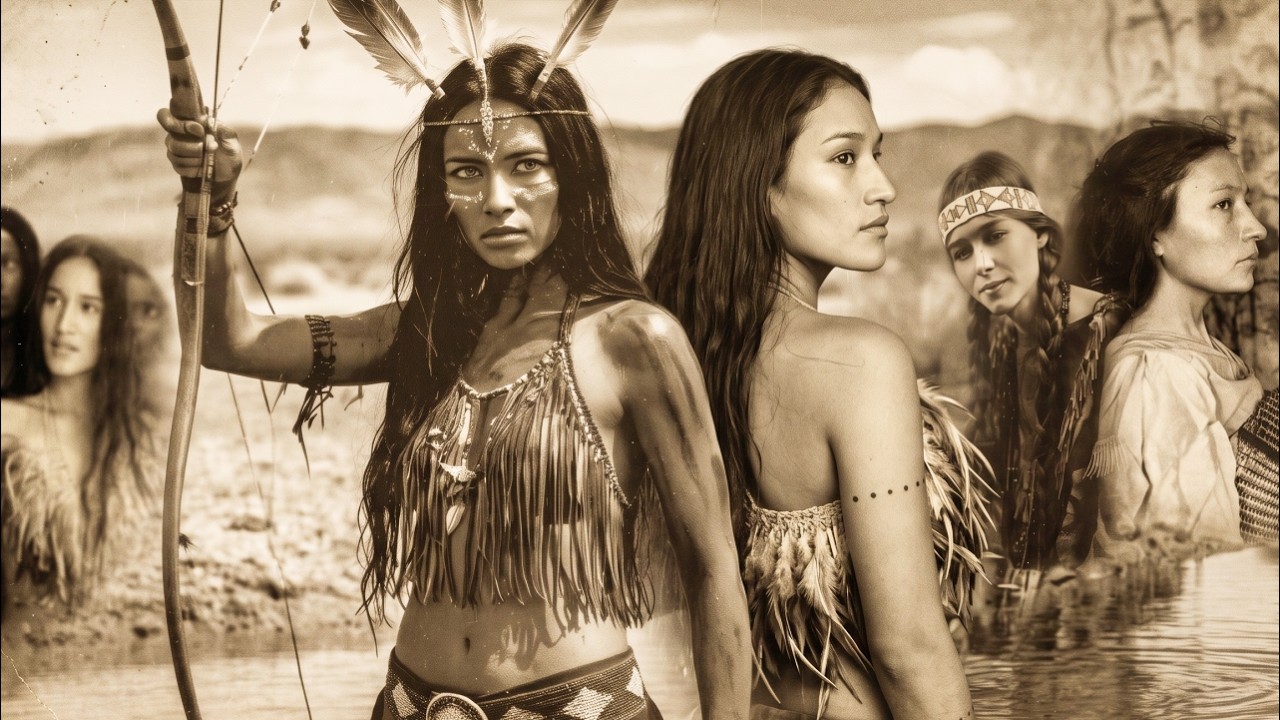
Hollywood gave the American West thousands of warriors.
Almost all of them were men.
Apache raiders.
Lakota horsemen.
Cheyenne fighters.
Crow scouts.
Blackfeet war leaders.
Women, when they appeared at all, usually stood beside the lodge.
Waiting.
Watching.
Praying for the men to return.
The historical record tells a very different story.
Native women carried ammunition.
Recovered wounded warriors under fire.
Stole horses.
Led raids.
Counted coup.
Killed enemy fighters.
Negotiated surrenders.
Protected camps.
Organized resistance.
And sometimes rode directly into battles that later became legendary—only to disappear almost completely from the movies made about them.
Some became warriors because an enemy killed a brother.
Some inherited political authority.
Some were healers who fought when necessary.
Others lived in cultures where a woman taking up weapons was unusual but not unimaginable.
And a handful became so respected that male warriors followed them.
Here are some of the most formidable Native American women whose real stories were far stranger than the Westerns Hollywood produced.
LOZEN — THE APACHE WOMAN VICTORIO CALLED HIS “RIGHT HAND”
If Hollywood had invented Lozen, critics might have called the character unrealistic.
She was Chihenne Chiricahua Apache.
A warrior.
A horse thief.
A strategist.
A healer and spiritual figure.
And the sister of the Apache leader Victorio.
Lozen fought during one of the most violent periods of the Apache wars, when American and Mexican forces were attempting to force Apache groups onto reservations and destroy their ability to move independently through their homeland.
Apache tradition remembered her as extraordinarily skilled at locating enemies.
Her name itself has been interpreted as referring to her ability as a horse thief—an important military skill in a world where horses meant mobility, reconnaissance and survival.
Victorio reportedly described her as his “right hand,” praising her courage and strategic intelligence.
That quotation comes through later Apache recollections, especially those recorded by Eve Ball from people who had known Victorio’s world.
Its importance is not that Lozen behaved exactly like a male warrior.
It is that Victorio regarded her as indispensable.
When American forces pressured the Warm Springs Apache, Lozen rode with the resistance.
She could fight.
Scout.
Move families through dangerous territory.
And she was trusted with missions where failure could mean death.
During one famous episode, Lozen left the main fighting force to escort a woman and newborn child across dangerous country to safety.
She then reportedly returned to the conflict.
After Victorio was killed in Mexico in 1880, Lozen continued resisting.
She eventually joined Geronimo’s group during the final campaigns of the Chiricahua resistance.
In 1886, she and another Apache woman, Dahteste, were involved in attempts to negotiate with American troops.
When Geronimo finally surrendered, Lozen did not receive freedom.
She became a prisoner of war.
The United States transported her east.
She died of tuberculosis at Mount Vernon Barracks in Alabama in 1889.
A woman who had survived Mexican troops, American cavalry and years of flight died imprisoned far from her homeland.
RUNNING EAGLE — THE BLACKFEET WOMAN WHO WAS GIVEN A WARRIOR’S NAME
She was born Brown Weasel Woman.
The National Park Service records that she belonged to the Piikáni, or Piegan Blackfeet, and showed little interest in the gender roles expected of many girls around her.
Her father taught her to hunt.
Then to fight.
She became skilled enough to participate in buffalo hunts.
During one attack by an enemy war party, she reportedly helped save her father.
After his death, she took greater responsibility for supporting the family—but she did not abandon warfare.
Eventually, she joined war expeditions and became known for her courage.
Her people gave her the name Pi’tamaka—Running Eagle.
That was not simply a colorful nickname created by white newspapers.
It reflected recognition of unusual achievement.
Accounts credit her with joining or leading raids and capturing enemy horses.
She became one of the best-known examples of a Plains woman whose military reputation was recognized within her own community.
Later storytelling has embroidered parts of her life, including the precise circumstances of her death.
But her status as a respected Piikáni warrior is well established.
The woman Hollywood almost never showed existed:
Not the warrior’s wife.
The warrior.
BUFFALO CALF ROAD WOMAN — THE WOMAN WHO CHANGED A BATTLE BY REFUSING TO LEAVE HER BROTHER
June 17, 1876.
General George Crook’s forces were fighting Lakota and Cheyenne warriors along Rosebud Creek.
During the battle, Cheyenne warrior Comes in Sight was wounded and stranded.
Retreat could have left him to die.
Then his sister rode onto the battlefield.
Buffalo Calf Road Woman.
She charged through the fighting, reached her brother and helped carry him away.
The rescue had such an impact that Cheyenne tradition remembers the engagement not primarily by the American name “Battle of the Rosebud.”
They remember it as the fight where the girl saved her brother.
Her action reportedly rallied Cheyenne fighters.
Crook withdrew after the battle and did not join George Armstrong Custer nine days later.
Then Buffalo Calf Road Woman fought again.
At the Little Bighorn.
Cheyenne oral tradition later credited her with striking Custer or knocking him from his horse during the battle.
That claim should be presented carefully.
There is no surviving American record capable of establishing who delivered such a blow to Custer.
But Northern Cheyenne storytellers preserved the account for generations.
The historically secure part is extraordinary enough.
She fought.
She rode into Rosebud combat.
She rescued a wounded warrior.
And she later participated in one of the most famous Indigenous victories over the U.S. Army.
MOVING ROBE WOMAN — SHE HEARD HER BROTHER WAS DEAD AND RODE INTO THE LITTLE BIGHORN
Moving Robe Woman was Hunkpapa Lakota.
She was in camp on June 25, 1876, when fighting began along the Little Bighorn.
Then she learned that her brother, One Hawk, had been killed.
Her response was not to hide.
She went for her horse.
Later testimony attributed to Moving Robe Woman describes a desire for revenge after hearing of her brother’s death.
She entered the fighting against Custer’s command.
This matters because the Battle of the Little Bighorn is usually reconstructed as an almost entirely male event.
Custer.
Sitting Bull.
Crazy Horse.
Gall.
Reno.
Benteen.
But the Indigenous village under attack was filled with families.
Women were not distant spectators.
They gathered horses.
Carried ammunition.
Protected children.
Helped wounded people.
And some, including Moving Robe Woman, fought.
The battlefield was also their home.
That distinction changes everything.
The U.S. Army saw a hostile encampment.
For the women inside it, armed soldiers were entering the place where their families slept.
WOMAN CHIEF — A CROW WARRIOR WHO ROSE INTO THE COUNCIL OF CHIEFS
Her Crow name is usually rendered Bíawacheeitchish.
In English, history remembers her as Woman Chief.
She had been born among the Gros Ventre and was taken into Crow society while young.
As she grew older, she pursued activities more commonly associated with male warriors.
She became an exceptional rider.
Hunter.
And fighter.
Her reputation eventually became so strong that she gained political authority and reportedly became one of the most highly ranked members of the Crow council.
Nineteenth-century white visitors were fascinated by her because she disrupted their assumptions about Native women.
Some accounts identify her with the famous “Pine Leaf” described by mountain man James Beckwourth.
That identification remains debated because Beckwourth’s memoir contains exaggerations and literary embellishment.
The safer historical conclusion is still remarkable:
A Crow woman became a recognized warrior and chief.
She did not merely accompany raids.
She accumulated the social authority associated with military success.
And when later white writers struggled to explain her, the problem was often their own expectations rather than hers.
GOUYEN — THE APACHE WOMAN WHOSE REVENGE STORY BECAME LEGEND
Gouyen belonged to the Warm Springs Apache world of Victorio and Nana.
Her first husband was reportedly killed during a Comanche raid.
Apache oral history remembers what followed as a revenge story.
Gouyen allegedly tracked the man responsible and killed him herself.
The details have acquired legendary elements over generations and should not be treated like a modern police report.
But Gouyen’s larger identity as a formidable Apache woman connected to the resistance is supported in the historical tradition.
She later survived the catastrophic 1880 attack at Tres Castillos in Mexico, where Victorio and many members of his band were killed.
Gouyen escaped with her young son.
She later traveled with groups connected to Nana and Geronimo.
Another story credits her with killing an attacker who was about to ambush her second husband.
By 1886, her freedom ended the same way Lozen’s did.
The U.S. Army captured the surviving Chiricahua Apache resistance and transported families east as prisoners of war.
Gouyen eventually died at Fort Sill in Oklahoma.
The frontier celebrated men for vengeance.
When an Apache woman did it, later history often reduced her to folklore.
DAHTESTE — THE WARRIOR WHO COULD FIGHT AND NEGOTIATE
Dahteste complicates almost every stereotype at once.
She was a Chokonen Chiricahua Apache woman.
She participated in raids.
She rode with Apache groups connected to Cochise’s people.
She became closely associated with Lozen.
And she also spoke English well enough to function as interpreter and negotiator.
That combination made her unusually valuable.
A rifle could solve one kind of problem.
Language could solve another.
In 1886, as the United States closed in on Geronimo and Naiche, Dahteste and Lozen participated in diplomatic contacts surrounding surrender negotiations.
American soldiers often recorded Native men by name while reducing women in reports to generic descriptions.
Apache oral history preserved what military documentation often overlooked:
The women were participants.
Dahteste survived the final surrender period and lived far longer than Lozen.
Her life demonstrates that “warrior” did not necessarily mean someone whose only contribution was killing.
Information could be a weapon.
Translation could be power.
Negotiation could decide whether an entire group lived, surrendered or continued running.
EHYOPHSTA — THE CHEYENNE WOMAN WHO FOUGHT AT BEECHER ISLAND
Ehyophsta—often translated as Yellow-Haired Woman—was a Cheyenne warrior associated with some of the hardest fighting of the late 1860s.
Historical traditions place her at the Battle of Beecher Island in 1868.
That battle pitted U.S. scouts against Cheyenne, Lakota and Arapaho fighters.
Ehyophsta reportedly fought armed alongside Cheyenne warriors.
Other accounts credit her with fighting Shoshone enemies and personally killing opponents in battle.
Her existence is important because it shows that Buffalo Calf Road Woman was not an isolated anomaly.
Cheyenne women could, under particular circumstances, participate directly in warfare.
Their participation was uncommon enough to be remembered.
But not impossible.
Hollywood usually interpreted Plains warfare through nineteenth-century white expectations about gender.
The Plains themselves did not always follow Hollywood’s rules.
PRETTY NOSE — THE ARAPAHO WOMAN ASSOCIATED WITH LITTLE BIGHORN
A photograph taken in 1879 shows a young Arapaho woman wrapped in a buffalo robe.
Her name was Pretty Nose.
Later tradition identified her as a participant in the Battle of the Little Bighorn.
She reportedly lived past one hundred years old and was remembered within her family as having attained warrior status.
Some details surrounding Pretty Nose’s precise role at Little Bighorn are harder to reconstruct than the stories of Moving Robe Woman.
That is a recurring problem.
American officers wrote reports about American soldiers.
Native oral accounts preserved different participants.
Female fighters could disappear between the two records.
Pretty Nose became famous partly because a photograph survived.
Thousands of other Native women left no comparable image.
Their absence from archives does not prove their absence from events.
It proves who controlled most of the written record.
MINNIE HOLLOW WOOD — A WAR BONNET WAS NOT GIVEN FOR DECORATION
Minnie Hollow Wood is remembered as a Lakota woman associated with the Battle of the Little Bighorn.
Later accounts state that she received the right to wear a war bonnet because of bravery in combat.
That distinction mattered enormously.
War bonnets were not random costumes.
Their feathers could represent honors accumulated through courageous deeds.
Minnie and her husband later surrendered to Colonel Nelson Miles.
Her story survived partly because ethnographers eventually recorded information about women whose military roles had been ignored in earlier written histories.
Hollywood would later put war bonnets on almost anyone because they looked dramatic.
The actual societies that created them treated such honors much more seriously.
THE OTHER MAGPIE — SHE RODE INTO THE ROSEBUD WITH A COUP STICK
Among the most vivid female combat stories preserved from the Plains is that of The Other Magpie.
She was Crow.
Her brother had reportedly been killed by Lakota enemies.
When Crow scouts joined General Crook at the Battle of the Rosebud in 1876, she went with them.
She was not carrying one of the powerful rifles used by many of the Crow scouts.
Accounts recorded by Crow medicine woman Pretty Shield describe her carrying a knife and coup stick.
During the fighting, wounded Crow warrior Bull Snake fell from his horse.
Another remarkable Crow figure, Osh-Tisch, defended him with a firearm.
The Other Magpie rode around the position, challenged approaching Lakota fighters and helped drive them back.
Later in the battle she counted coup on an enemy warrior and participated in taking his scalp.
The story survived because Pretty Shield insisted that the men had not told enough about what the women did.
That complaint could stand as a summary of this entire article.
COLESTAH — THE YAKAMA WOMAN WHO RODE INTO BATTLE WITH A WAR CLUB
Colestah was a Yakama medicine woman and wife of Chief Kamiakin.
In September 1858, Colonel George Wright’s forces confronted Indigenous resistance in what became the Battle of Four Lakes in Washington Territory.
Accounts describe Colestah riding into battle carrying a stone war club.
During the fighting, Kamiakin was badly injured after artillery fire brought down part of a tree or branch near him.
Colestah reportedly reached him and helped remove him from danger.
Then she treated his injuries using her medical knowledge.
This is another case where Western categories fail.
Was she a healer?
Yes.
Was she a warrior?
Yes.
Was she protecting her husband?
Yes.
Those roles were not mutually exclusive.
A person capable of healing the wounded could also carry a weapon.
HANGING CLOUD — AN OJIBWE WOMAN WHO RECEIVED WARRIOR RECOGNITION
Aazhaweyaagiizhigokwe, known in English as Hanging Cloud, became famous among the Lac Courte Oreilles Ojibwe.
Accounts from the nineteenth century describe her joining warfare that would normally have been dominated by men.
She participated in conflict against Dakota enemies and was remembered for killing and scalping opponents.
Later observers described her as possessing warrior privileges rarely granted to women.
Her life also reveals another brutal transformation.
A woman who had once held an exceptional military reputation lived long enough to watch the political and military independence of her people shrink under American expansion.
Later in life, she reportedly worked as a housekeeper.
The warrior did not disappear because she became less formidable.
The world in which her warrior status had meaning was being dismantled around her.
NANYEHI — THE CHEROKEE WOMAN WHO WENT FROM BATTLEFIELD TO DIPLOMACY
Nanyehi, later widely known as Nancy Ward, lived earlier than the classic cowboy era.
But any story about Native warrior women in North American frontier history is incomplete without her.
Around 1755, she accompanied her husband Kingfisher during a Cherokee campaign against Creek forces.
Cherokee tradition says that after Kingfisher was killed, Nanyehi took his weapon and continued fighting.
Her actions helped earn her the status of Ghigau—Beloved Woman.
That title gave her extraordinary authority.
She participated in political councils.
Led women’s councils.
Held influence over the fate of prisoners.
And eventually became better known for diplomacy than combat.
Later in life, she repeatedly warned Cherokee leaders against surrendering additional land.
In 1817, she joined other Cherokee women in urging the council not to sell more territory.
The most dangerous person in a political conflict is not always the one holding the rifle.
Sometimes it is the person telling leaders:
Stop giving the country away.
TOYPURINA — THE WOMAN SPANISH COLONIAL AUTHORITIES COULD NOT IGNORE
Toypurina belonged to the Tongva people of Southern California.
In 1785, she became one of the leading figures connected to a planned uprising against Mission San Gabriel.
Spanish mission expansion had transformed Tongva life through land seizure, forced religious conversion, labor demands and violence.
Toypurina was young—probably in her twenties—but already had significant spiritual and political influence.
She helped recruit surrounding villages for the resistance.
The rebellion was discovered before it could succeed.
Spanish authorities arrested Toypurina and other leaders.
During interrogation and trial proceedings, her resistance became part of the colonial record precisely because the Spanish considered her influential.
She was eventually removed from her homeland.
Toypurina did not need to kill dozens of soldiers to be dangerous.
She possessed something colonial governments feared just as much:
The ability to persuade other people to resist.
ONE WHO WALKS WITH THE STARS — ANOTHER WOMAN IN THE FIGHT AGAINST CUSTER
One Who Walks With the Stars is remembered in Lakota accounts of the Little Bighorn.
Later historical compilations drawing on Native testimony describe her killing U.S. soldiers who were attempting to escape or cross the river during the battle.
One version says she was gathering loose cavalry horses when she encountered soldiers trying to flee.
As with many battlefield stories preserved through oral testimony, details vary and should be treated cautiously.
But the broader pattern is increasingly difficult to ignore.
Moving Robe Woman was there.
Buffalo Calf Road Woman was there.
Pretty Nose was associated with the battle.
Minnie Hollow Wood was remembered for it.
Other women participated in defending the village.
The Little Bighorn was not a male-only world.
The idea that it was comes mostly from histories written by men describing other men.
The most important truth is not that every Native American society had armies of female warriors.
They did not.
Gender roles differed enormously among Native nations.
In many communities, warfare was overwhelmingly male.
In others, women could enter military roles under exceptional circumstances.
Some societies recognized categories of identity and social responsibility that did not match the rigid male-female expectations later imposed by American officials.
That is precisely why the real history is more interesting than the myth.
There was no single “Native American culture.”
Crow society was not Apache society.
Cherokee political structures were not Cheyenne political structures.
Tongva resistance to Spanish missions was not the same conflict as Lakota resistance to the U.S. Army.
And women’s roles differed accordingly.
What connected these women was something else.
When crisis arrived, none of them behaved the way later Western movies said Native women were supposed to behave.
Lozen did not wait for Victorio to return from battle.
She rode with him.
Buffalo Calf Road Woman did not watch her brother die from a distance.
She rode through gunfire to retrieve him.
Moving Robe Woman learned her brother had been killed and entered the fight herself.
Colestah carried both medicine and a weapon.
Dahteste could raid one year and negotiate another.
Nanyehi turned battlefield courage into political authority.
Toypurina threatened colonial control through organization.
The Other Magpie entered battle carrying a coup stick against armed enemies.
And Woman Chief rose high enough that men recognized her authority.
Perhaps the most revealing part of these stories is how difficult they are to reconstruct.
American military officers usually wrote down the names of male chiefs.
Newspapers wanted male warriors.
Early historians wanted great men.
Photographers often posed Native women as symbols of domestic or “traditional” life.
That created an enormous archival distortion.
A woman could fight in a battle and appear nowhere in the official Army report.
She could save a wounded warrior and survive only in oral history.
She could negotiate between Apache leaders and the United States while soldiers recorded her simply as another woman traveling with the band.
Decades later, historians would look at those same documents and conclude that women had not been important because the documents barely mentioned them.
That logic created its own disappearance.
The women were missing from history because the people writing history had not thought they mattered.
Some Native communities remembered differently.
Pretty Shield remembered The Other Magpie.
Apache oral traditions remembered Lozen and Gouyen.
Cheyenne storytellers remembered Buffalo Calf Road Woman.
Lakota testimony remembered Moving Robe Woman.
Those voices changed the story.
And they expose the greatest fiction Hollywood ever created about Native women.
It was not that every woman was secretly a warrior.
It was the opposite.
Hollywood made them almost entirely passive.
The real women lived in communities facing warfare, migration, hunger, imprisonment and dispossession.
They moved camps.
Protected children.
Carried food.
Healed wounds.
Recovered horses.
Negotiated.
Organized resistance.
And sometimes picked up weapons themselves.
The American West produced famous male fighters because generations of writers decided those were the names worth remembering.
But when the forgotten testimony is put back into the story, another frontier appears.
One where a cavalryman could charge toward a Native village expecting to meet male warriors—
and discover that the woman riding toward him was armed too.


