Christa Pike Survived Two Lethal Injection Doses as Curtains Closed and Witnesses Heard Her Breathing
Christa Pike was supposed to die inside Tennessee’s execution chamber on September 30, 2026.
Instead, witnesses watched the curtains close while she was still alive.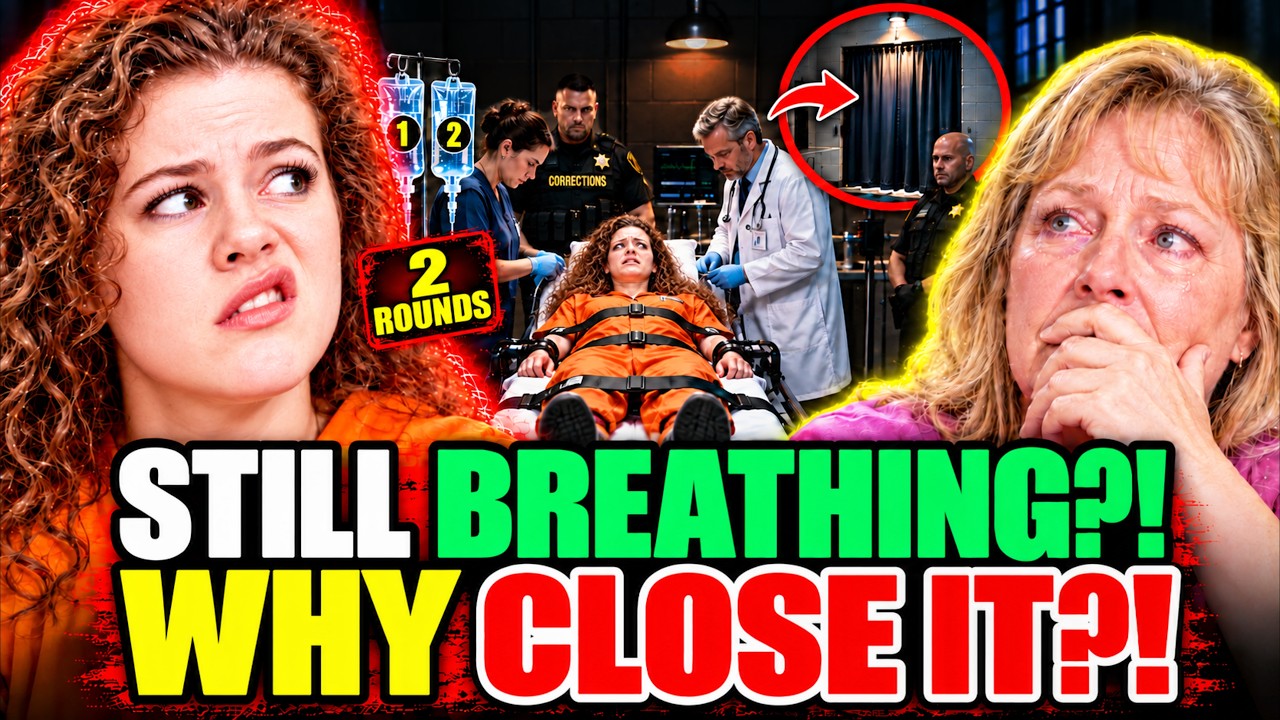
They heard her breathing after the first dose of pentobarbital failed to produce the expected result.
They heard her continue making sounds after Tennessee administered a second dose.
Then the witnesses lost visual access to what was happening inside the chamber.
Pike ultimately left Riverbend Maximum Security Institution alive in an ambulance.
Those details are extraordinary enough.
But a new viral account adds an even darker layer.
It claims prison officials violently blacked out the viewing glass because Pike’s chest continued heaving.
It alleges execution personnel panicked behind the curtain as monitoring equipment refused to show death.
It claims an illicit recording captured staff screaming that Pike’s heart was somehow “fighting off” the lethal compound.
And it promises a secret execution logbook revealing what officials supposedly did after the witnesses could no longer see inside.
The public evidence does not support those additional claims.
What it does support is one of the most unusual failed executions documented in the modern American death-penalty era.
Pike, 50, had spent decades on Tennessee’s death row for the 1995 murder of 19-year-old Colleen Slemmer.
After years of appeals and last-minute litigation, Tennessee attempted to carry out her death sentence using pentobarbital under the state’s single-drug lethal-injection protocol.
The procedure did not work as intended.
Pike received two administrations of the drug and survived.
According to media witnesses, the trouble began before the lethal drug was administered.
Execution personnel reportedly struggled to obtain reliable intravenous access.
Pike’s attorneys have said there were multiple needle attempts and that her medical history made IV access particularly difficult.
They later alleged that the lines were improperly positioned or that the veins failed, allowing the caustic drug to infiltrate surrounding tissue rather than circulate normally through her bloodstream.
That theory has become central to understanding why Pike remained alive.
Reuters reported that Pike’s attorneys described both arms as swollen, burned and blistered afterward.
They argued that pentobarbital had seeped into tissue rather than entering her circulation properly.
The state has not yet issued a final independent technical finding establishing exactly how the procedure failed.
Inside the chamber, witnesses began noticing signs that something was wrong.
Pike complained about her arm.
At one point, according to witness Tori Gessner, Pike said her arm felt as though it was about to “burst open.”
That statement has been independently reported and is one of the clearest indications of distress during the procedure.
Witnesses also described large breaths, gasping, exhaling and later snoring.
Those observations matter because pentobarbital was supposed to rapidly suppress consciousness and respiratory function at the massive dose used for execution.
Instead, Pike continued breathing.
The first administration did not kill her.
The backup administration did not kill her either.
The curtains then became one of the most controversial elements of the night.
Media witnesses said significant portions of the procedure occurred after their view had been obstructed.
AP noted that Tennessee, like several other death-penalty states, limits what witnesses can observe during IV placement and may close curtains when complications occur.
That lack of visibility became especially consequential during Pike’s failed execution because witnesses were unable to see what officials were doing while she remained alive.
This is where the verified story and the viral story begin to separate.
The curtains were closed.
That is documented.
Pike was still alive.
That is documented.
Witnesses continued hearing her breathing and making sounds.
That is documented.
But there is no authenticated evidence that the blinds were “violently slammed shut in hysteria.”
There is no public video showing officials panicking.
There is no reliable witness account describing executioners screaming behind the curtain.
And there is no authenticated audio recording from the concealed portion of the chamber.
The curtain itself created an information vacuum.
Social media has filled that vacuum with increasingly dramatic claims.
One version says monitors refused to “zero out.”
Another says Pike’s heartbeat remained defiantly strong as staff stared at the equipment.
Another claims executioners were heard swearing and demanding to know why the drug was not working.
Those stories may sound plausible in the context of a failed execution.
But plausibility is not authentication.
No monitor data have been publicly released.
No continuous electrocardiogram record has surfaced.
No heart-rate log has been published.
No execution-team member has provided an authenticated recording describing the monitors.
And no official incident report currently available contains the dramatic language attributed to staff.
The phrase that Pike’s heart was “fighting off the compound” is particularly misleading.
That is not how pentobarbital failure would normally be described medically.
Pike’s attorneys are not claiming her heart somehow resisted a lethal drug through unusual biological strength.
Their theory is that the drug did not enter her circulation correctly.
If a significant portion infiltrated surrounding tissue instead of reaching the bloodstream, the expected concentration in the central circulation may never have been achieved.
That is fundamentally different from the heart “fighting off” poison.
Pentobarbital is a powerful barbiturate.
At the dosage used in executions, the state expects rapid unconsciousness, respiratory arrest and eventually cardiac arrest.
But those effects depend on the drug reaching circulation.
If IV access fails, the drug can damage tissue locally while failing to produce the intended systemic effect.
That possibility is now being investigated in Pike’s case.
The severe arm injuries described by her attorneys make that question especially important.
The second drug administration is equally important.
Tennessee’s execution planning included dual IV lines and a backup dose of pentobarbital.
AP reported that both were used during Pike’s execution attempt.
Even those contingencies failed to produce death.
That is one reason the case has generated national attention.
Backup procedures are supposed to reduce the possibility that a single technical failure stops an execution.
Here, Tennessee used its backup drug sequence and Pike still remained alive.
Witnesses continued hearing her.
One of the most unsettling descriptions involved snoring.
Media witnesses said Pike began snoring loudly and continued doing so for an extended period.
Some described gasping or unusual exhalations.
The Guardian reported that journalists could hear Pike breathing and making noises after the drug administrations.
Those sounds are significant.
But they should not be exaggerated into claims unsupported by the witnesses.
There is no verified account of violent convulsions occurring behind the curtain.
There is no reliable evidence that Pike was thrashing uncontrollably against her restraints.
There is no authenticated audio of her screaming while officials cursed.
The witnesses described breathing, snoring, gasping and visible distress.
That is what the evidence supports.
Eventually, Tennessee ended the execution attempt.
Pike was taken away from Riverbend and transported to an outside medical facility.
AP reported the following day that she remained alive and in critical condition while receiving lifesaving treatment.
Reuters later reported that her attorneys said she was unconscious and on a ventilator.
They described her condition as critical and said both arms had suffered serious injuries associated with the alleged IV failure.
Those developments radically changed what had begun as an execution into an ongoing medical and constitutional crisis.
Governor Bill Lee responded by stopping Tennessee’s remaining executions for 2026 and ordering an independent investigation.
Lee described what happened as deeply disturbing.
The review is expected to examine the execution protocol, IV procedures, personnel decisions and the circumstances surrounding Pike’s survival.
That investigation is critical because the public still does not know precisely what happened during the periods when the curtain was closed.
Did both IV lines fail?
Did one fail before the other?
How much pentobarbital reached Pike’s bloodstream?
How much entered surrounding tissue?
What did the medical team see on the monitors?
When did officials first realize the execution was not proceeding normally?
What criteria were used to administer the backup dose?
What happened immediately after the second dose failed?
Those are legitimate unanswered questions.
But unanswered questions should not be converted into invented answers.
The alleged “wiretap” is a prime example.
No original recording has surfaced.
No source has authenticated it.
No network has published it.
No attorney filing identifies it.
No voice analysis has confirmed the speakers.
No timestamp has been independently established.
No explanation has been given for how someone secretly recorded execution-team conversations from behind the curtain.
Without provenance, the supposed recording cannot be treated as evidence.
The same problem applies to the promised “sealed execution logbook.”
There are real execution records.
There are protocols.
There are court filings.
Pike’s attorneys have also sought preservation of evidence related to what happened.
Those materials could eventually reveal important details about the execution.
But that is not the same as a leaked secret logbook proving officials committed acts they are now trying to conceal.
No authenticated document matching the viral description has been publicly established.
Pike’s lawyers have indeed accused the state of constitutional violations.
They argue that what happened amounted to cruel treatment and that the state should never subject her to another execution attempt.
They have also sought to preserve evidence before it can be lost or altered.
Those are serious legal claims.
They should not be confused with proof of a cover-up.
At this stage, there is evidence of a catastrophic procedural failure.
There is evidence of serious physical injury.
There is evidence that witnesses lost visual access during critical portions of the procedure.
There is evidence the state’s backup execution measures also failed.
There is not yet public proof that officials deliberately concealed criminal conduct.
The distinction matters because the failed execution is now likely to generate years of litigation.
Pike’s attorneys could challenge any future attempt under the Eighth Amendment.
They could argue that forcing her through another execution creates an unacceptable risk of severe pain.
They could seek discovery involving execution records, staff communications and medical documentation.
They could also bring civil claims depending on what the investigation eventually finds.
The state, meanwhile, will have to explain why its protocol failed despite using backup procedures.
That debate has already expanded beyond Pike’s individual case.
Tennessee lawmakers are now discussing whether the state needs additional execution methods after the failed lethal injection.
AP reported on October 6 that Republican legislative leaders are considering broader execution options, while Tennessee law already permits electrocution under certain circumstances.
Governor Lee’s review will likely influence what lawmakers pursue when they return to legislative work.
That means the closed curtains have become symbolic of a larger problem.
Capital punishment depends heavily on state control.
Officials design the protocol.
They choose the drug.
They train the execution team.
They decide what witnesses can see.
They control the chamber.
They control the records.
When the process fails behind a curtain, public trust becomes difficult to maintain.
That is why media witnesses matter.
Without them, much less would be known about Pike’s breathing, her arm complaint and the length of time she remained alive.
AP has emphasized that press access to executions serves an important public-accountability function precisely because states often limit visibility during critical portions of the procedure.
The witnesses did not see everything.
But what they did see and hear contradicts the idea of a routine execution.
Pike complained of severe discomfort.
She remained alive.
She continued breathing.
A backup dose was used.
The curtains obstructed portions of the process.
And ultimately the state could not complete the execution.
Those are extraordinary facts.
The viral story does not need to invent executioners screaming to make them disturbing.
The official outcome is already unprecedented.
AP described Pike as the first known person to remain alive after receiving lethal-injection drugs in this manner.
She was then hospitalized rather than pronounced dead inside the chamber.
Her survival has also reopened longstanding questions about whether lethal injection is as predictable or clinical as governments present it.
States adopted lethal injection partly because it appeared more controlled and medicalized than older methods such as electrocution.
Yet IV access has repeatedly caused problems in executions around the country.
Pike’s case is an extreme example of that vulnerability.
If the drug never reliably enters the bloodstream, the entire protocol can fail.
That appears to be one of the central possibilities under investigation now.
The most accurate breakdown therefore looks like this.
Pike received two administrations of pentobarbital.
Verified.
Both failed to kill her.
Verified.
Witnesses saw her continue breathing.
Verified.
Witnesses heard snoring, gasping and other respiratory sounds.
Verified.
Pike complained that her arm felt as though it might burst.
Verified through witness reporting.
The curtains were closed during important portions of the procedure.
Verified.
Witnesses therefore could not see everything officials did afterward.
Verified.
Pike was eventually transported to a hospital alive.
Verified.
Her lawyers say she remained critically ill and required ventilator support.
Verified as their statement.
They allege pentobarbital infiltrated surrounding tissue because of failed IV access.
Verified as their allegation.
Governor Bill Lee halted the state’s remaining executions for 2026 and ordered an independent investigation.
Verified.
Executioners were recorded screaming behind the curtain.
Not authenticated.
Monitoring screens “refused to zero out.”
No public evidence establishes that description.
Pike’s heart was medically shown to be “fighting off” pentobarbital.
Not established and medically misleading.
Officials confessed on audio to secret actions after the curtain closed.
Not authenticated.
A forbidden wiretap recording captures execution-team panic.
No credible evidence currently verifies such a recording.
A sealed logbook documents a hidden cover-up.
No authenticated public document currently establishes that claim.
State servers are preparing to purge the evidence.
No credible evidence.
What happened behind the curtain remains one of the most important unanswered questions in the case.
But the responsible way to describe that uncertainty is to say exactly what is known.
The public knows Pike remained alive.
The public knows the lethal injection failed twice.
The public knows witnesses heard her breathe after losing visual access.
The public knows she left Riverbend alive in an ambulance.
And the public knows Tennessee has now halted additional executions while an independent review tries to determine what went wrong.
Those facts are already extraordinary.
The secret recording, screaming executioners, defiant heart monitor and hidden logbook remain unsupported.
For now, the most disturbing part of the Christa Pike execution is not something captured on a forbidden wiretap.
It is what witnesses could still hear after the curtain closed:
Christa Pike was breathing.


