In November 2013, a horsedrawn carriage carried the new American ambassador through Tokyo. Thousands lined the route. Cameras followed her to the emperor. Her husband of 27 years was not beside her. He did not move to Japan. The public knew this marriage as the Kennedy exception, the one that lasted. Edwin Schlober has barely spoken about her in nearly 40 years.
She controls the library, the archive, the award, the estate, the photographs. He designed their wedding rings. She inherited a country’s memory. He married it and received no share. To understand that bargain, go back to London 1975. 9 years later, she did it again. In July 2022, Caroline Kennedy arrived in Canberra as ambassador to Australia, presented her credentials, moved into a residence with staff and a flag, and ran a posting that would include the AUS submarine agreement.
Her husband stayed in New York. Again, there were photographs, and again, he was not in them. Now, there is a perfectly boring explanation available for all of this, and I want to put it on the table early so you don’t think I’m building toward a scandal that doesn’t exist. Edwin Schwasberg runs a design firm in Manhattan.
He was in his late60s, then in his late ‘7s. Ambassadorial spouses are not required to relocate. Plenty of modern couples live apart for work. Fine. Except that explanation doesn’t account for the 40 years of silence around it. Try this. Name a quote from Edwin Schlober about his wife. Name a magazine profile. Name a joint interview.
Name a time he spoke about the Kennedys, the assassination, the library, the family, the money, the fame, any of it. There’s almost nothing. For a man married since 1986 into the most relentlessly photographed family in American public life, that is not an accident of temperament. It is a sustained operational achievement, and it required both of them.
So the question I want to follow isn’t whether this marriage was happy. By every visible measure, it functioned, produced three children, and outlasted practically every other union of its Kennedy generation, which given the divorce record on that side of the family, is not nothing. The question is what the marriage had to become in order to do that because one of these two people inherited a national inheritance that could not be shared, delegated, sold, or escaped, and the other one married her anyway. Start with what
happened to her when she was 17 because it explains the kind of man she eventually chose. In October 1975, Caroline Kennedy was in London staying with the family of Hugh Frasier, a conservative member of Parliament and a friend of her mother’s. She was about to begin an art course at Sibies. On the morning of October 23rd, a bomb was attached to the underside of Frraasier’s car outside his Holland Park house.
Frraasier was running late. A neighbor, Gordon Hamilton Fairley, a cancer specialist, was walking his dog past the car. He was killed. The IRA was blamed, and the device was widely understood to have been meant for Frraasier. Caroline was inside the house. She was 12 years out from Dallas, 5 years out from the loss of her stepfather’s world in Greece, and a bomb had gone off on the street where she was sleeping, killing a man who had nothing to do with any of it.
Her mother’s response tells you how this family metabolized danger. Jacqueline Onasses pulled her out of London. There was no public statement of any substance, no interview, no sitdown. Caroline went on with the year. Within months, she had traveled to Australia, a trip she referred to decades later when she arrived in Canberra as ambassador and mentioned having first visited in 1976 as a teenager, which is about as much as she has ever volunteered about that period.
Here is what I want you to carry forward. Caroline Kennedy did not learn privacy as a preference. She learned it as a safety procedure. Her mother had spent the 60s and 70s building an entire personal technology around it. No commentary, no access, no explanation, no cooperation with the press and litigation when necessary. Jackie famously went to court against a photographer who would not stop following her children.
That wasn’t vanity. That was perimeter maintenance. Caroline absorbed the system so completely that she later wrote the book on it. Literally. In 1995, she published The Right to Privacy, co-authored with the constitutional scholar Ellen Alderman, four [snorts] years after their first book together, In our Defense on the Bill of Rights.
Think about that for a second. The most photographed child in American history grew up, went to Columbia Law, and produced a popular legal volume about the right to be left alone. So, when we get to a husband nobody can quote, we should at least consider that this was not a man being hidden. It may have been a man agreeing to stand inside a perimeter she had been taught to build since childhood.
By 1980, she had graduated from Radcliffe and taken a job in the film and television office at the Metropolitan Museum of Art in New York. It was a real job with real tedium, the kind of position where you log footage and chase permissions. And it mattered for one reason. It put her in a professional environment where competence was the currency and her surname was an inconvenience rather than an asset. That’s where she met him.
In 1981, Edwin Schlloberg was working on exhibition design connected to the museum. He was 36. She was 23. He had a doctorate from Colombia in science and literature. And his dissertation has become the single most repeated fact about him because it is genuinely strange and genuinely revealing. An imagined dialogue between Albert Einstein and Samuel Beckett.
A conversation that never happened. constructed to see what two incompatible ways of describing reality would do to each other. He had worked with Buckminister Fuller. He wrote poetry. He designed objects and environments and eventually built a firm ESI design whose business was designing how the public moves through and experiences a space, museums, science centers, exhibits, visitor experiences.
He is professionally a man who builds the machinery through which large numbers of strangers encounter a story. Hold that. It becomes almost unbearably relevant later. The other thing about Edwin Schllober, and it is the thing that made the match possible, is that he did not need her money. His father, Alfred Schlawberg, had built a successful textile business.
The family lived on Park Avenue. They were Orthodox Jewish, prominent in Jewish philanthropic circles, and comfortable in a way that meant their son could spend years writing dialogues between dead physicists and Irish playwrights without anyone asking when he planned to get serious. Now, put the two profiles side by side, and the attraction stops being mysterious.
Every man Caroline Kennedy had grown up around came preloaded with a relationship to her father. Cousins who were running for office or planning to. family friends who were operatives, fundraisers, former aids, young men who the moment they walked into Hyannesport were being measured for a role in a project that had started before they were born.
The Kennedy family absorbed spouses. It had absorbed her mother. Ask the women who married into that generation how it went for them. Schlothberg had no relationship to the project at all. He was Jewish, 13 years older, from New York money rather than Boston politics, and employed in a field that had nothing to do with campaigns. He was, in the most precise sense, non-convertible.
There was no version of him that could be turned into a candidate. And from his side, he got a woman who had spent her entire life being handled and who had no interest in handling him. Whatever else can be said about this marriage, there is no evidence, none, that Caroline Kennedy ever tried to make her husband into a public figure.
This was not an obvious courtship to the people around them. They dated for roughly 5 years, which in that world and that era was a long engagement to an engagement. Contemporary reporting treated him as an unknown quantity, and the press struggled to categorize him. He was variously described as a designer, an artist, an author, a multimedia specialist.
The vagueness itself was a sign that nobody quite knew what to do with a Kennedy consort who wasn’t selling anything. The family’s reaction has been reported mainly through later recollection, which means it should be handled carefully. The persistent account repeated in multiple biographies of Jaclyn Onasses is that Jackie had initial reservations.
the age gap, the interfaith question, and a general maternal weariness. These accounts rest largely on secondhand sources and people recalling conversations years afterward, and they should be read as credible impression rather than documented fact. What is better supported is the outcome. Jackie came around.
She was present and visibly central at the wedding. In the years that followed, she and Schlloberg appear to have been on genuinely good terms. And Caroline’s first child would be named Rose after Rose Kennedy, a choice that tells you which family’s naming conventions were operating. Ted Kennedy, who functioned as the surviving patriarch and had walked into the role of father substitute after 1963, reportedly approved.
Why wouldn’t he? Caroline was by the mid80s the single most protected asset in the family’s reputational portfolio. The Kennedys of that decade did not need another ambitious in-law. They needed a daughter of John F. Kennedy to have an unembarrassing life. The engagement was announced in March 1986. And there is one detail from the planning that I think is the whole marriage in miniature.
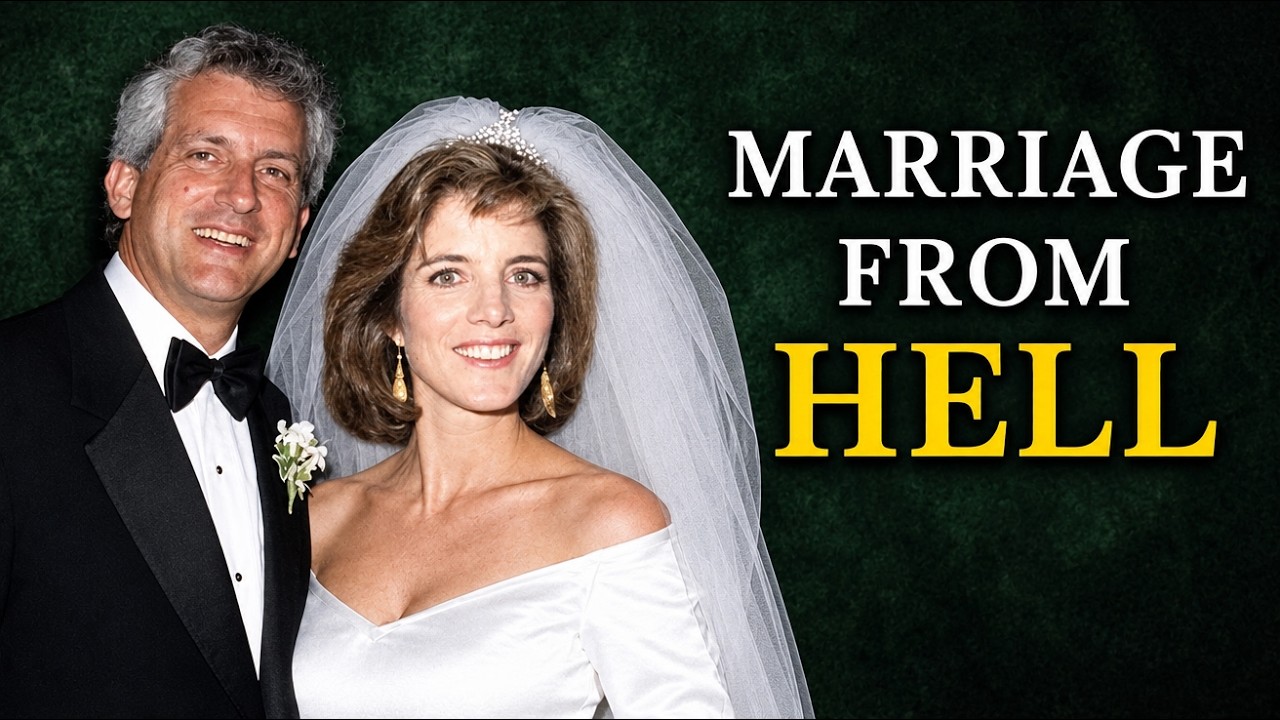
They set the wedding for July 19th, 1986. That was Edwin Schlothberg’s 41st birthday. It is the only date in the entire public chronology of this couple that belongs to him. Everything else on that July day would belong to her or to her father or to the family or to the crowd. The church would be Catholic. The setting would be Hyannisport.
The best man would be John F. Kennedy Jr. The toast would invoke a dead president. The crowd outside would be there for a surname that was not Schllothberg. He designed the rings. Keep that gold with a wave motion worked into the band. a design he made himself, which contemporary accounts described as modeled on something like a moving line or a tide.
He also had a hand in the printed material for the day. In a wedding covered by every wire service in the Western world, the groom’s creative contribution was the jewelry and the stationery. That is not a joke at his expense. It is a precise measurement of the terms. The ceremony took place at Our Lady of Victory in Centerville, Massachusetts, a modest church a few miles from the Kennedy compound.
Roughly 425 guests were inside. Outside, estimates ran into the thousands. People who had driven in from across New England and stood in the July heat behind barricades to watch a woman they had last seen as a six-year-old at a funeral walk into a church as a bride. Helicopters worked the airspace. Reporters were penned.
The cape had not seen crowds like it since the 60s. She wore a Carolina Herrera gown with shamrock appliques embroidered into the fabric. Shamrocks at a wedding to a Jewish man from Park Avenue. The dress was a statement of lineage and the lineage being stated was Irish Catholic Boston. The marriage was performed by a Catholic priest.
There was no rabbi at the altar. Accounts differ slightly on the degree of Jewish element included in the day, and I’d treat the more decorative claims cautiously, but the structural fact is not in dispute. A Jewish man married into that family in that church under that right, and the public iconography of the event was Kennedy from the first frame to the last. John F. Kennedy Jr. was best man.
He was 25, improbably good-looking, and already the subject of a national assumption that he would eventually run for something. The photographs from that day in which he appears are the ones that got reprinted for decades. Ted Kennedy gave the toast and he did what Ted Kennedy always did on family occasions, which was to summon the dead.
He spoke about his brother. He spoke about what Jack would have felt. It was warm. It was sincere. And it was also the family doing what the family did, using every public moment to renew the central claim. Here is the part I find genuinely interesting. There is no record of Edwin Schlober’s family receiving anything like equivalent attention.
His father had built a textile fortune. His mother was a presence in New York Jewish philanthropy. They were not nobodyies. They were simply that day invisible, absorbed into the background of someone else’s institution. The reception was at the compound Hyannisport, 6 acres of Kennedy property, three houses, lawn, water, and more than 60 years of accumulated family mythology.
The dancing went late. The photographs that survive show a visibly happy couple. And I want to be clear about this because the rest of the story depends on it. There is no credible evidence that this was a cold or arranged match. They dated 5 years. They chose each other. Multiple people who were there described a genuinely joyful day.
What I’m tracking isn’t whether they loved each other. It’s what the day established about who held what. So, let’s inventory it because by the end of that summer, the terms were visible to anyone paying attention. The church was hers. The compound was the family’s. The crowd belonged to her father. The press interest was entirely hers.
The surname she kept, she remained Caroline Kennedy professionally and publicly for the rest of her life. And all three children would be given Schllothberg as a surname while being raised in a world organized around the other one. The Toast was about a man who died in 1963. He got the rings and his own birthday.
They moved into Manhattan into an apartment on Park Avenue. And this is where the system around the marriage starts to come into focus. Because a marriage like this one doesn’t just involve two people. It involves property staff, trustees, lawyers, a foundation, a presidential library, a mother 2 miles away at 1045th Avenue, a brother in the same city, and a family office in Boston that managed money. neither of them had earned.
Caroline came into the marriage with a trust. The Kennedy children’s money had been structured by Joseph P. Kennedy decades earlier and later consolidated through Jackie’s own very substantial estate from the Onasis settlement. Her financial independence was absolute and it predated her husband entirely. Schlosberg had his own money and his own firm and by every account he kept working and kept it separate.
There is no indication he ever drew on hers. But here’s the thing about houses. Follow the property and you find the hierarchy. The apartment at 1045th Avenue was Jackie’s Redgate Farm on Martha’s Vineyard. 370ome acres on Aquina with a private beach and a view across to the water. Assembled by Jackie in the late ‘7s and built out as the one place on earth where she could not be photographed was Jackie’s.
The Hyannisport compound was the family’s. The place in New Jersey horse country was Jackie’s. Caroline and her husband bought their own apartment in Manhattan. And over time, she would accumulate her own holdings. But the emotional and symbolic real estate of her life, every place that meant something, every property with a story attached came down through her mother’s side of the ledger and her father’s name.
Schlloberg married into a geography that was already fully mapped. And then the children arrived, and the perimeter went up in earnest. Rose Kennedy Schlober was born in June 1988. Tatiana in May 1990. John Bouvier Kennedy Schllober in January 1993. Look at those names. Rose for her great-g grandandmother. Tatiana, which was Jackie’s choice of a name she loved, and a son carrying his grandmother’s maiden name and his uncle’s and grandfather’s first name, which is a remarkable amount of freight to hang on an infant. What Caroline did
next was the most deliberate act of her adult life, and it has been almost entirely overlooked because it consisted of things not happening. The children did not appear in magazines. There were no sitdowns, no family at home spreads, no cooperative photo sessions. When paparazzi got shots, there was no complaint and no cooperation, just continued non-engagement.
The kids went to New York private schools and were not available for comment. For roughly 20 years, the three grandchildren of John F. Kennedy grew up in Manhattan in near total media silence in the same city during the same years that their uncle John was on the cover of every magazine in America.
That contrast is the one worth sitting with. The two surviving children of President Kennedy made opposite choices about publicity and they made them at the same time in the same city within walking distance of each other. John Jr. went toward the lens. He posed. He appeared on talk shows. He launched George magazine in 1995 and put himself on the mast head of a glossy political monthly, which is a thing you can only do if you have decided affirmatively to be a famous person who works in the famous business.
His relationships were covered as national events. Caroline went the other way and she brought her husband with her. I think this is where the invisibility of Edwin Schlloberg stops being a quirk and starts being a method. He was not hidden from the public by a controlling family. He was positioned inside a privacy regime that his wife had inherited, refined, and was now operating at full strength on behalf of five people. He was one of the five.
The difference is that the other four had Kennedy blood. He had signed up. And in the same stretch of years that she was building the perimeter, she was also building something else. And this is the shift that nobody noticed at the time. In 1985, the year before the wedding, she entered Colombia Law School.
She took her JD in 1988, which means she was in law school, engaged, then married, then pregnant, and graduated the same year her first daughter was born. She never practiced in the conventional sense. She took the New York bar and did not build a litigation career. So, what was the degree for? Watch what she did with it. In 1989, the John F.
Kennedy Library Foundation created the profile encourage award named for the book published under her father’s name in 1956 and Caroline became the public face of it. She presented it, she spoke at it, she chaired the committee that selected recipients. Year after year, decade after decade, the person who stood on the stage in Boston and defined what political courage meant in her father’s name was his daughter.
That is not a ceremonial role. That is editorial control over a dead president’s meaning exercised annually in public with a trophy. She became president of the Kennedy Library Foundation. She sat on the board. She raised money. She was functionally the chief executive of her father’s memory. And she had equipped herself with a law degree and two books on constitutional rights to do it credibly.
Here’s the reclassification I want to make because it changes how everything after this reads. By the early 1990s, the marriage was no longer just a marriage between two private New Yorkers who had met at a museum. One of them had taken a job, not a career in the ordinary sense, a custodianship. The work had no salary, no term limit, no possibility of promotion, and no exit.
It involved an archive in Boston, a foundation, a family, a national myth, and the permanent expectation that she would be available to represent a man who died when she was six. And her husband’s role in that work was nothing. Not diminished, not secondary, nothing. He had no seat on it, no claim to it, no standing to speak about it.
He could not be asked what Jack Kennedy meant because he never met him and had no authority to say. In the one enterprise that increasingly organized his wife’s public life, he was structurally excluded, not by cruelty, but by the simple fact that the inheritance ran through blood and he didn’t have any.
I want to be fair to what was good here. By every available account, the 1990s were the strong years. The couple appeared together regularly at library foundation events and benefits. Friends described a genuinely warm household. He was by multiple accounts an involved father, and his interest in how people experience design space was the sort of thing that makes a man good at building things with children.
There is nothing in the record of that decade that suggests strain. The marriage worked. That is the honest finding. What was happening underneath was not unhappiness. It was asymmetry accumulating quietly with no one in the household doing anything wrong. Then in the winter of 1994, Jacqueline Onasses was diagnosed with non-hodkin lymphoma and the entire structure began moving toward the one person who had been quietly trained her whole life to hold it.
She died at the apartment on Fifth Avenue on May 19th, 1994 at 64 with her family around her. Caroline was there. John was there. Maurice Templesman, the man Jackie had lived with for years and never married, was there. 2 days later, there was a funeral at St. Ignatius Loyola on Park Avenue, the church where Jackie had been baptized and confirmed.
Caroline read a poem. John spoke and said the family had tried to choose readings that reflected three things their mother loved. words, home and family, and the ocean. Then they flew to Arlington and buried her beside the president between the graves of two infants under the eternal flame that had been lit at Caroline’s father’s funeral when she was six.
I’m going to move past the grief quickly because what matters for this story is what the death transferred. Jacqueline Onassus’ will was filed for probate in Manhattan surrogates court on May 23rd, 1994, and it is a public document. It is also one of the most revealing pieces of paper in this entire story, and almost nobody reads it as a document about a marriage.
The estate was valued at well over $und00 million. Caroline and John were the primary beneficiaries. Significant provisions were made for Templesman’s children and for a charitable lead trust that would eventually pass to the grandchildren. Redgate Farm on Martha’s Vineyard went to Caroline and John jointly.
The apartment at 1045th went to them. her papers, her furniture, her books, her jewelry, her letters, her photographs, all of it moved down one generation. Now, the part that matters here. Jackie’s will contains specific provisions concerning materials relating to President Kennedy with the clear intent that items of historical significance connected to her first husband should be directed toward the Kennedy Library.
She was managing from beyond the grave the boundary between family property and national property. She had spent 30 years doing that work and she used her last legal instrument to keep doing it. She also gave her children explicit discretion over the rest of it. And that discretion is what produced the strangest decision of Caroline Kennedy’s adult life.
In April 1996, Sibies on York Avenue held a 4-day sale titled The Estate of Jacqueline Kennedy Onasses. The catalog ran to nearly 600 pages and sold more than 100,000 copies on its own. More than 30,000 people came through the exhibition. The sale brought in roughly $34.5 million against a pre-sale estimate in the 4 to5 million range.
The numbers from that room still sound made up. A set of her fake pearls, costume jewelry, maybe $700 worth, sold for $211,000. President Kennedy’s golf clubs went to Arnold Schwarzenegger for72,000. A humidor given to the president by Milton Burl sold for $574,000. A foottool went for $33,000. People lost their minds over this.
The criticism was real and it came from serious places as well as tabloid ones. That the children had put their mother’s life on a block. That the woman who had spent three decades refusing to sell any piece of herself had been postumously inventoried and auctioned by her own kids.
that the sale cheapened exactly the thing Jackie had protected. There were defenses and they’re reasonable. The estate faced a substantial tax liability. Scattering the objects into private hands was arguably better than warehousing them. The sale also funded family charitable commitments. But look at what the decision actually reveals because this is where I think the character of the custodian becomes visible for the first time.
Caroline and John separated the estate into two categories. Things with historical weight. The papers, the documents, the material that constituted the record of a presidency and a first ladyhip were protected and directed toward the archive. Things that were merely personal, the foottool, the pearls, the chairs, the dresses she wore to dinner were sold.
That is an archavist’s logic, not a daughter’s. It requires looking at your mother’s possessions and sorting them by historical significance. Cold and completely consistent with everything that came before. And here is the detail I want to plant for later. In the extensive coverage of the auction, the planning, the controversy, the defense, the aftermath, there is no public role for Edwin Schllober. None.
The largest single disposition of property in his wife’s family’s history conducted in the city where he lived and worked involving the estate of his mother-in-law. And he is not in the story. He was not excluded. He was simply not a party to it. The inheritance was hers and her brothers. The decision was hers and her brothers.
The criticism landed on her and her brother. Her and her brother. That phrase is about to stop working. On the night of July 16th, 1999, John F. Kennedy Jr. flew a single engine Piper Saratoga from Essex County Airport in New Jersey toward Martha’s Vineyard. He was taking his wife Carolyn Betett and her sister Lauren to the vineyard.
The plan was to drop the sisters and continue to Hyannisport for the wedding of their cousin Rory Kennedy, which was scheduled for that weekend at the compound. The plane went into the Atlantic off Aquina off the water near Redgate Farm. The wedding at the compound was called off. Caroline spent days at the house her mother had built on the vineyard, waiting through the search while the Coast Guard worked the water in front of it.
The remains were recovered the following week and the ashes scattered at sea from a Navy destroyer. Caroline was aboard. She was 41 years old. Now count what she was holding when she came back to shore. She was the only surviving child of John and Jacqueline Kennedy. The last person alive who had lived in that White House as their child.
The only remaining direct heir to the entire estate. The entire name, the entire archive, and the entire national expectation. She and Jon had split it. co-owners of the vineyard property, co-executives, co-inheritors of a national myth, and co-targets of everyone who wanted a piece of it. Whatever the custodianship cost, it had been divided by two.
Now, the denominator was one. This is the moment the marriage reorganizes. And I want to be careful about how I say it because the record here is thin on interiors, and I’m not going to invent any. What I can tell you is what changed in behavior. She did not withdraw. That is the surprising part.
A reasonable person in that position with that family history and that much money might have disappeared permanently behind the perimeter she’d already built. Instead, over the following years, Caroline Kennedy steadily and visibly took on more public institutional weight, not less. She became the public anchor of the Kennedy Library Foundation in a way she had not been while Jon was alive.
She continued presenting the Profile Encourage Award. In 2002, she took an unpaid position as chief executive for strategic partnerships for the New York City public school system under Chancellor Joel Klein and Mayor Michael Bloomberg and raised substantial private money for city schools, reportedly in the range of 65 million to $70 million in her first stretch there.
She edited anthologies, a collection of her mother’s favorite poems, a volume of patriotic writings, books of poetry for children published in 2001, 2003, and 2005. Notice what all of that work has in common. Every single piece of it runs through the family’s moral inheritance. The award, the library, the poetry her mother loved, the school fundraising conducted as the president’s daughter.
She wasn’t building a career adjacent to the name. She was building a professional practice out of the name. and the man she married specifically because he had no relationship to that name had now been married for more than a decade to a woman whose entire working life was that name. This is the second reclassification.
The escape marriage had become an institutional partnership in which only one partner had standing in the institution. I want to pause on the good years here because they were real and because the rest of the story is unfair to them if I skip past the 2000s in New York look from the outside and from what friends have described like a genuinely functional family life.
Three teenagers in the city, school runs, graduations, summers on the vineyard. Schlloberg’s firm was doing significant work. ESI design built major visitor experiences including the extensive interactive installations for the Ellis Island Immigration Museum, work at the Reagan Library, children’s museums, science centers.
He was a successful man running a successful shop in his own field in his own city with his own staff. They appeared together. There are photographs of the two of them at library foundation dinners, at benefits, at family funerals, at the Kennedy Center. He shows up in the frame, usually slightly behind her, usually not speaking. And here’s the thing about those photographs that you only notice once you’ve looked at a few hundred of them.
He is always physically present and verbally absent. He attends. He does not comment. In nearly four decades of event coverage, the quantity of direct quotation from Edwin Schlloberg about his wife, his marriage, his in-laws, or his famous father-in-law is effectively nil. I’ve gone looking. The closest thing to a public statement about the relationship comes from her side, and it’s characteristically oblique.
Caroline has occasionally said warm, brief things about her husband in interviews and then moved on. She did not elaborate. He did not respond. Two people married 40 years with no joint interview is not shyness. It’s policy. Which brings us to the one moment when the policy nearly broke. And when for about six weeks the American press decided that the silence meant something sinister.
In late January 2008, Caroline Kennedy published an op-ed in the New York Times under the headline, “A president like my father,” endorsing Barack Obama for the Democratic nomination. It was a genuinely consequential intervention. She had spent her whole life refusing to spend the inheritance in public. And now she spent it deliberately in one shot on a first-term senator running against a Clinton.
She wrote that she had never had a president who inspired her the way people told her her father had inspired them and that for the first time she believed she had found the man who could be that president for a new generation. Ted Kennedy followed days later with his own endorsement at American University with Caroline standing on the stage beside him. Look at that stage.
the last daughter and the last brother together, handing the family’s moral authority to someone outside the family. She had just demonstrated that she could move the thing she had been guarding. And once you prove an inheritance can be spent, people start asking what else you might spend it on.
She campaigned for Obama through 2008, more than she had ever campaigned for anyone, including her own relatives. She turned up in Ohio, in Pennsylvania, in California. She was named to the three-person committee alongside Eric Holder and Jim Johnson that vetted candidates for vice president. That is an extraordinary thing to hand to a woman who had never held office.
It meant she was inside the room where the ticket was decided with access to the full private files of every politician being considered. Then Obama won and Hillary Clinton was named Secretary of State and her Senate seat in New York came open. In December 2008, Caroline Kennedy let it be known that she wanted it.
Under New York law, the appointment belonged to the governor, David Patterson. And for roughly 5 weeks, the state’s political class watched the strangest audition in modern New York politics. She went upstate. She did listening tours in Syracuse and Rochester and Buffalo. She met with county chairs. She sat for interviews with the Times, the Daily News, and the Associated Press.
The interviews went badly. In one widely circulated transcript, she used the filler phrase, you know, dozens of times in a single conversation. The tape became a national joke within about 48 hours. She was asked how she had decided to seek the seat and gave an answer that meandered. She was asked about her limited voting record in local elections and had no good answer because there wasn’t one.
I want to be precise about what went wrong because the easy read that she was unprepared or unintelligent is wrong and provably so. This is a Harvard graduate with a Colombia law degree who co-wrote two serious books on constitutional law and had run a nine-figure fundraising operation for the New York City schools.
She was not out of her depth on substance. What she was out of her depth on was being handled. For 51 years, she had operated a perimeter whose entire function was to refuse this exact kind of access. Now she was supposed to open it voluntarily on demand to reporters whose job was to extract the very material her mother had trained her to withhold.
The thing she was worst at was the thing the job required most. And into that vacuum came the tabloids. The New York Post and the Daily News ran a steady drip of unsourced claims through January 2009. Tax problems, a household employee issue, and repeatedly the suggestion that there was trouble in the marriage. that Edwin Schlloberg was unhappy about the Senate bid, that the couple were estranged, that there was something embarrassing waiting to come out.
Here’s where I’m going to slow down, because this is the moment the disturbing version of this story was manufactured. And it’s worth watching how none of those marriage claims were ever sourced. Not one. They were attributed to unnamed people, repeated across outlets, denied by her spokesman, and never substantiated in the 17 years since.
No document, no named witness, no court filing, no later memoir. In a media environment that has spent 60 years dismantling the private lives of this family with considerable success, nothing has ever emerged. What the press was actually reacting to was the absence. Schlober did not campaign for the seat. He did not appear in upstate photo ops.
He gave no supportive interview. And a political reporter looking at a candidate whose husband won’t show up draws one conclusion automatically because in that world a spouse’s visible enthusiasm is a required deliverable. The reporters weren’t wrong that the silence meant something. They were wrong about what? On January 21st, 2009, the day after the inauguration, Ted Kennedy had a seizure at the congressional lunchon in Statuary Hall and was carried out.
He had been diagnosed with a malignant brain tumor 8 months earlier. Caroline was at the capital that day. Within 48 hours, she withdrew. The initial statement cited personal reasons. Her spokesman then clarified that the decision was related to her uncle’s health, and Patterson’s office, in a leak that embarrassed everyone involved, suggested other factors.
Patterson appointed Kirstston Gillibrand instead. The sequence is documented and tight. And I’m going to resist the temptation to tell you the seizure caused the withdrawal because the honest position is that we don’t know the weight of each factor. What we know is that a woman who had spent a month absorbing the worst press of her life, whose uncle and last protector had collapsed in public pulled out of a process that was going badly, and that she has never given a full account of why.
She did say something later that I think is the single most useful line she’s ever given about herself. In interviews in subsequent years, she acknowledged that the experience had been difficult and that she had learned a great deal from it, framing it in retrospect as instructive rather than humiliating. The part people miss. She didn’t stop.
She was back campaigning for Obama in 2012. She spoke at the Democratic convention in Charlotte. She stayed inside politics as a supporter rather than a candidate, which it turns out is the role the inheritance was actually built for. And in 2013, the administration she had helped elect twice gave her something better than a Senate seat.
On November 12th, 2013, Caroline Kennedy presented her credentials to Emperor Akihito as United States Ambassador to Japan. She rode from the station to the Imperial Palace in a horsedrawn carriage with a mounted escort. It is the ceremonial arrival Japan reserves for new ambassadors and it is reliably photographed. In her case, crowds filled the route.
Japanese television carried it live. Newspapers printed her picture on the front page. The reaction in Japan was not polite diplomatic interest. It was something closer to a state event. She arrived carrying the one thing no career diplomat could bring. The surname of a president Japan associated with a particular moment of American idealism.
and the Japanese public responded to it on a scale that startled the embassy. Her husband did not move to Tokyo. He visited. He appeared at embassy functions on occasion. He kept running ESI Design in New York where the firm had staff, contracts, and ongoing work. Their children were grown or finishing school in the United States.
By any reasonable modern standard, this was a sensible arrangement between two adults with separate careers. It was also, in the plainst terms, the first time in 27 years of marriage that Caroline Kennedy had a house that was hers. Think about the property ledger, the apartment her mother owned, the compound her grandfather built, the vineyard land her mother assembled, the New York apartment she shared.
Every significant space in her life had come with someone else’s claim attached. A parents, a family’s, a husband’s, a ghost’s. The ambassador’s residence in Tokyo came with a staff of her own, a flag, a car, a security detail, a mission, and 150 or so American personnel who reported to her. Nobody in that building had ever met her father. Micro verdict.
And I think it’s earned. The arrangement that looked from the outside like a marriage running on fumes was the arrangement that finally gave her an institution she didn’t inherit. And she worked. This is the part that gets skipped because people assume a celebrity ambassadorship is a 4-year photo opportunity. She inherited the hardest unresolved item in the US Japan relationship, the relocation of Marine Corps Air Station Futenma on Okinawa, a dispute that had been grinding on since the ’90s against sustained local opposition. In December
2013, weeks after she arrived, the Okinawa governor approved the landfill permit for the Hanok replacement site. A decision with a long history behind it, but one that landed in her first month. She took a public position against Japan’s dolphin hunting practices at Taii in January 2014, posting her concern on social media, which caused a diplomatic flap in which the embassy did not walk back.
She spent 2 years working the ground for something larger. In May 2016, Barack Obama became the first sitting American president to visit Hiroshima. Caroline Kennedy was there, had been central to the preparation, and had pushed for it. The daughter of the president who signed the partial testban treaty stood at the peace memorial while an American president laid a wreath for the dead of an atomic bombing.
Whatever else that was, it was not ceremonial. Through all four years, the public record of her husband’s presence in Japan remains thin. There are a handful of appearances. There is no indication of conflict, no reporting of a rupture, no filing, no separation. The couple’s children visited. Schlloberg, now in his 70s, kept working.
And the American press, having tried the estrangement theory in 2009 and found nothing, largely stopped trying. She left the post in January 2017 at the end of the administration. She was 59. She returned to New York, to the apartment, to the library foundation, to the award. For 5 years, it looked like that was the end of the public phase.
Then in 2020, she and her children listed Redgate Farm, the Aquina property her mother had assembled parcel by parcel in the late ‘7s, built a shingled house on, and used as the one place she could be invisible. Roughly 340 acres with private beach frontage. The asking price was $65 million. It sold the following year, reported in the range of 27 million, with a substantial portion of the land placed under conservation protection.
That was the last physical piece of Jacqueline Onasses’s private world. The house she died owning, the land where her son’s plane went down a mile offshore, the beach where she walked to escape photographers, sold, subdivided between conservation and private ownership, gone from the family. Caroline kept the archive.
She sold the land, the house, the dock, the view. She kept the papers, the library, the foundation, the award, and the right to say what her father meant. If you want the clearest statement of her priorities that exists in documentary form, it’s that transaction. And then at 64, the exact age her mother was when she died, she took another posting.
She was confirmed as ambassador to Australia in May 2022 and arrived in Canra that July. The credentiing ceremony at Government House was smaller and less cinematic than Tokyo, but the pattern held exactly. The crowds, the local press treating her arrival as a cultural event, the questions about her father, and the chair beside her unoccupied.
Edwin Schlothberg was 77. He stayed in New York. The Australian posting was not decorative either. She arrived 4 months before the AA submarine arrangement moved into its detailed phase and spent 2 years working the hardest part of it, the transfer of nuclear propulsion technology to a country that had never had it through a legal framework that required American export control changes. She toured shipyards.
She went to Perth when American submarines began rotating through HMAS Sterling. She did the unglamorous labor of selling a 30-year defense commitment to a public that had reasonable questions about it. She also did the thing she has always done, which is to carry the dead president into the room as a credential. In 2023, she marked the 80th anniversary of PT 109, her father’s boat sunk by a Japanese destroyer in the Solomon Islands in August 1943 by traveling to the Solomons and swimming out with her son to the island where Kennedy and his
crew had washed up. Jack Schlober filmed it. The video went out on embassy channels. That is the clearest single image of what this family inheritance actually is. A woman in her 60s swimming to a rock in the Pacific with her son as a diplomatic act because her father’s survival story in 1943 remains a usable instrument of American foreign policy 80 years later.
Her husband was not on that trip. She left Canberra in 2024. By then she had served two administrations on two continents across a combined 6 years. and she had spent most of that time living on a different land mass from the man she married. I’ve now laid out everything the record supports about these two people. And I want to state the finding plainly because I think the honest answer is stranger than the tabloid answer ever was.
There is no evidence this marriage failed. No separation, no filing, no lawyers, no public rupture, no credible report of infidelity from either side in 39 years. The children speak warmly about both parents. friends describe a functioning household. He attended the events. She spoke well of him when asked. What the record shows instead is a marriage that was slowly reorganized around a job only one of them could hold.
The man she chose in 1981 was chosen precisely because he stood outside the family enterprise. He had his own money, his own doctorate, his own strange and genuine intellectual life, and no convertible value to the Kennedy operation. That was the appeal. It was also in the end the problem. The quality that made him safe to marry, his complete non-involvement in the inheritance meant that as the inheritance expanded to fill her entire public existence, there was less and less of her public existence he could occupy. He didn’t lose a competition. He
was never entered in one. And here is the symmetry I find genuinely remarkable, which I’ve been holding back since the beginning. Edwin Schlothberg’s profession, the work he did for 50 years, was designing how the public experiences institutional memory. ESI Design built the interactive exhibits at the Ellis Island Immigration Museum, where millions of Americans go to encounter their own family origins.
The firm did work connected to presidential libraries. He spent his career engineering the machinery by which strangers walk through a building and come away feeling something about the past. He married the woman who was the machinery. She didn’t need a designer. She was the exhibit, the dosent, the archive, and the board of trustees simultaneously for 60 years without a day off.
Which brings us to the question of who controlled the story because that is the only competition in this marriage that was ever actually held and it was over before it started. Caroline Kennedy has been a trustee or president of the John F. Kennedy Library Foundation for most of her adult life. The foundation raises the private money that supports the library.
The library holds the papers. She has chaired the profile and courage award committee since its creation in 1989, which means that for more than 35 years, she has personally participated in deciding annually which living American best embodies her father’s stated ideal of political courage. She edited the books. She approved the documentaries.
She has been for decades [clears throat] the person a historian has to go through. In 2017, for the centennial of her father’s birth, she presided over a substantial release of material and a wave of commemorative programming. She published a volume of his letters. She narrated audio books of her mother’s oral history recordings, the 1964 Arthur Slesinger interviews that Jackie had sealed, which Caroline chose to release in 2011 in a book she introduced herself.
Sit with that decision for a second. Her mother recorded candid conversations about the presidency in 1964 and locked them. Caroline decided when America got to hear them, how they were packaged, and what the framing introduction said. The thing Jacqueline Onasses spent 30 years protecting.
Her daughter spent 30 years curating. That is not a betrayal. It is a succession. And in January 2025, the custodian finally used the inheritance as a weapon. Her first cousin, Robert F. Kennedy Jr. had been nominated as Secretary of Health and Human Services. Days before his confirmation hearings, Caroline Kennedy released a video statement and a letter she had sent to members of the Senate.
She called him a predator. She described him, in her own words, as someone who had a history of luring vulnerable people into addiction, referenced the atmosphere around his household when her own children were young, and said flatly that he was unqualified for the office. She had spent 67 years declining to comment on anything.
She broke the silence to try to stop a family member from running a federal agency. The statement did not work. He was confirmed. But watch what it demonstrates. The thing she inherited was never money or property. She’d already sold the vineyard. What she inherited was standing. The right to be believed about what the Kennedy name means because she is the last person alive who was in the room when it meant something.
and she spent some of it publicly against her own cousin in the last available window. Her husband said nothing again. Meanwhile, the surname he gave his children went into politics without him. Jack Schllober, John Bouvier Kennedy Schlober, born in 1993, Yale, a joint law and business degree from Harvard, an unusual and relentless presence on social media, spent 2024 as an aggressively online political commentator.
and then in 2025 launched a congressional campaign in New York. He is the only grandson of John F. Kennedy. He has his grandmother’s maiden name, his grandfather’s first name, and his father’s last name. And the last of those three is the only one that doesn’t help him. So, the Schlloberg name finally entered the Kennedy business two generations in, carried by a young man whose political capital comes entirely from his mother’s side.
Now, go back to the carriage. November 2013. The route to the Imperial Palace, the crowds, the mounted escort, and the empty space beside her. For 12 years, the standard reading of that image has been absence. A woman alone in the most photographed moment of her adult life. A husband who wouldn’t come. Something quietly wrong.
Here is what I think that photograph actually shows. Every vehicle Caroline Kennedy had ever ridden in as a public person had belonged to someone else. The car in Dallas was her father’s. The limousine behind the quesan in 1963 was estate funerals. The plane in 1999 was her brother’s.
The properties were her mother’s. The award bears her father’s book title. The library bears his name. The foundation exists because he died. The carriage in Tokyo was the first conveyance in her life that was hers by appointment rather than by blood. The flag on the car was hers. The staff were hers.
The seat was empty because the man who married her in 1986 had agreed somewhere in the unwritten terms of that marriage that he would not require a seat. That was the deal, not a tragedy, a transaction made by two adults in which he received a private life with a woman he appears to have genuinely loved and gave up the ordinary spousal claim to be part of her public one.
He honored it for 39 years without a single interview. And the rings, he designed them himself, gold with a wave worked into the band. Of all the objects produced by that July wedding in 1986, the dress went to storage, the church photographs went to the wire services, the compound went to the family trust, the crowds went home, and the toast about a dead president went into the permanent record of the Kennedy mythology.
The rings are the only artifact of that day that Edwin Schlollberg made. And they are the only part of it that was never archived, never auctioned, never released to a library, never put behind glass in an exhibition of the kind he spent his career designing. A man whose profession was building how America remembers things.
Married into the one family that needs no help remembering. And the only thing he contributed to its permanent record was a piece of jewelry he gave away privately to one person. That is the disturbing part. Not cruelty, not betrayal, not a secret second life, something quieter and harder to look at. A marriage in which one person’s inheritance was so total that there was simply nothing left for the other person to own.
And both of them knew it in 1986, and he married her anyway. She kept the name. She kept the archive. She kept the award, the foundation, the papers, the right to say what her father meant, and the standing to break a 67-year silence and be believed. He kept the wave in the gold and his mouth shut.


