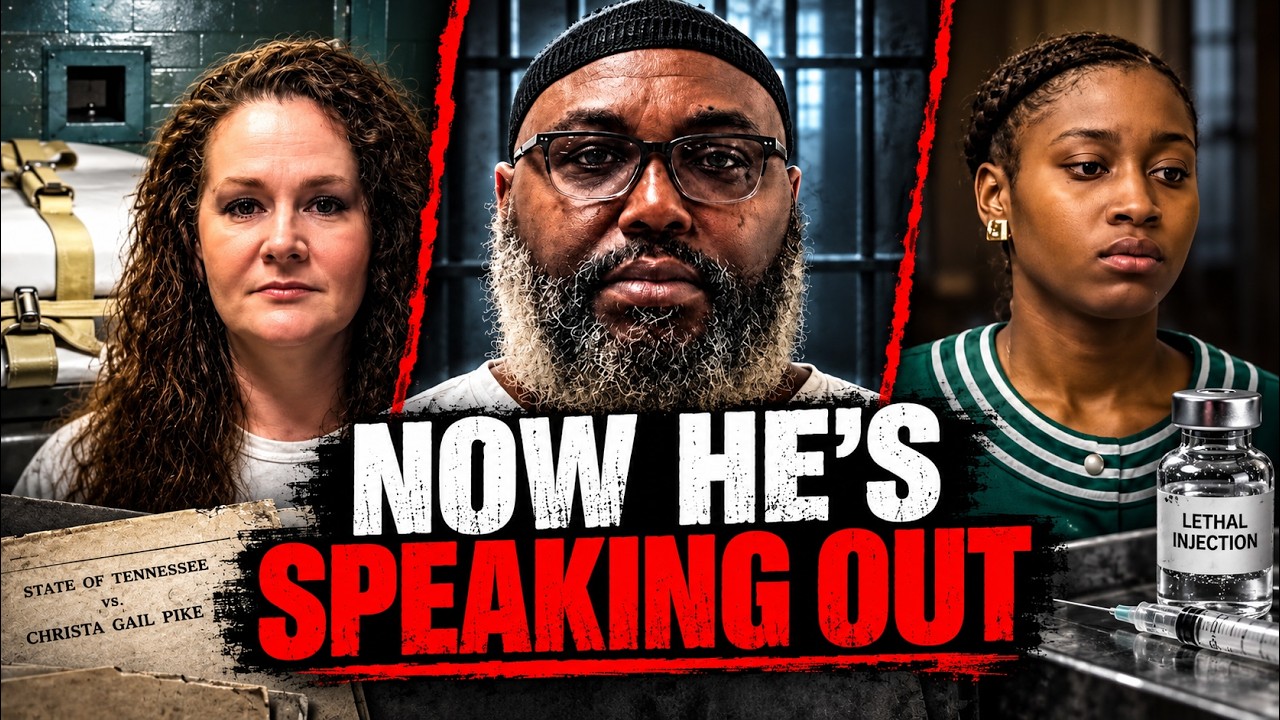
For more than thirty years, one question has followed the Christa Pike case almost as closely as the crime itself.
Why was Christa Pike sentenced to death while the boyfriend who participated in Colleen Slemmer’s murder remained alive?
The contrast has become even harder to ignore after Tennessee’s failed attempt to execute Pike on September 30, 2026.
Pike received two rounds of pentobarbital.
She survived.
She was taken from Riverbend Maximum Security Institution to a hospital, where her attorneys later said she remained unconscious and mechanically ventilated.
Meanwhile, Tadaryl Shipp—the teenage boyfriend who was beside Pike on the night Colleen Slemmer was killed—remains in prison.
He was not executed.
He was not sentenced to death.
And unlike Pike, he could eventually become eligible for release.
That contrast has generated an increasingly provocative question online:
How did Christa Pike get death while her boyfriend “got life”?
The answer begins with a difference of only a few months.
Pike was eighteen.
Shipp was seventeen.
That small numerical gap created an enormous legal divide.
But before examining the sentencing difference, there is another important development that has received surprisingly little attention.
Tadaryl Shipp has actually spoken publicly from prison.
In May 2026, months before Pike’s scheduled execution, Shipp participated in a recorded jailhouse interview with the podcast Unforbidden Truth.
The conversation was conducted through the Tennessee prison telephone system.
It lasted nearly an hour.
And after decades during which Shipp had largely existed in public memory as little more than “Christa Pike’s boyfriend,” listeners heard the middle-aged prisoner describe the life he had built behind bars.
He talked about music.
Playing bass.
Using music to decompress.
Collaborating with other prisoners.
Participating in educational programs.
Helping other incarcerated people through peer mentorship.
He described music as something that allows him to focus mentally on a world beyond confinement.
At one point, he said it helped him feel mentally free even while physically imprisoned.
That interview is real.
But it should not be confused with a dramatic post-execution confession.
There is currently no credible evidence that Shipp has given a new October 2026 interview reacting to Pike’s failed execution.
He has not publicly announced that Tennessee treated them unfairly.
He has not suddenly revealed a hidden fact about the killing.
And he has not walked out of prison while Pike lies in a hospital.
The real story is more complicated.
Shipp remains incarcerated at Northwest Correctional Complex.
His latest parole bid was denied in 2025 because of the seriousness of Colleen Slemmer’s murder.
A future review has been scheduled years from now.
So the comparison is not:
She died, he went free.
It is:
She received death. He received life imprisonment with the possibility of parole.
And that happened because the criminal justice system treated one fact as decisive.
Age.
On January 12, 1995, Christa Pike was eighteen.
Tadaryl Shipp was seventeen.
Both were students connected to the Knoxville Job Corps program.
Colleen Slemmer was nineteen.
The Tennessee Supreme Court record establishes that Pike, Shipp and Shadolla Peterson walked away from the Job Corps Center with Slemmer that night.
The prosecution’s evidence established that Pike had been angry with Slemmer and believed she was interfering with her relationship with Shipp.
What followed became one of Tennessee’s most notorious murder cases.
Slemmer was taken to an isolated area near the University of Tennessee agricultural campus.
The attack lasted for an extended period.
She was beaten and cut.
A pentagram was carved into her body.
She ultimately died from severe injuries.
Pike later possessed a fragment of Slemmer’s skull and talked about the killing afterward.
Shipp was not merely someone who happened to be nearby.
His own conviction was for first-degree murder and conspiracy to commit first-degree murder.
Tennessee’s appellate court upheld both convictions.
The appellate record also described evidence that Shipp had participated in the violence.
This matters because modern retellings sometimes transform the sentencing difference into another claim:
Pike was the killer.
Shipp was simply the boyfriend watching.
That is not what his conviction says.
A Knox County jury found him guilty of murder.
He received life imprisonment.
He also received a twenty-five-year sentence for conspiracy.
The appellate court later reviewed whether those sentences should run consecutively and required additional findings on that issue, but it did not disturb his murder conviction.
Then why no death sentence?
Because he was seventeen.
Recent reporting about the case confirms that Shipp was not death-eligible because he was still a juvenile when Slemmer was killed.
Pike had crossed the legal line into adulthood.
She had turned eighteen.
That made her eligible for Tennessee’s death penalty.
It is difficult to overstate how dramatic that difference became.
They were close in age.
Both were teenagers in ordinary speech.
Both participated in the same murder.
Both were convicted.
But one fell on one side of the legal boundary.
The other fell on the opposite side.
Pike’s later clemency lawyers repeatedly emphasized that fact.
In one filing, her attorneys argued that Shipp was only a few months younger and yet received an entirely different punishment.
They also cited post-conviction testimony portraying Shipp as violent and controlling toward Pike and argued that their relative culpability complicated the fairness of sentencing Pike to death.
That was the defense argument.
The state’s position was different.
Pike’s jury heard evidence that prosecutors believed demonstrated especially aggravated conduct.
The Tennessee Supreme Court ultimately concluded that the evidence supported the aggravating factors found by the jury and affirmed the death sentence.
For decades, that ruling controlled Pike’s fate.
Shipp went to prison.
Pike went to death row.
The third person, Shadolla Peterson, received a dramatically lighter outcome.
Peterson ultimately pleaded guilty to being an accessory after the fact and received probation after cooperating with prosecutors.
Modern reporting says she completed her sentence long ago and has remained largely private.
That meant three people connected to the same night ultimately received three radically different legal outcomes.
Pike:
Death.
Shipp:
Life imprisonment.
Peterson:
A lesser conviction and probation.
Those differences continue to fuel arguments about proportionality.
But proportionality is not determined merely by placing defendants side by side and asking whether their punishments look similar.
Age.
Charge.
Trial evidence.
Plea agreements.
Cooperation.
Individual aggravating factors.
Mitigation.
All can produce different outcomes.
In Shipp’s case, his age was critical.
And the legal significance of being seventeen became even stronger a decade after the murder.
In 2005, the United States Supreme Court decided Roper v. Simmons and categorically prohibited executions for crimes committed by people younger than eighteen.
That ruling came years after Slemmer’s murder and the Pike/Shipp prosecutions.
But today it makes the legal distinction absolute at the constitutional level.
A person who commits a crime one day before turning eighteen cannot constitutionally be executed.
Someone who commits the same crime after turning eighteen may still face capital punishment in a state where the death penalty is authorized.
Pike was on the second side of that line.
Shipp was on the first.
That is one reason Pike’s defenders have spent years pointing to their nearly identical ages.
They argue that human development does not transform overnight on an eighteenth birthday.
Pike’s clemency case emphasized youth, trauma and mental-health evidence that her lawyers believed had not been adequately presented during her original sentencing.
Those arguments did not convince Governor Bill Lee to commute her sentence before September 30.
Then the execution failed.
And the comparison with Shipp suddenly became much more emotionally powerful.
Pike is now fifty.
Shipp is around the same age.
Both have spent more than three decades incarcerated.
Yet Shipp has been permitted to imagine a future outside prison through parole hearings.
Pike spent those same decades anticipating execution.
Shipp’s 2026 interview reveals how profoundly those different sentences shape daily life.
He discussed education.
Music.
Personal development.
Peer mentoring.
He spoke about his denied parole hearing.
The language was oriented toward rehabilitation and the possibility—even if remote—that a parole board might eventually decide he can leave prison.
Pike’s world was structurally different.
Her legal team was preparing her for death.
Weeks before September 30, the question was not whether she would ever receive parole.
It was whether the courts would allow Tennessee to inject her with pentobarbital.
Then came the execution attempt.
The first dose did not kill her.
The backup dose did not kill her.
She remained alive and was transported to a hospital.
Tennessee Governor Bill Lee halted the state’s remaining 2026 executions and ordered an investigation.
That failure has pushed the sentencing comparison back into national discussion.
Some Pike supporters ask how Tennessee can continue pursuing death against her when Shipp received life for participating in the same killing.
But there is another perspective.
Colleen Slemmer’s family has consistently resisted narratives that shift sympathy entirely toward Pike.
Slemmer’s mother has spent more than thirty years living with what happened to her daughter.
When Pike survived the execution, she said she still had not received the justice she had expected.
The failure did not erase the murder.
And Shipp’s lighter sentence does not erase his responsibility either.
That becomes particularly important when discussing parole.
Shipp has now spent more than thirty years incarcerated.
His 2025 parole hearing forced Tennessee to consider whether rehabilitation should eventually outweigh the gravity of his original crime.
The answer was no.
A parole board member recommended denying release specifically because of the seriousness of the offense.
Officials also recommended that Shipp continue appropriate programming and maintain positive institutional behavior before another review.
So even after decades of education, music and mentorship, the murder remains the central fact in his prison record.
His public interview does not change that.
It does, however, reveal the strange divergence created by the two sentences.
Shipp gets evaluated.
Pike gets an execution date.
Shipp can demonstrate rehabilitation to a parole board.
Pike’s rehabilitation is relevant mainly to clemency.
Shipp can talk about what he might do if circumstances ever change.
Pike prepared final statements.
That difference began with only a few months of age.
There is also another controversial element.
Pike’s post-conviction lawyers presented testimony suggesting that Shipp had been controlling and abusive toward her.
A 2021 filing described testimony from a Job Corps instructor who considered Shipp dangerous and knew him to be associated with weapons.
The defense used this material to argue that Pike’s relationship with Shipp should have been presented more fully as mitigation.
That does not mean Shipp forced Pike to murder Slemmer.
Nor does it erase evidence of Pike’s own actions.
The jury convicted Pike based on her conduct.
The courts upheld that verdict.
But the relationship became part of a broader argument that the two teenagers’ roles and developmental circumstances were more complicated than the original sentencing story suggested.
Even here, however, modern viral headlines can go too far.
There is no verified new statement from Shipp saying:
“I controlled Christa.”
No new confession that he masterminded everything.
No reliable evidence he has stepped forward after her failed execution to take sole responsibility.
Those claims would require evidence that does not currently exist.
What does exist is the court record.
And the court record is already powerful.
Shipp was a convicted murderer.
He was not merely Pike’s boyfriend.
He received life because the legal system treated his age differently.
Pike received death because she had reached eighteen.
Now, thirty-one years later, their lives remain divided by that distinction.
Shipp’s 2026 prison interview makes the contrast unusually visible.
The teenage boy in the case is now a middle-aged man talking about playing bass.
He described music as therapeutic.
He discussed the band room.
Graduations inside prison.
Education.
Mentorship.
He said music allows him to concentrate on possibilities rather than only on his confinement.
Those details are almost startlingly ordinary.
There is no dramatic jailhouse confession.
No theatrical description of Pike.
No attempt in the published transcript to transform himself into the forgotten victim of the case.
It is simply a prisoner describing the structure he has created inside a life sentence.
That may be more revealing than the sensational version.
Thirty years ago, Tadaryl Shipp was a seventeen-year-old convicted of participating in Colleen Slemmer’s murder.
Today, he has had enough time to become somebody with routines, musical interests, educational goals and parole hearings.
Christa Pike also had thirty years.
But the state always intended hers to end differently.
That is why the phrase “he got life” requires context.
A life sentence is not freedom.
Shipp has lived more of his life inside Tennessee prisons than outside them.
He was denied release in 2025.
His next meaningful opportunity for parole remains years away.
And even if he is ever released, the murder conviction will remain.
But life contains something death row does not.
Possibility.
That is ultimately what separated their sentences.
Shipp could hope.
Pike could appeal.
Shipp could appear before a parole board.
Pike could ask a governor for mercy.
Shipp could theoretically walk out alive one day.
Tennessee attempted to ensure Pike never would.
Then September 30 happened.
The state tried to execute her.
She survived.
Now Pike’s attorneys are again arguing that her sentence should be commuted to life imprisonment.
If Governor Lee ever grants that request, Pike could finally move legally into the category Shipp has occupied for three decades:
Alive.
Imprisoned.
But no longer awaiting execution.
Whether that happens remains uncertain.
Pike remains critically ill after the failed procedure, and no court or governor has yet erased her death sentence.
Shipp remains incarcerated.
And despite the headline, he did not simply “walk away with life.”
He walked into a Tennessee prison as a teenager.
He is still there in middle age.
The real disparity is more precise—and perhaps more uncomfortable.
Two teenagers participated in the same murder.
One was seventeen.
One was eighteen.
That legal line put one on a path toward parole hearings.
It put the other on a gurney.
Thirty-one years later, Tennessee is still dealing with the consequences of that difference.


