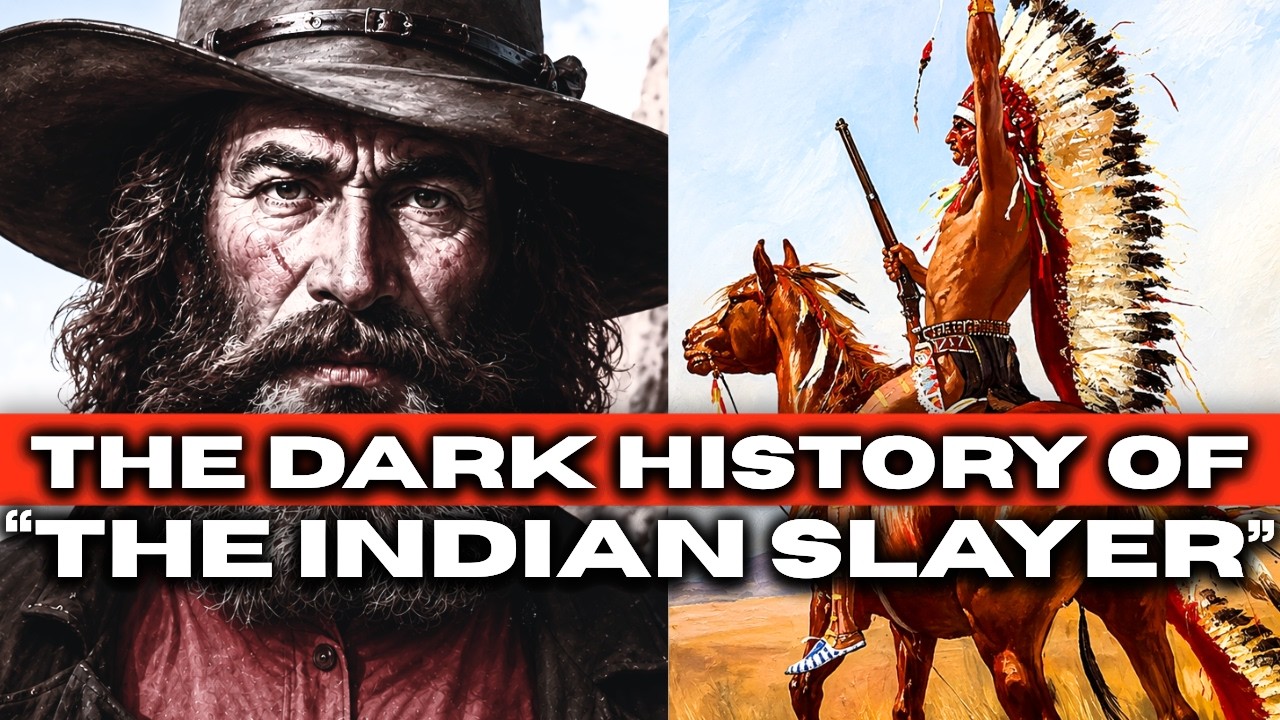
Jeff Turner appears in one of the strangest frontier stories ever attached to early Texas.
According to the tale preserved by nineteenth-century writer John C. Duval, Turner had once been an ordinary settler.
Then his family was killed.
What emerged afterward was something different.
A solitary hunter.
A man living beyond normal settlement life.
A man supposedly obsessed with revenge against Native people.
And, in the version told through Big-Foot Wallace, a man who claimed to be collecting scalps until he reached one hundred.
The story is horrifying.
It is also exactly the kind of Old West story that demands skepticism.
Because almost everything we know about Jeff Turner comes through storytellers who were already turning the Texas frontier into legend.
The earliest widely accessible account comes from The Adventures of Big-Foot Wallace, the Texas Ranger and Hunter, published by John C. Duval in 1870.
Duval presented the recollections of legendary Texas frontiersman William Alexander Anderson Wallace, better known as “Big-Foot Wallace.”
Wallace himself was real.
He had come to Texas in the 1830s, fought in multiple frontier campaigns and became one of the most famous figures associated with early Texas Ranger mythology.
But Duval’s book was written for readers who wanted adventure.
Dialogue was reconstructed.
Scenes were dramatized.
Stories were polished.
So when Jeff Turner rides into the narrative, historians have to distinguish between a plausible frontier figure and the theatrical character preserved on the page.
In Duval’s story, Turner appears unexpectedly while Wallace and a group of Texans are pursuing Native raiders who had stolen horses.
Wallace notices a strange rider approaching.
Turner is described as rough, heavily armed and physically unsettling.
His hair hangs around his face.
His eyes seem almost unnaturally intense.
He carries a Kentucky rifle, a tomahawk and a scalping knife.
Wallace is immediately uncomfortable.
Then Turner explains why.
He says his wife and young sons were killed by Native attackers years earlier.
Since then, according to the book, he has devoted himself to revenge.
He travels alone.
He follows Native trails.
He kills whenever he can.
And he scalps the dead.
Duval has Turner tell Wallace that long periods without taking a scalp make him feel “like a crazy man,” because when he lies down at night he sees the bodies of his wife and boys.
Then comes the line that transformed Turner from obscure frontier wanderer into nightmare legend.
He supposedly tells Wallace that he already has forty-six scalps hanging at his camp and will not be satisfied until he reaches one hundred.
It is one of the most shocking statements in nineteenth-century Texas literature.
It is also impossible to independently verify.
No surviving inventory confirms forty-six scalps.
No authenticated diary written by Turner has surfaced.
No government record gives a body count.
The number comes through Wallace as presented by Duval.
That does not necessarily mean Turner never existed.
Later frontier accounts repeat his name.
A twentieth-century biographical encyclopedia of western fighters describes a Jeff Turner whose family had allegedly been killed years earlier and whose “sole purpose in life” became killing Native people. It places him alongside Wallace during an 1838 pursuit near the Lavaca River.
But repetition is not independent proof when later writers may ultimately be drawing from the same nineteenth-century tradition.
The 1838 episode is nevertheless central to the legend.
Wallace and several companions were pursuing a group that had taken horses.
Turner joined them.
The trackers eventually encountered a camp.
According to the traditional account, a brief but violent fight followed.
The Texans opened fire.
Native defenders returned fire with guns or arrows.
Eventually the camp was abandoned.
The later encyclopedia says four dead Native men were scalped by Turner.
Duval’s version goes farther in describing Turner’s behavior.
He presents him as calm during violence.
Efficient.
Almost disturbingly practiced.
Turner allegedly knew how to follow trails better than everyone else in the group and repeatedly insisted he would continue pursuit even if the others turned back.
Later retellings describe him scalping fallen opponents with extraordinary speed.
Those scenes helped create the image of Turner as something less like a conventional Ranger and more like a lone predator roaming the Texas frontier.
But one major correction is necessary.
The people being pursued in various Turner stories are not consistently identified as Comanche.
Some accounts involving Wallace refer to different Native groups, and later writers often collapsed multiple frontier conflicts into the broader and more recognizable “Comanche war” narrative.
That matters.
Texas in the 1830s and 1840s was inhabited and traversed by numerous Indigenous nations, including Comanche, Lipan Apache, Tonkawa and others.
Settlers themselves frequently misidentified attackers.
Later storytellers simplified those distinctions even further.
Calling every Native opponent Turner supposedly killed “Comanche” may make the story cleaner.
It does not necessarily make it accurate.
The larger historical setting, however, was undeniably violent.
Comanche power dominated much of the southern Plains.
Mounted Comanche forces conducted raids into Mexican and Anglo settlements.
Settlers, Rangers and militias responded with punitive expeditions.
Captives were taken on multiple sides.
Horses were stolen.
Homes were attacked.
Communities were destroyed.
And retaliatory violence frequently produced new retaliation.
The result was not a simple story of innocent settlers confronting a naturally violent enemy.
It was a frontier war created by competing claims to land, resources, sovereignty and survival.
Turner’s legend fits perfectly inside that environment because revenge became a recurring frontier theme.
A relative dies.
A survivor seeks vengeance.
The vengeance produces another death.
That death becomes the justification for the next raid.
In Turner’s case, the story removes almost every boundary.
He supposedly no longer cared about farming.
Or business.
Or domestic life.
Or permanent settlement.
His entire identity became pursuit.
That is where the “mountain man” image comes from.
Later stories describe Turner disappearing into remote country and emerging occasionally for ammunition or supplies.
Duval says that after Wallace’s final encounter with him, Turner was sometimes seen returning to settlements carrying several fresh scalps.
Then he vanished.
“He went off and never returned,” the book says in substance.
People assumed Native fighters eventually caught him.
No confirmed grave.
No reliably documented final battle.
No known death certificate.
Just disappearance.
That absence made the legend stronger.
Because a man without an ending can become almost anything.
By the twentieth century, frontier writers were still repeating Turner stories.
A 1935 issue of Frontier Times listed Jeff Turner among Lavaca County frontier figures.
Later issues ran stories specifically about “Jeff Turner, The Indian Hater.”
A 1967 Texas newspaper columnist openly wrestled with the same problem historians face today.
Was Turner fact or legend?
The writer acknowledged that the frontier was full of inflated tales, then cited older accounts in an attempt to argue that Turner had a historical basis.
Another early twentieth-century collection described Turner as known across South and Southwest Texas and claimed he had dozens of scalps hanging in his cabin.
Again, the story grows.
One source says forty-six.
Another says thirty-five.
Some say camp.
Others say cabin.
Some identify one creek.
Others another.
That is precisely what happens when history turns into folklore.
One detail in the modern version is even more difficult to substantiate:
The black horse called “Pepper Pod.”
The name has become attached to contemporary retellings of Turner’s story.
But it does not appear in the strongest nineteenth-century source material surfaced here.
Without a contemporaneous source, it should be treated as a later embellishment unless further documentary evidence emerges.
The same caution applies to claims that Turner specifically hunted by moonlight.
Or systematically entered Comanche villages alone.
Or was known by a particular nickname among Comanches.
These details sound cinematic because they may have developed precisely through generations of cinematic storytelling before cinema even existed.
That does not make the underlying violence imaginary.
Scalping was real.
Settlers practiced it.
Native fighters practiced it.
Governments and local authorities sometimes offered bounties or rewards tied to Native deaths in different frontier contexts.
Bodies became trophies in a conflict where racial hatred could be openly celebrated.
Turner’s story is useful partly because it destroys another comfortable Hollywood myth.
The myth says scalping was primarily something Native warriors did to white settlers.
The historical reality is that white frontiersmen also scalped Native people.
Turner’s entire reputation depends upon it.
Wallace’s account does not present the act as an accidental battlefield horror.
Turner supposedly collects scalps deliberately.
Counts them.
Displays them.
Uses them as proof of revenge.
That is why the story remains disturbing even if the exact numbers are exaggerated.
The legend exposes a culture in which mutilating a dead enemy could become part of frontier identity.
It also reveals how nineteenth-century storytelling sometimes celebrated behavior that would now be described very differently.
Turner is introduced almost like a gothic monster.
His appearance is terrifying.
His violence is extreme.
But the narrative still treats his hatred as understandable because his family was allegedly killed.
That framing matters.
The dead Native people in the story rarely receive names.
Their families disappear.
Their reasons for being where they were disappear.
Their villages become targets.
Turner alone receives psychology.
He grieves.
He remembers.
He suffers.
He seeks revenge.
The people he kills become simply “Indians.”
That imbalance is one of the defining problems with many frontier memoirs.
They preserve valuable eyewitness material while simultaneously reflecting the racial assumptions of the men who wrote them.
Modern historians therefore cannot simply discard such books.
But neither can they read them literally without context.
Big-Foot Wallace himself openly enjoyed embellishing frontier stories.
A later biographical account describes him as a congenial storyteller who happily embroidered his exploits in classic frontier fashion.
That admission should hover over every Turner scene.
Did Wallace meet a brutal anti-Native hunter named Jeff Turner?
Very possibly.
Did Turner lose family members to a frontier attack?
Possibly.
Did he participate in violent pursuit parties?
The historical tradition strongly says yes.
Did he scalp Native casualties?
Multiple accounts say so.
Did he possess exactly forty-six scalps and intend to reach exactly one hundred?
That belongs to the part of the story we cannot securely verify.
Did he ride a black horse called Pepper Pod through moonlit hills while single-handedly hunting Comanche camps?
That should be treated as legend unless stronger evidence appears.
This distinction does not weaken the story.
It makes it darker.
Because now Jeff Turner becomes more than another cartoon frontier killer.
He becomes an example of how violence itself was transformed into folklore.
A grieving man may have existed.
He may have become a relentless killer.
His contemporaries may genuinely have feared him.
Then storytellers took that man and sharpened every edge.
The eyes became wilder.
The hair longer.
The scalps more numerous.
The hatred absolute.
The disappearance mysterious.
Eventually it became difficult to separate Jeff Turner the person from Jeff Turner the warning.
And there is another side to the story.
The Comanche world Turner supposedly hunted was not an empty wilderness inhabited only by raiders.
It contained families.
Children.
Traders.
Hunters.
Political leaders.
Horse herders.
Women processing hides and food.
Communities moving through a homeland that outsiders were increasingly attempting to occupy.
Contemporary art from the period depicts organized Comanche camps containing large numbers of tipis and domestic activity—not merely bands of warriors waiting to attack settlers.
The Comanche were also one of the dominant military powers of the southern Plains.
Their mastery of mounted warfare made them extraordinarily effective fighters.
Texas settlers feared raids for good reason.
Mexican communities feared them too.
Captivity, killing and livestock theft occurred.
But the violence existed within a larger struggle over territory that Anglo-American settlement was rapidly transforming.
By the 1840s and 1850s, forts, roads and farms increasingly penetrated Native territory.
The U.S. military later built chains of frontier forts intended to protect settlement and push Indigenous power farther west.
The cycle intensified.
Seen in that context, Jeff Turner’s legend is not simply:
A man loses his family and gets revenge.
It is:
A frontier society experiences cycles of violence so severe that a man allegedly dedicated his entire existence to racial vengeance—and later generations turned him into entertainment.
That is a very different story.
Even Big-Foot Wallace appears uneasy around him.
In Duval’s telling, Wallace jokes nervously about hoping Turner will not take a white man’s scalp if he cannot find a Native one.
Turner laughs.
But Wallace’s fear does not disappear.
The man beside him is useful because he can track.
He is frightening because hatred has apparently become the only organizing principle of his life.
Then Turner finds the trail.
That detail appears consistently.
He is portrayed as extraordinarily skilled at reading signs other men cannot see.
Broken grass.
Disturbed soil.
Tracks across difficult ground.
When Wallace’s party loses the trail over rocky terrain, Turner supposedly recovers it.
The others begin following him.
That image might contain the core of the historical figure.
Not supernatural.
Not an invincible killer.
An experienced frontier tracker who had spent enough time following Native movements to become extremely good at it.
Everything else could have grown around that skill.
The stories say Turner eventually left the company and returned to his solitary life.
Then he disappeared.
Perhaps he was killed.
Perhaps he died somewhere unknown.
Perhaps he left Texas.
No surviving evidence provides a satisfying ending.
And that uncertainty is exactly why he survived in frontier folklore.
Legends need empty space.
Jeff Turner has plenty of it.
No portrait securely identified as him.
No grave everyone can visit.
No diary explaining himself.
No official record listing one hundred victims.
Instead there is Wallace’s remembered encounter, Duval’s dramatic prose, later frontier writers repeating it, and a modern audience still asking whether this terrifying man actually existed.
The most accurate answer is uncomfortable.
There is historical tradition supporting a Jeff Turner known as an exceptionally violent “Indian-hater.”
But the most sensational details remain impossible to verify independently.
So the story should not end with:
Jeff Turner killed countless Comanches.
It should end with a harder question.
How much violence does a frontier have to experience before a story like Jeff Turner becomes believable?
Because whether every scalp was real or not, nineteenth-century readers accepted the character immediately.
A man driven insane by the killing of his family.
A rifle.
A knife.
A lonely camp.
Scalps hanging nearby.
No home left to return to.
Only another trail.
That tells us something important about early Texas.
The legend could survive because the world around it had already become violent enough that nobody found it impossible.


