In December 1944, Omar Bradley watched a map he had approved turn against him.
The headquarters of the U.S. 12th Army Group occupied a former bank building in Luxembourg City. Signal troops had run military communications through corridors built for clerks. Situation maps covered walls once meant for financial ledgers.
The headquarters had a code name: Eagle Tac.
From there, Bradley controlled more American soldiers in the field than any American commander before him.
And on one wall was the decision that would haunt him.
The Ardennes.
Eighty-eight miles of front.
Three infantry divisions.
Most of an armored division.
Bradley knew the numbers.
He had chosen them deliberately.
He called it a calculated risk.
Thirty days later, German armies would tear through that same sector.
Two American field armies would be removed from Bradley’s operational control and placed under a British field marshal.
Then the crisis would become even larger.
The question would no longer simply be whether Hitler’s tanks could reach Antwerp.
It would become a struggle over who would command the Allied ground war in Western Europe.
And the intervention that helped settle it would come not from a battlefield headquarters, but from a desk roughly 4,000 miles away.
George C. Marshall had spent years building the American Army.
He had also spent years refusing to tell his field commanders how to fight their battles.
In late December 1944, he broke that rule.
Almost once.
Almost with one sentence.
To understand why that sentence mattered, begin with Bradley’s map.
By autumn 1944, Allied armies stretched across an enormous front.
Bradley’s forces were attacking at both ends of his sector.
In the north, American troops were being consumed by the Hürtgen Forest.
In the south, Patton’s Third Army was pushing toward the Saar.
Both operations demanded infantry.
Both demanded supplies.
Both demanded attention.
Something in the middle had to be weaker.
That place was the Ardennes.
The terrain seemed to support the decision.
Forested ridges.
Narrow valleys.
Poor winter roads.
No major industrial objective.
No obvious strategic prize close behind the front.
American formations battered elsewhere were sent there to recover.
New formations were sent there to gain experience.
Soldiers called it the “ghost front.”
Some troops could sleep in barns instead of foxholes.
Hot food sometimes arrived hot.
Companies were spread so widely that enormous gaps existed between them.
The sector felt less like the front line than a place where exhausted units could breathe.
Major General Troy Middleton’s VIII Corps held approximately 88 miles.
According to the source, three infantry divisions and most of an armored division covered that frontage, with additional cavalry screening part of the sector.
Bradley understood how thin it was.
He accepted it anyway.
His reasoning was straightforward.
He did not possess unlimited divisions.
If he wanted strength elsewhere, the Ardennes had to remain thin.
And if Germany did attack through the forest, Bradley believed the terrain would slow the advance long enough for American armor to close the penetration from the flanks.
Calculated risk.
The phrase would follow him.
The problem was not that there had been no warnings.
There were.
Rail traffic moving west.
Reports of German armor gathering.
Prisoners talking about a major blow before Christmas.
Civilians hearing engines in forests at night.
German formations that Allied intelligence could not confidently locate.
The information existed.
The failure came in interpretation.
Allied commanders knew Germany was weakening.
France had been lost.
Fuel was desperately short.
The Soviet Union was crushing German forces in the east.
The Western Allies were approaching Germany itself.
A rational German command, the Americans reasoned, would preserve its remaining armor for defense.
Therefore, German troop movements in the west could be interpreted as defensive preparations.
The observations were not necessarily wrong.
The conclusion was.
The source argues that Eisenhower and Bradley had already considered the possibility of a German counteroffensive through the Ardennes in November and concluded that such an attack would offer Germany too little return to justify the cost.
Their reasoning contained one dangerous assumption.
Hitler would make a rational calculation.
He did not.
German forces assembled under extraordinary secrecy.
Orders were restricted.
Radio silence concealed movement.
Units moved at night.
More than 200,000 troops and hundreds of armored vehicles gathered opposite a sector the Allies still treated as relatively quiet.
Then, at 5 a.m. on December 16, the forest exploded.
Approximately 1,600 German guns opened fire.
Telephone wires disappeared almost immediately.
American formations lost communications before many commanders understood the scale of the attack.
Infantry came through the darkness.
Then assault guns.
Then tanks.
German forces penetrated the front in multiple places.
Reports reaching higher headquarters were delayed and incomplete.
Battalions did not know what neighboring battalions were seeing.
Regiments knew they were under attack but could not determine the shape of it.
Division headquarters received information already hours old.
The front was changing faster than the map.
Bradley was not at Eagle Tac when the offensive began.
He was traveling toward Versailles to discuss another problem with Eisenhower’s headquarters.
Infantry replacements.
His armies were running short of riflemen.
During the meeting, reports from the Ardennes began arriving.
Bradley offered an interpretation.
Spoiling attack.
The Germans were trying to disrupt Patton’s offensive farther south.
Eisenhower looked at the developing penetrations and rejected it.
“This is no spoiling attack,” he said according to the source.
Bradley returned to Luxembourg.
His map was already becoming obsolete.
On December 17, clerks struggled to keep the situation board current.
Units disappeared.
Positions moved miles.
Two regiments of the 106th Infantry Division became trapped.
Thousands of Americans eventually entered captivity.
Near Malmedy, American prisoners were killed after being captured by an SS formation.
News of the killings spread through the American ranks.
But Bradley had another problem that was visible only from headquarters.
The German penetration was not merely taking territory.
It was destroying the geometry of American command.
Bradley commanded three field armies.
Courtney Hodges’s First Army.
William Simpson’s Ninth Army.
George Patton’s Third Army.
Bradley remained south of the German penetration.
First and Ninth Armies were north of it.
The German wedge was driving directly through the communications connecting them.
This mattered enormously in 1944.
Command traveled through wires.
Telephone cables ran along roads.
German armor seized road junctions.
The same advance that moved the front west also severed the communications Bradley needed to control the battle.
By December 18, according to the source, Bradley’s headquarters had lost reliable contact with First Army for roughly two days.
Liaison officers could carry messages by jeep.
But a message that took hours to arrive might describe a battlefield that no longer existed.
Bradley’s command structure was being physically divided.
Then came Verdun.
December 19.
Eisenhower summoned senior commanders to a cold French barracks.
Bradley arrived from Luxembourg.
Patton came from the south.
Staff officers crowded around a map.
Outside stood the landscape where France and Germany had destroyed hundreds of thousands of men during World War I.
Inside, Eisenhower refused to describe the German offensive simply as a disaster.
It was an opportunity.
Germany had committed precious reserves into a salient.
If the Allies could contain the penetration, those forces could be destroyed in the open instead of fought later behind German defenses.
Then Eisenhower turned toward Patton.
How quickly could Third Army attack north?
Patton’s answer startled the room.
December 22.
Three divisions.
He had already prepared for the possibility.
His staff had developed contingency plans.
The Third Army could pivot north.
Patton had provided a solution for the southern side of the Bulge.
The northern side remained.
And that problem could not be solved merely by attacking.
Somebody had to command it.
Two British officers at Supreme Headquarters—Kenneth Strong and John Whitley—recognized the problem.
The German advance had physically separated Bradley from his northern armies.
There was one major Allied headquarters positioned to communicate effectively with those forces.
Field Marshal Bernard Montgomery’s 21st Army Group.
The military solution was simple.
The political consequences were enormous.
Temporarily place the American First and Ninth Armies under Montgomery.
Walter Bedell Smith initially reacted furiously to the suggestion.
According to the source, he accused the British officers of thinking nationally rather than as Allied officers and relieved them.
Then he studied the situation.
By morning, Smith reached the same conclusion.
Bradley could not effectively communicate with the northern armies.
Montgomery could.
Command had to follow communications.
On December 20, Eisenhower called Bradley.
Montgomery would receive temporary operational control of Allied forces north of the German penetration.
That included First Army.
It included Ninth Army.
For Bradley, it meant losing operational control over roughly two-thirds of what had been his command.
Bradley did not deny the military logic.
That was what made the conversation painful.
According to the source, he effectively acknowledged that if Montgomery’s headquarters had been American, the decision would have been obvious.
His objection was nationality.
Two American field armies had suffered a major surprise attack.
Now they would be placed under a British field marshal.
The symbolism could be devastating.
It might appear that American command had failed and Britain had been called in to rescue it.
Eisenhower made the change anyway.
He was right about the immediate military problem.
Montgomery’s headquarters could communicate with the northern forces.
Bradley’s could not.
So the map changed again.
Not because German tanks had moved another twenty miles.
Because Eisenhower had moved a command boundary.
Bradley remained outwardly controlled.
His staff felt humiliated.
He returned to the forces still under him and kept working.
It was perhaps the lowest point of his war.
The commander once celebrated as the quiet “GI general” had watched the weakness he knowingly accepted become the center of Hitler’s greatest western offensive.
His intelligence assumptions had failed.
His communications had been cut.
His headquarters was threatened.
Two armies had been removed from his control.
Yet the German plan was about more than Bradley.
Antwerp was the geographic objective.
The coalition was the political objective.
Hitler believed Britain and the United States could be separated.
He knew the two allies had argued repeatedly over strategy.
He knew their commanders competed for influence.
He knew Americans increasingly resented British assumptions of strategic seniority.
If German forces could split the armies physically, perhaps humiliation and recrimination would finish the job politically.
By December 20, something dangerously close to that had happened.
American armies were under British command.
The British press was watching.
American officers were furious.
The seam Hitler wanted to open was visible.
And George Marshall did almost nothing.
That was intentional.
Marshall had spent years selecting commanders.
Once he selected them, he generally expected them to command.
He did not try to fight Eisenhower’s war from Washington.
Even as the Ardennes crisis grew, Marshall did not flood Supreme Headquarters with tactical instructions.
He did not demand constant explanations.
He did not attempt to control individual divisions.
Instead, Washington accelerated the machinery behind Eisenhower.
Replacements.
Shipping.
Divisions.
Supplies.
Marshall’s philosophy was simple.
If the Chief of Staff in Washington began directing the battle in Europe, Eisenhower would cease to be a commander.
He would become an intermediary.
So Marshall remained largely silent.
On the battlefield, the German offensive began slowing.
Bastogne held.
The 101st Airborne and elements of the 10th Armored resisted inside the German encirclement.
The weather remained brutal.
Then, on December 23, the skies cleared.
Allied aircraft returned.
Supplies reached Bastogne from the air.
German columns became vulnerable to fighter-bombers.
On December 26, Patton’s 4th Armored Division broke through to Bastogne.
By late December, Hitler’s offensive was failing strategically.
The Germans had not reached the Meuse.
They had not taken Antwerp.
They had not destroyed the Allied coalition.
Then, just as the military crisis began easing, the political command crisis became more dangerous.
On December 29, Montgomery wrote to Eisenhower.
Montgomery had handled the northern shoulder of the Bulge competently.
He had reorganized forces.
He had stabilized the command situation.
But he had also spent months arguing that Eisenhower’s command structure was wrong.
Montgomery believed the Western Allies needed a single commander directing the ground battle.
Eisenhower would remain Supreme Commander.
But operational control of the land war would be concentrated beneath him.
Montgomery had an obvious candidate for that job.
Montgomery.
Now he possessed something he had not possessed during earlier arguments.
First and Ninth Armies were already temporarily under him.
The emergency seemed to validate his position.
According to the source, Montgomery’s December 29 letter went so far as to include suggested wording for the new command arrangement.
He had effectively drafted the directive that could place himself in the expanded position and sent it to Eisenhower for approval.
To Montgomery, this was an argument about military efficiency.
To Americans, it could look like something very different.
A British field marshal using America’s worst battlefield crisis in Europe to take permanent command over American armies.
British newspaper commentary intensified the problem.
Some coverage suggested that American forces had been caught unprepared and Montgomery had stabilized the crisis.
There were arguments that Eisenhower had too much responsibility and that a professional ground commander should direct land operations.
The issue was becoming political.
Eisenhower had spent years absorbing this kind of tension.
Now he reached his limit.
He prepared a message for the Combined Chiefs of Staff.
The essence was unmistakable.
If Montgomery would not accept Eisenhower’s authority, the Allied governments would have to choose between them.
Montgomery or Eisenhower.
One of them would go.
Sending that message in the middle of the Battle of the Bulge could have triggered an extraordinary Anglo-American command crisis.
Then Washington intervened.
George Marshall had been following British press reports.
He understood the growing argument over Allied command.
Eisenhower had not requested political rescue.
Marshall sent support anyway.
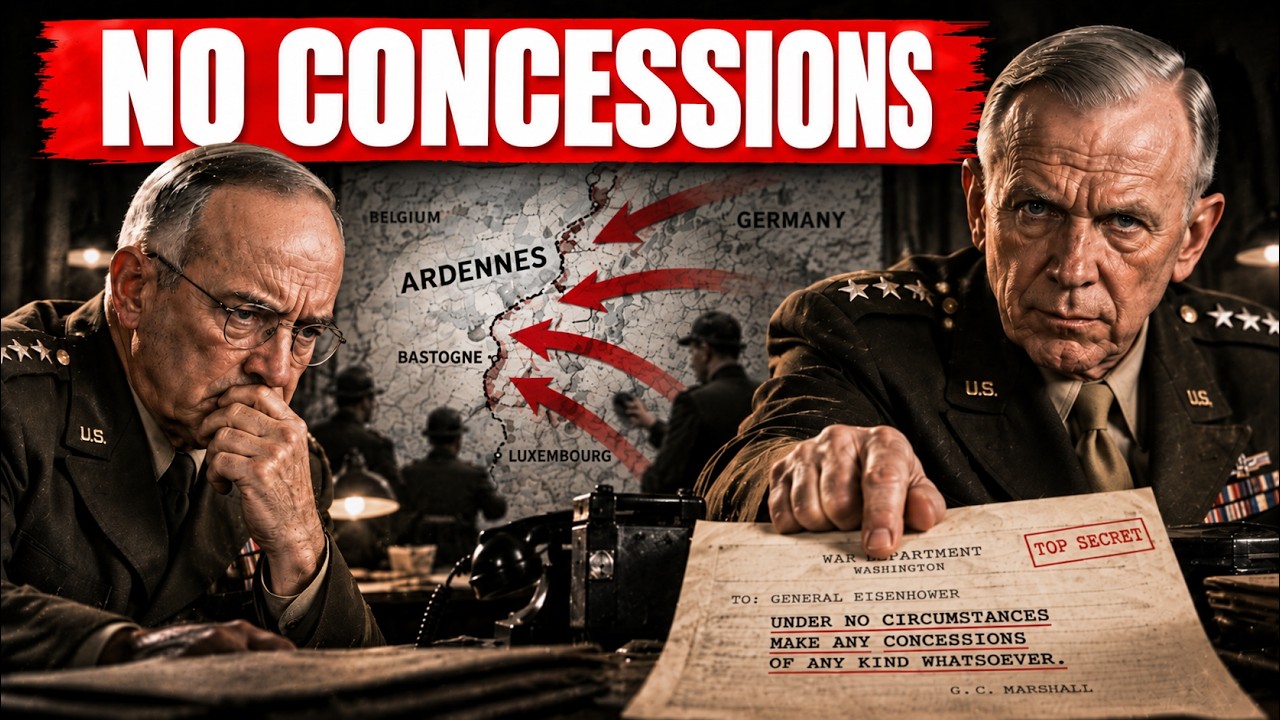
The key sentence, as quoted in the source, was uncompromising:
“Under no circumstances make any concessions of any kind whatsoever.”
Marshall then made clear that he was not suggesting Eisenhower intended to concede anything.
He simply wanted Eisenhower to know where the U.S. Army Chief of Staff stood.
That distinction matters.
Marshall did not order Eisenhower to fire Montgomery.
He did not order him to send the ultimatum.
He did not tell Eisenhower how to fight the Battle of the Bulge.
He did not move a division.
He did not name an objective.
He did not change the front.
He told Eisenhower one thing.
Do not surrender command authority.
For almost the entire war, Marshall’s power had partly come from restraint.
He selected commanders and backed them.
He did not constantly reach into their theaters.
That meant when he finally intervened, the intervention carried unusual weight.
Eisenhower now knew Washington was behind him.
There would be no pressure from Marshall to split his authority merely to preserve political harmony.
The ground beneath him was solid.
The crisis was not finished.
Francis de Guingand, Montgomery’s chief of staff, traveled to Versailles.
He understood Americans better than Montgomery did and recognized the danger.
Bedell Smith showed him how serious the situation had become.
Eisenhower had prepared his message.
A possible replacement for Montgomery was already being discussed.
De Guingand returned to Montgomery.
The warning was unmistakable.
This was no longer another argument about strategy.
Montgomery’s position was in danger.
According to the source, Montgomery backed down.
He sent Eisenhower another message.
The earlier proposal should be discarded.
Eisenhower could rely on Montgomery completely to carry out whatever decision the Supreme Commander made.
The confrontation receded.
Eisenhower did not send his ultimatum to the Combined Chiefs.
No permanent Allied ground commander was created beneath him.
The command structure survived.
Then Montgomery nearly ignited the controversy again.
January 7, 1945.
Press conference.
Montgomery praised American soldiers.
He praised their fighting.
He called for Allied unity.
But his account of the battle placed his own intervention prominently in the story.
Many American commanders interpreted the presentation as Montgomery claiming credit for rescuing a collapsing American situation.
Bradley had remained quiet for weeks.
Now he erupted.
He told Eisenhower he would not accept permanent subordination of American armies to Montgomery.
Other American officers were similarly furious.
But the decisive command question had already been settled.
Marshall’s message had removed ambiguity about Washington’s position.
On January 16, forces from First and Third Armies linked up near Houffalize.
The German salient was being cut apart.
On January 17, First Army returned to Bradley’s command.
The temporary boundary disappeared from the map.
The price did not.
Towns had been destroyed.
Tens of thousands of Americans had become casualties.
Bradley’s calculated risk had produced consequences he would never forget.
So what did Marshall’s message actually accomplish?
It did not save Bastogne.
The soldiers at Bastogne did that.
It did not stop German armor.
It did not clear the Ardennes.
It did not move Patton north.
It did not shoot down a German aircraft.
Not one rifleman advanced because Marshall wrote those words.
Its effect was elsewhere.
It answered a command question.
Who would remain in control of American armies in Europe?
Marshall’s message told Eisenhower that Washington would not force him into a compromise that weakened his authority.
The Rhine crossings that followed.
The encirclement of the Ruhr.
The advance toward the Elbe.
The final operations against Germany.
All would continue beneath an Allied command structure headed by Eisenhower.
That makes the Battle of the Bulge more than a story about snow, tanks and Bastogne.
It was also a test of institutions.
Bradley’s story is particularly revealing.
He was not incompetent.
The source portrays something more complicated.
His strengths and weaknesses grew from the same instinct.
He trusted calculation.
He trusted organization.
He trusted rational analysis.
That approach helped make him one of America’s most important commanders.
It also contributed to the assumption that Germany would not spend its remaining strength on an offensive through the Ardennes.
He had accepted the thin sector deliberately.
Then he watched it collapse.
And when Eisenhower took two armies from him, Bradley understood the military logic even while hating the political meaning.
He did not appeal over Eisenhower’s head.
He did not ask Marshall to reverse the order.
He did not publicly attack the Supreme Commander.
He absorbed it.
Marshall’s restraint was similar, but exercised from Washington.
The Battle of the Bulge gave him every excuse to interfere.
American divisions had been surprised.
Thousands of soldiers had surrendered.
Congress wanted explanations.
Newspapers demanded answers.
The commander he had helped elevate was facing the greatest American battlefield crisis in Europe.
Marshall stayed away from the tactical battle.
That made his eventual intervention more powerful.
He broke his own rule only when the question became larger than tactics.
Who commanded?
The source’s central argument is strongest when stated carefully.
Marshall’s cable did not single-handedly save the Allied coalition.
It did not defeat Hitler’s offensive.
It did not prove Eisenhower would otherwise have surrendered his authority.
What it did was remove uncertainty at precisely the moment Eisenhower was preparing for a confrontation over the command structure.
Marshall told him that Washington stood behind him.
And he did so without trying to take over the battlefield himself.
That distinction separates Marshall’s intervention from ordinary micromanagement.
He did not tell Eisenhower what to do with his armies.
He told Eisenhower he still had the authority to decide.
There is an irony in that.
Hitler had launched the Ardennes offensive partly because he believed the Anglo-American coalition contained a fatal weakness.
National pride.
He was not imagining it.
The British and Americans did distrust one another in important ways.
Their commanders did fight over strategy.
Montgomery and Bradley would carry bitterness from the Battle of the Bulge long after the German offensive disappeared.
The coalition could crack.
It almost did.
But Hitler needed it to crack while his tanks still possessed fuel.
While Bastogne was still vulnerable.
While the weather still protected German columns.
While the road toward Antwerp remained theoretically open.
Instead, the Allies temporarily crossed the national boundary in the opposite direction.
American armies went under British operational command because the battlefield required it.
Then, when the emergency arrangement threatened to become something larger, Eisenhower reasserted the authority of Supreme Headquarters.
And behind him stood Marshall.
Quietly.
From Washington.
Bradley finished the war commanding an enormous American force.
The map recovered.
His relationship with Montgomery did not.
Neither did his memory of the Ardennes.
That may be the most revealing part of the story.
Wars are remembered through things that make noise.
German artillery opening fire at dawn.
Machine guns in frozen fields.
Paratroopers defending Bastogne.
McAuliffe’s one-word refusal.
Patton’s tanks turning north through winter roads.
Those moments deserve their place.
Marshall’s contribution to this particular crisis produced no battlefield photograph.
No soldiers cheered when his cable arrived.
No German commander even knew it existed.
It was a message from a 64-year-old man sitting thousands of miles from the fighting.
And its most important words did not order anyone to attack.
They did not order anyone to retreat.
They did not move a single division.
“Under no circumstances make any concessions of any kind whatsoever.”
For years, George Marshall had built his command system around one principle:
Choose the commander.
Give him responsibility.
Then let him command.
In December 1944, with German armies tearing through the Ardennes and the Allied command structure beginning to fracture under the political shock, Marshall broke his own silence.
Not to fight Eisenhower’s battle for him.
To make certain Eisenhower remained the man allowed to fight it.


