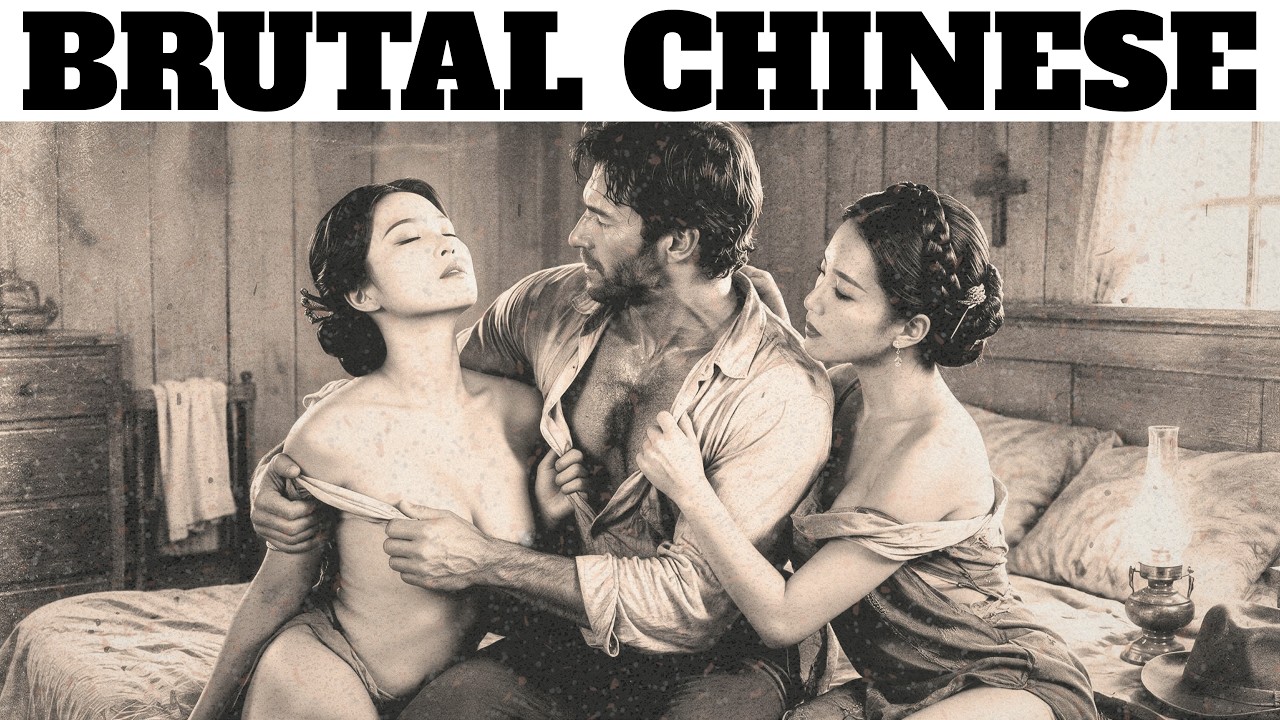
Hollywood almost erased Chinese women from the American West.
When Chinese characters appear at all, they are usually men: railroad workers swinging hammers, miners washing gravel, cooks standing behind restaurant counters, laundrymen framed by steam.
That picture is incomplete.
Chinese women were in California before the Gold Rush fully exploded. They lived in mining settlements, raised families, operated businesses, worked as domestic servants, challenged segregated schools, escaped trafficking networks, testified against exploiters, and survived communities that sometimes decided they should not be allowed to exist there at all.
But their history requires one crucial distinction.
Not every Chinese woman in the West was trafficked or involved in prostitution.
That stereotype was itself one of the weapons used against them.
Some women were indeed kidnapped, deceived, sold or forced into sexual exploitation. Others arrived as wives, daughters, servants or independent migrants. Yet American politicians increasingly treated almost any arriving Chinese woman as potentially “immoral,” helping produce one of the earliest racially targeted federal immigration regimes in U.S. history.
Here are twenty brutal truths Hollywood rarely shows.
1. THERE WERE SO FEW CHINESE WOMEN THAT SIMPLY BEING FEMALE COULD MAKE YOU CONSPICUOUS.
Chinese migration to the American West was overwhelmingly male.
Economic conditions in southern China, the cost of passage, family migration strategies and the brutal realities of western labor encouraged many households to send men abroad first.
American policy made the imbalance much worse.
By restricting Chinese female immigration, especially after 1875, the United States helped create communities in which men dramatically outnumbered women. NPS historians note that the Page Act helped make Chinese families rare in the United States.
A Chinese woman arriving in a mining settlement therefore might not simply be another newcomer.
She could be one of only a handful of women sharing her language and background for miles.
Scarcity could create economic opportunities.
It could also make her intensely visible—and vulnerable.
2. SOME WOMEN WERE IN CALIFORNIA BEFORE THE “WILD WEST” MYTH HAD EVEN FORMED.
Chinese women did not suddenly appear years after Chinese men established western communities.
Women were present during the earliest period of Chinese settlement in California.
The historical record remains fragmentary because official sources often ignored women unless they entered courts, immigration proceedings or institutions.
That silence helped create the later illusion that Chinese women were absent.
They were not.
Their lives were simply less likely to be documented.
3. SOME GIRLS REALLY WERE SOLD ACROSS THE PACIFIC.
The ugliest stories are not entirely myth.
Poverty, gambling debts, family desperation and organized trafficking networks produced circumstances in which girls and young women could be transferred into domestic servitude or prostitution.
Liang May Seen’s case is documented by the National Park Service.
A procurer brought her from China and sold her to a brothel owner in San Francisco.
She later escaped and reached the Presbyterian Mission Home in 1889.
National Archives records also document women who testified in federal cases against traffickers and enslavers operating in San Francisco.
The cruelty was not merely that money changed hands.
A woman could cross an ocean believing she was entering service, marriage or respectable employment and discover after arrival that somebody else claimed control over her body.
4. A FAMILY COULD THINK IT WAS SENDING A DAUGHTER INTO DOMESTIC SERVICE—AND LOSE HER TO A BROTHEL.
Not every sale in China was initially understood as sexual trafficking.
In impoverished households, girls might be placed into wealthier families as servants or dependents.
NPS documentation explains that procurers sometimes exploited these arrangements, deceiving families and redirecting women into sex work or domestic bondage.
That matters because the popular phrase “sold woman” can hide several very different realities.
Some families knowingly entered exploitative agreements.
Some did not understand what would happen in America.
Some women themselves were lied to.
The journey created distance so immense that correcting the deception could become almost impossible.
5. “DEBT” COULD FUNCTION LIKE A CHAIN.
Trafficked women could be told that they owed money for passage, clothing, food, purchase costs or lodging.
That debt could be extended indefinitely.
One National Park Service account describes a trafficked woman who brought in $25 from a customer while $21 went to the women controlling her.
For comparison, the same source notes that a Chinatown garment worker might earn around $30 in an entire month.
The mathematics reveal the system.
A woman could generate enormous revenue without accumulating enough independent money to escape.
No iron shackles were necessary.
Debt, threats, confiscated documents, unfamiliar language and fear could accomplish the same purpose.
6. SOME WOMEN WERE FORCED TO SEE TEN OR MORE CUSTOMERS IN A NIGHT.
The most exploitative San Francisco brothels contained tiny compartments sometimes called cribs.
NPS historians describe women and girls being required to receive ten, fourteen or even sixteen men in a night.
Disease, physical abuse and shortened life expectancy followed.
This is one of the areas where sensational history can actually understate rather than exaggerate what happened.
But another correction is necessary:
Those women were victims of particular systems of exploitation.
They were not representative of every Chinese woman in western America.
Treating all Chinese women as prostitutes repeats the exact racial stereotype nineteenth-century exclusionists promoted.
7. WHITE MEN HELPED CREATE THE MARKET—THEN POLITICIANS BLAMED CHINESE WOMEN FOR IT.
Prostitution in California was not limited to Chinese customers.
Men across racial groups used Chinese brothels.
NPS historical analysis notes that prostitution itself was legal in California during much of the early period and that men of different racial backgrounds patronized these establishments.
Yet the political response focused heavily on the women.
Rather than defining male demand as the central moral problem, exclusionists portrayed Chinese women as sexually corrupting American society.
The customer could disappear from the moral argument.
The immigrant woman became the threat.
8. TWENTY-TWO CHINESE WOMEN ONCE HAD TO TAKE THEIR CASE TO THE U.S. SUPREME COURT BECAUSE CALIFORNIA ASSUMED THEY WERE PROSTITUTES.
In 1875, twenty-two women arriving from China were detained by California authorities.
Why?
They were traveling without husbands.
Officials classified them as “lewd and debauched women.”
The case became Chy Lung v. Freeman.
The U.S. Supreme Court ruled against California, holding that individual states could not independently regulate immigration in that manner.
Consider the assumption underneath the case.
A Chinese woman traveling independently was not simply a passenger.
Her sexual morality became a government question.
9. THEN THE FEDERAL GOVERNMENT CREATED ITS OWN SYSTEM FOR QUESTIONING CHINESE WOMEN.
California lost Chy Lung.
Federal restriction expanded anyway.
President Ulysses S. Grant signed the Page Act on March 3, 1875.
The law addressed involuntary labor, certain criminal migrants and the importation of Asian women for prostitution.
In practice, it fell especially hard on Chinese women.
Federal immigration officials received wide discretion to determine whether an arriving Asian woman was entering for what the statute called “lewd and immoral purposes.”
The language sounded like an anti-trafficking measure.
Its administration turned female Chinese migration itself into a suspicious activity.
10. EVEN A LEGITIMATE WIFE COULD BE FORCED TO PROVE SHE WAS NOT A PROSTITUTE.
Documents did not always solve the problem.
National Archives immigration records show Chinese women presenting papers supporting their right to enter and still undergoing questioning about whether they were morally admissible.
Officials could ask about marriages, family relationships, household details and financial circumstances.
A discrepancy could create suspicion.
For a woman arriving after weeks at sea, speaking through an interpreter in an unfamiliar legal system, this was more than routine border control.
Her intimate life could determine whether she was allowed into the country.
11. AMERICAN LAW HELPED CREATE “BACHELOR CHINATOWNS.”
This is one of the most important truths.
Chinese men were often accused of refusing to assimilate or establish conventional American families.
Yet U.S. law made bringing wives extraordinarily difficult.
The Page Act heavily restricted women.
The Chinese Exclusion Act of 1882 then blocked most Chinese labor migration and created further obstacles to departure and reentry.
The result was predictable.
Communities became overwhelmingly male.
Then exclusionists pointed at the shortage of families as evidence that Chinese immigrants were temporary aliens incapable of becoming part of America.
Government policy helped create the condition it later condemned.
12. A WOMAN COULD SURVIVE THE IMMIGRATION SYSTEM AND STILL BE TOLD HER AMERICAN-BORN CHILD DID NOT BELONG IN A WHITE SCHOOL.
Mary Tape’s life exposes the contradiction perfectly.
Born near Shanghai in 1857, she came to the United States as a child and later built a middle-class family in San Francisco with her husband Joseph.
Their children were born in America.
In 1884, Mary attempted to enroll her eight-year-old daughter Mamie in a nearby white public school.
Mamie was refused because she was Chinese American.
The Tapes sued.
California’s courts ruled that Chinese children could not simply be denied public education.
San Francisco responded by creating a segregated Chinese school instead.
Mary’s furious response survives.
She asked whether being born Chinese was somehow a disgrace.
The frontier could demand assimilation from Chinese people—
and then block their children when they attempted it.
13. EVEN “SUCCESSFUL” ASSIMILATION DID NOT ERASE RACISM.
Mary and Joseph Tape adopted American-style names, English language practices, western clothing and a middle-class lifestyle.
They even lived outside Chinatown.
It did not matter.
Authorities still defined their children by ancestry.
That exposed the weakness of the claim that anti-Chinese hostility was simply about cultural difference.
Chinese families were often told to assimilate.
When they did, racial boundaries remained.
The rules changed faster than a family could satisfy them.
14. A CHINESE WOMAN COULD BE DRAGGED OUT OF HER OWN HOME BY A WHITE MOB.
In Tacoma, Washington, anti-Chinese activists escalated from political agitation to forced expulsion in 1885.
On November 3, armed groups entered Chinese homes and businesses and drove residents from the city.
Merchant Lum May later gave an affidavit describing what happened to his wife.
She refused to leave.
White men dragged her out.
According to Lum May, the terror of the riot shattered her mental health so badly that she became violently unstable afterward.
That testimony strips away the abstraction of the phrase “Chinese expulsion.”
This was not merely an economic boycott.
A woman was inside her home.
A mob came through the door.
And people physically removed her from the city.
15. ENTIRE CHINESE COMMUNITIES COULD BE ORDERED TO LEAVE.
Tacoma was not an isolated case.
Anti-Chinese violence erupted across the western United States during the 1870s and 1880s.
The Library of Congress has documented major incidents across the West, while NPS records describe expulsions and killings in places including Rock Springs, Tacoma and Seattle.
When a community was driven out, women lost more than an address.
They could lose a shop.
A kitchen.
A customer base.
Neighbors.
Family contacts.
Years of accumulated property.
Safety could disappear overnight because white residents decided an entire racial group had to leave.
16. CHINESE WOMEN COULD ESCAPE ONE FORM OF CONTROL ONLY TO ENTER ANOTHER SYSTEM THAT WANTED TO REMAKE THEM.
The Presbyterian Mission Home in San Francisco opened in 1874 and became a refuge for women escaping prostitution, trafficking and domestic exploitation.
Its staff undoubtedly saved lives.
Liang May Seen escaped to the Home in 1889.
There she learned English, mathematics, household skills and Christianity.
Mission leaders often hoped residents would become Christian, domestically respectable women suitable for marriage or religious work.
That was vastly different from sexual slavery.
It was also not culturally neutral.
A Chinese woman escaping exploitation frequently had to navigate competing institutions, each with its own idea of what her life should become.
17. SOME OF THE MOST IMPORTANT ANTI-TRAFFICKING WORK WAS EVENTUALLY DONE BY CHINESE WOMEN THEMSELVES.
One of the most remarkable figures associated with the Mission Home was Tien Fuh Wu.
She had been sold after her father’s gambling debts and arrived using false papers.
As a child she worked in exploitative domestic conditions before being rescued.
She later became one of the Mission Home’s most trusted interpreters and workers in efforts to help other trafficked women.
Her life destroys the image of Chinese women as passive figures waiting for white reformers to save them.
A girl who entered the system as someone being controlled grew into a woman helping others escape it.
18. “MARRIAGE” COULD MEAN LOVE, ECONOMIC SURVIVAL, FAMILY STRATEGY—or COERCION.
There was no single Chinese female marriage experience in the West.
Some marriages were conventional family arrangements.
Some women met husbands through churches or community organizations.
Liang May Seen, after escaping exploitation, married Woo Yee Sing in 1892 with missionary assistance and moved with him to Minnesota.
Other marriages could be transactional or coercive.
The popular modern phrase “Chinese women sold as wives” therefore needs caution.
A bride price, arranged marriage, indenture, domestic servitude and outright sale into sexual exploitation were not identical institutions.
Historical records sometimes blur those distinctions because white observers themselves did not understand—or did not care to understand—the difference.
19. POLLY BEMIS BECAME A WESTERN LEGEND—AND THE LEGEND ALMOST SWALLOWED THE REAL WOMAN.
Lalu Nathoy, better known as Polly Bemis, lived in Idaho’s Warren mining district.
Historical sources associate her arrival with indentured circumstances, while later popular stories embellished her life into increasingly dramatic tales of sale, gambling and rescue.
Her later existence is much better documented.
She became part of the Warren community, married Charlie Bemis and lived for decades along the Salmon River.
Her home is now listed on the National Register of Historic Places.
Polly illustrates another danger in telling Chinese women’s history.
When documentation is thin, legend rushes in.
A complicated immigrant woman becomes the exotic “Chinese slave girl” of frontier folklore.
The myth survives because it satisfies what later audiences expect the Old West to look like.
20. THE MOST BRUTAL TRUTH: AMERICA USED THE EXPLOITATION OF SOME CHINESE WOMEN AS A REASON TO EXCLUDE ALMOST ALL OF THEM.
This is the contradiction underneath the entire story.
Trafficking existed.
Women were deceived.
Girls were sold.
Brothel owners profited from coercion.
Those facts called for serious intervention.
But an obvious response might have focused on traffickers, abusive employers and buyers.
Instead, the Page Act helped redirect suspicion onto the women themselves.
NPS historians explicitly describe the law as effectively excluding Chinese women by associating them with prostitution and moral danger.
Fewer wives could join husbands.
Fewer families formed.
Chinese communities remained disproportionately male.
The shortage of women increased the vulnerability and economic value of illicit trafficking routes.
Then politicians complained that Chinatowns contained too many single men and too few respectable families.
That is the cycle.
American society feared Chinese labor.
It sexualized Chinese women.
It restricted Chinese wives.
It produced male-heavy communities.
Then it used those same communities as proof that Chinese immigrants could never belong.
The cruelty was not limited to immigration law.
A woman who successfully entered could encounter segregation.
Her children could be excluded from school.
Her family could be barred from citizenship.
Her neighborhood could become a target for a mob.
Her marriage choices could be constrained by racial laws and social hostility.
And if she was trafficked, the people allegedly protecting American morality might still begin by treating her as the moral problem.
Yet Chinese women remained.
They raised children.
Worked in shops.
Managed households.
Opened businesses.
Worked in domestic service.
Joined churches.
Maintained Chinese traditions.
Adapted others.
Went to court.
Escaped brothels.
Helped other women escape.
Demanded schools for their children.
Built lives in places where the law repeatedly suggested those lives were temporary.
And that may explain why they appear so rarely in classic Western mythology.
Their stories do not fit the frontier fantasy.
The Western hero is supposed to be free.
Chinese women reveal how regulated the West could be.
The Western hero crosses boundaries.
Chinese women were interrogated at them.
The Western hero reinvents himself.
Chinese women could assimilate and still be rejected because ancestry remained visible.
The Western hero fights the outlaw.
Chinese women sometimes had to fight laws, employers, traffickers, school boards and mobs simultaneously.
The West promised reinvention.
For a Chinese woman, that promise often came with a question:
Will America even let you stay long enough to try?
Some did.
Some escaped.
Some prospered.
Some disappeared from the records almost entirely.
And that final disappearance may be one of the cruellest parts of the story.
The Old West remembered gunfighters who killed three men.
It remembered sheriffs who held office for a year.
It remembered saloons destroyed by fire.
But a Chinese woman could cross the Pacific, survive trafficking, build a household, raise American children and fight discrimination—
and leave behind little more than a name in an immigration file.
Hollywood did not invent the absence of Chinese women.
It inherited an archive that had already treated too many of them as invisible.
The real history begins when we put them back.


