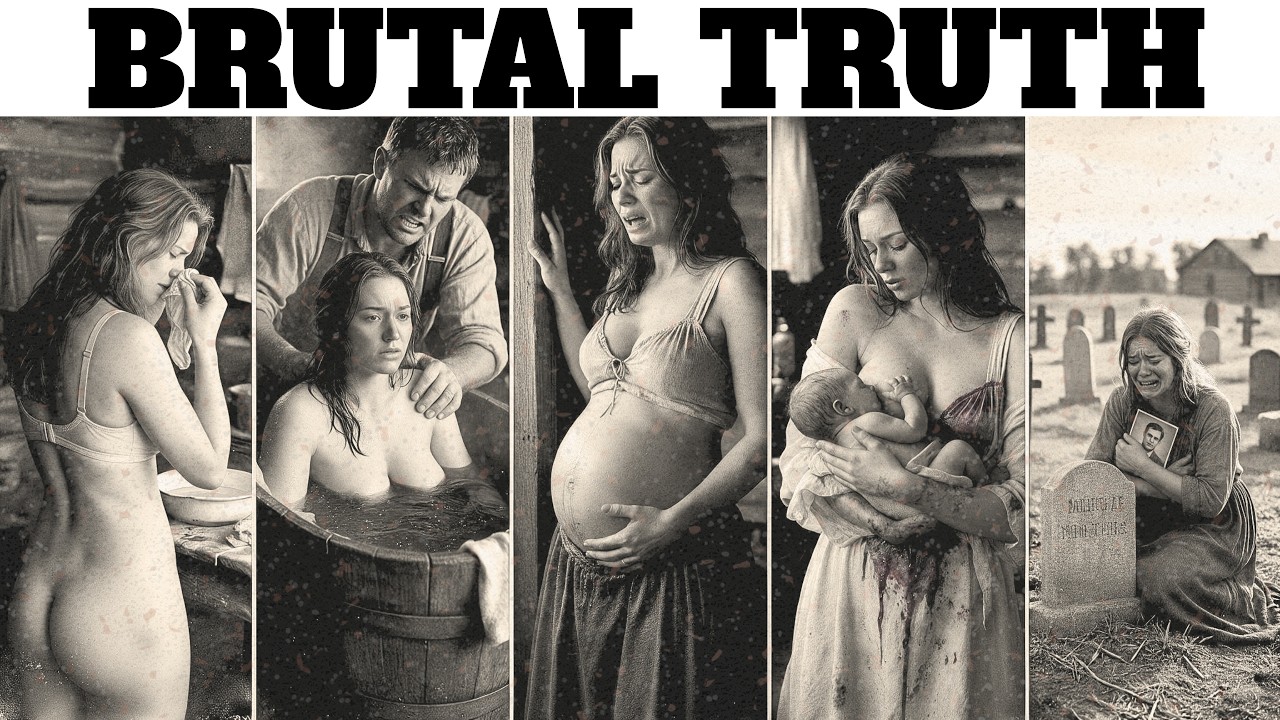
Hollywood usually shows the frontier woman after the hard part is over.
She stands beside a cabin.
Her dress is clean.
Her hair is pinned.
A baby rests peacefully against her shoulder.
Somewhere behind her, a husband splits wood while sunlight falls across an untouched prairie.
The image looks difficult enough to feel authentic.
It is not difficult enough.
Because for thousands of women who crossed, settled, worked and survived the nineteenth-century American West, the frontier was experienced through the body before it was experienced as an idea.
Feet blistered from walking beside wagons.
Hands split from laundry and winter water.
Spines carried children, water buckets, firewood and food.
Pregnancy continued while wagons continued.
Birth occurred without hospitals.
Infection could follow.
Blood loss could become fatal.
Illness had to be endured while meals were still prepared and livestock still needed attention.
And for women whose race or legal status placed them outside white society’s definition of “respectable womanhood,” the danger could go much further.
Their bodies could be bought.
Inspected.
Interrogated.
Restricted.
Worked without consent.
Sexualized by immigration law.
Or moved across hundreds of miles because somebody else claimed ownership over them.
That is the part of the frontier mythology almost always cropped out of the picture.
The first brutal truth is that the covered wagon was not a protective shell carrying women comfortably west.
Most able-bodied emigrants walked enormous portions of the route.
The wagon carried flour.
Tools.
Furniture.
Bedding.
Weapons.
Spare parts.
Food.
Children too small to walk.
The sick.
The injured.
Space was precious.
A pregnant woman did not simply stop being part of the migration because her body was preparing to give birth.
The Sager family’s journey in 1844 shows what that could mean.
Naomi Sager left Missouri pregnant with her seventh child.
Five weeks into the journey, she gave birth on the Oregon Trail.
Her daughters later remembered how visibly weak the birth left their mother.
The family continued west.
Then Naomi was injured and later developed a severe fever.
Her husband died first.
Naomi, still physically depleted, died before the children reached Oregon.
Seven children arrived as orphans.
Her daughter Matilda remembered her mother’s suffering inside the moving wagon.
The jolting itself became almost unbearable.
That detail matters.
A covered wagon had little meaningful suspension.
Travel over ruts, rocks and uneven ground repeatedly slammed bodies against wood.
Pregnancy did not magically turn that motion gentle.
Childbirth did not produce six weeks of protected recovery.
The trail kept moving because weather did.
Grass disappeared.
Food declined.
Snow approached mountain passes.
A woman’s body could require rest at precisely the moment the migration schedule allowed none.
That contradiction followed women west.
Pregnancy was not an unusual interruption to frontier life.
It was part of frontier life.
Women conceived during migration.
They gave birth in cabins.
Mining settlements.
Army posts.
Farmhouses.
Wagons.
And homes that might be many miles from the nearest trained physician.
In much of nineteenth-century America, childbirth still depended heavily on women themselves.
Experienced relatives.
Neighbors.
Midwives.
Women who had attended enough births to know when something looked wrong.
Sometimes they could save a mother.
Sometimes nobody could.
Before modern antibiotics, puerperal infection could turn childbirth into a death sentence.
Before blood transfusion became practical medicine, catastrophic hemorrhage offered few good options.
Before cesarean surgery became reliably survivable, an obstructed birth could place both mother and child in extreme danger.
And even a technically successful delivery could leave a woman physically weakened while the workload around her barely changed.
The frontier did not invent dangerous childbirth.
Women everywhere faced it.
What the frontier often added was distance.
Distance from doctors.
Distance from hospitals.
Distance from family.
Distance from another experienced woman.
Distance from help.
That medical isolation eventually helped create opportunities for women healers precisely because communities desperately needed them.
Susan La Flesche Picotte grew up on the Omaha Reservation in Nebraska.
According to the National Library of Medicine, she remembered watching a sick Indigenous woman die after a white doctor failed to come and provide care.
The experience helped drive her toward medicine.
In 1889, she became the first American Indian woman in the United States to earn a medical degree.
After returning to Nebraska, she was responsible for medical care across an enormous territory, eventually serving more than 1,300 people over approximately 450 square miles.
That number reveals something beyond Picotte’s achievement.
It reveals how thin medical infrastructure could be.
A single physician could be responsible for people scattered across hundreds of square miles.
Illness did not wait for the doctor’s horse to arrive.
Birth certainly did not.
Women therefore became nurses by necessity even when nobody called them nurses.
They treated children.
Cleaned wounds.
Prepared food for the sick.
Sat beside fevers.
Helped neighbors through labor.
Used remedies passed through families.
And watched people die when those remedies were not enough.
The body was also a labor machine.
Frontier mythology often describes women as “helping” husbands establish farms.
The verb is misleading.
Women planted.
Harvested.
Raised poultry.
Milk cows.
Made butter.
Preserved food.
Carried water.
Cooked over heat.
Made clothing.
Mended clothing.
Washed clothing without modern plumbing.
Cared for children.
Managed boarders.
Worked businesses.
And sometimes did traditional male agricultural labor because nobody else was available.
Adeline Warfield Hornbek’s Colorado life is one example.
She helped build and operate a ranch, gave birth while living in Colorado, endured a devastating flood, became a widow with three young children at thirty-one, rebuilt, later homesteaded in the Florissant Valley and eventually managed a substantial cattle operation employing ranch hands.
The point is not that every frontier woman possessed superhuman stamina.
The point is that survival could demand work regardless of whether a body was exhausted.
Domestic work is physically repetitive.
Laundry alone could consume enormous strength.
Water had to be carried or heated.
Wet cloth became heavy.
Scrubbing meant bending and lifting for hours.
In winter, cold water cracked skin.
Cooking meant smoke and heat.
Childcare happened simultaneously.
A woman might spend all day producing the basic conditions that allowed everybody else in the household to work.
None of that looked heroic enough for dime novels.
Yet settlements could not function without it.
Women’s bodies also became economically valuable in unexpected ways.
During mining booms, thousands of men arrived without families.
Suddenly tasks treated as unpaid female obligations back East became marketable services.
Cooking.
Laundry.
Beds.
Sewing.
Meals.
A woman capable of feeding fifty miners could make more money than she had ever imagined earning elsewhere.
But opportunity did not remove physical cost.
A woman running a boardinghouse might wake before her customers, cook breakfast, clean rooms, wash bedding, shop for provisions, prepare supper and repeat the process every day.
The frontier could give women economic independence by commercializing the very labor that had exhausted them for free.
That contradiction appears again in homesteading.
The Homestead Act allowed certain unmarried, widowed and otherwise legally eligible women to claim land in their own names.
Women became landowners in meaningful numbers, particularly across western states.
The National Park Service links female homesteading to the growth of western suffrage movements and notes that land-owning women became participants in political networks that helped push voting rights forward.
But owning land did not mean escaping physical labor.
It could mean the opposite.
A woman without a husband might now possess legal control over a farm precisely because she was responsible for proving it up.
The independence was real.
So was the work.
Then there was clothing.
Popular culture has produced two equally misleading pictures.
One claims frontier women somehow abandoned nineteenth-century fashion and lived in comfortable modern-looking dresses.
The other imagines every woman permanently crushed inside an impossibly tight corset.
Neither works.
Corsets were common in nineteenth-century female dress, particularly among middle- and upper-class women, but how tightly they were worn varied enormously.
Work, class and circumstance affected clothing.
Dress reformers did argue that extreme tight lacing could compress the ribs and internal organs, and physicians debated its health consequences for generations.
But the familiar myth that ordinary frontier women universally laced themselves until they fainted is not history.
What mattered more practically was the sheer quantity of fabric.
Long skirts.
Petticoats.
Layers.
Heavy winter clothing.
Clothing became soaked.
Mud clung to hems.
Open fires created risk.
Horseback riding required adaptation.
Physical work occurred inside clothing designed partly around ideals of modesty rather than ease of movement.
The frontier did not erase femininity standards simply because those standards were inconvenient.
Another bodily reality is strangely difficult to reconstruct.
Menstruation.
Women obviously menstruated on wagon trains, ranches and in mining towns.
Yet nineteenth-century diaries that describe death, birth, food shortages and weather in exquisite detail often become silent around menstrual bleeding.
That silence should not be filled with invented claims.
We know women historically used washable cloth and other reusable absorbent materials before commercial disposable menstrual products became common.
What we often do not know is exactly how an individual frontier woman managed her period during a specific crossing or settlement.
The absence itself is historically revealing.
Women were expected to manage a recurring bodily process privately even in circumstances where privacy barely existed.
A wagon train might contain dozens of people sleeping only yards apart.
Water might be limited.
Laundry was laborious.
Yet menstruation remained socially unspeakable enough to disappear from many surviving records.
Childbirth could at least enter the diary.
Menstruation often did not.
Sexuality was regulated just as intensely.
The nineteenth-century West did not simply divide women into respectable wives and prostitutes.
That was the mythology.
Real lives crossed those boundaries.
Sex workers could become wives.
Wives could run businesses.
Widows could remarry.
Single women could own land.
Some women voluntarily entered sex work because frontier economies offered unusually high earnings.
Others were coerced.
Still others were trafficked outright.
Chinese women reveal the darkest version of this history.
Human trafficking into western prostitution networks was real.
National Archives records document women recruited in China with promises of work or marriage and then sold after arriving in the United States.
One trafficking organization was estimated to have moved thousands of women during the nineteenth century.
The 1870 census counted more than 1,500 Chinese women classified as prostitutes in San Francisco alone.
But American politics converted that genuine exploitation into a racial stereotype.
Instead of distinguishing between trafficked women, voluntary migrants, wives and daughters, lawmakers increasingly treated Chinese female immigration itself as suspicious.
The Page Act of 1875 prohibited importing women for prostitution and gave immigration officials broad power to determine whether Asian women were supposedly arriving for “lewd and immoral purposes.”
The National Park Service notes that in the intensely anti-Chinese climate of the era, the law became a major barrier for Chinese women generally and helped prevent Chinese men already living in America from forming families.
So a woman’s body became evidence.
Female.
Chinese.
Therefore potentially immoral.
The state could interrogate her sexual respectability before deciding whether she belonged in the country.
This is one of the ugliest recurring patterns in western women’s history.
A real danger to women becomes a reason to control women.
Trafficking existed.
The response became female exclusion.
Sexual exploitation existed.
The response included moral policing of women.
Disease existed.
Sex workers themselves became stigmatized as disease carriers while their male customers often escaped equivalent condemnation.
The body became both victim and alleged source of the problem.
For Black women, the frontier’s promise of freedom could be equally deceptive.
California entered the Union as a free state.
That did not prevent enslavers from bringing enslaved people west.
In 1856, fourteen Black women and children held by slaveholder Robert Smith were freed through a California legal case.
Among them was Biddy Mason, who later became a successful Los Angeles property owner and community leader.
Her story destroys the idea that crossing into the West automatically meant freedom.
A Black woman could physically enter “free soil” while another person continued claiming ownership of her labor and movement.
Her body crossed a legal boundary before her legal status caught up.
For Indigenous women, the frontier was not a frontier at all.
It was home.
That distinction changes the entire narrative.
White women moving west are often described as entering wilderness.
Indigenous women were watching settlers enter existing nations, communities and landscapes.
Colonization disrupted food systems.
Moved populations.
Introduced epidemic disease.
Imposed federal authority.
And eventually placed many Native communities under reservation systems where medical care could be inadequate and controlled by outside agencies.
Susan La Flesche Picotte’s childhood memory of a woman dying after a white physician failed to come is inseparable from that system.
Her later medical career was therefore more than an individual triumph.
It was an answer to a structure in which Indigenous bodies could depend upon officials who did not treat their lives as urgent.
Frontier medicine itself often misunderstood women.
Nineteenth-century medical theory routinely treated the female reproductive system as central to women’s physical and psychological health.
Menstruation, pregnancy, sexuality and menopause could all be interpreted through theories now recognized as deeply limited.
Women also faced obstacles entering formal medicine.
The 1870 census counted 525 trained women physicians in the entire United States, and only a minority attended conventional medical schools because most institutions still excluded them.
That shortage mattered enormously on the frontier.
Many women preferred female practitioners for reproductive care.
Yet there might be none.
The result was an odd medical world where women possessed enormous practical experience caring for bodies but little institutional authority over medicine.
A midwife might have attended hundreds of births.
A male doctor with formal credentials could still possess greater legal and social standing.
Professional medicine expanded westward slowly.
Women continued filling the gaps.
Then there were bodies damaged not by dramatic frontier events but repetition.
Arthritis.
Back injuries.
Rheumatism.
Chronic pain.
Bodies prematurely aged by labor.
Matilda Sager’s later life illustrates the continuity.
She survived the Oregon Trail as a child.
She became a wife and mother.
She was widowed young with five children.
She worked as a laundress to survive.
Later in life, rheumatism became increasingly troublesome.
No gunfighter caused that.
No Indian attack.
No legendary blizzard.
A lifetime did.
That may be the darkest truth about women’s bodies on the American frontier.
Most physical suffering was not spectacular enough to become legend.
The body simply accumulated the frontier.
Pregnancy.
Birth.
Work.
Heat.
Cold.
Smoke.
Poor water.
Infection.
Injury.
Grief.
Repeated pregnancies.
Child deaths.
Widowhood.
Miles walked.
Buckets carried.
Laundry lifted.
Sleep lost.
The mythology preserves the moment a woman survives a dramatic crossing.
It rarely asks what that crossing felt like in her hips twenty years later.
Or whether childbirth damaged her permanently.
Or whether she lived with prolapse, incontinence or chronic pelvic pain that no diary named.
Historians must be careful here.
We cannot diagnose dead women simply because such injuries were medically possible.
The surviving record often does not tell us.
That silence matters too.
Women lived inside bodies that official history frequently refused to describe.
Census takers counted them.
Land offices recorded them.
Courts classified them.
Immigration inspectors interrogated them.
Doctors sometimes described them.
But the woman herself might leave no testimony explaining what the body actually felt like.
And this is why the frontier photograph can lie without being fake.
Look at a nineteenth-century woman standing beside a sod house.
She is upright.
Still.
Covered from throat to ankle.
The exposure lasts seconds.
You cannot see whether she is pregnant.
Bleeding.
Recovering from childbirth.
In pain.
Exhausted.
Hungry.
Or stronger than the people around her imagined possible.
You cannot see how many hours she worked before the photographer arrived.
You cannot know whether the child missing from the photograph had died.
You cannot know whether the house belongs to her.
You cannot know whether the law considers her free.
The picture records a body.
History has to recover the life inside it.
That is where the darker frontier appears.
Women’s bodies were not simply passengers through western expansion.
They powered it.
They reproduced settler populations.
Worked its farms.
Fed its miners.
Nursed its sick.
Built households.
Provided paid sex and unpaid domestic labor.
Carried children across trails.
And survived legal systems that frequently classified them according to race, marital status and sexual respectability.
Some women gained freedoms unavailable elsewhere.
Land.
Business ownership.
Political influence.
Professional careers.
The West could genuinely widen possibilities.
But those possibilities were purchased through bodies expected to absorb extraordinary physical cost.
That is what Hollywood almost never shows.
The frontier woman standing proudly beside her cabin is real.
But so is the woman who gave birth five weeks into an Oregon Trail journey and never recovered her strength.
So is the Chinese woman who arrived expecting employment and discovered somebody had purchased her.
So is the Black woman who reached a free state while still being held as property.
So is the Native woman waiting for a doctor who never came.
And so is the widow who harnessed the horses the morning after realizing nobody else was going to do it.
The darkest truth about women’s bodies on the American frontier is not that they were fragile.
It is that society repeatedly demanded that they endure conditions that would break almost anyone—
and then remembered their endurance as if the suffering had never happened.


