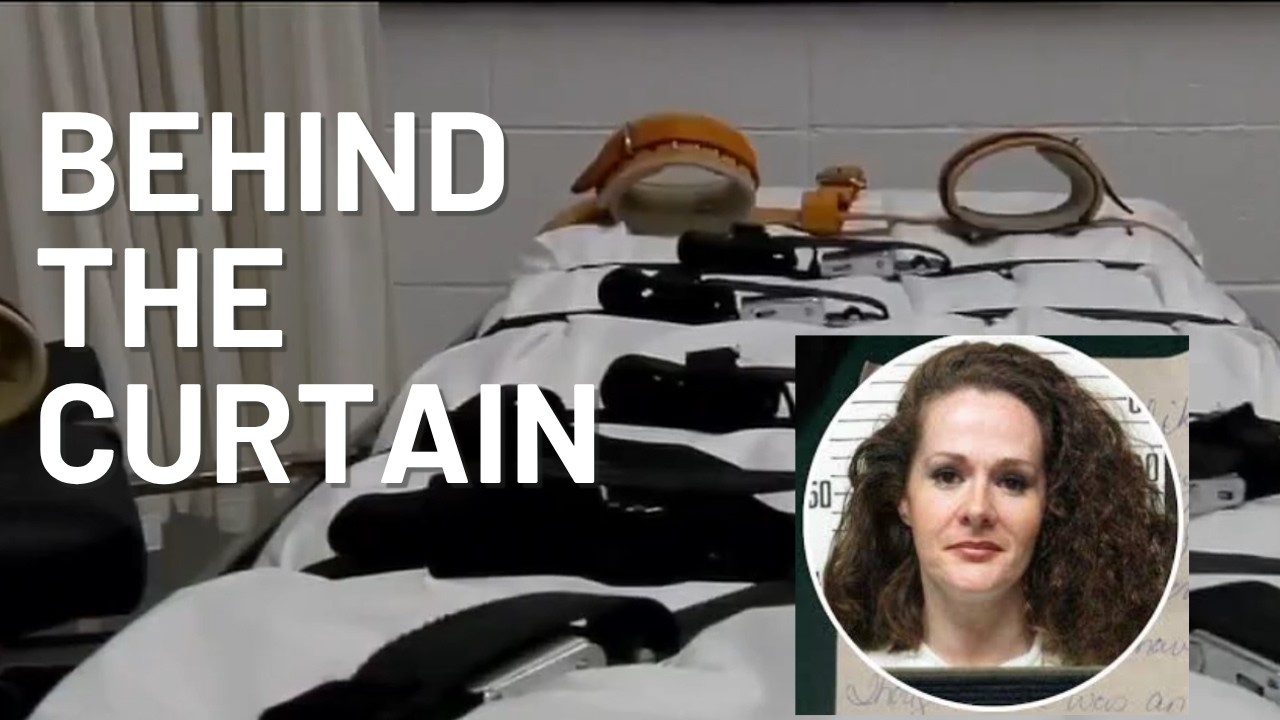
At 7:27 p.m. on September 30, 2026, the curtain inside Riverbend Maximum Security Institution opened.
Christa Pike was already strapped to the execution gurney.
Intravenous lines had been inserted.
Her spiritual adviser stood near her head.
Behind thick glass sat reporters, attorneys and relatives of the woman Pike had been convicted of killing more than thirty years earlier.
Everyone in the witness rooms had been brought there for the same reason.
They expected to watch Christa Pike die.
Instead, they watched something Tennessee’s execution protocol apparently had not prepared them for.
She stayed alive.
For more than an hour, witnesses saw or heard Pike breathe after the state began administering pentobarbital.
They watched her lift her head.
They heard her complain that her arm hurt.
One reporter heard her say it felt as though the arm might burst.
They watched the curtain close.
Then reopen.
They heard breathing described as snoring.
At moments, one witness thought the sound resembled choking.
Then the curtain closed again.
This time it stayed shut.
Pike was still alive behind it.
What happened after that second closure has become one of the central mysteries of Tennessee’s failed execution.
The state says it followed every step of its protocol.
Pike’s lawyers say the procedure became a medical catastrophe.
Witnesses say they were prevented from seeing much of the most consequential period.
And four days later, Pike’s attorney said she still had not regained consciousness.
The public record begins hours before the curtain ever opened.
Pike had been scheduled to die at 10 a.m.
A federal appeals court temporarily stopped the execution while judges considered claims involving her sentencing and medical circumstances.
The legal battle lasted most of the day.
Then shortly before 6 p.m. Central time, the U.S. Supreme Court allowed Tennessee to proceed.
That meant an execution originally planned for the morning was suddenly being prepared in the evening after hours of uncertainty.
By the time witnesses were brought into position, Pike had already undergone the process of establishing IV access.
Her lawyers later said that stage itself had been extraordinarily difficult.
Attorney Randy Spivey said he saw at least seven needles used on one arm.
He said one appeared badly bent when it was removed.
The defense had warned Tennessee beforehand that Pike had difficult veins and a blood disorder that could complicate IV access.
Those warnings would become crucial after the procedure failed.
But the people in the witness room did not see most of that preparation.
What they saw began at 7:27.
The curtain rose.
Pike was conscious.
Her spiritual adviser spoke quietly to her.
The two sang together.
Associated Press witnesses could not make out all the lyrics, but heard a repeated expression of affection.
Her adviser stroked her forehead.
Pike smiled.
She looked around the room.
Then she delivered what everyone assumed would be her final statement.
One witness, journalist Damon Lawrence, recalled her saying:
“I’m at peace, and I’m ready to go.”
Pike also spoke about leaving the world with love, including love for people angry with her.
For a brief period, the execution appeared to be proceeding like other lethal injections.
Then Pike began reacting.
She raised her head.
She looked around.
And she started talking about her arm.
Associated Press witnesses heard her ask whether the pain she was feeling was normal.
Another media witness, Tori Gessner, recalled Pike saying that her arm felt as though it was about to burst open.
That statement now matters far beyond the witness room.
Pike’s attorneys say hospital examinations later showed severe injuries to both arms.
They allege pentobarbital escaped the veins and entered the surrounding tissue.
If that occurred, it could explain both Pike’s pain and why a drug intended to reach her bloodstream rapidly failed to kill her.
The state’s independent review has not yet issued a final determination, so IV infiltration remains an allegation and leading hypothesis rather than an established official finding.
At 7:37 p.m., witness Will Puckett saw Pike take several very large breaths.
He described the movement as strong enough that her body visibly rose against the restraints.
Four minutes later, something unusual happened.
A small rock or paperweight was placed on a ledge inside the chamber.
Witnesses had seen this signaling practice in other Tennessee executions.
TDOC has not publicly explained its meaning, but its timing appeared to correspond with the point in the written protocol after drug administration when officials begin counting down toward the next stage.
At 7:45, Pike gave what one witness described as a very large yawn.
At 7:46, the curtain closed.
She was still alive.
That fact is undisputed.
What happened in the next three minutes was hidden from the witness room.
Then the curtain reopened.
Pike’s spiritual adviser returned to her side.
And Pike began making a noise that has become one of the most discussed details of the entire execution.
Snoring.
Witnesses described rhythmic respiratory sounds.
Her mouth was open.
She continued breathing.
One reporter said the noise sounded less like peaceful sleep and more like someone almost choking.
The distinction matters.
“Snoring” sounds harmless.
Medically, it does not establish comfort.
A deeply unconscious person can snore because air is moving through a partially obstructed airway.
Someone in respiratory distress can also make harsh airway sounds.
No witness could know precisely what Pike was experiencing internally.
But they did know one thing:
She was not dead.
At approximately 7:56, witnesses saw Pike’s head lift slightly and turn to one side.
She continued breathing.
Tennessee’s protocol contained a contingency.
If the first pentobarbital administration failed to result in death, a second round could be administered.
The state used that backup.
At around 8:01, witnesses saw the small rock placed on the ledge again.
The precise internal sequence remains under investigation, but the timing suggested the second administration had reached a comparable stage.
Still, Pike remained alive.
Five minutes later, at approximately 8:06, officials closed the curtain for the second time.
It did not reopen.
This is the moment that now dominates the questions about transparency.
Tennessee law allows media witnesses to observe executions because the act is being carried out by the government in the name of the public.
Yet WSMV found that the state’s witness policy does not clearly explain when officials may close the curtain.
Witnesses said significant portions of Pike’s failed execution occurred while they could not see inside.
The curtain blocked sight.
It did not block sound.
For roughly another forty minutes, witnesses could hear Pike breathing from behind it.
AP described a regular, rhythmic snoring pattern.
Nobody in the witness room had been told that the execution had officially ended.
Nobody had been told that Pike was dead.
Nobody had been told that doctors were now trying to save her.
They simply waited.
Pike’s attorney Randy Spivey later said that around 8:22 p.m., he demanded access to a telephone.
He wanted to contact other members of the legal team and ask a court to halt what was happening.
He also demanded emergency medical treatment.
According to Spivey, there were delays before he could communicate outside the witness area.
At approximately 8:50, he was told an ambulance was coming.
Then, at 8:53, the witnesses heard an announcement telling them to leave.
They were escorted from the area.
A prison spokesperson had no explanation ready for them.
The curtain was still closed.
Pike had never been pronounced dead.
And witnesses were being removed from the prison without knowing what state she was in.
Emergency vehicles arrived at Riverbend at roughly 9:14.
An ambulance later left the prison under police escort.
Christa Pike, who had entered the execution process under a valid death warrant, was now being taken to a hospital for life-saving treatment.
That sequence is almost impossible to overstate.
The state had spent decades defending the legality of Pike’s death sentence.
It had fought last-minute appeals that same day.
It had obtained permission from the Supreme Court to proceed.
It administered the primary pentobarbital dose.
Then the backup dose.
And after exhausting the procedures its own protocol authorized, Tennessee had to call an ambulance because the prisoner was still alive.
The Department of Correction’s initial explanation was extraordinarily limited.
It said its personnel had followed the protocol.
It said the chemical had previously been effective.
And it acknowledged that its written procedure contained no additional execution step after the measures already attempted.
That left witnesses with more information about Pike’s visible condition than the public initially received from the state.
May Martinez, Colleen Slemmer’s mother, had traveled to Nashville to witness the execution.
She said she never took her eyes off Pike.
According to Martinez, Pike remained awake and moving during portions of the procedure.
She saw Pike move her head and feet.
She said Pike appeared at one point to try to lift herself.
Martinez had expected the night to provide finality after more than thirty years.
Instead, she later said simply:
She did not get justice for her daughter.
That response matters because the failed execution produced trauma on multiple sides.
Pike’s attorneys describe severe suffering inflicted by the state.
Slemmer’s mother describes being forced to watch another traumatic event related to the murder of her nineteen-year-old daughter.
Both now want answers from Tennessee, even though they want very different outcomes.
For the defense, those answers begin with the IVs.
Pike’s lawyers say both arms became swollen and blistered.
They argue that the pentobarbital entered soft tissue.
If confirmed, that could explain Pike’s complaint that her arm felt as though it might burst.
It could also explain why the nominal amount of drug administered did not translate into a lethal concentration in the bloodstream.
Investigators must examine other possibilities too.
Drug potency.
Preparation.
Storage.
Timing.
The integrity of the IV lines.
When officials first recognized that death was not occurring.
Why the backup dose was used if the primary administration may already have demonstrated IV problems.
And what happened during the approximately forty-seven minutes after witnesses lost visual access.
Those questions are exactly why Pike’s lawyers have asked a court to preserve records, communications, images, video and physical evidence from September 30.
There is another troubling aspect.
This was not Tennessee’s first failed execution attempt in 2026.
In May, officials abandoned Tony Carruthers’ execution after they could not establish the required secondary IV line.
No lethal drug was administered in that case.
Pike’s attorneys cited that failure while warning that her own vein-access problems could produce a dangerous result.
Months later, Tennessee encountered IV difficulties again—except this time, the state proceeded with the drugs.
That history has now triggered consequences beyond Pike’s individual case.
Governor Bill Lee halted Tennessee’s remaining execution for 2026 and ordered an independent review.
Former U.S. Attorney Ed Stanton has been selected to conduct it.
Corrections Commissioner Frank Strada announced his resignation after the failed execution, while maintaining that he believed staff had followed the protocol.
The review will have to reconcile two statements that cannot comfortably coexist.
The first is Tennessee’s position that the protocol was followed.
The second is the result.
A living prisoner.
Severe arm injuries.
Emergency transportation.
Four days of unconsciousness and mechanical ventilation.
If staff deviated from the protocol, investigators must find where.
If staff followed it correctly, Tennessee may have an even larger problem:
A protocol can be technically followed and still fail catastrophically.
The curtain issue could therefore become more important than it first appears.
Execution secrecy is not unique to Tennessee.
States commonly restrict public access to details about drugs, personnel and technical procedures.
But AP notes that Tennessee, like several other death-penalty states, also limits what witnesses can see during parts of the execution process.
Critics argue that closing curtains during complications prevents journalists from fulfilling their role as independent public observers.
Pike’s execution provides a nearly perfect example of that tension.
Before the second curtain closure, witnesses saw a prisoner still breathing.
Afterward, they heard her breathing but could not see what staff were doing.
They did not know whether officials were checking IV access.
Whether more medication was being considered.
Whether medical personnel had entered.
Whether the state had shifted from execution to resuscitation.
Whether Pike’s physical condition was deteriorating.
They knew only what sound could travel through the barrier.
Then even that stopped when the microphone was cut and the witnesses were removed.
Pike’s legal team says that uncertainty itself demonstrates why Tennessee needs greater transparency.
Assistant Federal Defender Stephen Ferrell argued on October 4 that the public should know exactly what its government does during an execution carried out in its name.
His urgency has increased because Pike remains unable to provide her own account.
Ferrell told CNN that, to his knowledge, she has not regained consciousness since the execution attempt.
She gave another person medical power of attorney before the procedure, and that person is currently controlling access to her private medical information.
Her lawyers say they may not know her ultimate prognosis for several more days.
That makes the witness testimony unusually significant.
If Pike never remembers the procedure, outside observers may provide the only independent descriptions of what happened while she was visibly conscious.
They heard the complaint about her arm.
They saw her lift her head.
They watched the large breaths.
They heard the snoring-like respiration.
They saw the curtain close while she remained alive.
And they can establish roughly how long the state continued its process before an ambulance was summoned.
What they cannot tell investigators is what happened after the curtain fell.
Only Tennessee’s internal records, execution personnel and preserved physical evidence can do that.
And that is why September 30 is no longer simply a story about a death sentence.
It is a story about public accountability.
The state has extraordinary authority when it executes a prisoner.
It chooses the room.
The restraint system.
The witnesses.
The chemicals.
The IV procedure.
The timing.
The employees permitted inside.
The information released afterward.
And, in Tennessee, when the curtain comes down.
Normally, the prisoner cannot later challenge the state’s description of those final minutes.
The prisoner is dead.
Christa Pike survived.
That single fact changes the nature of the investigation.
If she recovers, she may someday describe what the witnesses could not see.
She may explain what she felt when she complained about her arm.
She may remember when she lost consciousness.
She may remember nothing.
For now, Pike cannot speak.
The witnesses can.
Their accounts do not tell us exactly why Tennessee failed.
They do establish something the state cannot explain away.
At 7:27 p.m., the curtain opened on what everyone expected to be an execution.
At 8:06, it closed on a woman who was still breathing.
For approximately forty more minutes, the witnesses could hear her alive behind it.
Then Tennessee sent them away.
An ambulance arrived.
And the next time the public learned where Christa Pike was, she was not in a morgue.
She was in a hospital, unconscious, on a ventilator.
Four days later, she still has not awakened.
The investigation now has to determine what the curtain concealed.
Because somewhere between Pike saying she was ready to die and the ambulance leaving Riverbend—
Tennessee’s execution became an emergency rescue.


