October 1946.
A German former officer sat down somewhere inside the British occupation zone of Germany and began writing a letter in English.
The recipient was not a relative.
Not another German soldier.
Not a government official.
He was an American cotton farmer in Arkansas.
The German reminded the farmer who he was.
He had worked on his farm the previous summer.
He had picked cotton for him.
Then he explained what had happened.
In April, he had left the United States believing that after years of war and captivity he was finally going home.
Instead, he wrote, he had been transferred to the British Army of occupation.
The war had ended 17 months earlier.
He was still a prisoner of war.
His family did not have enough food.
And because he remained a prisoner, he could do almost nothing to help them.
So the former enemy soldier asked the American farmer for something painfully simple.
A food package.
At the bottom of the letter, he apologized.
“Please excuse my bad English style.”
His name, rendered imperfectly in the source transcript, was something close to Verer Gay Bower.
He was far from alone.
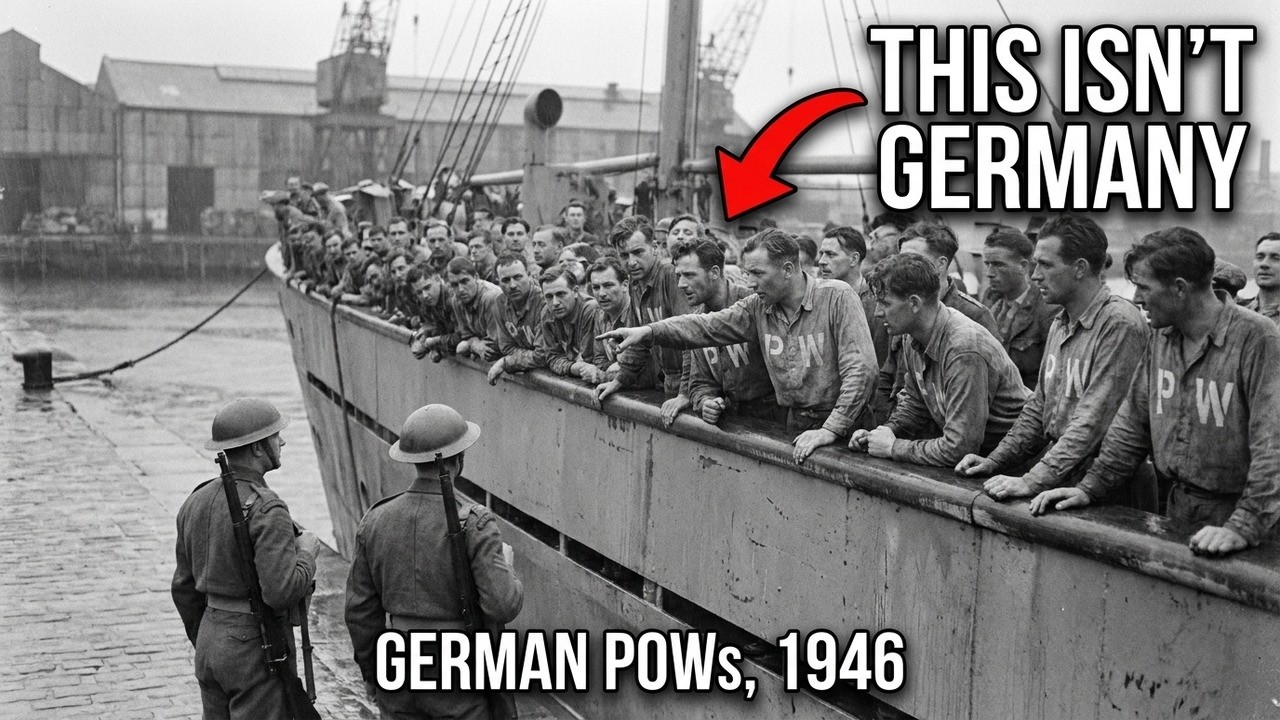
During the spring and summer of 1946, tens of thousands of German prisoners boarded ships in American ports.
Many believed the ships were finally taking them home.
Some had spent years behind American barbed wire.
They had worked on farms.
Picked fruit.
Harvested cotton.
Baked bread.
Repaired equipment.
They had watched Germany surrender from thousands of miles away.
Now the prison camps were closing.
The United States wanted them gone.
For many prisoners, there seemed to be only one logical destination.
Germany.
Then the ships reached Europe.
And thousands discovered that captivity was not over.
Some were sent to Britain.
Some to France.
Others remained under British control inside Germany.
They would continue working.
Continue sleeping behind wire.
Continue waiting.
One British member of Parliament would later say the men felt they had been tricked.
Yet this story contains a strange contradiction.
Some of the same Germans who bitterly remembered being shipped away from America would later spend years trying to return to it.
One former prisoner had picked lemons in California.
After finally regaining his freedom, he discovered that his hometown now lay inside the Soviet occupation zone.
He did not want to stay there.
He wanted California.
Years later, he made it back.
He attended an American university.
Built a career in electronics.
Became a Boy Scout leader.
And settled along the same California coast where he had once worked as an enemy prisoner.
His wife eventually described him with three words that would have been almost unimaginable when he first arrived behind American barbed wire.
A true American.
The story begins during the war.
At 18, the young German identified in the source approximately as U. Vin Halt faced a choice.
Wait to be drafted and risk being sent to the Eastern Front.
Or volunteer for the Luftwaffe.
He chose the Luftwaffe.
He trained as a radar operator.
Eventually he was stationed on a beach in southern France.
Then came the summer of 1944.
American forces landed along the French Mediterranean coast.
Halt was captured.
Like hundreds of thousands of other German POWs, he crossed the Atlantic in the opposite direction from the American troops heading toward Europe.
His destination was California.
Camp Cooke in Santa Barbara County.
From there, he was sent into branch camps serving the citrus-growing areas farther south.
Fillmore.
Santa Paula.
Ventura.
Oxnard.
American agriculture had a manpower problem.
Millions of men had entered military service.
Farms still needed workers.
Fruit still had to be harvested.
So prisoners became part of the labor supply.
Halt picked lemons.
The work was important enough that the University of California produced German-language instructions explaining how to do it correctly.
The central lesson was simple.
Treat the lemons carefully.
Like eggs.
Halt was approximately 20 years old.
For months, the German radar operator worked among California citrus groves.
He was still a prisoner.
Still under American authority.
Still thousands of miles from Germany.
But he was also encountering the United States at ground level.
Farmers.
Workers.
Small towns.
Agricultural routines.
Ordinary Americans.
That experience would matter later.
When Germany surrendered in May 1945, the legal and practical question of what to do with the prisoners became increasingly urgent.
American farmers had grown dependent on POW labor.
Many wanted the Germans to remain longer.
Fields did not suddenly stop requiring workers because Hitler was dead.
According to the source, President Harry Truman allowed the prisoners to remain for an additional 60 days of agricultural work beginning in January 1946.
But pressure was changing.
American veterans were coming home.
They needed jobs.
Keeping enemy prisoners in the United States as laborers became increasingly difficult to justify.
In April 1946, Truman refused to continue holding them for that purpose.
The order was clear.
German prisoners were to be out of the United States by the end of June.
For the POWs, that sounded like freedom.
The camps were closing.
Ships were waiting.
Germany was no longer at war.
Many prisoners assumed deportation from America meant repatriation to Germany.
But rumors circulated.
England.
France.
Russia.
A POW newspaper in Massachusetts noted how much the men talked about where they might actually be sent.
Some feared they would not be going home at all.
Yet when departure finally came, many apparently still believed Germany was their destination.
Wolfgang Yonir, another former prisoner mentioned in the source, later said American personnel at his camp told him he would be shipped directly home.
On July 22, 1946, roughly 1,500 men reportedly sailed from Camp Shanks north of New York City in the final major shipment described by the source.
But behind the scenes existed an arrangement many prisoners apparently did not understand.
The problem reached back to 1942.
Britain had captured large numbers of German soldiers.
Housing and feeding them during wartime created pressure on British resources.
So Britain asked the United States to hold tens of thousands of prisoners on its behalf.
Physically, those men lived in American camps.
American guards watched them.
American farms employed them.
American communities encountered them.
But administratively, many remained British prisoners.
One German estimate cited by the source placed the number at roughly 130,000.
If that estimate was correct, a substantial portion of the Germans held in the United States were never America’s prisoners to release directly into Germany.
The distinction existed on paper.
The prisoners themselves did not necessarily understand it.
That difference between administrative reality and human expectation became explosive when the ships crossed the Atlantic.
Otto Horns had been imprisoned in Massachusetts.
He sailed in June 1946.
After approximately eight days at sea, a rumor moved through the ship.
The Americans had “sold” them to England as labor.
Horns later remembered that nobody wanted to believe it.
Then the ship arrived.
England.
July 4.
For the United States, Independence Day.
For the German prisoners, another chapter of captivity.
Yonir arrived at Liverpool.
Britain faced the same agricultural labor shortage that had made German POWs valuable in the United States.
So Britain put the prisoners to work.
Halt’s route was different.
According to the Museum of Ventura County account cited in the source, he was first taken to Belgium.
There, American custody ended.
The British Army took control.
Then the British transported him to England.
Once again, he worked on farms.
England.
Wales.
The war was over.
He remained a prisoner.
Others experienced different versions of the same story.
Alois Ziegmund had been held at Fort Robinson in Nebraska.
He too ended up in Britain.
Gay Bower, the former Arkansas cotton worker, did not.
British authorities held him inside Germany at Münster in the British occupation zone.
That may have been especially bitter.
He was back in his own country.
His family was hungry.
Yet he remained unable to go home and help them.
So he wrote across the Atlantic to Ed Gregory, the Arkansas planter and cotton buyer for whom he had once worked.
A German prisoner asking an American former employer to help feed his family.
Other prisoners went to France.
Ernst Kerning had spent his American captivity doing agricultural and food-processing work around an Iowa camp.
Peas.
Corn.
Canned vegetables.
When he returned to Europe, he was not sent home.
He was sent into a French mine.
According to the source, Kerning did not return to Germany until November 1948.
More than three years after Germany’s surrender.
By 1947, complaints about the situation had reached the British Parliament.
In February, the Bishop of Sheffield raised the issue in the House of Lords.
He described German prisoners transferred from America.
They had returned to Europe believing—correctly or incorrectly—that they were finally heading home.
Instead, they found themselves behind British barbed wire.
The distinction in his phrasing matters.
“Rightly or wrongly.”
The source does not establish that every prisoner had been formally promised immediate repatriation.
Nor does it demonstrate a universal American policy of deliberately lying to the men.
Individual prisoners remembered promises.
Individual American personnel may have made them.
Rumors clearly circulated.
Expectations were widespread.
But the documentary arrangement assigning many prisoners to British custody already existed.
Six weeks later, however, the accusation in the House of Commons became sharper.
Tom Driberg, identified by the source as the member for Maldon, said the prisoners had been brought to Britain after receiving specific assurances from Americans that they were going directly home.
Driberg acknowledged an important possibility.
The American officers who made those statements may not have had authority to promise anything.
They may even have said it simply to persuade prisoners to board peacefully.
But according to Driberg, the men believed the assurances.
Then Britain kept them.
The result was resentment.
They felt deceived by people presenting themselves as democrats.
That accusation reveals one of the most uncomfortable contradictions in the postwar POW story.
During captivity in America, the United States had deliberately tried to expose German prisoners to democratic ideas.
Some camps offered education.
Prisoners worked beside civilians.
Friendships formed.
Many Germans later remembered individual Americans with considerable affection.
Then the final act of American captivity appeared, to some prisoners, to violate the trust that had developed.
You are going home.
Board the ship.
Then:
Welcome to Britain.
You are still a prisoner.
Whatever the precise legal arrangements, that experience could feel like betrayal.
And yet the story did not end there.
Because while governments were transferring prisoners through administrative systems, ordinary Americans were writing letters.
Remembering faces.
Offering jobs.
Sponsoring visas.
And waiting for former enemies to return.
Ed Gregory was one of them.
Gregory was a planter and cotton buyer in Parkdale, Arkansas.
German POWs from the nearby camp had worked for him.
After the war, they wrote back.
The University of Arkansas, according to the source, preserves ten letters sent to Gregory by former prisoners.
One came from Fritz Becca.
Becca had been luckier than some of the others.
After being transferred to France, he was released after approximately two months.
In June 1946, Gregory answered him.
At the top of the reply, someone recorded Becca’s appearance.
Black curly hair.
About 155 pounds.
Five feet seven.
A broad smile.
Those details feel almost strangely intimate.
The war had classified Becca as an enemy prisoner.
Gregory’s correspondence remembered him as a person with a face.
Gregory wrote that he was pleased to hear from him.
He was glad Becca’s family was well.
Then he ended with a hope shaped by everything both men had experienced.
May their generation not fail so badly that their children would have to return to the battlefield.
Becca’s own letter contained another remarkable line.
He had spent years behind barbed wire in America.
Yet he told Gregory that three months working with Americans had taught him more about the country and its people than the previous two and a half years of imprisonment.
That distinction appears repeatedly in POW memories.
A camp could show a prisoner American power.
Working beside Americans showed him American people.
The two experiences were not identical.
Some relationships went far beyond correspondence.
At Fort Robinson in Nebraska, an American sergeant had supervised the POW camp bakery.
After the war, he opened his own bakery in Rushville.
One of his former German prisoners was Alois Ziegmund.
Ziegmund had a serious problem.
He no longer had a hometown to return to in the way he remembered it.
Postwar borders had shifted.
His former home was now part of Poland.
The American sergeant offered him a job.
Come back to Nebraska.
Work in the bakery.
It took years.
The immigration quota did not immediately allow Ziegmund to enter the United States.
According to a Nebraska newspaper account cited by the source, he waited approximately four years.
By the time he finally reached Nebraska, the bakery was gone.
The former sergeant had been unable to find enough help.
He had closed it.
Ziegmund stayed anyway.
The original job had disappeared.
The relationship had still brought him back.
He built a new life as an interior decorator.
Another former POW went even further.
William Oadik had picked apples while imprisoned near Nebraska City.
His employer was orchard owner Richard Kimmel.
After the war, Oadik returned to Germany.
Approximately four years later, Kimmel sponsored him.
Oadik came back to Nebraska.
This time he was not alone.
He brought his new wife.
And their baby daughter.
Then he returned to the same orchard where he had once worked as a prisoner.
But his status had completely changed.
Prisoner became immigrant.
Enemy laborer became employee.
Eventually employee became owner.
In 1967, Kimmel sold the orchard to him.
That transformation would have been almost impossible to imagine when Oadik first arrived behind barbed wire.
Yet he was not unique.
The sociologist Barbara Schmidter Heistler studied German immigration to the United States between 1947 and 1960.
According to the source, more than half a million Germans entered during that period.
Among them were several thousand men who had previously lived in America as prisoners of war.
Think about what that means.
Their first American residence had been compulsory.
They crossed the Atlantic under guard.
They slept in camps.
They worked because they were prisoners.
Then they returned voluntarily.
Something about the country they encountered while imprisoned had become attractive enough that, once free, they wanted to build their lives there.
No story illustrates that contradiction better than the former California lemon picker.
Halt was not released until 1948.
By the time he finally returned to Germany, the political map had changed.
His hometown was inside the Soviet occupation zone.
For someone who had spent years experiencing life in the United States and Britain, the prospect held little appeal.
He wanted to return to California.
But wanting America and entering America were different things.
By the time he applied for a visa, the Korean War had begun.
So he went first to Canada.
From there he boarded a train for the West Coast.
His wife later remembered how little he had to eat during the journey.
A loaf of bread.
Some bologna.
He kept going.
Eventually the former German POW reached the place he had been trying to return to.
California.
He attended the University of California at Santa Barbara.
He built a career in electronics.
He became active in the Boy Scouts.
And he settled in Carpinteria, on the same stretch of California coastline where he had once picked lemons as a captive.
The geography had barely changed.
His relationship to it had.
The first time, American soldiers had brought him there.
The second time, he fought to get there himself.
In 2011, when he was 87, his wife Inger spoke to a local columnist about the former Luftwaffe radar operator.
Her assessment was emphatic.
He had become a true American.
She could hardly imagine anyone loving the country more.
That is the paradox at the heart of this story.
The United States captured these men.
Transported them across an ocean.
Held them behind wire.
Used their labor.
Then, when the war ended, transferred many of them to other Allied powers rather than immediately sending them home.
Some prisoners experienced that final transfer as deception.
British politicians publicly acknowledged their resentment.
Yet years later, thousands of former German POWs apparently chose the United States as the country where they wanted to begin again.
The explanation cannot be reduced to one thing.
Postwar Germany was devastated.
Cities had been destroyed.
Food was scarce.
Millions were displaced.
Borders changed.
The Soviet occupation zone offered an uncertain future for men like Halt.
America, by contrast, had emerged from the war economically powerful and physically intact.
Migration could therefore be practical.
But the surviving letters suggest economics alone do not explain everything.
Former prisoners remembered people.
Ed Gregory.
Richard Kimmel.
The Fort Robinson bakery sergeant.
Farm families.
Orchard owners.
Workers.
They had experienced America not as tourists, but from an extraordinarily strange position.
They were enemies who had lost.
They lived inside the victorious country.
They saw its abundance.
Its contradictions.
Its people.
Its farms.
Its workplaces.
Its racial divisions.
Its military discipline.
Its civilian life.
And in some cases, they formed relationships strong enough to survive the end of the war.
That is why Gay Bower’s letter matters.
He had returned to Europe.
But when his family was hungry and he was still imprisoned, whom did he ask for help?
An American cotton farmer.
The relationship between victor and prisoner had somehow survived the Atlantic.
Bower wrote again in January 1947.
His first letter, he explained, had been written while he was still a British prisoner.
Now he had better news.
That small transition captures what tens of thousands of men had been waiting for.
Not the end of the war.
That had happened long before.
Not departure from America.
That had not guaranteed freedom.
What they wanted was the end of prisoner status itself.
To become civilians again.
To return to families.
To decide where to live.
To work because they chose to work.
For some, freedom meant Germany.
For others, the postwar world had changed too much.
Home no longer existed in the same form.
And surprisingly, the place that had once represented captivity began to represent possibility.
America.
This is also why the claim that prisoners were simply “sold” by the United States to Britain needs careful handling.
That was how some prisoners remembered and described the transfer.
It captures their sense of powerlessness.
But the source itself provides a more complicated administrative explanation.
Britain had asked the United States during the war to house large numbers of prisoners on its behalf.
Those prisoners remained, in an important legal or administrative sense, Britain’s responsibility.
When the United States emptied its camps, custody reverted.
That does not erase the prisoners’ anger.
It explains why the transfer happened.
And it leaves a separate question about what individual American personnel told them before departure.
The source supports testimony that some prisoners believed they had been explicitly promised direct repatriation.
It also records British parliamentary criticism of those assurances.
What it does not establish is a universal American policy deliberately designed to deceive every German POW.
That distinction matters.
History becomes less dramatic when uncertainty is preserved.
It also becomes more credible.
What is clear is that many prisoners expected home.
Many did not get it.
Some remained captive until 1947.
Others until 1948.
Ernst Kerning worked in a French mine until November 1948.
Halt remained under British authority until 1948.
Meanwhile, the Americans they had known continued living ordinary postwar lives.
Some of those Americans remembered them.
A cotton farmer answered letters.
A former Army sergeant offered a job.
An orchard owner sponsored an immigrant.
The personal relationships outlasted the prisoner system.
In one case, the former POW eventually owned the orchard where he had once been compelled to work.
That image may be the perfect counterpoint to the ships arriving in Britain.
On one side:
A German prisoner stands aboard a ship believing captivity is over.
He discovers it is not.
On the other:
Years later, another former prisoner steps onto American soil voluntarily.
No guard.
No barbed wire.
No POW number.
He returns to the same farm country where he once worked under captivity.
And stays.
The first journey to America was forced.
The second was chosen.
Perhaps that is why these stories remain so difficult to categorize.
They are not simple accounts of benevolent captivity.
Captivity is still captivity.
The men did not choose to be prisoners.
Some were held long after Germany surrendered.
Some were transferred without understanding what would happen.
Some felt lied to.
Some spent years separated from hungry families.
Nor are they simply stories of Allied exploitation.
The same records preserve affection.
Friendship.
Sponsorship.
Correspondence.
Former prisoners choosing America as their future home.
Both realities existed.
A German could resent what the American government did with him in 1946 and still love the Americans he had met in 1945.
He could remember barbed wire and generosity at the same time.
He could feel deceived by his transfer to Britain and still dream of California.
Institutions and individuals occupied different places in his memory.
That is why the letters are so valuable.
Government records explain policy.
Parliamentary debates explain controversy.
Statistics explain scale.
But a letter to an Arkansas farmer shows what the policy felt like to one man.
The war had ended 17 months earlier.
His family was hungry.
He was still a prisoner.
He could not help them.
So he wrote to the man whose cotton he had picked while imprisoned thousands of miles away.
Please send food.
Please excuse my English.
Behind those sentences is the strange afterlife of America’s German POW camps.
The camps closed.
The men left.
But the relationships did not necessarily end at the gate.
Some crossed the Atlantic through letters.
Some through sponsorship papers.
Some through immigration quotas.
Some took years.
One former POW returned to an orchard.
Another returned to Nebraska after the promised bakery had already disappeared.
And one former Luftwaffe radar operator crossed Canada with little more than bread and bologna because the place he wanted to reach was the same coast where America had once imprisoned him.
He had been shipped there as an enemy.
Years later, he came back by choice.
And stayed for the rest of his life.


