November 3, 1945.
Fort Custer, Michigan.
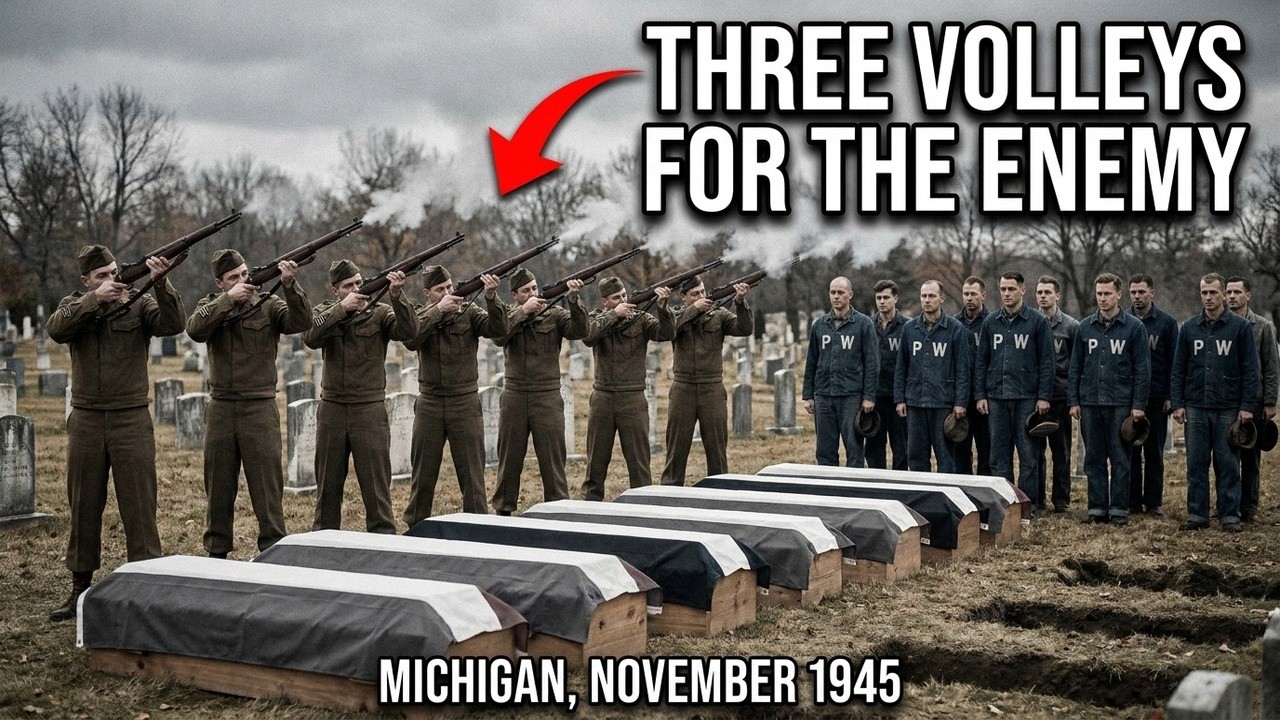
Nine American soldiers stood beside a row of open graves.
Every one of them had served overseas.
Their uniforms carried the evidence.
Ribbons.
Overseas stripes.
Men who had gone abroad during a war against Germany and returned.
Now, six months after the fighting in Europe had ended, they were standing before the coffins of German soldiers.
Not American allies.
Not civilians.
German prisoners of war.
Sixteen of them.
The Americans raised their rifles.
Then fired three volleys over the graves.
Only months earlier, some of those nine soldiers might have been firing at men wearing the same uniform as the dead.
Now they were giving them military honors.
And the day before the funeral, the United States Army had discovered an unusual problem.
Fort Custer possessed exactly one German flag.
Sixteen German POWs were about to be buried.
One flag was not enough.
So the Army contacted its quartermaster system.
Seven more German flags were flown from a depot in Philadelphia to Michigan.
Not Nazi swastika flags.
The contemporary newspaper cited in the source described them as the red, white and black flag of the German Republic.
They would be used to drape the coffins of enemy soldiers who had died in American captivity.
Why?
Because the war was over.
Because these men were prisoners.
And because international law required something from the country holding them.
They had to be buried honorably.
Their graves had to be respected.
And maintained.
The reason 16 Germans needed those graves began three days earlier, on Halloween.
October 31, 1945.
Blissfield, Michigan.
A farming community near the Ohio state line.
The shooting war had been over for months.
But thousands of German prisoners were still in the United States.
According to the cemetery history cited in the source, more than 5,000 German POWs had been held at Fort Custer near Battle Creek.
Some were housed at a branch camp on the outskirts of Blissfield.
They were there because Michigan had a labor problem.
The war had taken American workers away from farms.
Crops did not care.
Tomatoes still had to be picked.
Sugar crops still had to be harvested.
Canneries still needed produce.
So German prisoners became agricultural laborers.
Local histories remembered them earning approximately 80 cents per day.
Residents sometimes brought them lemonade and cookies.
The prisoners played soccer.
For some local Americans, it was their first encounter with a game that millions elsewhere already loved.
One former prisoner later summarized the strange nature of their confinement with a memorable observation.
It was not simply the guards or the barbed wire that prevented escape.
It was the Atlantic Ocean.
Germany was thousands of miles away.
Even outside the fence, freedom was largely theoretical.
On Wednesday, October 31, a work detail of 24 German POWs was sent into the fields several miles from the camp.
They had been hired through the Great Lakes Sugar Company.
Their guard was Private First Class Edward Loan.
Loan was from Cadillac, Michigan.
Their driver was a civilian employee of the sugar company named Pascal Martinez.
The men worked through the day.
Then, as afternoon faded, they climbed into the back of an open stake truck for the ride to camp.
It was Halloween.
According to the local history cited in the source, the prisoners were thinking about what waited for them back at the camp.
A hot shower.
A Halloween party.
Instead, shortly after 4:30 p.m., the truck approached a railroad crossing about half a mile southeast of Blissfield.
There were no flashing lights.
No gates.
Only the ordinary wooden crossing signs.
The camp commander later said visibility extended down the tracks in both directions.
At the same time, a northbound Michigan Central passenger train was approaching from Toledo.
The truck entered the crossing.
The train hit it.
The collision was catastrophic.
A Battle Creek newspaper reported that 11 German prisoners died immediately.
The force threw men more than 300 feet along the railroad tracks.
Others were rushed to hospitals in Adrian and Toledo.
Five more German prisoners died there.
Eight were seriously injured.
The civilian driver survived the initial crash but remained unconscious two days later.
Contemporary newspaper reporting cited in the source never established why the truck had entered the crossing.
And Edward Loan, the American soldier guarding the prisoners, was also mortally injured.
He died at the hospital in Adrian.
One truck.
Sixteen German POWs dead.
One American soldier dead.
A work detail returning from a Michigan farm had become one of the area’s worst wartime-era tragedies after the war itself was already over.
People nearby responded immediately.
A local doctor provided first aid at the crossing.
A Lutheran pastor who had conducted services at the POW camp came to the scene.
So did the Catholic priest from Blissfield.
They prayed with the dying.
Back at the camp, news spread among the prisoners.
The camp commander later said the Germans were stunned.
But there was no riot.
No disturbance.
They gathered along the barbed-wire fence.
Then they watched.
Army ambulances carried away the bodies of their friends.
The prisoners stood silently as the dead left for Fort Custer.
Behind the number 16 were individual lives.
Hans Becker had seven children waiting at home.
Philip Alman had five.
Seven of the dead were married.
Ralph Arnold was only 20.
Only two of the 16, Curt Berno and Carl Artsberger, had been captured in North Africa.
The others had entered American captivity at different stages of Germany’s collapse.
Italy.
France.
Belgium.
Germany itself.
Now they had survived combat, capture, transportation across the Atlantic and months of imprisonment in the United States.
They died not in battle.
Not during an escape attempt.
Not in a bombing.
They died while returning from farm work in rural Michigan.
Their families did not immediately receive their names through the American press.
The Army followed a process.
Under the international arrangements described in the source, notification first went to the Swiss legation in Washington.
Switzerland, acting as an intermediary, could then transmit information to the families in Germany.
The Geneva Convention imposed another responsibility.
Article 76 required belligerents to ensure that prisoners who died in captivity were honorably buried.
Their graves were to contain proper identifying information.
They were to be respected.
And properly maintained.
Those last words would outlive the prison camp.
But in November 1945, the immediate problem was the funeral.
Fort Custer interpreted honorable burial as full military ceremony.
That meant coffins.
Religious services.
A military band.
An honor guard.
And flags.
The Army had not planned for 16 German prisoners to die simultaneously.
Only one German flag was available.
So the quartermaster system was asked for more.
Seven arrived from Philadelphia by air.
That logistical detail may seem almost absurd beside the tragedy.
But it reveals something important.
Germany had surrendered.
These men were no longer combatants.
Whatever they had done as soldiers, the United States now held responsibility for them as prisoners.
Death did not erase that responsibility.
On Saturday, November 3, the funerals began.
Forty-five minutes late, according to the source, because of a mix-up involving the bodies.
There were three separate religious services.
Seven Catholic prisoners received a high requiem Mass.
Seven Protestant prisoners received a Protestant service.
Two men had listed no religious affiliation.
A separate prayer service was held for them.
Approximately 100 German prisoners attended each ceremony.
The POWs carried the coffins themselves.
Other prisoners gathered around the compound to watch the processions.
Inside the prison chapel were wreaths.
The prisoners had purchased them using their own canteen money.
Then the procession moved toward the cemetery.
A military band led the way.
German prisoners followed with the dead.
And at the graves stood nine Americans.
Men with overseas service visible on their uniforms.
Men who knew what the European war had looked like.
The German coffins reached the burial ground.
The honor guard prepared.
Rifles rose.
Three volleys.
The sound rolled across an American military cemetery for 16 enemy prisoners.
At roughly the same time, elsewhere in Michigan, Edward Loan’s family faced its own funeral.
His parents buried their son in Cadillac.
The guard and the prisoners had died in the same crash.
But they would not be buried together.
Contemporary reporting suggested the German bodies might eventually be returned to Germany.
They never were.
In 1946, the remaining POWs at Fort Custer finally left.
The camps emptied.
The prisoners went home.
The 16 men killed at Blissfield stayed.
They joined ten other Germans who had died while imprisoned at Fort Custer.
Twenty-six German graves.
One of those men, Ludvig Curts, had been born in 1894.
The source describes him as an older soldier from Hitler’s last-ditch home defense forces.
Another prisoner had died after a wire snapped during a work detail.
Different lives.
Different deaths.
One cemetery.
Twenty-six stones.
Eventually, the burial ground became part of a national cemetery associated overwhelmingly with American veterans.
Yet the German graves remained.
And something happened to them that Article 76 could never have required.
People kept coming back.
In 1953, according to local accounts cited by the source, members of a Battle Creek American Legion post placed German flags on the 26 graves.
German-American women in the Detroit area had made the flags.
That became the beginning of a memorial tradition.
Almost every year afterward, people returned.
Not to celebrate Nazi Germany.
Not to rewrite which side had started the war in Europe.
Not to pretend the causes for which everyone fought were morally interchangeable.
They came because 26 human beings had died far from home and remained buried in American soil.
Around 1984, another chapter began almost accidentally.
Phil Rolfs was walking through the cemetery on Memorial Day.
His father was buried there.
His father had been a career Navy man.
Rolfs noticed the German graves.
No flowers.
No flags.
Nothing.
That bothered him.
The following Memorial Day, Phil and his wife, Glattis, returned.
They brought 26 potted geraniums.
One for every German grave.
Then they did it again.
And again.
According to their own account, they continued for approximately 30 years.
Their explanation was not complicated.
Phil viewed the dead primarily as conscripted soldiers doing their duty, much as American servicemen had done theirs.
But he also understood the reality of captivity.
The prisoners might have been adequately fed.
They might have been treated decently.
Some might even have developed friendly relationships with local Americans.
They were still prisoners.
Held against their will.
Thousands of miles from home.
Glattis reduced the idea even further.
These were kids.
That sentence captures something the cemetery stones could not.
One of the Blissfield dead had been only 20.
Others had wives.
Children.
Parents.
Some had probably believed Nazi propaganda.
Some may have been committed Nazis.
Others may simply have been soldiers caught inside a regime and a war larger than themselves.
The source does not provide enough evidence to judge the personal politics of all 26 men.
Their graves cannot answer that question.
What the graves establish is simpler.
They died in American custody.
America buried them.
And decades later, Americans who had never known them decided the graves should not look abandoned.
Then the gesture crossed in the opposite direction.
German organizations came to the cemetery each November.
One year, they placed a German flag on the grave of Phil Rolfs’s father.
An American sailor.
Phil was not offended.
He said his father would have been proud.
For him, the flag no longer represented an enemy standing across a battlefield.
It represented reconciliation.
Former enemies had made peace.
That was how he wanted history to move.
In 1991, a plaque was installed near the 26 graves.
Its final words were signed not by one nationality.
But by two.
“Your German and American friends.”
The ceremony continued.
Every November, around Germany’s national day of mourning, a representative from the German consulate traveled to the cemetery.
American veterans stood with German representatives.
Two national anthems were sung.
Wreaths were placed at the graves.
That scene contains an obvious tension.
The German military of World War II fought for a dictatorship responsible for aggressive war, occupation and mass murder.
American forces fought to defeat it.
Remembering German dead therefore requires care.
Military death alone does not make opposing causes equivalent.
Respecting a grave is not the same thing as endorsing the government the dead soldier served.
The source’s strongest moments understand that distinction even when individual speakers sometimes express the issue more simply.
A Korean War veteran from Kalamazoo named Frank Warren explained his participation by emphasizing their shared status as veterans.
They had fought for what they believed was right, he said, just as Americans had fought for their own side.
His words describe a veteran’s perspective on common military experience.
They should not be stretched into a historical judgment that the causes were equivalent.
The ceremonies can be understood more precisely as something else.
The war had ended.
The prisoners were dead.
Their graves remained under American care.
And generations later, people who had inherited the history chose maintenance over neglect.
That returns the story to Article 76.
Respected.
Properly maintained.
The treaty made those things an obligation.
The Army was supposed to bury prisoners honorably.
It was supposed to identify them.
It was supposed to care for their graves.
That explains the military funeral.
It helps explain the flags.
It explains why German dead were not simply placed anonymously in the ground and forgotten.
But international law did not require Phil and Glattis Rolfs to buy 26 geraniums.
It did not require them to return the next year.
Or the year after that.
It did not require German clubs to place a flag on the grave of an American sailor.
It did not require veterans from countries that had once fought each other to stand together decades later.
Those were choices.
That is why the Blissfield tragedy is not really one story.
It is three.
The first is about captivity.
Thousands of German POWs lived and worked in Michigan because American agriculture needed labor.
Their captivity could include decent treatment, wages in canteen coupons and surprisingly ordinary interactions with local civilians.
But they remained prisoners.
The second story is about death.
On Halloween 1945, 24 prisoners climbed into a truck after working in a field.
A passenger train struck them at an unprotected crossing.
Sixteen Germans and their American guard died.
Why the truck entered the tracks remained unexplained in the newspaper reporting cited by the source.
The third story began after the graves were closed.
What does a country owe an enemy soldier once the enemy is dead?
In 1945, the Army’s answer came partly from treaty law.
Honor the burial.
Identify the grave.
Maintain it.
Decades later, ordinary Americans added their own answer.
Flowers.
Flags.
Memory.
The difference matters.
Rules can require respect.
They cannot require affection.
They cannot require reconciliation.
Those things have to develop afterward.
The 16 Germans killed at Blissfield never saw Germany again.
Hans Becker never returned to his seven children.
Philip Alman never returned to his five.
Ralph Arnold died at 20.
The other ten German POWs buried with them had their own unfinished lives.
Edward Loan did not survive either.
His parents buried him in Michigan while the prisoners he had guarded were buried at Fort Custer.
The accident did not care which uniform anyone had worn.
The cemetery did remember.
Today, within the source’s account, the most striking image is not necessarily the train wreck.
It is what happened three days later.
Nine American soldiers.
Men marked by overseas service.
Standing beside German coffins.
The war in Europe had ended less than six months earlier.
Memories of combat were fresh.
American families were still burying their own sons.
German prisoners were still behind barbed wire.
Yet the rifles rose.
Three volleys were fired.
The dead were lowered into American soil.
Then the Army maintained the graves.
Years passed.
The prison camp disappeared.
The survivors went home.
Germany changed.
America changed.
The cemetery remained.
Then an American veteran’s son walked past 26 German stones and noticed they were bare.
He could have kept walking.
Nobody had ordered him to stop.
Instead, he returned with flowers.
Twenty-six geraniums.
One for every grave.
And for roughly three decades, he and his wife kept coming back.
That may be the detail that gives the story its lasting meaning.
The Army had been obligated to care for the prisoners.
Phil and Glattis Rolfs were not.
The Geneva Convention could order a nation to maintain enemy graves.
It could not make ordinary people remember the men beneath them.
That part came later.
The treaty demanded respect.
The geraniums were a choice.


