December 1944.
Belgium.
Corporal Ray Dolan had spent six days pulling boots from the feet of American soldiers.
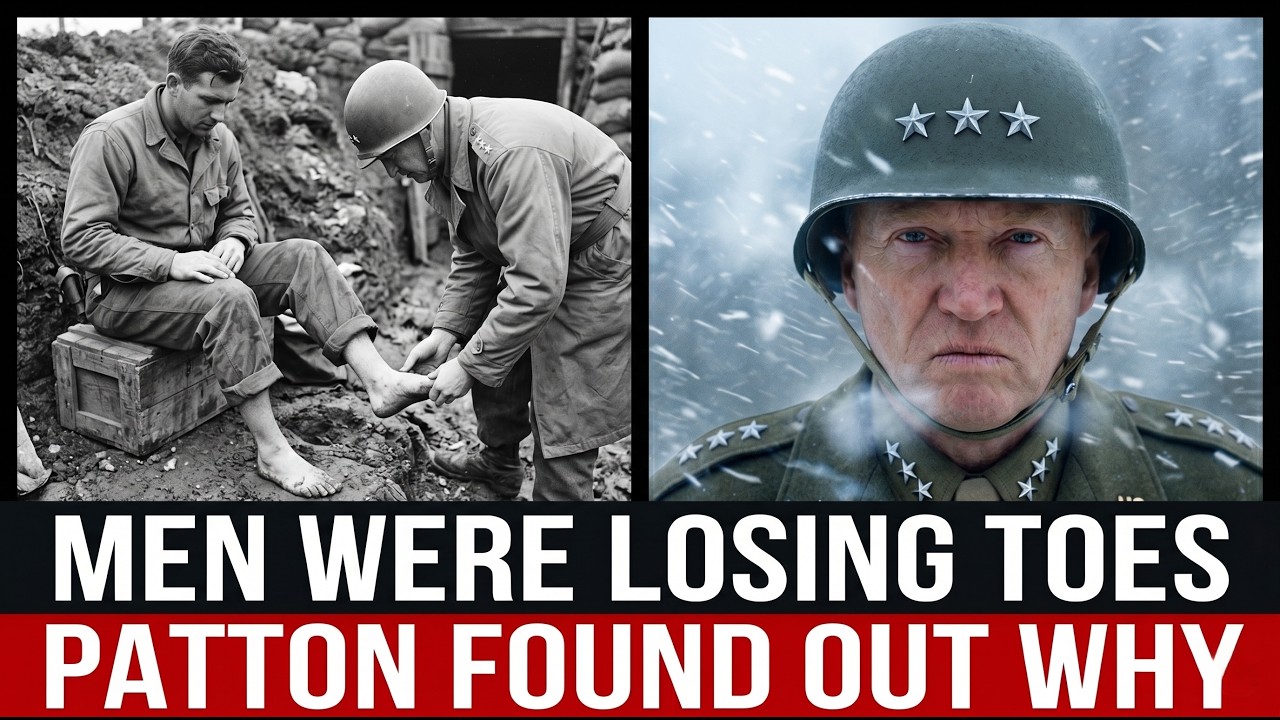
He was 23 years old, from Cleveland, serving as a medic during one of the coldest and most punishing periods of the war in Europe.
By then, what he found inside those boots had stopped surprising him.
Blackened toes.
Waterlogged skin.
Socks that had remained wet for days.
Feet so badly damaged that separating fabric from flesh had become difficult.
One soldier was Private Eddie Marsh.
Twenty years old.
Tulsa.
According to the account, Marsh’s feet had deteriorated so badly that Dolan could barely distinguish where the sock ended and damaged tissue began.
Marsh lost two toes.
The diagnosis was trench foot.
The immediate cause was not mysterious.
Wet feet.
Wet boots.
No dry socks.
No opportunity to change.
Dolan documented the case.
But his report was not unusual.
By the time it reached battalion level, 43 similar medical reports had accumulated.
The men needed dry socks.
They had been asking for them for two weeks.
The socks existed.
That was the part that eventually caught General George S. Patton’s attention.
When the casualty figures reached him, he did not begin by asking how many additional medics were needed.
He asked something more basic.
Where are the socks?
The answer would expose a failure that had almost nothing to do with shortages.
Twenty thousand pairs of wool socks were reportedly sitting in a warehouse only 17 miles from men whose feet were deteriorating in the freezing mud.
The Army had the solution.
It simply could not get the solution through its own paperwork.
To understand how something that absurd could happen, the story has to begin with the Ardennes in December 1944.
The German offensive that became known as the Battle of the Bulge erupted on December 16.
American units found themselves fighting through brutal winter conditions.
Temperatures plunged.
The ground froze.
Snow, rain and mud became part of daily survival.
Infantrymen occupied foxholes for long periods.
Keeping warm was difficult.
Keeping dry could be almost impossible.
Fires created their own danger.
Smoke could reveal positions.
Movement could expose soldiers to enemy observation or fire.
So men remained in the ground.
Their uniforms became wet.
Their boots became wet.
And eventually their feet stayed wet.
That was when trench foot became dangerous.
The prevention advice was straightforward.
Keep feet as dry as possible.
Maintain circulation.
Change socks regularly.
American soldiers had reportedly been issued instructions explaining exactly that.
The knowledge existed.
The problem was material.
A card telling a soldier to change his socks was useless if he did not have another pair.
Supply Sergeant Bill Hooper had been trying to solve that problem.
According to the account, Hooper was 32 and from Detroit.
For 11 days, he submitted requests for replacement socks.
Those requests went to Lieutenant Arthur Crane, 26, from Hartford.
Crane forwarded them toward a quartermaster depot approximately 17 miles behind the front.
The depot received them.
Logged them.
And did not release the socks.
Not because the warehouse was empty.
Quite the opposite.
Twenty thousand pairs were reportedly already there.
Sorted.
Labeled.
Waiting.
They had allegedly been sitting in the warehouse since December 9.
The problem was a number on a form.
Wool socks belonged under one supply classification.
Crane’s requests had been submitted under another.
Cold-weather field gear was coded differently from general clothing.
The difference looked minor.
Inside a military supply system, it was enough to stop the requisition.
The depot received the request.
Wrong code.
Return it.
Another request arrived.
Wrong code.
Return it again.
Then another.
And another.
According to the narrative, the cycle eventually produced 41 requests or correction notices over 11 days.
Paper traveled west.
Corrections traveled east.
The socks did not move at all.
Meanwhile, soldiers continued standing in wet boots.
This was not simply a story about one incompetent officer.
That would make it easier.
The actual failure described in the source was systemic.
The depot tried to contact Crane’s battalion.
The switchboard was overwhelmed by wartime communications traffic.
A message was taken.
It never reached the right person.
Crane’s battalion tried calling the depot.
After waiting, they reached the wrong section.
The sergeant who answered did not know anything about the requisition.
They tried again.
Then the telephone line failed.
Ice had damaged a relay junction.
For four days, the connection remained down while repair personnel dealt with the problem.
Every individual failure had an explanation.
Wrong code.
Overloaded switchboard.
Misrouted call.
Broken line.
Delayed repair.
Correction notice.
Resubmission.
Another correction.
Nothing in isolation looked like the moment when men began losing toes.
Together, however, they created exactly that result.
Eleven days.
Forty-one pieces of corrective paperwork.
A broken telephone connection.
Twenty thousand pairs of dry socks.
Forty-three medical reports.
Then Dolan’s report moved higher.
On December 22, according to the account, Third Army medical personnel were looking at a wider pattern.
Trench-foot cases were rising.
The condition was preventable.
Yet the materials needed to prevent it were not reaching the soldiers.
The analysis reached Patton that evening.
He read the numbers.
Then the notation explaining that the injuries were preventable.
His question was immediate.
Where were the socks?
His aide began making calls.
By midnight, the answer was apparently clear.
Seventeen miles away.
Twenty thousand pairs.
Sitting in a depot.
They had been there for almost two weeks.
The requisition had never cleared.
The forms contained the wrong code.
Telephone calls had failed.
A communications line had gone down.
The bureaucracy could explain every step.
That did not explain why nobody had solved the problem.
Patton ordered his jeep ready for 0600.
He was going to the warehouse himself.
The depot commander in the story was Major Charles Voss.
Thirty-eight years old.
Pittsburgh.
A career supply officer.
And importantly, Voss was not portrayed as running a chaotic operation.
His warehouse was organized.
His paperwork was clean.
His records were meticulous.
When Patton arrived around 0700, Voss could produce everything the general requested.
The requisition file.
Telephone logs.
Reports concerning the damaged line.
Correction notices.
Dates.
Call attempts.
Documentation.
The file was reportedly two inches thick.
Patton went through it.
He could see that the telephone line had actually failed.
He could see that attempts at communication had been made.
He could see that the original requisition contained an incorrect supply code.
Then he identified the part that angered him.
The paperwork showed the problem repeating itself.
Day three.
Correction notice.
No corrected requisition.
Day four.
Another notice.
Day five.
Another.
Day six.
Another.
The process remained technically alive.
The problem remained practically unsolved.
According to the narrative, Patton did not blame Voss for the weather.
He did not blame him for the German offensive.
He did not blame him for the damaged telephone line.
He did not even blame him for the incorrect code originally submitted by somebody else.
He blamed him for allowing those explanations to become an excuse for doing nothing different.
That distinction is the heart of the story.
A procedure had failed.
Voss continued using the procedure.
Again.
Again.
Again.
Each individual action could be defended.
The regulations required a correct requisition.
The depot sent correction notices.
The records showed attempts to contact the requesting unit.
Everything could be documented.
Everything could be explained.
And men were still losing toes.
Patton reportedly told Voss that his file was excellent.
His procedures were correct.
His records were clean.
Then came the line that defined the confrontation.
Men were losing toes because of it.
The point was not that regulations were useless.
An army needs procedures.
Without supply codes, requisitions and inventory controls, thousands of units competing for limited resources would create chaos.
The point was that procedures existed to deliver supplies to soldiers.
Soldiers did not exist to satisfy procedures.
At some point, Patton believed, an officer had to stop asking whether the form was correct and start asking what the form was trying to accomplish.
In this case, the answer was embarrassingly simple.
Dry socks had to move east.
The paperwork was supposed to make that happen.
Instead, the paperwork had become the reason it was not happening.
According to the account, Patton confronted Voss with the human cost.
Every finger or toe amputated because of preventable cold injury represented something more than a medical statistic.
Not because Voss had caused winter.
Not because he had caused the battle.
But because thousands of pairs of the preventive item had remained inside his building.
The major attempted to explain that the release required the proper code.
Patton already knew.
He knew about the code.
He knew about the telephone.
He knew about the line failure.
But he had noticed another detail in the records.
By day eight, according to the narrative, telephone service had returned.
The log showed one outbound call attempt.
Then nothing.
That was the moment the explanations became harder to defend.
The communication problem was no longer absolute.
The supply problem was still urgent.
Yet the socks remained in place.
Patton ordered the trucks loaded.
All 20,000 pairs.
They were to be moving east before 0900.
Voss reportedly raised another procedural issue.
The release required authorization.
Patton gave it.
Release them under his authority.
Whatever paperwork was necessary could be signed afterward.
That order reversed the priorities that had governed the previous 11 days.
Before:
Paper first.
Supplies second.
Now:
Supplies first.
Paper afterward.
But Patton did not stop with the trucks.
According to the account, he told Voss that the depot’s procedures and the major’s handling of the requisition would receive a formal review.
Then he went further.
He recommended Voss be reassigned.
And he requested that Voss’s replacement have cold-weather field experience.
The final part was characteristic of the Patton portrayed in the story.
Voss himself should receive that experience.
The major had spent the crisis inside a functioning supply depot.
Patton wanted him closer to the environment where delayed supplies had consequences.
Cold weather, Patton reportedly suggested, taught lessons paperwork could not.
Then he left.
By 0900, the trucks were loaded.
Twenty thousand pairs of wool socks began moving east.
Within hours, they reached forward positions.
Bill Hooper, who had spent 11 days sending requests into a system that kept returning them, signed for the shipment.
There was apparently no celebration.
He started distributing.
That was the job.
In Dolan’s sector, the socks arrived before the afternoon medical check.
Men began removing their boots.
Some had reportedly been wearing the same wet socks for eight days.
Ten days.
Twelve.
They peeled damp fabric away from damaged feet.
Then put on dry wool.
One of the soldiers in the narrative was Private Thomas Cole.
Eighteen years old.
Louisville.
He sat in his foxhole after putting on the clean socks.
And cried.
Quietly.
No dramatic speech.
No cheering.
He simply moved his toes.
Checking.
One after another.
They still moved.
For him, at least, the socks had arrived before the damage became irreversible.
For Eddie Marsh, they had not.
He had already lost two toes.
That contrast explains why Patton did not treat the incident as a completed supply problem once the trucks departed.
He spent the following day attacking the system that had allowed it to happen.
First came communications.
According to the narrative, Patton directed his signals personnel to examine telephone conditions across the supply chain.
Fault repairs connected to critical supply movement would receive priority.
Battalion switchboards needed proper staffing.
Rear-area supply nodes would have dedicated telephone operators rather than personnel simultaneously handling unrelated responsibilities.
The second problem was paperwork.
The source attributes a remarkably concise philosophy to Patton:
Paperwork is a tool, not a substitute for judgment.
When paperwork fails, pick up the phone.
When the phone is not enough, get in the jeep.
Whether those exact words appeared in a surviving three-sentence memorandum is a question that would require documentary verification.
But within the source’s narrative, they summarize the entire incident.
The Army had possessed everything necessary to prevent at least some of the injuries.
Knowledge.
Medical guidance.
Wool socks.
Trucks.
Roads.
Supply personnel.
Officers.
Telephones.
Forms.
Warehouses.
What it lacked was a person willing to override the loop once the loop stopped serving its purpose.
The formal review described in the account reportedly confirmed the basic sequence.
It also found three other recent cases in which similar procedural loops had delayed supplies to frontline units.
That finding matters.
If true within the source’s narrative, the socks were not an isolated accident.
They were evidence of a structural weakness.
A system designed for order had become vulnerable to repetition.
Submit.
Reject.
Correct.
Resubmit.
Call.
Wait.
Call again.
File.
Return.
Every participant could point toward the previous step and say he had done what the process required.
Nobody had to make a dramatic mistake.
The catastrophe emerged from ordinary compliance.
That is one reason organizational failures can be so difficult to prevent.
Clear misconduct is visible.
A soldier abandons his post.
An officer steals supplies.
Someone ignores a direct order.
Those situations have obvious disciplinary answers.
But what happens when everyone follows a recognizable procedure and the outcome is still disastrous?
Who owns the result?
Patton’s answer, as portrayed in the story, was leadership.
Rank existed partly for the moment when procedure stopped producing reality.
A clerk might be expected to return a form with the wrong code.
A junior sergeant might not have authority to release 20,000 pairs of Army property without documentation.
But the higher the chain the problem traveled, the weaker “the form was wrong” became as an explanation.
At some level sat an officer with enough authority to make a decision.
Patton believed Voss had reached that level.
The review did not reportedly send Voss directly into an infantry foxhole.
Instead, he was transferred to a forward-positioned field supply operation working under winter conditions.
That outcome was less dramatic than Patton’s initial recommendation.
But it preserved the logic behind it.
If Voss was going to make decisions about cold-weather supplies, he would benefit from seeing what cold weather did to soldiers.
Not on a report.
Not in a requisition code.
In boots.
That brings the story back to Corporal Ray Dolan.
After the war, according to the narrative, Dolan returned to Cleveland.
He spent approximately 30 years working in a Veterans Administration hospital.
Years later, a local newspaper interviewed him around Veterans Day.
The reporter asked what he remembered most about the war.
Not artillery.
Not tanks.
Not German soldiers.
Boots.
He remembered pulling boots from American feet.
Again.
Again.
Again.
And seeing injuries he believed should not have happened.
Trench foot was different from a bullet wound.
A medic could not stop an enemy projectile after it had been fired.
But wet feet were something an army could address.
Dry the foot.
Change the sock.
Protect circulation.
Thirty seconds.
That was the bitter simplicity.
The reporter reportedly asked whether the Army had been prepared.
Dolan paused.
Then answered with the line that captures the entire story.
The socks existed.
That is what makes this account more disturbing than a conventional wartime shortage.
If the socks had not existed, the explanation would have been obvious.
War consumes resources faster than nations can produce them.
Factories fall behind.
Roads become impassable.
Trucks break.
Fuel disappears.
Enemy action cuts supply lines.
Soldiers suffer because the material simply cannot reach them.
But that was not the problem described here.
The socks were already there.
Seventeen miles.
Twenty thousand pairs.
The distance between a warehouse full of dry wool and a foxhole full of wet feet was not primarily physical.
It was administrative.
A routing number.
A correction notice.
A telephone message.
A broken line.
Another correction notice.
Another day.
Another night in wet boots.
Then another medical report.
The story therefore creates an uncomfortable question about Major Voss.
Was Patton right?
Voss had not simply ignored the requests.
His depot processed them.
Correction notices were sent.
Telephone contact was attempted.
The communications network genuinely failed.
The original requisition genuinely used the wrong code.
The Battle of the Bulge genuinely placed enormous pressure on American logistics.
If those facts are accepted, Voss was operating inside a system under extreme wartime strain.
Punishing him alone risks turning a systemic failure into an individual one.
But the opposite argument is equally powerful.
Voss was the commander.
His records eventually showed the same urgent request returning again and again.
He possessed the material.
He had authority.
He knew communication had failed.
Once the telephone service returned, the problem still remained.
At what point does following procedure stop being diligence and become avoidance?
That is the leadership problem Patton supposedly saw.
Responsibility is not simply the obligation to follow a process.
For commanders, responsibility includes noticing when the process has stopped accomplishing its purpose.
The depot’s purpose was not to maintain beautiful files.
It was to supply an army.
The requisition system’s purpose was not to produce correct routing numbers.
It was to connect soldiers with equipment.
The telephone network’s purpose was not to generate call logs.
It was to communicate.
The paperwork was not the mission.
The socks were.
And the socks mattered because the feet inside those wet boots belonged to soldiers.
Private Eddie Marsh lost two toes.
Private Thomas Cole still had his.
Between those two outcomes sat time.
Every additional hour mattered.
That is why the story’s most powerful image is not Patton confronting Voss.
It is not 20,000 pairs of socks loaded into trucks.
It is an 18-year-old soldier sitting in a frozen foxhole wearing dry wool for the first time in days.
Moving his toes.
Checking that they still worked.
Then crying when they did.
For eleven days, requests had moved through the system.
On the twelfth, the socks moved.
That was the difference.
And according to the Patton portrayed in this account, it was the difference between administration and command.
Administration could explain why the socks had not moved.
Command had to make them move anyway.


