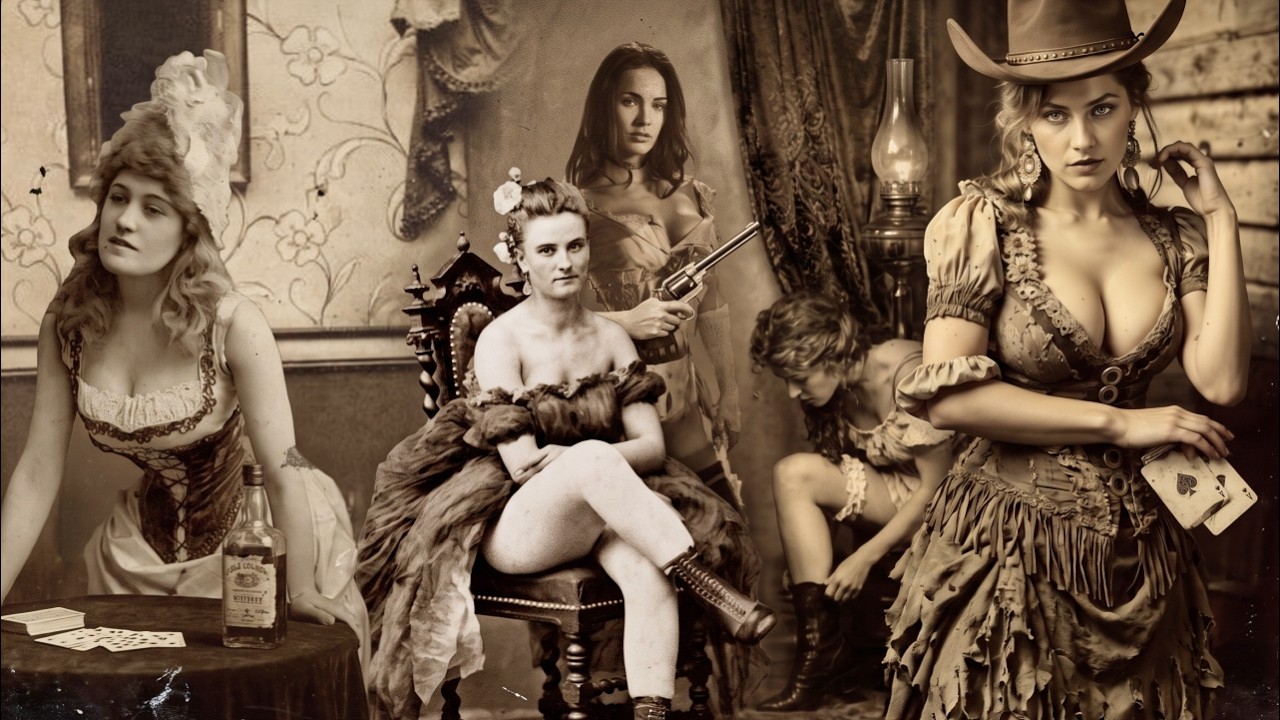
The Old West most people remember was already becoming a lie before the real frontier had disappeared.
While cowboys were still riding cattle trails, publishers were printing dime novels about superhuman gunfighters.
While Native nations were still resisting confinement, stage performers were reenacting simplified “Indian attacks” for cheering crowds.
While Chinese laborers were laying track across mountains, popular culture was already pushing them toward the margins of the story.
Then movies inherited the mythology.
The lone white cowboy.
The empty land.
The lawless town.
The unrestricted six-shooter.
The savage ambush.
The duel at high noon.
The beautiful saloon.
The fearless settler.
The myth became so familiar that the documented history now sounds like the controversial version.
Here are twenty-one truths the Western legend largely buried.
21. THE OLD WEST WAS ALREADY BEING TURNED INTO FICTION WHILE IT WAS STILL HAPPENING.
Hollywood did not invent the fake West.
Hollywood inherited it.
Dime novels appeared in the nineteenth century and turned frontier personalities into larger-than-life heroes and villains while many of those people were still alive.
The Library of Congress notes that Ned Buntline introduced “Buffalo Bill” to mass readers in 1869.
William F. Cody then launched Buffalo Bill’s Wild West in 1883.
His enormous traveling spectacle presented horsemanship, shooting exhibitions, staged frontier combat and dramatic confrontations with Native peoples to audiences across the United States and Europe.
That means Americans did not wait until the frontier was over to romanticize it.
They were paying to watch a simplified version while real western expansion was still taking place.
The legend competed with reality in real time.
And the legend had better marketing.
20. SOME OF THE MOST FAMOUS “GUN TOWNS” HAD STRICTER PUBLIC-CARRY RULES THAN PEOPLE ASSUME.
The classic Western street is filled with armed men wearing revolvers openly.
Real western towns often wanted the opposite.
Tombstone required visitors to turn in firearms at a hotel or law-enforcement office.
Dodge City, Abilene and other famous cattle towns also imposed restrictions on carrying weapons within town limits.
Smithsonian reports that when Dodge City organized its municipal government, prohibiting firearms in town was among its earliest laws.
People still owned guns.
They used them outside towns for hunting, travel and protection.
But civic leaders understood something Hollywood rarely shows:
A town full of businesses, families and investors could not survive indefinitely if every drunken argument became an armed confrontation.
Law and commerce often demanded disarmament.
19. THE O.K. CORRAL SHOOTOUT WAS, IN PART, A GUN-CONTROL CONFRONTATION.
The most famous gunfight in Western history is usually framed as a simple confrontation between heroic lawmen and dangerous cowboys.
One essential part gets left out.
Virgil Earp was trying to enforce Tombstone’s weapons ordinance.
On October 26, 1881, several members of the opposing group were openly carrying firearms despite the town’s rules.
When the Earps and Doc Holliday approached them, Virgil again demanded that they disarm.
Nobody knows with certainty who fired first.
Three men died.
Virgil and Morgan Earp were wounded.
The showdown later became the symbol of a West where armed individuals supposedly settled disputes themselves.
Historically, one of the central issues was almost the reverse:
Town authorities were trying to enforce a restriction on carrying guns.
18. THE MOST FAMOUS CATTLE TOWNS WERE NOT EXPERIENCING A MURDER EVERY AFTERNOON.
The phrase “Wild West” implies almost continuous killing.
Some mining and railroad boomtowns really were exceptionally violent.
But the famous cattle towns were often less murderous than later storytelling suggested.
Historian Robert Dykstra’s study, summarized by Smithsonian, identified 45 murders across five major Kansas cattle towns between 1870 and 1885.
That averaged roughly 0.6 murders per town per year.
Dodge City’s reputation became especially exaggerated through sensational journalism and later fiction.
This does not mean the frontier was safe.
Per-capita violence could be high in small settlements.
Bodie, California, was genuinely notorious.
But the image of every western main street functioning as a permanent shooting gallery is mythology.
Most people had businesses to run.
Animals to feed.
Children to raise.
Debts to pay.
They could not spend every day dueling.
17. THE WHITE COWBOY WAS NEVER THE WHOLE COWBOY STORY.
Hollywood overwhelmingly turned the cowboy into a white American male.
The actual workforce was far more diverse.
National Park Service material estimates that roughly one out of every four cowboys was African American.
Hispanic cowboys were strongly represented.
Native cowboys also worked the range.
Irish, German, English and French immigrants joined them.
Many Black cowboys entered the profession after emancipation.
Cattle work offered wages and a degree of mobility unavailable in much of the postwar South.
Yet when the cowboy became America’s defining Western hero, Black faces largely disappeared from film.
The myth did not simply add characters.
It deleted them.
16. MUCH OF “AMERICAN COWBOY CULTURE” WAS MEXICAN BEFORE IT WAS AMERICAN.
The American cowboy did not invent roping cattle from horseback.
Spanish and Mexican vaquero traditions had developed over centuries.
The National Park Service traces familiar cowboy equipment and vocabulary directly to those traditions.
“Lariat” derives from la reata.
“Chaps” developed from chaparreras.
A herd of horses became a remuda.
Even “buckaroo” evolved from vaquero.
The riding styles, livestock knowledge and equipment that later became symbols of Anglo Western masculinity were deeply indebted to Mexican culture.
Hollywood kept the boots.
The ropes.
The hats.
The riding techniques.
It often removed the people who helped create them.
15. THE AVERAGE COWBOY WAS MORE LIKELY TO BE A YOUNG EMPLOYEE THAN A RICH GUNFIGHTER.
Cowboys were laborers.
They worked for outfits owned by ranchers or cattle companies.
Many were teenagers or men in their twenties.
The work was physically punishing enough that it often did not remain a lifelong occupation.
National Park Service accounts describe six-month trail drives, livestock injuries, rough living conditions and economic hardship.
The cowboy’s day was not primarily about gunfighting.
It was about cattle.
Keeping animals moving.
Finding water.
Controlling stampedes.
Taking night watches.
Crossing rivers.
Repairing equipment.
Then doing it again.
The movie cowboy became an aristocrat of personal freedom.
The real cowboy usually had a boss.
14. WOMEN WON THE VOTE IN PARTS OF THE WEST DECADES BEFORE THE REST OF THE COUNTRY—BUT THE STORY WAS NOT PURELY PROGRESSIVE.
Wyoming Territory granted women voting rights in 1869.
Utah women gained suffrage in 1870.
That seems radically modern.
And in many ways, it was.
But the politics could be contradictory.
The National Park Service notes that Wyoming legislator William Bright’s support for women’s suffrage was entangled with his opposition to Black male civil rights.
African American, Chinese American and Latina women still had to fight racial barriers within supposedly progressive western political systems.
Utah reveals another strange twist.
Women gained the vote—
then Congress took it away in 1887 through the Edmunds-Tucker Act during the federal campaign against plural marriage.
The frontier could expand women’s rights and restrict them in the same generation.
13. THE GOVERNMENT HELPED CREATE THE MALE-DOMINATED CHINATOWNS IT LATER USED AS PROOF THAT CHINESE IMMIGRANTS COULD NOT ASSIMILATE.
Chinese migration was already heavily male.
Then federal law intensified the imbalance.
The Page Act of 1875 supposedly targeted involuntary labor and prostitution.
In practice, federal officials often treated Chinese women broadly as suspected prostitutes.
The National Park Service describes the law as effectively shutting out large numbers of Chinese women.
Then the Chinese Exclusion Act imposed broader restrictions.
The result was a western Chinese population dominated by men separated from wives and families.
Politicians subsequently pointed at these “bachelor societies” as evidence that Chinese immigrants supposedly would not form normal American families.
Government policy had helped create the condition being criticized.
12. MORE THAN 11,000 CHINESE WORKERS HELPED BUILD THE TRANSCONTINENTAL RAILROAD—AND THEY WERE PAID LESS.
The iconic railroad story usually ends at Promontory Summit with locomotives facing each other and dignitaries celebrating the Golden Spike.
Behind that photograph were thousands of Chinese laborers.
The National Park Service says more than 12,000 Chinese immigrant workers contributed to the Central Pacific effort, with roughly 11,000 employed by 1868.
They graded track.
Cut through mountains.
Worked as masons.
Assisted blacksmiths.
Cooked.
Built through the Sierra Nevada and across desert terrain.
They were paid on average about 30 percent less than European or European-American counterparts.
Another NPS history notes that Chinese workers were deliberately left out of the famous Golden Spike celebration photograph.
They connected the country.
Then the national image cropped them out.
11. WESTERN TOWNS SOMETIMES DID NOT JUST DISCRIMINATE AGAINST CHINESE RESIDENTS—THEY PHYSICALLY EXPELLED THEM.
Anti-Chinese violence became organized across the West during the 1880s.
In Rock Springs, Wyoming, white miners killed 28 Chinese men and wounded others in 1885.
In Tacoma, civic leaders and mobs organized the forced removal of hundreds of Chinese residents.
Homes and businesses were invaded as people were pushed out of town.
Seattle experienced similar agitation.
Other western communities used boycotts, intimidation, arson and violence to drive Chinese residents away.
The classic Western plot asks whether the sheriff can protect one settler from an outlaw gang.
Real western history includes moments when an entire community became the gang.
10. BLACK SOLDIERS HELPED EXPAND THE WEST WHILE LIVING UNDER SEGREGATION THEMSELVES.
After the Civil War, Congress created segregated Black regiments that became known as Buffalo Soldiers.
They built roads.
Escorted travelers.
Protected mail routes.
Mapped terrain.
Fought outlaws.
And fought Native peoples during the U.S. government’s western campaigns.
The contradiction is extraordinary.
Many Buffalo Soldiers were formerly enslaved or came from families directly shaped by slavery.
Military service offered regular wages, education and dignity unavailable to many Black civilians.
Yet they served an army helping force Indigenous peoples from their homelands.
NPS describes the Guadalupe Mountains story starkly: African American soldiers seeking freedoms they had rarely possessed were fighting Apache people trying to preserve freedoms they had always known.
The real West does not fit comfortably into heroes and villains.
Sometimes oppressed people were placed inside institutions oppressing somebody else.
9. THE “EMPTY WEST” WAS NEVER EMPTY.
This may be the foundational Western myth.
Settlers did not move into an unused landscape.
They moved onto homelands occupied by Indigenous nations with existing political systems, economies, travel routes, hunting territories and sacred places.
Federal policy repeatedly reduced those territories.
The Indian Appropriations Act confined Native peoples to reservations.
The Dawes Act later broke communal reservation lands into individual allotments and opened so-called surplus land to non-Native settlement.
NPS estimates that federal policies and related expansion transferred hundreds of millions of acres of Indigenous land.
By the 1880s, the Library of Congress notes, most western Native Americans had been confined to reservations, often on land settlers considered less desirable.
Hollywood often calls this “settling the frontier.”
To the people already there, it looked very different.
8. THE DESTRUCTION OF THE BISON WAS NOT SIMPLY OVERHUNTING. IT ALSO HELPED DESTROY INDIGENOUS RESISTANCE.
North America may once have held 30 to 60 million bison.
By the 1890s, fewer than 1,000 remained.
Some estimates place the surviving population at only about 300 at its lowest point.
Railroads gave hunters access.
Powerful rifles increased killing efficiency.
International hide markets made carcasses profitable.
But NPS also identifies government efforts to destroy bison as part of attempts to control Plains Indigenous peoples whose food systems and cultures depended heavily upon the herds.
The buffalo skull piles photographed in the nineteenth century were not merely symbols of reckless hunting.
They represented the collapse of an ecosystem and the deliberate destruction of a foundation of Native survival.
The cowboy era expanded into the ecological vacuum that followed.
7. NATIVE ATTACKS WERE NOT THE MAIN THREAT TO WAGON TRAINS.
Western films taught generations that every emigrant wagon circle existed because Native warriors might attack at any moment.
The National Park Service says most encounters between emigrants and Native peoples were peaceful.
Native communities traded food and clothing with travelers.
They assisted with river crossings.
Some operated ferry systems.
Hostile encounters happened, particularly as settler traffic damaged resources and conflicts intensified.
But NPS explicitly says attacks occurred far less frequently than Western mythology suggests.
Some robberies attributed to “Indians” were apparently carried out by white criminals using disguises.
Some emigrants themselves fired at Native people because of fear or even for target practice.
The mythology turned the people whose land travelers were crossing into the default villains.
6. NEARLY ONE IN TEN EMIGRANTS ON THE GREAT OVERLAND TRAILS MAY HAVE DIED—AND DISEASE WAS THE BIGGEST KILLER.
Forget arrows.
Forget bandits.
Think contaminated water.
NPS calls the Oregon, California and Mormon trail system “the nation’s longest graveyard.”
Nearly one in ten people who set out did not survive.
Disease was the number-one killer by a wide margin.
Cholera was particularly brutal.
It spread through contaminated water and unsanitary camps.
Victims could begin the morning apparently healthy and be dead twelve hours after symptoms started.
Thousands died.
There were no antibiotics.
Travelers often had no understanding of how the disease spread.
They treated cholera with remedies such as camphor and laudanum that did little to stop the infection.
Hollywood gave the emigrant a rifle.
History gave him bacteria.
The bacteria was usually more dangerous.
5. YOUR OWN WAGON, ANIMALS AND FIREARMS COULD BE MORE DANGEROUS THAN AN OUTLAW.
Wagons did not merely transport people.
They crushed them.
Children and adults fell underneath moving wheels.
Draft animals kicked, dragged and trampled travelers.
River crossings drowned people.
Exhaustion caused mistakes.
Then there were the guns.
Because emigrants feared attack, wagon companies carried large quantities of firearms.
NPS describes many wagons as effectively rolling arsenals.
Accidental shootings were common.
Murders were comparatively rare.
Hunters shot companions.
Travelers accidentally shot themselves.
Poor-quality firearms misfired or exploded.
The fictional West makes the gun the solution.
The historical West repeatedly records it as another hazard.
4. SOME EMIGRANTS WERE BURIED DIRECTLY UNDER THE ROAD SO WAGONS COULD DRIVE OVER THEIR GRAVES.
This sounds like a horror-film invention.
It was burial strategy.
People died faster than emigrant parties could hold elaborate funerals.
Families also feared grave robbers and vandals.
NPS records that individual graves were sometimes dug directly into the trail itself.
The loose soil was then compacted as later wagons rolled over it.
Many graves were intentionally left unmarked.
Imagine heading west toward a promised new life.
Your wheels pass over thousands of miles of earth.
Somewhere beneath them may be someone who made the same journey weeks earlier.
No headstone.
No name.
Just the road.
3. THE GOVERNMENT OFFERED 160-ACRE HOMESTEADS IN PLACES WHERE 160 ACRES COULD BE FAR TOO SMALL TO SUPPORT A FAMILY.
The Homestead Act became one of the great symbols of western opportunity.
Claim land.
Improve it.
Build a farm.
Become independent.
But eastern agricultural assumptions did not fit much of the arid West.
Explorer John Wesley Powell understood the problem.
His 1878 report warned that western settlement had to be organized around water.
In very dry regions, he argued, families might require as much as 2,560 acres rather than the standard 160.
Congress largely ignored the warning.
Thousands of settlers arrived with legal title to land that could not reliably support the farming system they expected.
The government could give somebody acreage.
It could not give the acreage rain.
2. THE CLASSIC OPEN-RANGE COWBOY ERA WAS NOT ENDED BY GUNFIGHTERS. WEATHER, ECOLOGY, ECONOMICS AND BARBED WIRE KILLED IT.
By the mid-1880s, the northern cattle industry looked almost unstoppable.
Then ranchers overstocked the range.
Grass deteriorated.
The winter of 1886–87 arrived with extreme cold, deep snow and ice that prevented cattle from reaching forage.
Losses were catastrophic.
In some places, ranchers lost between 60 and 95 percent of their herds.
Then came fencing.
Homesteaders enclosed land with barbed wire.
Rail lines changed markets.
Quarantine laws altered cattle routes.
Long-distance drives became less necessary.
The National Park Service describes the great open-range cattle economy as lasting only a few decades.
The cowboy did not ride into a final shootout.
He increasingly became a ranch hand repairing fences and feeding cattle hay.
One of America’s most romantic eras ended through spreadsheets, winter weather and wire.
1. THE WESTERN TOWN USUALLY DIED WHEN THE MONEY MOVED—NOT WHEN THE GUNFIGHT ENDED.
This may be the biggest myth Hollywood created.
Movies give towns dramatic endings.
The outlaw is killed.
The sheriff leaves.
The railroad arrives.
The hero rides away.
Real boomtowns usually died much more quietly.
They existed because money was flowing through one specific economic system.
Silver.
Gold.
Cattle.
Railroad construction.
Timber.
Military contracts.
When the reason disappeared, the population followed.
Mining camps declined when ore became too expensive to extract.
Cattle towns declined as railroad routes, quarantine laws and fencing changed the livestock economy.
Places like Schwab, Nevada, faded as mines closed and nearby settlements became more practical commercial centers.
The famous gunfight at Tombstone happened in 1881.
Tombstone did not immediately disappear.
Its economy continued because silver continued.
The larger threat was always whether mines could remain profitable.
The gunfighters became legends because a shootout has a beginning and an ending.
Economic decline does not.
It looks like one family leaving.
Then another.
An empty hotel room.
A saloon ordering less whiskey.
A newspaper losing advertisers.
A store closing two days a week.
The railroad carrying customers somewhere else.
A mine reducing shifts.
A school with fewer children.
Then a building nobody repairs after the roof collapses.
That is how much of the West actually ended.
And that helps explain why Hollywood changed it.
The true history has no single hero.
There is no single villain.
The story includes settlers searching for opportunity and Indigenous nations losing homelands.
Formerly enslaved Black soldiers gaining dignity through military service while enforcing federal expansion.
Chinese immigrants building railroads that transformed the country while laws increasingly tried to exclude them from that country.
Women gaining the vote in Wyoming while racial barriers remained intact.
Cowboys borrowing Mexican traditions while popular culture transformed the cowboy into an exclusively Anglo symbol.
Towns restricting firearms while later films turned unrestricted gun carrying into the defining frontier right.
Emigrants terrified of Native attack while cholera, wagon wheels and their own weapons killed far more of them.
Millions of bison disappearing as railroads, hide markets and federal policy transformed the Plains.
The Old West was violent.
But not always in the way Hollywood taught us.
It was not simply one man shooting another man.
Violence could be a mob expelling an entire Chinese neighborhood.
A government forcing a nation from ancestral land.
A labor system paying one ethnic group less for doing the hardest work.
A disease spreading through water nobody knew was contaminated.
A family discovering that the 160 acres promised as independence could not grow enough food.
A herd of cattle freezing because investors had overloaded the grasslands.
The most successful Western myth removed systems and replaced them with individuals.
Land seizure became “adventure.”
Economic labor became “freedom.”
Immigration became background scenery.
Racial violence disappeared.
Government policy disappeared.
Environmental collapse disappeared.
Then one white man with a revolver stood in the center of the frame.
And perhaps the strangest truth is that this myth was not imposed on the West centuries later.
The real West helped manufacture it.
Buffalo Bill turned frontier history into a traveling entertainment empire beginning in 1883.
Dime novels turned real people into exaggerated characters.
Newspapers sensationalized violent towns because frightening stories sold copies.
Later, towns themselves promoted their “Wild West” reputations to attract visitors.
The Library of Congress holds tens of thousands of dime novels and popular Western stories that helped establish many of the tropes later inherited by cinema.
The myth survived because it was simpler.
And because it was profitable.
A cowboy sells better than a labor history.
A shootout sells better than a water-rights dispute.
A heroic wagon train sells better than cholera statistics.
An empty frontier sells better than a map full of Indigenous nations.
A lone gunfighter sells better than the thousands of Chinese laborers who actually connected the continent.
Hollywood did not exactly hide the real West.
It inherited a story America had already chosen to tell about itself.
Then it printed the legend again.
Bigger.
Cleaner.
Whiter.
More violent.
More heroic.
And far easier to watch than the truth.


