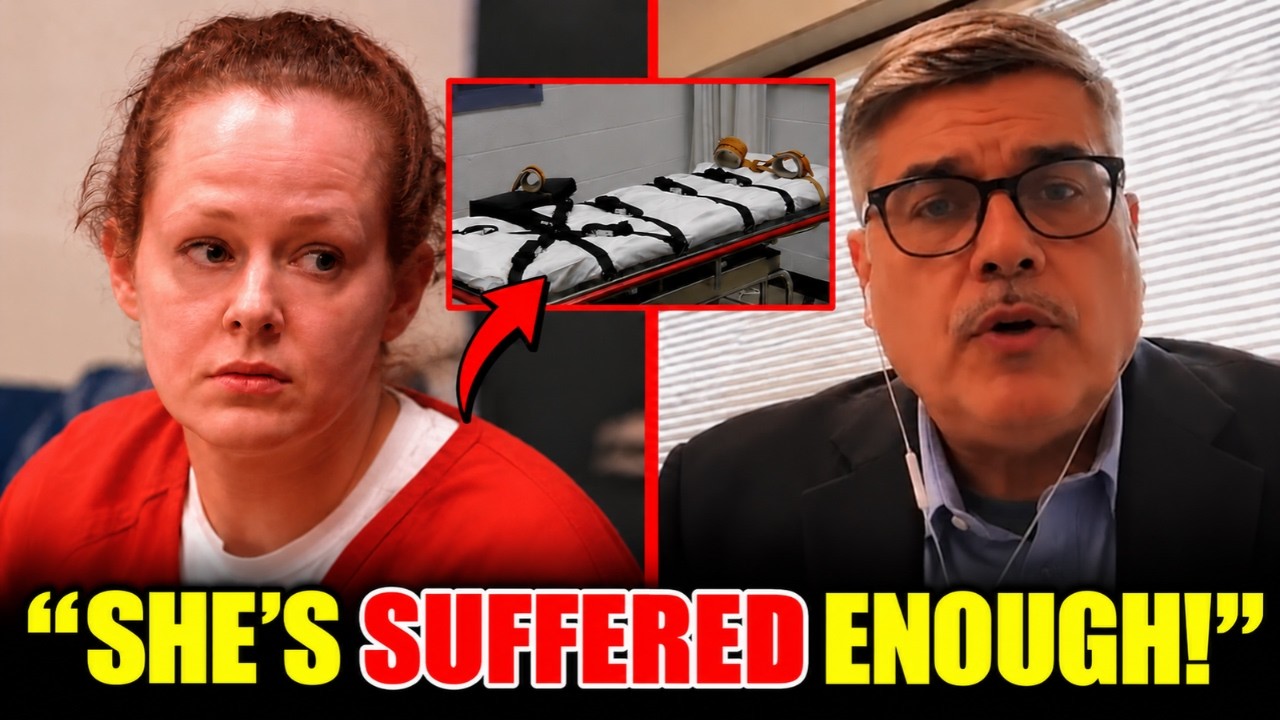
Christa Pike was supposed to die on September 30, 2026.
Instead, three days later, the head of Tennessee’s prison system was resigning, the governor had frozen the state’s execution calendar, lawyers were demanding that Pike never be placed on an execution gurney again, and the mother of Colleen Slemmer was returning home without the ending she had waited thirty-one years to witness.
The failed execution has created two stories that now exist almost painfully beside one another.
One begins with Christa Pike.
Fifty years old.
Unconscious.
Intubated.
On a ventilator.
Both arms swollen, burned and blistered after two rounds of pentobarbital failed to kill her.
Her attorneys say Tennessee inflicted a punishment so extreme that Governor Bill Lee should commute her death sentence immediately
The other story begins with May Martinez.
Her daughter, Colleen Slemmer, was nineteen when she was killed in Knoxville in 1995.
Martinez traveled to Nashville expecting finally to watch the sentence against Pike carried out.
She watched instead as Pike moved on the gurney after the first dose.
Then after the second.
Then prison officials removed the victim’s family from the viewing area.
Pike left Riverbend Maximum Security Institution in an ambulance.
Martinez left without what she regarded as justice.
“I didn’t get justice for my daughter,” she said afterward.
That is the collision at the center of the case now.
Pike’s lawyers say the state has already taken punishment beyond any acceptable constitutional boundary.
Slemmer’s mother says the state still has not completed the punishment a jury imposed.
Both are looking at the same September night.
They are seeing completely different things.
Pike’s attorneys began making their new demand almost immediately after the execution failed.
Randy Spivey called the procedure cruel, torturous and predictable.
The defense says Tennessee had been warned months before that Pike had unusually difficult veins and thrombocytosis, a blood condition involving an elevated platelet count.
According to the lawyers, medical professionals had previously struggled to draw Pike’s blood, making intravenous access one of the specific dangers raised before the execution.
Then the state attempted to establish IV lines anyway.
Spivey said the process lasted roughly an hour.
He counted at least seven needle attempts.
One needle, he said, came out visibly bent.
Pike was reportedly not resisting.
The defense says she was actively trying to help execution personnel find a usable vein, pointing to areas on her body where they might have better success.
Eventually officials believed they had established access.
Pentobarbital began flowing.
Witnesses then heard Pike complain about her arm.
She said it burned.
She asked whether what she was feeling was normal.
Later she described pressure intense enough that her arm seemed ready to burst.
But the execution continued.
Tennessee administered the initial pentobarbital dose.
Pike remained alive.
The state then used the backup dose allowed by its protocol.
She still did not die
The injuries discovered afterward became central to the defense’s argument.
Pike’s attorneys say both arms were badly swollen and blistered.
Their theory is that one or both IV catheters failed to remain inside functioning veins, allowing the chemically harsh pentobarbital solution to leak into surrounding tissue instead of moving rapidly through her circulation.
If that happened, it could potentially explain both the severe local injuries and Pike’s survival.
But it remains an allegation under investigation rather than an official final determination of what caused the failure
Pike was rushed to a Nashville-area hospital.
By October 2, her lawyers said her condition had deteriorated to the point that she was unconscious, intubated and dependent on mechanical ventilation.
Doctors were providing life-saving treatment and attempting to deal with the effects of the pentobarbital.
The defense also raised concern about possible brain injury from impaired oxygenation, although the extent of any lasting neurological damage has not been publicly established.
As of the latest confirmed public reporting available on October 4, there has been no reliable announcement that Pike has awakened or been removed from the ventilator.
That makes the phrase “take her off death row” particularly complicated.
Her lawyers are not asking for freedom.
They are not arguing that the murder conviction disappears.
They are not asking Tennessee to release her.
They are asking the governor to change the punishment.
Spivey summarized their position with extraordinary language.
“Christa has endured punishment greater than any other person in the history of the American death penalty,” he said while demanding commutation.
That statement is advocacy.
It is meant to persuade Governor Lee.
There has been no court ruling declaring Pike historically more punished than every other condemned prisoner.
But the defense can now point to facts that did not exist when Lee rejected clemency shortly before September 30.
Pike has actually experienced an execution attempt.
Two rounds of the lethal drug were administered.
She suffered serious physical injuries.
She was hospitalized.
She remains critically ill.
And the state’s own procedure reached its endpoint without producing death.
That gives Pike’s legal team an entirely different clemency argument.
Before September 30, they were asking Lee to spare her from what might happen.
Now they are asking him to act because of what already happened.
The governor has not granted that request.
Instead, Lee ordered a comprehensive independent investigation and stopped Tennessee’s remaining executions for 2026.
Former U.S. Attorney Ed Stanton has been tapped to lead the review.
Then, on October 3, another consequence arrived.
Tennessee Department of Correction Commissioner Frank Strada announced his resignation.
Strada said he still believed department personnel had followed the protocol but that leaving was in Tennessee’s best interests while investigators determined exactly what occurred.
Pike’s lawyers welcomed the resignation but said the problem went beyond one official.
Their argument is systemic.
They point out that Tennessee had already suffered another failed execution attempt earlier in 2026 when officials could not establish usable IV access for Tony Carruthers.
The state abandoned that procedure before lethal drugs were administered.
With Pike, officials encountered IV difficulty again—but this time proceeded far enough to administer pentobarbital twice.
The result, the defense says, was exactly the type of medical catastrophe it had predicted.
But May Martinez does not experience September 30 as an argument about lethal-injection protocols.
For her, every technical discussion risks moving Colleen further into the background.
Martinez said she watched Pike closely throughout the attempt.
She saw her moving her head.
Moving her feet.
Trying to lift herself.
“I watched the whole thing,” Martinez later said.
After the first dose failed, there was another.
Still no death.
Then the communication from Tennessee officials collapsed.
Martinez said the victim’s relatives were abruptly told to leave the witness area.
They were not immediately given a clear explanation.
Only later did they learn from the corrections commissioner that the execution had failed and Pike was being taken to a hospital.
Martinez said no state official had apologized.
She believes Tennessee owes her one.
She also rejected the idea that Pike used those final moments to express remorse for Colleen.
Martinez told NBC-linked reporting that she heard nothing about her daughter during the attempted execution.
That point matters deeply to her because Pike’s lawyers had emphasized remorse in the clemency campaign.
Pike herself had previously written that she now understood the gravity of the murder and the number of people whose lives she destroyed.
Martinez remains unconvinced.
Her anger is therefore directed in two directions.
At Pike.
And at Tennessee.
Pike survived.
The state failed.
And Martinez is left wondering whether she would ever agree to sit in another execution witness room.
She has indicated that she may not be willing to return if Tennessee eventually schedules another attempt.
That possibility makes the defense demand even more consequential.
What happens if Governor Lee refuses to commute Pike’s sentence?
Under Tennessee law, failure to carry out an execution does not by itself erase the death sentence.
The statute states that when a condemned inmate is not executed, the sentence remains in force.
So Pike did not legally “complete” her sentence simply by surviving.
Nor does surviving automatically convert her punishment into life imprisonment.
Tennessee could eventually seek another execution date.
But that does not mean a second attempt would happen quickly—or necessarily at all.
Pike’s attorneys have already filed an emergency motion seeking preservation of evidence from September 30.
They want the state to protect physical materials, IV equipment, execution records, drug information and electronic communications so investigators and courts can reconstruct precisely what happened.
That evidence could form the foundation of a new Eighth Amendment challenge if Tennessee tries again.
The defense would likely argue that Tennessee knew Pike presented unusually difficult IV-access problems, proceeded anyway, saw those problems materialize, administered lethal chemicals despite apparent complications and caused serious injuries.
That argument is significantly different from simply claiming a person can never be executed twice.
American law has never established such a simple rule.
But Pike’s lawyers can now argue that repeating a method that already produced severe physical harm in this particular prisoner creates an unconstitutional risk of unnecessary suffering.
The state would likely respond that the death sentence remains valid and that whatever technical failure occurred can be identified and corrected.
That fight has not yet happened.
There is currently no second execution date.
The independent review comes first.
Pike’s medical recovery—or failure to recover—comes first.
And evidence preservation comes first.
Then the political decision begins.
Governor Lee has one option courts cannot force him to choose:
Commutation.
He could convert the sentence and ensure Pike dies in prison without another execution attempt.
That is what her legal team wants.
It would not mean exoneration.
It would not mean release.
It would mean the state stops trying to kill her.
For Slemmer’s mother, that outcome would be almost impossible to accept.
Martinez had opposed clemency before September 30.
Her position did not soften after watching the execution fail.
If anything, the experience intensified her sense that justice remains unfinished.
And there is a painful symmetry here.
Both sides now accuse Tennessee of failing them.
Pike’s lawyers say the state ignored medical warnings and subjected their client to chemical torture.
Martinez says the state promised to carry out a lawful sentence after thirty-one years and then failed in front of her.
The defense wants the failure to become the reason no second execution occurs.
The victim’s family sees the same failure as unfinished business.
Meanwhile, Tennessee’s government is trapped between them.
If Lee commutes Pike’s sentence, he will face criticism from the family of Colleen Slemmer and death-penalty supporters who will argue that a botched procedure should not nullify a jury’s punishment.
If Tennessee seeks another execution, Pike’s lawyers will argue that the state is knowingly exposing an already injured prisoner to a second potentially torturous procedure.
If the independent investigation reveals serious violations of protocol, the political cost rises.
If it finds that officials followed the protocol correctly, an even more disturbing question appears:
What does it say about the protocol if following it can produce this outcome?
The resignation of Commissioner Frank Strada guarantees that question will not disappear quietly.
And then there is Christa Pike herself.
She is currently unable to participate publicly in any of this.
If she wakes, her memory of September 30 could become unprecedented evidence.
She may be able to describe when she lost consciousness.
What she felt when the pentobarbital entered her arm.
Whether she experienced the second administration.
Whether she remembers choking, burning or difficulty breathing.
Most executed prisoners can never tell anyone what the procedure felt like.
Pike might.
If she suffers permanent neurological injury, another entirely different legal question could develop over whether she remains competent to be executed.
But no responsible conclusion can be drawn about that now because her long-term neurological condition has not been established.
For now, two sentences define the case.
From Pike’s attorney:
The governor must commute the sentence.
From Colleen’s mother:
“I didn’t get justice for my daughter.”
Between those statements sits the Tennessee government.
An execution chamber that did not produce death.
A hospital trying to preserve the life the state attempted to end.
An independent investigator trying to reconstruct what happened.
A prison commissioner leaving his position.
A victim’s family demanding answers.
And attorneys arguing that whatever Christa Pike did in 1995, Tennessee forfeited the moral and constitutional right to place her on that gurney again.
Nothing about the original murder has changed.
Colleen Slemmer is still dead.
Pike is still convicted of killing her.
Her death sentence technically remains in force.
But September 30 changed the question.
Before that night, Tennessee was deciding whether Christa Pike should die.
Now it must decide something far stranger:
After trying twice in a single execution procedure, injuring her severely and sending her to intensive care—
does the state have the right to try again?
And whichever answer Tennessee chooses, one side will almost certainly believe justice failed them.


