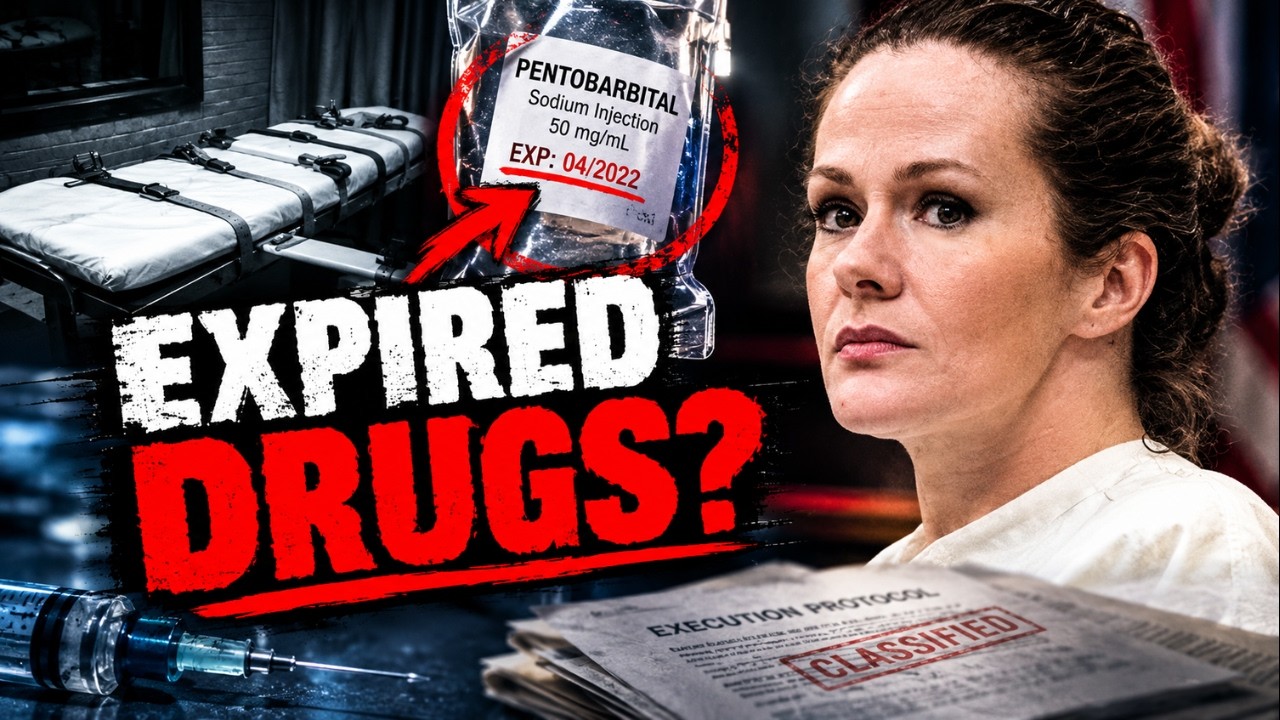
Christa Pike told them where to try.
That may become one of the most disturbing details in the entire investigation.
On September 30, 2026, Tennessee’s execution team was struggling to establish intravenous access in the only woman on the state’s death row.
Pike was strapped to the execution gurney at Riverbend Maximum Security Institution.
Personnel repeatedly searched for usable veins.
Attorney Randy Spivey later said he counted at least seven needle attempts in Pike’s left arm alone.
One needle, he said, appeared badly bent when it came out.
And Pike herself was reportedly trying to help.
“Please try here.”
Then somewhere else.
“Please try here.”
Hours earlier, Tennessee had been fighting in court for the right to execute her.
Now the condemned woman was trying to help execution personnel locate the veins through which they intended to kill her.
That scene would be disturbing under almost any circumstances.
What makes it potentially devastating for Tennessee is that the state had already been warned.
For months.
Pike’s attorneys had told courts that she had unusually small veins.
They had raised her thrombocytosis, a blood condition involving elevated platelets.
They had warned that establishing and maintaining IV access could prove difficult.
Their experts specifically raised the possibility of IV infiltration—the precise type of failure now suspected after Pike’s execution went catastrophically wrong.
They also pointed to another execution failure that had already happened in the same state.
Only months earlier, Tennessee tried to execute Tony Carruthers.
Officials could not establish the required intravenous access.
The execution was abandoned.
No lethal drug was administered.
Carruthers received a one-year reprieve before Tennessee could try again.
That should have been an unmistakable warning.
Instead, Tennessee proceeded with Christa Pike.
And this time, the failure happened after the drug began flowing.
At approximately 7:30 that evening, witnesses watched Pike receive Tennessee’s execution drug, pentobarbital.
Pentobarbital is a powerful barbiturate.
In a sufficiently large dose delivered correctly into the bloodstream, it depresses the central nervous system, suppresses respiration and can cause death.
Tennessee’s protocol uses an enormous dose specifically for that purpose.
There is also a backup set of syringes.
If the first administration does not kill the prisoner, the protocol permits the second.
That is exactly what happened.
The first dose failed.
Then Tennessee administered the backup.
That failed too.
Pike remained alive.
And before she became unresponsive, witnesses heard something that is now central to understanding why.
Her arm hurt.
Badly.
According to witness accounts, Pike complained that one area was burning and throbbing.
Then she said her arm felt as though it was about to burst.
Her attorneys later said that after the second dose her arm appeared to be turning purple.
Those are not the expected signs of a properly functioning intravenous execution.
They are highly consistent with something going wrong at the injection site.
Dr. Paul Allen, a Tennessee anesthesiologist and professor at the University of Tennessee Health Science Center, looked at those early details and reached a straightforward conclusion.
The needle may never have been functioning properly inside the vein.
For pentobarbital to rapidly produce its intended effect, Allen explained, it has to enter the bloodstream directly.
If the IV is not correctly positioned—or if the vein fails—the drug does not travel through the body the way the protocol assumes it will.
Another anesthesiologist has gone further.
Dr. Joel Zivot, an Emory professor retained by Pike’s defense, examined the reported injuries and believes one or both veins may have ruptured after the IVs were inserted.
That would allow the catheter to stop functioning correctly.
The execution team might still push pentobarbital through the tubing.
But instead of entering the circulatory system, the chemical could pour into surrounding soft tissue.
That is called infiltration or extravasation.
And it could explain almost everything.
The burning.
The swelling.
The purple discoloration.
The blisters.
And most importantly—
why Christa Pike did not die.
Zivot’s logic is simple.
If Tennessee’s full execution dose had reached Pike’s circulation in sufficient concentration and then reached her brain as intended, the drug should have been lethal.
She survived.
Therefore, he argues, the amount entering her bloodstream could not have been sufficient to do what Tennessee expected.
Some pentobarbital clearly affected her.
Witnesses watched her mental state change.
Her breathing changed.
She eventually lost consciousness.
But not enough apparently reached her circulation fast enough to stop her heart and respiration permanently.
Then doctors saw the physical aftermath.
When Pike reached a Nashville-area hospital, her attorneys said both arms were swollen, burned and blistered.
She was unconscious.
She was intubated.
She required mechanical ventilation.
Medical staff were attempting to remove the pentobarbital from her system while simultaneously treating the injuries produced during the attempt to kill her.
That image alone may eventually become one of the strongest pieces of evidence in any lawsuit that follows.
Both arms injured.
Not simply one bad needle.
Not just one uncomfortable insertion.
Both sides.
Zivot described pentobarbital solution as chemically caustic and highly alkaline.
When it enters tissue instead of remaining inside a vein, it can cause significant chemical irritation and damage.
He compared the reported injuries to the kind of burning produced by harsh alkaline substances.
The analogy is dramatic, but the underlying chemistry matters.
The execution drug was designed to travel inside blood vessels.
It was never supposed to sit in soft tissue.
That may be what Tennessee now has to explain.
And the reason the phrase “they ignored the warnings” is no longer merely rhetorical is that this possibility had appeared in Pike’s litigation before September 30.
Her attorneys did not simply say:
“Something might go wrong.”
They identified her veins.
Her blood disorder.
The state’s recent IV failure.
The possibility of infiltration.
And the absence of a meaningful emergency plan if lethal injection failed after drugs were administered.
The courts still allowed the execution to proceed.
The state proceeded.
And then Pike began complaining about exactly the part of her body her lawyers had warned could become a problem.
That does not prove misconduct.
It does not establish that prison officials knowingly wanted Pike to suffer.
It does establish that the eventual failure was not an unimaginable freak event nobody had considered.
People had considered it.
They had placed it in legal filings.
They had raised it in hearings.
And the objections were rejected.
There was another warning.
Tennessee’s protocol did not contain a meaningful next step if the two authorized pentobarbital administrations failed.
That became painfully important after the second dose.
Pike was still alive.
Tennessee had reached the end of the written execution procedure.
The Department of Correction later issued an extraordinary statement.
It said every step of the lawful protocol had been followed.
It said pentobarbital had been consistently effective.
Then it admitted the protocol authorized no additional procedure beyond what officials had already done.
Pike was transported to an outside medical facility.
Read that carefully.
The state says the protocol was followed.
Yet the prisoner survived.
That creates two possibilities, neither comfortable.
Either the protocol was not followed correctly in practice.
Or the protocol was followed and was insufficient to prevent this outcome.
That is one of the central questions now facing investigators.
And it is why Governor Bill Lee has handed the case to Ed Stanton.
Stanton is not new to Tennessee’s execution problems.
He is the former U.S. Attorney who led a previous review after Tennessee’s execution system collapsed into controversy in 2022.
That earlier investigation found that Tennessee had failed to comply with its own lethal-injection procedures.
The state subsequently rebuilt its protocol.
It moved to single-drug pentobarbital.
Officials presented the new system as simpler and more reliable.
Four prisoners were executed under the revised process beginning in 2025.
Then came 2026.
First Carruthers.
Then Pike.
Two failed executions in less than five months.
And now the official responsible for the prison system is leaving.
Corrections Commissioner Frank Strada announced his resignation days after Pike survived.
He continues to maintain that the department carried out its responsibilities according to protocol.
But he said stepping aside was in the public interest while Stanton conducts the investigation.
That resignation does not prove wrongdoing.
It does demonstrate how serious the institutional fallout has become.
The investigation now has to reconstruct virtually every step.
Who inserted each needle?
What qualifications did those personnel have?
How was IV placement confirmed?
Was blood return checked?
Did either vein rupture?
When did staff first recognize that the infusion might not be reaching the bloodstream?
Why was the second dose administered?
Was the second IV functioning any better than the first?
When Pike complained of burning, what did the team do?
Did anyone inspect the injection site?
Did swelling begin before or after the backup syringes?
What emergency medical equipment was immediately available?
When did officials decide Pike needed a hospital?
And why did so much of this happen behind closed curtains?
Those curtains have fueled some of the loudest “cover-up” allegations online.
Witnesses said the blinds closed more than once during the failed execution.
At one point they reopened.
Later they closed again and remained shut.
Witnesses could still hear Pike breathing and making sounds described as snoring.
Eventually the microphone was cut.
For almost an hour, observers were left without a clear understanding of what was happening inside.
That secrecy naturally breeds suspicion.
But suspicion is not evidence of a deliberate cover-up.
There is currently no authenticated evidence that officials falsified records, destroyed evidence or knowingly concealed an identified cause of the failure.
In fact, one reason Pike’s lawyers moved so quickly after the execution was to make sure no such evidence could disappear.
They filed an emergency motion seeking preservation of the physical and electronic record.
Needles.
IV tubing.
Drug information.
Execution logs.
Internal communications.
Documents concerning pentobarbital preparation and storage.
Potentially anything that could allow independent experts to reconstruct the failure.
There is another unresolved issue.
The drug itself.
Some critics have questioned where Tennessee obtained its pentobarbital.
Major pharmaceutical manufacturers generally restrict their products from being sold for executions.
Death-row attorneys had previously raised concerns about whether Tennessee obtained its supply through less transparent distribution channels.
The state says the pentobarbital was commercially manufactured, but secrecy laws have prevented public identification of the supplier.
That has produced theories about potency.
Expiration.
Storage.
Preparation.
Degradation.
Some experts initially suggested those possibilities immediately after the execution failed.
They remain legitimate subjects for the review.
But no public evidence currently proves that defective pentobarbital was the main cause.
The strongest medical clue available right now is the IV problem.
Pain at the injection site.
Visible discoloration.
Post-execution burns and blistering.
Known difficulty accessing Pike’s veins.
And two nominally lethal administrations that apparently failed to reach the bloodstream in sufficient quantity.
That is why saying simply “pentobarbital didn’t work” is misleading.
Pentobarbital may have worked exactly as pharmacology predicts on whatever quantity actually reached Pike’s circulation.
The failure may have been delivery.
The drug cannot kill reliably through an IV that is no longer inside a functioning vein.
And that difference matters enormously.
Because Tennessee was warned that delivery could be the problem.
The state also knew it had struggled with exactly that issue before.
Tony Carruthers was scheduled for execution in May.
His execution team managed one IV but could not establish the required backup access.
Officials eventually stopped.
Court filings surrounding that episode raised questions about the qualifications and recent experience of medical personnel involved in IV placement.
Then Pike arrived in September with known difficult veins.
The same general vulnerability returned.
This time, Tennessee did not stop before administering the drug.
That difference is why Pike’s case is historically extraordinary.
A failed IV attempt is one thing.
A failed execution after the state has pumped both authorized rounds of lethal chemical into the prisoner is something else entirely.
The consequences may extend beyond burned arms.
Zivot warned that doctors will need time to determine whether Pike experienced prolonged periods of inadequate oxygen or circulation.
The brain is particularly vulnerable.
So are the heart, kidneys, liver and other organs.
As of the latest public medical information, the full extent of her injuries remained unknown.
There is also no confirmed public update showing that Pike has fully awakened or recovered.
AP reported Saturday that her lawyers had not supplied a newer condition update beyond their disclosure that she had been unconscious and ventilated after the execution attempt.
If she survives and regains the ability to communicate normally, her testimony could become extraordinarily important.
Almost nobody who reaches this stage of an execution lives to describe it later.
Pike could potentially tell lawyers and doctors exactly what she felt.
How long she remained aware.
Whether she experienced the second infusion.
Whether her breathing felt impaired.
When consciousness disappeared.
How severe the burning became.
Those memories could become evidence in the constitutional litigation almost certain to follow.
Tennessee law does not automatically erase Pike’s death sentence because the execution failed.
But a second attempt would now face a completely different legal landscape.
Before September 30, Pike’s lawyers were arguing that Tennessee might expose her to severe suffering.
Now they can point to the execution itself.
The needles.
The burns.
The hospital.
The ventilator.
And the warnings made in advance.
The state will have to explain why another procedure would not simply reproduce what happened the first time.
That question is especially serious if investigators ultimately conclude that Pike’s anatomy made conventional peripheral IV access predictably unreliable.
The state could argue that new safeguards or a different access technique would solve the problem.
Her attorneys would likely argue that Tennessee has already demonstrated it cannot execute her using the existing method without an unacceptable risk of severe pain.
No court has resolved that fight yet.
There is not currently another execution date.
Governor Lee has paused executions while the review proceeds.
That pause has consequences beyond Pike.
It forces Tennessee to confront a deeper problem.
What exactly did the 2022 reform fix?
The state had already investigated itself once.
It had already changed protocols.
It had already moved to a supposedly simpler one-drug system.
Yet in 2026 it encountered two separate IV crises.
The second left a condemned prisoner alive after both drug administrations.
If Stanton concludes that the problem was improper IV placement, the state has to confront training and qualification.
If he concludes the execution team followed procedure correctly, the procedure itself becomes the issue.
If he finds the pentobarbital was compromised, Tennessee will have to explain acquisition, testing and storage.
If he finds multiple failures, the problem becomes much larger than one bad needle.
That is why the resignation of Frank Strada matters.
Pike’s lawyers say the failure reflects a systemic problem rather than the actions of any single person.
Strada’s departure may remove the person at the top.
It does not answer what happened inside the chamber.
And there is another person whose name should not disappear beneath the execution controversy.
Colleen Slemmer.
She was nineteen when Pike and others killed her in Knoxville in 1995.
Pike was eighteen.
She was convicted of murder and sentenced to death.
Slemmer’s mother waited more than thirty years to witness that sentence carried out.
Instead she watched an execution fail.
That means the consequences of Tennessee’s breakdown are not confined to Pike.
The victim’s family now faces more litigation, more uncertainty and the possibility of another execution proceeding sometime in the future.
The state intended September 30 to end the case.
Instead, its own failure prolonged it.
That is perhaps the most important reason to distinguish fact from conspiracy.
Tennessee does not need a secret plot for this story to be damaging.
The documented facts are already serious enough.
Attorneys warned the state about Pike’s veins.
Medical experts warned about infiltration.
Tennessee had recently failed to establish IV access in another prisoner.
The state went forward anyway.
Execution personnel struggled repeatedly with needles.
Pike complained of intense arm pain.
Both authorized doses were administered.
She survived.
Her arms were later described as burned, swollen and blistered.
She ended up unconscious on a ventilator.
The governor halted executions.
The corrections commissioner resigned.
And an outside investigator who has already found serious flaws in Tennessee’s execution system once before has now been asked to return.
That is not proof of a cover-up.
It is proof of a system that has a great deal to explain.
The phrase “they ignored the warnings” therefore does not need embellishment.
The warnings are in the record.
What investigators must determine now is why those warnings did not prevent September 30 from unfolding exactly the way Pike’s lawyers feared it might.
The simplest current medical theory is also the most devastating.
Tennessee may have successfully pushed the lethal drug through its syringes—
but failed to deliver enough of it into Christa Pike’s bloodstream.
If that is confirmed, the failure will not be mysterious.
It will be mechanical.
Medical.
And, according to the defense, predicted.
The final answer belongs to Ed Stanton’s investigation.
Until that report is complete, nobody can honestly say the exact cause has been officially established.
But the evidence available now points in one direction more strongly than any other:
The drug may not have failed.
The veins did.
And Tennessee had been warned that they might.


