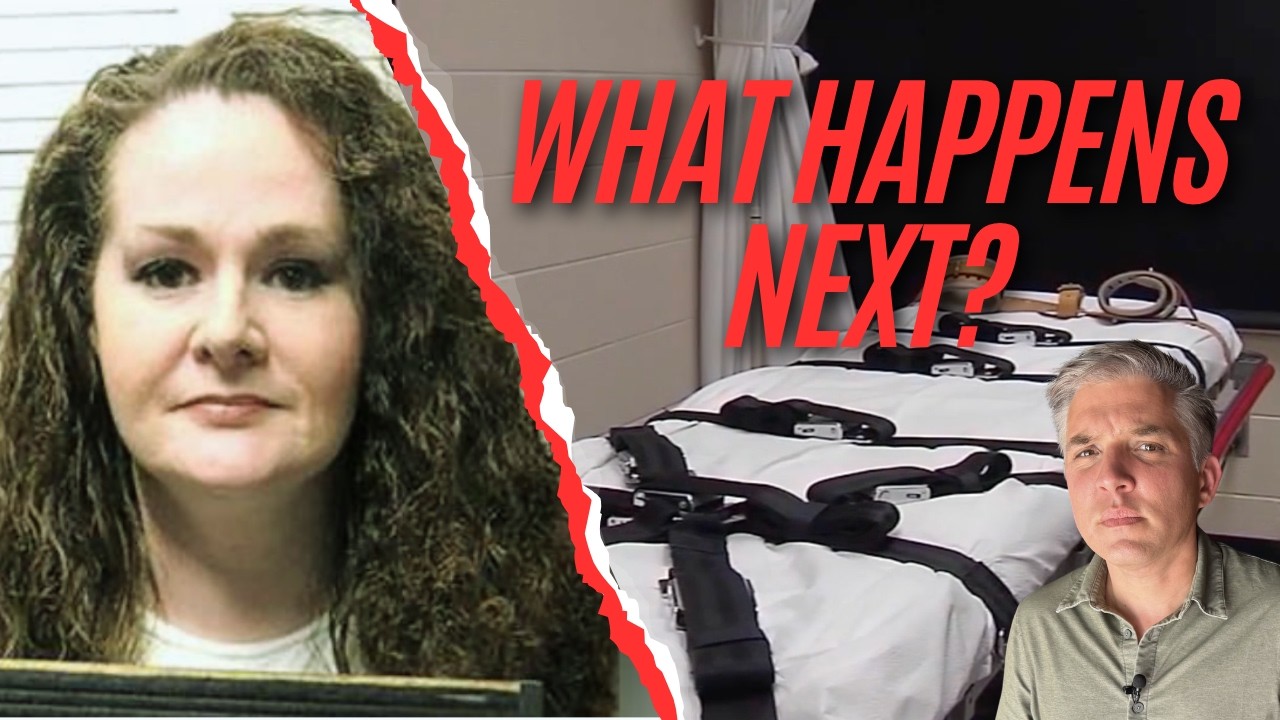
For several hours after Tennessee tried to execute Christa Pike, the story seemed to have only two possible endings.
Either she would die from the pentobarbital already inside her body.
Or she would survive with catastrophic injuries.
Then an emergency-room physician introduced a third possibility.
She could recover.
Completely.
Dr. James Williams, an emergency physician who has studied execution methods, told Brian Entin that a full recovery was medically possible if Pike had avoided significant hypoxic brain damage during the failed execution.
That single possibility changes almost everything.
Because if Christa Pike wakes up, regains normal neurological function and eventually leaves intensive care, Tennessee will be confronted with something almost unprecedented in modern American capital punishment:
A prisoner who can personally describe what it felt like to survive an execution after the state administered its primary and backup lethal doses.
But there is an enormous word inside Williams’ assessment.
If.
If Pike’s brain received enough oxygen.
If her heart and circulation were not seriously damaged.
If her kidneys, liver and other organs recover.
If the chemical injuries to her arms can be treated successfully.
If the prolonged period between drug administration and medical rescue did not cause permanent neurological damage.
Another physician watching the case is far less ready to predict the outcome.
Dr. Joel Zivot, an anesthesiologist and surgery professor retained by Pike’s defense team, said the full extent of her injuries may take time to become clear.
He said the brain is particularly vulnerable to even short interruptions in circulation and oxygen, but warned that other organs—including the heart, kidneys, liver and intestines—could also have been affected.
His assessment was stark:
Doctors do not yet know what kind of life Pike may have if she survives.
As of the latest public information, Pike remains critically ill.
Her attorneys say she is unconscious.
She has been intubated.
A ventilator is breathing for her.
Both arms were described after hospital admission as swollen, burned and blistered.
Doctors have been working to save the same woman Tennessee was legally trying to kill only hours earlier.
The apparent explanation for the execution failure is becoming clearer, although Tennessee’s independent investigation has not yet issued its final conclusion.
Pike’s lawyers say execution personnel struggled badly to establish intravenous access.
One attorney counted at least seven needle attempts.
A needle was reportedly removed visibly bent.
Pike had warned officials that she was difficult to stick.
Her lawyers had also raised concerns before the execution about her small veins and thrombocytosis, a condition involving elevated platelet levels.
Then Tennessee administered pentobarbital.
Pike almost immediately began complaining about her arm.
Witnesses heard her say it was burning.
She said it felt as though the arm might burst.
The state continued.
When the first administration did not kill her, Tennessee used the backup dose allowed under the protocol.
She continued breathing.
According to Zivot, the most likely explanation is that the intravenous catheter stopped functioning properly.
Instead of remaining inside the vein, the drug entered surrounding tissue.
Pentobarbital is highly alkaline.
When it leaks outside a vein, it can damage tissue.
That would help explain the burns and blistering on Pike’s arms.
It would also explain why an amount of pentobarbital intended to be lethal failed to kill her.
If enough drug never reached the bloodstream, it could not rapidly reach the brain and heart in the concentration Tennessee intended.
Zivot emphasized that the fact Pike survived tells doctors something important.
Whatever quantity actually reached her circulation was insufficient to cause death.
It was enough to alter her consciousness and breathing.
It was not enough to complete the execution.
That is where Dr. Williams’ more hopeful scenario becomes possible.
Pentobarbital itself does not automatically create irreversible injury merely because somebody becomes deeply unconscious.
In hospital medicine, patients can survive barbiturate overdose when breathing and circulation are supported while the drug is metabolized and cleared.
The crucial unknown in Pike’s case is therefore not simply how much pentobarbital entered her.
It is what happened to oxygen delivery during the prolonged failed execution and afterward.
If her brain remained sufficiently oxygenated, Williams believes meaningful or even full recovery could occur.
If it did not, the consequences could be permanent.
And if Pike does recover, the next phase of this case becomes legal rather than medical.
The first misconception is the simplest.
Surviving the execution does not automatically erase her death sentence.
Tennessee law specifically says that when an inmate sentenced to death is not executed “from any cause,” the sentence remains in force.
So Pike does not become legally free from capital punishment merely because the state failed on September 30.
But Tennessee cannot simply wheel her back into the execution chamber as soon as doctors discharge her.
The September 30 warrant has been exhausted.
For another execution to occur, the state would have to return to the Tennessee Supreme Court and request a new execution date.
Tennessee’s Rule 12 process allows the condemned prisoner to respond with legal and factual reasons why another date should not be set or why an execution should not occur.
Pike’s lawyers would suddenly have evidence they did not have before September 30.
Before the failed execution, they could argue only that Tennessee’s procedure might fail because of Pike’s veins and medical history.
Now they have swollen arms.
Chemical burns.
Hospital records.
Witness testimony.
Needle-placement problems.
Two failed drug administrations.
Potential neurological consequences.
And whatever Tennessee’s independent investigation eventually discovers.
That turns a theoretical Eighth Amendment argument into a factual one.
The defense could argue that forcing Pike through another lethal injection after the first produced severe injuries would expose her to a known risk of serious suffering.
That does not guarantee success.
American law contains an uncomfortable precedent for the state.
In 1946, Louisiana attempted to execute Willie Francis in the electric chair.
The equipment malfunctioned.
Francis survived the electrical current.
He argued that forcing him through another execution would violate protections against cruel and unusual punishment and double jeopardy.
The U.S. Supreme Court rejected that categorical argument in Louisiana ex rel. Francis v. Resweber.
Louisiana was permitted to try again.
Francis was later executed.
More recently, Alabama failed to execute Kenneth Eugene Smith by lethal injection in 2022 after officials could not establish working IV lines.
Courts later allowed Alabama to attempt another execution using nitrogen hypoxia.
Smith was executed in 2024.
Those cases establish a harsh legal reality.
There is no constitutional rule saying:
The government gets one chance.
But Pike’s situation is unusual even compared with those cases.
Tennessee did not stop before administering its lethal chemicals.
Officials gave her both authorized rounds of pentobarbital.
The execution process reached essentially the end of the written protocol.
Pike remained alive.
And her lawyers say she was then hospitalized with serious injuries caused by the procedure itself.
That distinction may give her attorneys arguments that Willie Francis or Kenneth Smith presented under very different facts.
Temple University law professor Jules Epstein, interviewed by Brian Entin, described several potential legal paths.
They include challenging any second execution under the Eighth Amendment, raising method-of-execution claims, pursuing remaining post-conviction avenues where legally available, seeking clemency, and—if Pike suffers significant neurological injury—examining whether she remains competent to be executed.
That last possibility needs careful explanation.
Brain damage alone does not make someone constitutionally ineligible for execution.
The Supreme Court’s competency cases ask a specific question.
Does the prisoner have a rational understanding of why the state intends to execute them?
In Madison v. Alabama, the Supreme Court held that conditions such as dementia can prevent an execution if they leave the prisoner incapable of rationally understanding the reason for the punishment.
But memory loss or neurological disease by itself is not enough.
So if Pike eventually wakes with severe cognitive impairment, doctors and courts may have to evaluate what she understands.
Can she understand that she was convicted of Colleen Slemmer’s murder?
Can she understand that Tennessee intends to execute her as punishment for that conviction?
Can she rationally comprehend the relationship between those two things?
If she cannot, a competency challenge could become significant.
If she wakes neurologically intact, that particular argument becomes much weaker.
Which creates an extraordinary irony.
The better Pike medically recovers, the less likely competency law is to protect her.
But the better she recovers, the more capable she becomes of participating directly in an Eighth Amendment challenge to what Tennessee did to her.
She could talk to her attorneys.
Undergo independent medical examinations.
Describe the pain she experienced.
Describe what she heard.
Describe how long she remained aware.
Explain whether she remembers the backup injection.
And potentially testify about details no person who died during lethal injection has ever been able to explain afterward.
That could make Pike’s account uniquely important.
Most lethal-injection litigation relies on pharmacology.
Autopsies.
Witness observations.
Execution logs.
Expert reconstruction.
The condemned person cannot describe what happened because the execution succeeded.
Pike might.
That possibility is one reason her attorneys moved immediately to preserve physical and documentary evidence from September 30.
They want needles.
IV equipment.
Drug records.
Electronic communications.
Execution logs.
Information about preparation and storage of the pentobarbital.
Anything that might show exactly when the IVs stopped functioning and whether officials knew the drug was no longer entering Pike’s circulation correctly.
The investigation has already produced consequences inside Tennessee’s prison administration.
Governor Bill Lee halted further executions for the remainder of 2026 and ordered an independent review.
On October 3, Department of Correction Commissioner Frank Strada announced his resignation.
Strada said he continued to believe a review was necessary and that stepping aside was in the state’s best interest.
Those developments do not answer whether Pike will ever face execution again.
They show that Tennessee itself is not treating September 30 as a routine complication.
The state now has to determine whether the failure came from personnel, training, IV placement, the protocol, the drugs, or some combination of those factors.
That inquiry matters enormously if Tennessee eventually asks for another execution date.
The state would have to explain why the conditions that produced the first failure will not simply happen again.
Pike’s attorneys will argue the opposite.
They have already demanded that Governor Lee commute her sentence.
Their position is that she has undergone a complete execution attempt and should not be subjected to another.
Lee has not announced that he will grant commutation.
Nor has Tennessee announced that it will seek another execution date.
For now, both questions remain unresolved.
And any discussion about what happens next has to remember why Pike was on the gurney in the first place.
She was sentenced to death for the 1995 murder of nineteen-year-old Colleen Slemmer.
Slemmer’s mother witnessed the September 30 attempt and left without the finality she had expected after more than three decades.
She has expressed anger at the execution failure and uncertainty about whether she would ever attend another attempt. AP News
That means every path forward carries consequences for two very different sides of the case.
If Pike recovers, her lawyers will argue that she should not be subjected to another execution.
If Tennessee eventually seeks another date, Slemmer’s family could face another long period of litigation and another trip to the death chamber.
If Pike suffers permanent brain injury, courts may have to decide whether her medical condition makes execution legally impermissible.
If she dies in the hospital from injuries caused by the September 30 procedure, an entirely different set of medical, legal and administrative questions would follow.
Right now, doctors cannot responsibly choose among those futures.
Dr. Williams’ assessment provides something the case had very little of after September 30:
A medically plausible hopeful outcome.
Pike could wake up.
She could recover neurological function.
She could eventually leave the ventilator.
She could potentially recover fully.
But Dr. Zivot’s warning remains just as important.
It may take time to learn what the failed execution did inside her body.
The burns visible on her arms are only the injuries doctors can see immediately.
The consequences of oxygen loss, circulation problems and organ stress may take longer to reveal themselves.
So what happens next?
First, Pike has to survive.
Then doctors determine whether she has suffered permanent neurological or organ damage.
At the same time, Tennessee’s independent review reconstructs what went wrong.
Pike’s attorneys preserve evidence and prepare constitutional challenges.
The governor considers renewed requests for clemency.
And only after those pieces begin falling into place could Tennessee realistically decide whether to ask its Supreme Court for another execution date.
The most extraordinary possibility is therefore also the simplest.
Christa Pike might wake up.
If she does, Tennessee will no longer be dealing only with a botched execution.
It will be dealing with a living witness to one.
And for the first time, the person at the center of the procedure may be able to tell a court exactly what the state’s failed attempt to kill her felt like.


