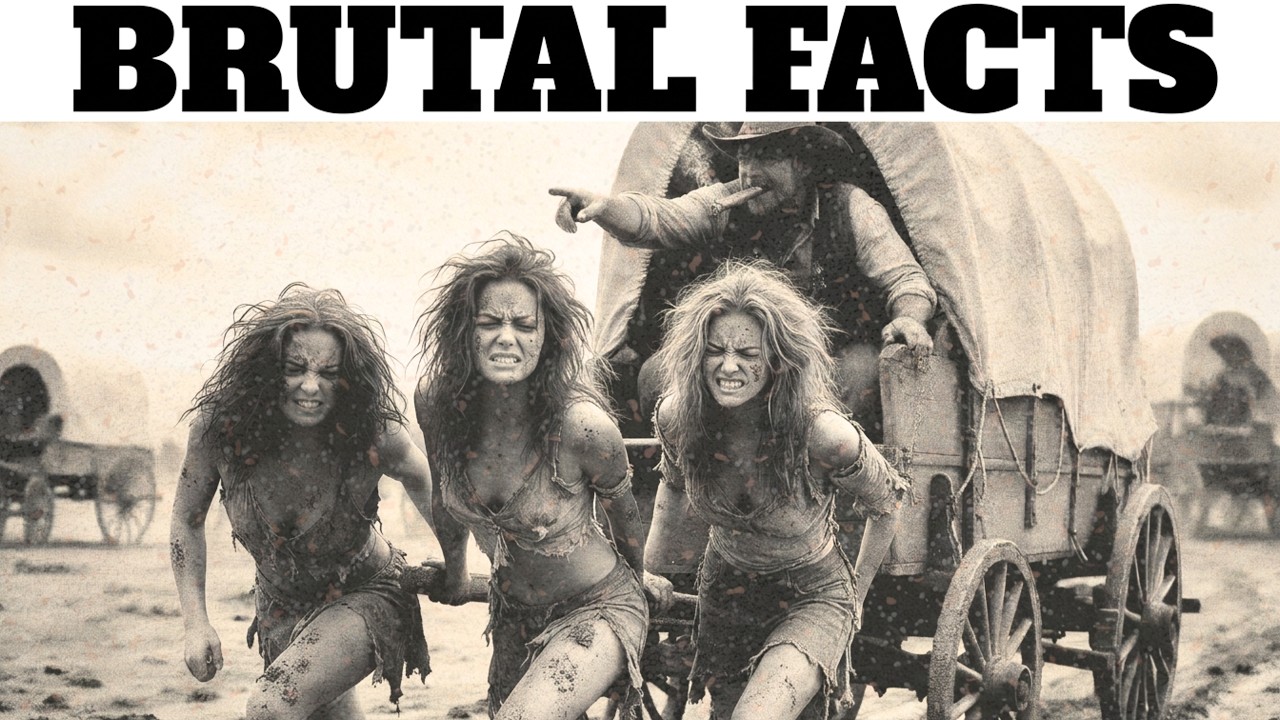
The Old West most people remember never existed.
Not exactly.
Hollywood gave us gunfighters standing ten paces apart.
Cowboys sleeping peacefully beneath stars.
Covered wagons rolling toward empty land.
Saloons filled with dangerous men.
Native warriors appearing over ridgelines.
Sheriffs arriving just before the final showdown.
Parts of that world were real.
But the real West was usually dirtier, stranger and more brutal in completely different ways.
Disease killed people who were afraid of bullets.
Wagon wheels crushed children.
Some graves were deliberately buried underneath the road.
Cowboys were low-paid laborers rather than wandering aristocrats.
Huge numbers of them were Black, Mexican or Native.
Entire Chinese neighborhoods were expelled by mobs.
Millions of bison were turned into hides while carcasses rotted across the Plains.
Families were encouraged to claim farms on land federal officials already knew might be too dry to support them.
And while all of this was happening, entertainers were already turning the frontier into mythology.
Here are twenty-five truths about the Old West that sound invented.
They are not.
1. NEARLY ONE IN TEN PEOPLE WHO STARTED WEST ON THE GREAT EMIGRANT TRAILS NEVER FINISHED THE JOURNEY.
The Oregon, California and Mormon trails have been called the nation’s longest graveyard.
The National Park Service estimates that nearly one in ten emigrants who set out failed to survive.
The main killers were disease, gunshot wounds, accidents, drowning and weather.
Not gunfighters.
Not dramatic Indian attacks.
Ordinary nineteenth-century survival was dangerous enough.
A family could spend months planning a new life in Oregon or California and lose a parent before even reaching the mountains.
Some children reached the destination as orphans.
Some entire branches of families simply disappeared along the road.
2. CHOLERA COULD TAKE A HEALTHY PERSON BEFORE DINNER.
Cholera devastated the overland trails.
The disease spread especially easily through contaminated water at crowded campsites.
Travelers could drink from a water source used by hundreds of people before them without understanding that invisible human waste had contaminated it.
NPS records describe victims deteriorating with extraordinary speed.
Some died within roughly twelve hours after symptoms began.
Imagine feeling healthy at breakfast.
Vomiting by midday.
Dead before the evening fire.
That happened repeatedly.
3. SOME DEAD EMIGRANTS WERE BURIED DIRECTLY UNDER THE WAGON ROAD.
This sounds like a horror story.
It was practical burial strategy.
The National Park Service notes that single graves were sometimes dug directly in the trail.
Wagons then rolled over the disturbed soil.
The purpose was partly to conceal the grave from vandals and grave robbers.
Many graves were deliberately left unmarked.
So emigrants sometimes crossed the West literally driving over the dead who had gone before them.
They simply did not know whose bodies were beneath the wheels.
4. THE WAGON ITSELF WAS ONE OF THE MOST DANGEROUS THINGS ON THE TRAIL.
Covered wagons look comforting in paintings.
In reality, they could kill you.
Adults and children fell from moving wagons.
Some slipped underneath.
The heavy wheels crushed them.
Others were dragged by draft animals, kicked by horses, thrown from mounts or injured while handling oxen.
NPS identifies wagon accidents as among the most common trail accidents.
A child did not need to meet a rattlesnake or outlaw.
One badly timed fall could be enough.
5. EMIGRANTS WERE OFTEN MORE DANGEROUS WITH THEIR OWN GUNS THAN THEIR ENEMIES WERE.
Many wagon families were terrified of attacks.
So they armed themselves heavily.
NPS describes wagons as effectively becoming rolling arsenals.
The result was grimly predictable.
Accidental shootings were common.
Murders were comparatively rare.
Travelers accidentally shot themselves.
Hunting accidents happened frequently.
Cheap firearms misfired or exploded.
The gun purchased to save a family from danger could become the thing that killed somebody inside it.
6. NATIVE AMERICANS WERE OFTEN AMONG THE LEAST DANGEROUS PROBLEMS EMIGRANTS FACED.
This may be one of the greatest reversals of the movie version.
NPS says Native peoples were generally among the lesser problems faced by trail emigrants.
They traded food and moccasins.
They sometimes assisted travelers.
Native ferry systems helped emigrants cross dangerous rivers.
Hostile encounters certainly occurred, especially as settler expansion intensified conflict.
But stories of attacks often overshadowed how frequently interaction was peaceful.
Some frightened emigrants even fired at Native people without provocation.
Hollywood later made the attack the default.
The historical record does not.
7. COWBOYS WERE BASICALLY LOW-WAGE WORKERS DOING A BRUTAL SEASONAL JOB.
The romantic cowboy appears free.
His real counterpart usually worked for somebody else.
NPS describes cowboys as the working class of the cattle industry.
A cowboy might earn about one dollar a day plus food and lodging where available.
The hours were long.
The work was dangerous.
And employment could be seasonal.
He was not necessarily riding toward personal freedom.
He was often riding another man’s cattle toward a railroad.
8. MANY REAL COWBOYS WERE TEENAGERS.
The weathered fifty-year-old gunfighter in a dust coat is a classic movie image.
Actual trail-driving cowboys were often much younger.
NPS says most were in their teens and twenties.
There was a practical reason.
Six-month cattle drives battered the body.
Falls.
Kicks.
Long hours in the saddle.
Bad weather.
Stampedes.
Years of that work could destroy a man physically.
Cowboying was a young man’s occupation because youth helped people survive it.
9. ABOUT A QUARTER OF HISTORIC COWBOYS MAY HAVE BEEN BLACK.
Hollywood nearly erased them.
NPS estimates roughly one quarter of historic cowboys were African American.
Hispanic cowboys were also strongly represented.
Native cowboys worked the ranges.
European immigrants joined them.
The white cowboy became the cultural symbol.
The actual cattle workforce was far more diverse.
10. THE “AMERICAN” COWBOY BORROWED MUCH OF HIS ENTIRE PROFESSION FROM MEXICAN VAQUEROS.
Even the vocabulary gives the game away.
The earliest cowboys were Mexican vaqueros.
American cattle hands learned riding, roping and livestock techniques from Spanish and Mexican traditions.
NPS traces familiar cowboy terms directly back to Spanish:
Lariat from la reata.
Remuda.
Chaps from chaparreras.
Even “buckaroo” developed from vaquero.
One of the most iconic American figures was built on a Hispanic tradition older than the United States itself.
11. A SKILLED HUNTER COULD SHOOT HUNDREDS OF BISON IN A SINGLE DAY.
The destruction of the bison was industrial.
Theodore Roosevelt National Park reports that a skilled market hunter could kill as many as 250 bison in one day.
A fast skinner could remove a hide in roughly five minutes.
At the trade’s peak, auctions reportedly handled extraordinary quantities of hides as railroad expansion accelerated the slaughter.
This was not subsistence hunting.
It was mass extraction.
12. TENS OF MILLIONS OF BISON WERE REDUCED TO ONLY A FEW HUNDRED.
NPS estimates that perhaps 30 to 60 million bison once ranged across North America.
By around the turn of the twentieth century, only roughly 300 remained.
Market hunting, railroad expansion and organized killing pushed the species toward extinction.
The destruction had another consequence.
Bison were central to Plains Indigenous life.
They provided food, hides, shelter and tools.
Destroying the herds also devastated cultures whose survival depended on them.
The landscape of the West did not simply change.
It was deliberately transformed.
13. ONE WINTER COULD DESTROY AN ENTIRE CATTLE EMPIRE.
The cattle business looked unstoppable in the early 1880s.
Then came the winter of 1886–87.
Extreme weather combined with overgrazing caused enormous herd losses across the northern plains.
NPS estimates that roughly one-third to one-half of cattle in some regions were lost.
Some ranchers lost as much as 95 percent of their herds.
Years of wealth could freeze to death in one season.
No outlaw was necessary.
14. BARBED WIRE HELPED KILL THE CLASSIC COWBOY ERA.
Not a final shootout.
Not one legendary sheriff.
Wire.
Open-range cattle once wandered enormous distances across unfenced land.
Then homesteaders and ranchers began fencing claims.
Between roughly 1880 and 1900, barbed wire increasingly divided the range.
Cowboys who had once driven enormous herds across open country found themselves repairing fences, cutting hay and feeding enclosed livestock instead.
The cowboy did not disappear.
His job changed.
15. THE GOVERNMENT GAVE PEOPLE 160 ACRES IN PLACES WHERE 160 ACRES COULD BE NEARLY USELESS.
The Homestead Act sounds generous.
Live on 160 acres.
Improve it.
Eventually own it.
But much western land was too dry for eastern-style farming.
NPS notes that the standard 160-acre claim often proved inadequate in arid regions.
John Wesley Powell understood the problem in the nineteenth century.
He argued that some western settlers needed dramatically larger holdings because water, not acreage alone, determined survival.
Congress largely ignored him.
Settlers learned the lesson personally.
16. LAND PROMOTERS SOLD PEOPLE FARMS USING CLAIMS ABOUT RAINFALL THAT WERE SOMETIMES BASICALLY FANTASY.
Western settlement was also a sales business.
Railroads, promoters and developers needed people to move west.
NPS documentation from Nebraska records dubious claims about soil productivity and rainfall.
Many dry-land farmers arrived expecting fertile opportunity and discovered that the climate did not cooperate.
In some Nebraska rangeland, 160 acres could support only about five to sixteen breeding cattle.
That was not enough for a profitable ranch.
The American dream could fail because the advertisement contained more water than the land did.
17. THE UNITED STATES EFFECTIVELY MADE CHINESE FAMILIES HARDER TO FORM—THEN TREATED CHINESE COMMUNITIES AS FOREIGN BECAUSE THEY LACKED FAMILIES.
The 1875 Page Act sharply restricted Chinese female immigration.
The Chinese Exclusion Act followed in 1882 and imposed much broader restrictions on Chinese labor immigration.
The result was an overwhelmingly male population in many western Chinese communities.
Families became exceptionally difficult to establish.
Then the “bachelor” structure of Chinatowns fed stereotypes that Chinese immigrants were temporary outsiders incapable of becoming American.
Policy helped create the condition.
Prejudice then blamed immigrants for it.
18. WHITE MOBS SOMETIMES ERASED ENTIRE CHINESE COMMUNITIES FROM WESTERN TOWNS.
This was not metaphorical exclusion.
People were physically driven out.
Anti-Chinese campaigns across the West included intimidation, arson, assault, murder and mass expulsions.
NPS documents major violence in places including Tacoma, Seattle and Rock Springs.
At Rock Springs, Wyoming, white miners murdered 28 Chinese men and wounded others in 1885.
The Wild West had racial pogroms.
They rarely make the cowboy movies.
19. ONE CALIFORNIA CITY DROVE OUT ITS ENTIRE CHINESE POPULATION IN ABOUT TWO DAYS.
After violence in Eureka, California, in the 1880s, a white city councilman was accidentally killed during a conflict involving Chinese residents.
White mobs responded collectively.
They looted businesses and forced Chinese residents toward the docks.
NPS records that within two days, no Chinese people remained in Eureka.
Other nearby communities followed with expulsions of their own.
A person could own a business on Monday.
By Wednesday, the community might have expelled everyone who looked like him.
20. THE “FREE” WEST GAVE SOME WOMEN THE VOTE DECADES EARLY—FOR REASONS THAT WERE NOT ALWAYS NOBLE.
Western territories were early laboratories for women’s suffrage.
Wyoming granted women voting rights in 1869.
Utah followed in 1870.
That sounds purely progressive.
The history is messier.
NPS notes that Wyoming legislator William Bright’s support existed partly within racial and partisan politics after Black male suffrage.
Communities of Black, Chinese and Latina women also fought for political rights across western states.
Western suffrage was groundbreaking.
It was not always born from modern ideas of equality.
21. CONGRESS ACTUALLY TOOK VOTING RIGHTS AWAY FROM UTAH WOMEN AFTER THEY HAD ALREADY WON THEM.
Utah women voted beginning in 1870.
Then the federal government intervened.
In 1887, Congress passed the Edmunds-Tucker Act as part of its campaign against plural marriage.
The law stripped Utah women of voting rights.
So women in one part of the supposedly backward frontier had the vote decades before national women’s suffrage—
and then lost it because Washington took it away.
22. BOOMTOWN SEX WORK COULD BE BOTH AN ECONOMIC OPPORTUNITY AND ONE OF THE MOST DANGEROUS JOBS IN TOWN.
Mining towns attracted enormous populations of single men.
Women who entered the sex industry sometimes earned income unavailable to them in conventional female employment.
Some operated businesses.
Others worked under dangerous or exploitative conditions.
At Klondike-era Skagway, NPS records Black women Ruth Brown and Rose Arnold establishing a house near the barracks of Black soldiers partly because white prostitutes sometimes refused Black clients.
Even prostitution could reproduce the racial segregation of the wider West.
23. IN SOME BOOMTOWNS, DISEASE KILLED MORE PEOPLE THAN GUNFIGHTS DID.
Skagway earned an infamous reputation during the Klondike Gold Rush.
Gambling.
Prostitution.
Drunkenness.
Violence.
All were real.
But NPS research identifies contagious disease as one of the most common causes of death there.
Physical trauma from violence was another major cause, accounting for about twenty percent of recorded deaths in the studied period.
The headline danger was the gunman.
The quieter danger was the person coughing beside you.
24. THE WEST WAS ALREADY BEING TURNED INTO FICTION WHILE THE REAL FRONTIER WAS STILL HAPPENING.
This may sound impossible.
It is one of the most important facts on the list.
Dime novels began romanticizing western violence in the nineteenth century.
By the 1890s, brightly colored stories of bloodshed and heroic adventure were already mass entertainment.
Then Buffalo Bill Cody went further.
In 1883, he launched Buffalo Bill’s Wild West.
The production staged attacks, trick riding, shooting exhibitions, Native dances and frontier spectacles.
It toured internationally.
Queen Victoria reportedly saw the show three times.
The myth of the Wild West was not created after the frontier disappeared.
People living through the actual era were already paying to watch a theatrical version of it.
25. THE BRUTAL FINAL TRUTH: THE “EMPTY WEST” WAS NEVER EMPTY.
This is the myth underneath almost every other myth.
The West was not an unused landscape waiting for settlers to discover it.
Indigenous nations had lived across those lands for generations.
The nineteenth-century expansion celebrated as “opening the West” meant warfare, destruction of food systems, land seizure and forced confinement for Native peoples.
The Library of Congress notes that the destruction of bison and rapid white settlement radically transformed Indigenous life.
By the 1880s, most Native Americans in the West had been forced onto reservations, often on land settlers considered less desirable.
The National Park Service makes the same connection between expansion, bison slaughter and increasing confinement of Native peoples.
That is the truth beneath the cowboy legend.
The West was not wild because nobody lived there.
It became violent because multiple peoples, governments and economic systems were colliding over land, labor, water and survival.
The cowboy was real.
So was the outlaw.
So was the saloon.
So was the stagecoach.
But those characters occupied only a small corner of a much larger transformation.
There were Black cowboys whose faces disappeared from films.
Mexican vaqueros whose techniques became “American” cowboy culture.
Chinese railroad workers who helped build the West and were later expelled from western towns.
Women who won political rights before many eastern women did.
Homesteaders sold dreams that rainfall could not sustain.
Indigenous nations whose homelands were transformed into somebody else’s “frontier.”
And travelers who feared warriors while cholera moved invisibly through the water they were drinking.
Perhaps that is why the real Old West sounds fake.
The fictional version has had more than a century to become familiar.
It gave us the clean story.
Good man.
Bad man.
Gunfight.
Sunset.
History gave us something much messier.
Disease.
Debt.
Racial violence.
Government policy.
Environmental destruction.
Exhaustion.
Low wages.
Failed farms.
Mass migration.
And an entertainment industry that began turning all of it into legend before the dust had even settled.
The strangest truth about the Wild West is that Americans did not wait for it to end before they started lying about what it had been.


