Caitlin Clark Questioned Game 3 Officiating—but There Is No Evidence She Accused Referees of Taking Bribes or Produced a Secret “Rigging” Dossier
Indiana’s playoff elimination ended with genuine frustration over officiating.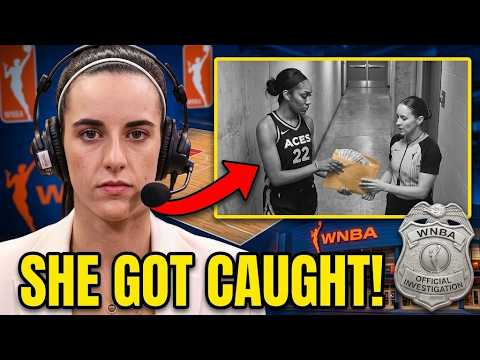
That part is documented.
The Fever lost 94–83 to the Las Vegas Aces in the deciding Game 3 on October 1.
Las Vegas advanced.
Indiana’s season ended.
A’ja Wilson scored 36 points and 10 rebounds while leading the Aces into the semifinals.
But the newest viral claim goes far beyond anything Caitlin Clark actually said publicly.
It says Clark accused the officials of accepting money to manipulate the result.
It says she produced confidential banking records.
It says encrypted text messages proved the outcome had been arranged before tip-off.
And it says secret tunnel footage captured Clark confronting league executives with a six-page dossier.
I found no credible evidence for any of those claims.
The real postgame criticism was much narrower.
Stephanie White focused heavily on the foul and free-throw disparity.
Las Vegas attempted 35 free throws.
Indiana attempted 20.
White raised that difference during the postgame media availability.
Clark responded simply:
“Hm, interesting.”
That remark clearly reflected skepticism or frustration.
It was not a bribery allegation.
Clark did not publicly say referees had been paid.
She did not publicly say the WNBA fixed the result.
She did not identify a bookmaker, league executive, referee or financial intermediary.
She did not present bank records.
And she did not claim to possess encrypted communications proving corruption.
Another real controversy occurred late in the game.
Clark was hit in the mouth by Jewell Loyd while the two battled for a rebound.
The contact left Clark visibly bleeding.
No foul was called.
Clark briefly left the floor for treatment and later returned.
Afterward, when reporters asked Clark what explanation she received for the no-call, she said:
“Your guess would be as good as mine.”
That is one of Clark’s strongest verified postgame comments about the officiating.
Again, it expresses frustration.
It does not allege criminal corruption.
The Fever also objected to other calls during the series.
One particularly controversial sequence involved Lexie Hull being called for a foul after Brianna Turner appeared to hook or pull her down.
Indiana tried to challenge.
Officials determined the request came too late.
Stephanie White became furious and received a technical foul while protesting.
Those moments helped fuel the perception among some Fever supporters that the officiating favored Las Vegas.
Fans reacted intensely online.
Some used words such as “rigged.”
Others accused officials of protecting the Aces.
Those reactions were real as expressions of fan anger.
But fan accusations are not proof.
A controversial whistle does not establish bribery.
A free-throw disparity does not establish payment.
A missed foul does not establish a predetermined result.
To prove a game was fixed, investigators would need much stronger evidence.
That might include financial transfers.
Betting anomalies.
Communications between officials and outside parties.
Confessions.
Law-enforcement evidence.
Or authenticated internal records.
No such evidence has surfaced here.
The alleged banking records are especially serious.
If Clark possessed records proving referees or league officials had received payments to manipulate a playoff game, that would likely trigger immediate scrutiny from the WNBA, sportsbooks, law enforcement and major national media.
I found no current report describing such an investigation.
No bank has been identified.
No account numbers have been cited.
No financial institution has confirmed suspicious transfers.
No regulator has opened a publicly reported case.
No prosecutor has announced an inquiry.
No league statement acknowledges a corruption allegation.
The claim of encrypted text chains has the same problem.
Which messaging platform?
Whose accounts?
Who obtained them?
How were they authenticated?
Were they subpoenaed?
Were they leaked?
Was metadata preserved?
No credible source answers those questions.
The viral story simply declares the messages exist.
That is not evidence.
The alleged confidential binder is also unsupported.
I found no credible report of Clark carrying a binder into a tunnel confrontation.
No photographer captured it.
No reporter described it.
No team official referenced it.
No league executive acknowledged receiving it.
No attorney said it contained financial evidence.
And no document matching a six-page corruption dossier has been authenticated.
Indiana’s official media page provides a far more reliable record of what Clark actually said after the series ended.
The Fever list a postgame media appearance featuring Kelsey Mitchell, Caitlin Clark and Stephanie White.
That is public.
It is attributable.
It has a known source.
And it does not show Clark unveiling evidence of bribery.
The supposed tunnel security footage has no comparable provenance.
No original recording has surfaced through the Fever.
No Aces source has published it.
No arena security department has authenticated it.
No league investigator has cited it.
No major outlet says it reviewed the full recording.
A ten-second clip without those elements would not establish corruption even if one appeared online.
Short clips can be edited.
Audio can be detached from its original video.
Subtitles can alter meaning.
Old footage can be relabeled.
Voices can be misidentified.
And generated audio can imitate public figures.
That is why provenance matters.
The phrase “broadcast cut out” also appears unsupported.
The game and immediate postgame coverage produced extensive reporting.
I found no credible report that a live broadcast was intentionally terminated because Clark confronted league executives.
Broadcasts end for ordinary programming reasons.
A transition away from tunnel footage does not prove a cover-up.
There is no verified indication that producers cut away to conceal a corruption accusation.
The distinction between criticism and accusation matters enormously.
Clark criticizing a missed call is normal sports reporting.
Clark expressing skepticism about a free-throw disparity is also normal.
Clark accusing referees of accepting bribes would be a completely different event.
It would potentially implicate criminal law.
It would affect betting integrity.
It could trigger league discipline.
It could lead to lawsuits.
It would almost certainly produce major national coverage.
No such verified development has occurred.
There are also ordinary basketball explanations for the free-throw difference.
Wilson attacked the paint repeatedly.
Las Vegas generated significant interior pressure.
Indiana committed 27 fouls according to postgame reporting.
The Aces were also the more effective team down the stretch.
That does not prove every whistle was correct.
It simply means a 35–20 free-throw advantage cannot be treated as standalone evidence of corruption.
Indiana had basketball problems of its own.
Clark finished with 18 points.
She shot 6-of-18 from the field.
She made 3-of-12 three-point attempts.
She committed six turnovers.
Las Vegas also received strong production beyond Wilson.
Chelsea Gray scored 23.
Jackie Young added 18.
Jewell Loyd scored 11.
Those facts matter because conspiracy claims often reduce an entire game to officiating.
Game 3 contained disputed calls.
It also contained missed shots, turnovers and strong Las Vegas performances.
Both can be true.
Another complication is that Clark had already been visibly frustrated with officials earlier in the series.
During Game 2, commentators discussed her interactions with referees.
Candace Parker even criticized Clark for spending too much time arguing instead of immediately moving to the next play.
That existing frustration makes a later tunnel-rage rumor sound plausible.
But plausibility is not proof.
A player who disagrees with officiating does not automatically believe officials are corrupt.
The actual language from Clark remains restrained compared with the viral version.
“Hm, interesting.”
“Your guess would be as good as mine.”
Those are the documented statements.
There is no authenticated public Clark statement saying:
The referees were paid.
The result was fixed before tip-off.
Bank records prove it.
Encrypted messages prove it.
League executives knew.
Those claims remain unsupported.
The idea of a six-page evidence dossier also lacks any legal or investigative footprint.
If Clark formally accused the WNBA of manipulating playoff outcomes, her representatives could theoretically send evidence to the league.
They could contact law enforcement.
They could contact a gaming regulator.
They could retain outside counsel.
None of those steps has been credibly reported.
There is no case number.
No complaint.
No subpoena.
No official investigation notice.
No public demand for preservation of referee communications.
No betting-integrity alert tied to Game 3 has been identified.
The rumor therefore jumps directly from controversial officiating to a fully documented conspiracy without providing the intermediate evidence that would make such a conclusion credible.
That leap is the central problem.
The most reliable breakdown is straightforward.
Indiana lost Game 3 to Las Vegas 94–83.
Verified.
Las Vegas attempted 35 free throws compared with Indiana’s 20.
Verified in postgame reporting.
Stephanie White criticized the officiating.
Verified.
Clark responded “Hm, interesting” to the free-throw disparity.
Verified.
Clark was hit in the mouth and visibly bled without receiving a foul call.
Verified.
Clark publicly questioned the explanation for that no-call.
Verified.
Fans accused officials of favoring Las Vegas.
Verified as fan reaction.
Clark publicly accused the referees of accepting bribes.
Not verified.
Clark said the game had been fixed before tip-off.
Not verified.
She produced banking transactions proving corruption.
Not verified.
She possessed encrypted text chains involving league executives.
Not verified.
She slammed a confidential binder onto a tunnel table.
Not verified.
League officials panicked during a confrontation with Clark.
Not verified.
A ten-second security video proves the allegations.
Not authenticated.
A six-page evidence dossier has been released.
No credible source currently identifies such a document.
The genuine controversy is therefore about officiating quality and consistency.
That is enough to debate.
There were disputed calls.
There was a substantial free-throw disparity.
Clark was visibly injured on a no-call.
White publicly criticized the officials.
Clark clearly shared some of that frustration.
But the public evidence stops there.
There is no verified bribery allegation from Clark.
There are no authenticated bank records.
There are no verified encrypted messages.
And there is no credible evidence that Game 3 was predetermined before tip-off.
The “RECEIPTS” dossier and tunnel confrontation remain unsupported.


