March 6, 1943.
Tunisia.
Ten o’clock in the morning.
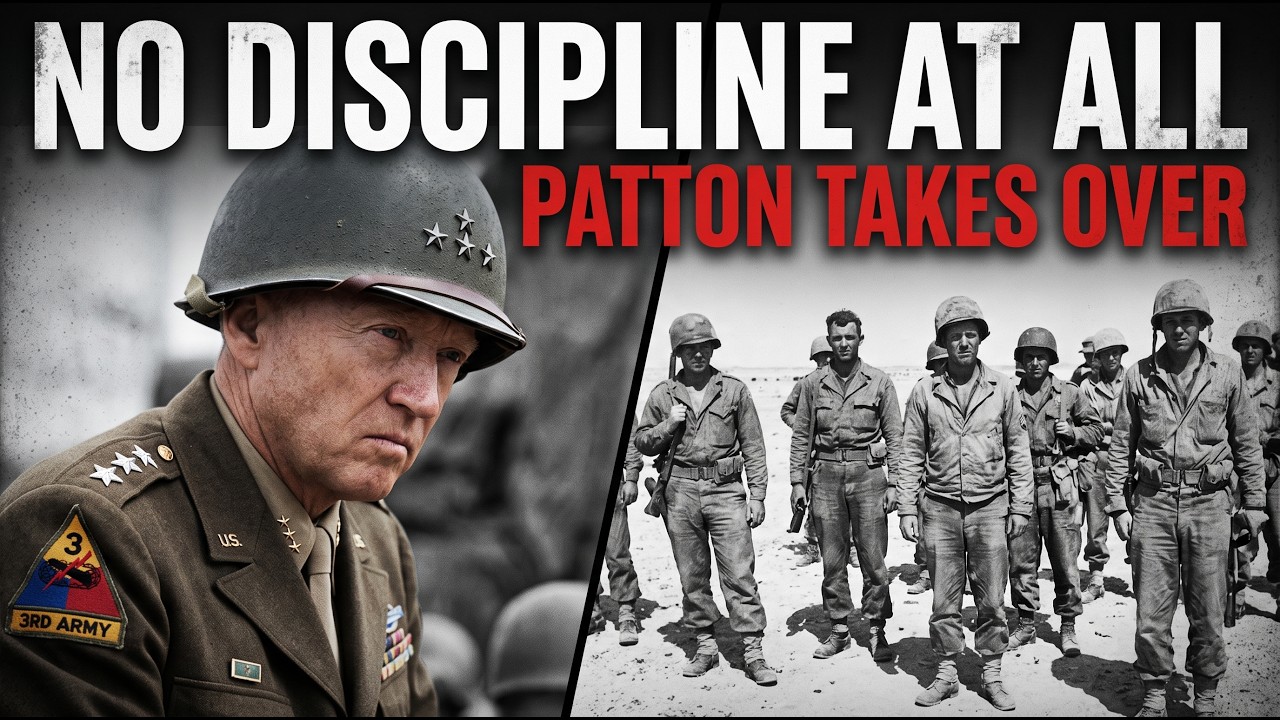
Major General George S. Patton arrived to take command of an American corps that had just endured the most humiliating battlefield lesson of its young war.
According to the supplied narrative, the man Patton was replacing was still sitting at breakfast.
Lloyd Fredendall had commanded U.S. II Corps through the disaster around Kasserine Pass.
Now Patton was taking his place.
There was no leisurely transition.
No long period of orientation.
No comfortable month to study the command before changing it.
Patton had roughly two weeks before his troops were expected to fight aggressively again.
The same soldiers who had recently been pushed backward through the Tunisian mountains would soon face German armor once more.
Patton began issuing orders almost immediately.
Seventeen days later, at El Guettar, American troops would stand against the German 10th Panzer Division.
This time, they would not collapse.
The tempting version of the story is simple.
Patton arrived.
Patton imposed discipline.
Patton transformed a defeated army.
Patton won.
The real story presented by the source is more complicated.
And more interesting.
The American Army that entered Tunisia was still learning what modern war against Germany actually meant.
Operation Torch had brought American ground forces into major combat in North Africa.
Many of the soldiers were inexperienced.
Many officers were fighting their first sustained campaign.
The institution possessed enormous potential.
Potential was not the same thing as battlefield experience.
The Germans had experience.
Years of it.
Mechanized warfare.
Combined arms.
Rapid movement.
Armor supported by artillery and infantry.
Commanders accustomed to identifying weakness and exploiting it before an opponent could recover.
In Tunisia, American units were about to discover how unforgiving that difference could be.
The problems began before Kasserine itself.
According to the source, the German 21st Panzer Division struck French positions at Faid Pass at the end of January.
What followed exposed weaknesses throughout the Allied structure.
Training.
Equipment.
Doctrine.
Coordination.
Intelligence.
Command.
Then came the fighting around Kasserine.
Between February 14 and 22, German forces including elements of the 10th and 21st Panzer Divisions struck the Americans.
The result was severe.
The source puts American casualties at roughly 6,000 and describes II Corps as being driven back approximately 50 miles.
For American soldiers experiencing major combat against the Germans for the first time, the psychological impact mattered almost as much as the physical losses.
Kasserine was not simply a story about inexperienced soldiers running into veteran Germans.
The command structure above them had serious problems.
At its center was Fredendall.
The supplied narrative is brutal in its assessment.
Fredendall operated from a headquarters far behind the fighting.
The source describes an elaborate bunker complex constructed with engineering resources at a moment when those resources were desperately useful elsewhere.
It also says he rarely visited frontline units.
His relationship with subordinate commanders deteriorated.
Confidence moved in the wrong direction.
Soldiers and officers facing the enemy did not believe the man commanding them truly understood what they were experiencing.
Above Fredendall, coordination was also confused.
He operated within an Allied command system involving British and French formations.
Authority was not always clear.
Communication was inadequate.
Orders could conflict.
The Germans did not need to create every weakness they exploited.
Some were already waiting for them.
That is one of the most important lessons in the entire source.
Battlefield collapse rarely comes from one cause.
A unit can have brave soldiers and still fail.
It can have good weapons and still fail.
It can have intelligent officers and still fail.
If command relationships do not function, all those pieces may never combine into effective combat power.
Eisenhower needed to know whether the problem could be repaired with Fredendall still in command.
He sent Omar Bradley to inspect II Corps.
According to the source, Bradley spoke with the division commanders.
His conclusion was devastating.
Confidence in Fredendall had disappeared.
That mattered.
An army does not operate on popularity.
Commanders are not elected.
Subordinates do not need to enjoy receiving orders.
But they do need to believe orders are connected to reality.
They need confidence that headquarters understands the battlefield.
When every major subordinate commander has lost faith in the man above them, the problem is no longer personal.
It is operational.
Eisenhower acted.
On March 6, Fredendall was relieved.
Patton received the assignment on extremely short notice.
The source describes a motorcycle courier reaching him while he was still in Casablanca.
No elaborate transition.
Go.
Take command.
Fix it.
Patton arrived at II Corps headquarters that morning.
The source says he found Fredendall eating breakfast.
Whether that moment carried all the symbolism later storytellers attach to it is impossible to know from the file alone.
But as narrative contrast, it is powerful.
Fredendall leaving.
Patton arriving.
One commander associated with physical distance from the front.
The other about to make personal visibility part of his command method.
Patton did not wait long before making his presence felt.
On his first full day, he ordered the officers’ mess closed at 7:30 in the morning.
Then came inspections.
Saluting.
Uniforms.
Helmets.
Neckties.
Chin straps.
The details have become legendary because they sound absurd.
American soldiers were preparing to fight German panzers.
Patton wanted to discuss ties.
Tunisia was hot.
Patton wanted uniforms worn correctly.
Men had survived artillery, mines and retreat.
Patton threatened fines over military appearance.
To some soldiers, the conclusion seemed obvious.
The new commander cared more about looking like an army than fighting like one.
Patton believed those were connected.
That distinction is essential.
Patton was not simply trying to create attractive formations for inspection.
His theory of discipline operated from the small toward the large.
Salute correctly.
Wear the uniform correctly.
Maintain the weapon correctly.
Respond to orders correctly.
Stand correctly.
Move correctly.
Do the small things when they seem unnecessary.
Then perhaps the habit of obedience and attention will still exist when the situation becomes terrifying.
Patton believed battlefield discipline did not suddenly materialize when artillery started falling.
It was constructed beforehand.
Every day.
Through repetition.
Through standards.
Through habits that might seem trivial until the moment a frightened soldier had to perform automatically.
That theory does not prove every specific rule was necessary.
A necktie is not an antitank gun.
A chin strap does not stop a Panzer IV.
A salute does not replace artillery coordination.
Some of Patton’s measures may indeed have contained an element of theater.
The source acknowledges that debate.
But theater itself can serve a command function.
Patton needed II Corps to understand immediately that the old standard was gone.
A subtle administrative memorandum would not communicate that transformation as effectively as a general suddenly appearing everywhere and fining men for things nobody had enforced the previous week.
The message was not really about the tie.
The message was:
Someone is watching again.
Standards matter again.
This headquarters expects something from you again.
And, perhaps most importantly:
This headquarters expects you to win.
Patton reinforced that message by doing something Fredendall had been criticized for not doing.
He went forward.
The source describes him touring frontline positions and speaking directly with enlisted soldiers.
He entered slit trenches.
He inspected weapons.
He corrected men personally.
He made himself visible.
That visibility carried risk.
A corps commander does not become more useful merely by exposing himself unnecessarily to enemy fire.
Senior officers have responsibilities that require them to remain alive and maintain the larger picture.
But physical presence can also communicate something maps cannot.
Patton wanted to see the condition of the force directly.
He did not want every unpleasant fact polished as it moved upward through staff channels.
And the soldiers saw him.
That mattered after Kasserine.
Men who had come to associate higher headquarters with distance suddenly had the corps commander standing in their dust.
Patton’s uniforms and theatrical manner may have emphasized rank.
His physical presence emphasized something else.
Shared conditions.
Not equal danger.
Not equal hardship.
But enough proximity to make the command relationship visible.
The new general was not an abstraction located somewhere beyond the horizon.
Patton also changed the language surrounding the corps.
A defeated formation can become psychologically defensive long after the immediate retreat ends.
Every order begins to sound like:
Hold.
Protect.
Avoid another disaster.
Preserve what remains.
Patton wanted the opposite mentality.
The source describes communications in which he told his men that simply being willing to die was not enough.
The language was violent and intentionally aggressive.
The purpose was not subtle.
II Corps had spent weeks being acted upon.
Patton wanted it thinking about acting on the enemy.
That shift is difficult to measure.
Morale does not appear on a map like fuel or ammunition.
Confidence cannot be counted like tanks.
But armies are human organizations.
Expectations influence behavior.
A formation convinced it will lose may interpret every setback as confirmation.
A formation convinced it can recover may interpret the same setback as temporary.
Patton was trying to change that expectation before the next major test arrived.
He did not have long.
March 23.
El Guettar.
The German 10th Panzer Division attacked.
This was not an abstract test.
According to the source, the same German formation had participated in the fighting that helped break American positions during the previous crisis.
Now American soldiers would meet German armor again.
The memory of Kasserine was barely a month old.
German tanks advanced.
American positions held.
That sentence is the center of the entire story.
They held.
Not because German armor had suddenly become harmless.
Not because the Americans had transformed into invulnerable veterans in seventeen days.
Not because a necktie possessed magical military properties.
They held because multiple things had changed.
Defensive positions.
Artillery.
Antitank organization.
Command.
Experience.
Preparation.
Coordination.
Confidence.
The fighting was costly.
The source explicitly warns against turning El Guettar into a clean cinematic victory.
American troops suffered casualties.
The battle was hard.
But when German armor struck, the line did not dissolve as it had during the earlier crisis.
The psychological importance was enormous.
The American Army had now experienced two different outcomes against German mechanized forces.
Kasserine said:
This enemy can break you.
El Guettar said:
This enemy can be stopped.
That is a profound change for an inexperienced army.
Not because one battle proves superiority.
Because it destroys the myth of enemy invincibility.
Before soldiers can defeat an enemy consistently, they usually need to believe the enemy can be defeated at all.
El Guettar helped provide that evidence.
The source describes it as the first clear American tactical success against a German armored attack.
Whether every superlative surrounding that characterization should be stated without qualification would require comparison with the broader North African operational record.
But within the source’s framing, its psychological significance is unmistakable.
Kasserine had humiliated the Army.
El Guettar showed that Kasserine did not have to define it.
This is also the point where bad history can begin.
The timeline is irresistible.
February:
Defeat.
March 6:
Patton arrives.
March 23:
German panzers are stopped.
Therefore:
Patton did everything.
The source itself rejects that conclusion.
Correctly.
Patton’s reforms mattered.
Leadership mattered.
Visibility mattered.
Discipline mattered.
But II Corps was not transforming in isolation.
Eisenhower was reorganizing the broader Allied command structure.
The source points to the creation of 18th Army Group under General Harold Alexander as part of the attempt to impose greater unity over British, American and French operations.
Lessons from Kasserine were also spreading through the Army.
Combined arms.
Tank destroyer employment.
Intelligence.
Replacement systems.
Training.
Logistics.
Battlefield experience.
Reinforcements.
An increasingly strained Axis logistical position.
These factors did not compete with Patton’s contribution.
They interacted with it.
That is the more accurate way to understand institutional recovery.
A general can accelerate change.
He cannot personally become artillery, logistics, intelligence, doctrine and training.
Patton did not rebuild II Corps by himself.
He became the most visible human expression of a much larger recovery.
This actually makes his contribution more interesting.
If the argument were simply that Patton was a genius who arrived and fixed everything, there would be little to learn.
Genius is difficult to reproduce.
Institutional recovery is not.
What Patton appears to have understood was that technical reform alone would not be enough.
The Army could improve doctrine.
It could improve antitank defenses.
It could reorganize command.
It could deliver reinforcements.
But somebody also had to convince the men inside the organization that the organization itself had changed.
Patton made change visible.
The closed mess hall was visible.
The neckties were visible.
The fines were visible.
The salutes were visible.
The inspections were visible.
Patton himself was visible.
Every one of those things communicated rupture with the previous regime.
Yesterday’s standards were gone.
A new standard had arrived.
That is a leadership technique independent of whether every specific rule was wise.
Organizations emerging from failure often need visible discontinuity.
A new policy nobody notices does not change psychology quickly.
A new commander appearing in your trench and correcting your uniform certainly does.
Patton understood symbolism.
Sometimes excessively.
But symbolism is not automatically superficial.
Military organizations live on symbols.
Rank.
Flags.
Salutes.
Insignia.
Uniforms.
Ceremonies.
Unit histories.
Battle honors.
None of those things fires a rifle.
All can influence the human being who does.
That helps explain why Patton’s approach could look ridiculous and still produce an effect.
He was communicating:
You are soldiers again.
Act like it.
Then he expected the combat organization behind that message to give them the means to fight like it.
Fredendall’s fate provides the contrast.
The source says he received no further combat command during the war.
Instead, he returned to the United States and served in training assignments.
The transcript then moves beyond description into judgment, portraying later historical assessments as overwhelmingly negative.
There is substantial criticism of Fredendall in the source.
But labels such as one of the “worst” American commanders are evaluative rankings rather than simple historical facts.
The more useful evidence is concrete.
Bradley’s inspection reportedly found subordinate commanders had lost confidence in him.
Eisenhower relieved him.
He did not return to combat command.
Those facts, if supported by the cited records, tell the story without requiring a ranking.
Likewise, Fredendall’s bunker headquarters and reported concern with personal security are meaningful because they illustrate the perception gap between commander and troops.
The problem was not simply that a headquarters existed behind the front.
Corps headquarters must operate far enough from immediate combat to function.
The problem described by the narrative was the combination.
Distance.
Limited frontline contact.
Poor subordinate relationships.
Command confusion.
Loss of confidence.
Any one might be manageable.
Together they became corrosive.
Patton reversed that perception deliberately.
Where Fredendall had seemed distant, Patton appeared forward.
Where standards had become inconsistent, Patton made them rigid.
Where defeat encouraged defensive thinking, Patton spoke offensively.
Where subordinate confidence had collapsed, Patton projected absolute confidence.
Whether that confidence was always justified is another question.
Later in the war, the same trait would contribute to both remarkable successes and serious controversies.
But in Tunisia, confidence was precisely what II Corps lacked.
Patton supplied it in overwhelming quantities.
The source presents Kasserine and El Guettar as an early model for Patton’s later command behavior.
There is something useful in that interpretation.
Patton trusted speed.
He trusted visible command.
He trusted aggression.
He trusted his own judgment.
He believed uncertainty should often be answered with action rather than waiting.
Those characteristics would reappear.
France.
The Ardennes.
The Rhine.
They would also create problems.
The same commander willing to act decisively could act too far.
The same confidence that restored morale could become stubbornness.
The same willingness to reject caution could become unnecessary risk.
That is why Tunisia should not be treated as proof that Patton’s instincts were universally correct.
It shows something narrower.
In March 1943, Eisenhower had a corps whose confidence and command structure had been badly damaged.
He needed a commander capable of creating an immediate psychological break with failure.
Patton was extraordinarily suited to that assignment.
Not subtle.
Not gentle.
Not universally liked.
But unmistakable.
Nobody in II Corps had to wonder whether the new commander intended things to remain as they had been.
By March 7, they knew.
By March 23, they were tested.
And when the German armor came, they stayed.
The broader Tunisian campaign continued after El Guettar.
That also matters.
El Guettar was not the final battle.
It did not destroy Axis power in North Africa by itself.
The campaign continued for weeks.
Patton moved toward planning for Sicily.
Other commanders and formations carried the fight forward.
In May, Axis forces in Tunisia surrendered in enormous numbers.
The source gives a figure of roughly 250,000 German and Italian prisoners.
The strategic result dwarfed the earlier embarrassment at Kasserine.
That victory belonged to an Allied campaign, not to one American corps commander.
And that is exactly why Kasserine’s aftermath is such an important institutional story.
The United States Army had failed.
Then it learned.
Rapidly.
Commanders changed.
Doctrine changed.
Coordination changed.
Soldiers gained experience.
Units discovered what German armor could do.
Then they discovered what stopped it.
A young army became less young with every battle.
Patton was part of that transformation.
A memorable part.
Not the whole of it.
The source’s final question asks whether the necktie order was genius or theater.
That framing creates a false choice.
It could be theater and still serve a purpose.
Military leadership frequently contains theater because command is partly communication.
Patton understood this perhaps better than almost any American general of his generation.
His uniforms were theater.
His language was theater.
His inspections could be theater.
His insistence on visible standards was theater.
But theater can communicate expectation.
The real question is whether the symbolic measures were accompanied by substantive military improvement.
In Tunisia, according to the narrative, they were.
That does not mean the tie caused the victory.
It means the tie was one visible component of a broader attempt to restore organizational discipline while tactical and structural reforms occurred around it.
Take away the artillery improvements, command restructuring and battlefield learning, and the tie means nothing.
Take away morale and discipline, and the technical reforms may still fail because frightened human beings must execute them.
Armies require both.
Systems.
And people willing to trust those systems under fire.
Patton worked on the second problem with extraordinary intensity.
That may be the real meaning of those seventeen days.
He did not transform inexperienced Americans into veteran soldiers by decree.
He could not erase Kasserine.
He could not make German experience disappear.
He could not personally solve every doctrinal weakness the battle had exposed.
What he could do was make defeat stop feeling normal.
That is different.
And perhaps more important.
A defeated organization can become comfortable with explanations.
The enemy was stronger.
The command structure was bad.
The equipment failed.
The intelligence was wrong.
We were inexperienced.
All may be true.
But if explanations become identity, recovery becomes harder.
Patton offered another identity.
Professional soldiers.
Standards.
Aggression.
Expectation.
He demanded the men behave like the army he wanted them to become before they had completely become it.
Then El Guettar gave that identity evidence.
The Germans attacked.
The Americans held.
The psychological equation changed.
Kasserine was now something that had happened.
It was no longer necessarily something that would happen again.
That difference cannot be measured as neatly as casualties or miles of terrain.
But armies remember.
Units remember.
Soldiers remember.
A formation that has never stopped German armor wonders whether it can.
A formation that has done it once knows.
And once the answer becomes yes, the next battle begins from a different psychological position.
That is why the most important part of the story is not the necktie.
It is not even Patton.
It is the speed at which an institution responded to failure.
February exposed almost everything wrong with the American effort in Tunisia.
March began correcting it.
Some corrections came from Eisenhower.
Some from Alexander.
Some from Bradley’s assessment.
Some from tactical lessons learned by officers and enlisted men.
Some from better coordination and logistics.
And some came from a newly arrived corps commander who believed the road back to battlefield confidence began with making every soldier understand that standards had returned.
Patton arrived on March 6.
He saw a corps that had been beaten.
He did not pretend Kasserine had not happened.
He simply refused to allow Kasserine to define what happened next.
Seventeen days later, German panzers attacked at El Guettar.
This time, the Americans did not run.
That was not George Patton’s victory alone.
But it was the first battlefield proof that the army he had inherited was no longer behaving like the army that had been driven backward through Kasserine Pass.
And for a commander trying to rebuild confidence, there could have been no more important evidence than that.


