August 1944.
Brittany, France.
George S. Patton’s Third Army was moving fast.
Very fast.
American forces had broken loose in France, German units were retreating, and every hour mattered.
On some days, Patton’s formations were advancing extraordinary distances.
Towns fell behind them.
Roads filled with tanks, trucks, fuel vehicles, ambulances and supply columns.
The philosophy was simple.
Keep moving.
Do not give the Germans time to reorganize.
Do not allow a retreating enemy to turn withdrawal into another defensive line.
Then, at 6:30 one morning, an American supply convoy stopped.
There was no German roadblock.
No artillery.
No destroyed bridge.
No minefield.
No enemy soldiers.
The road ahead appeared completely clear.
Except for one man.
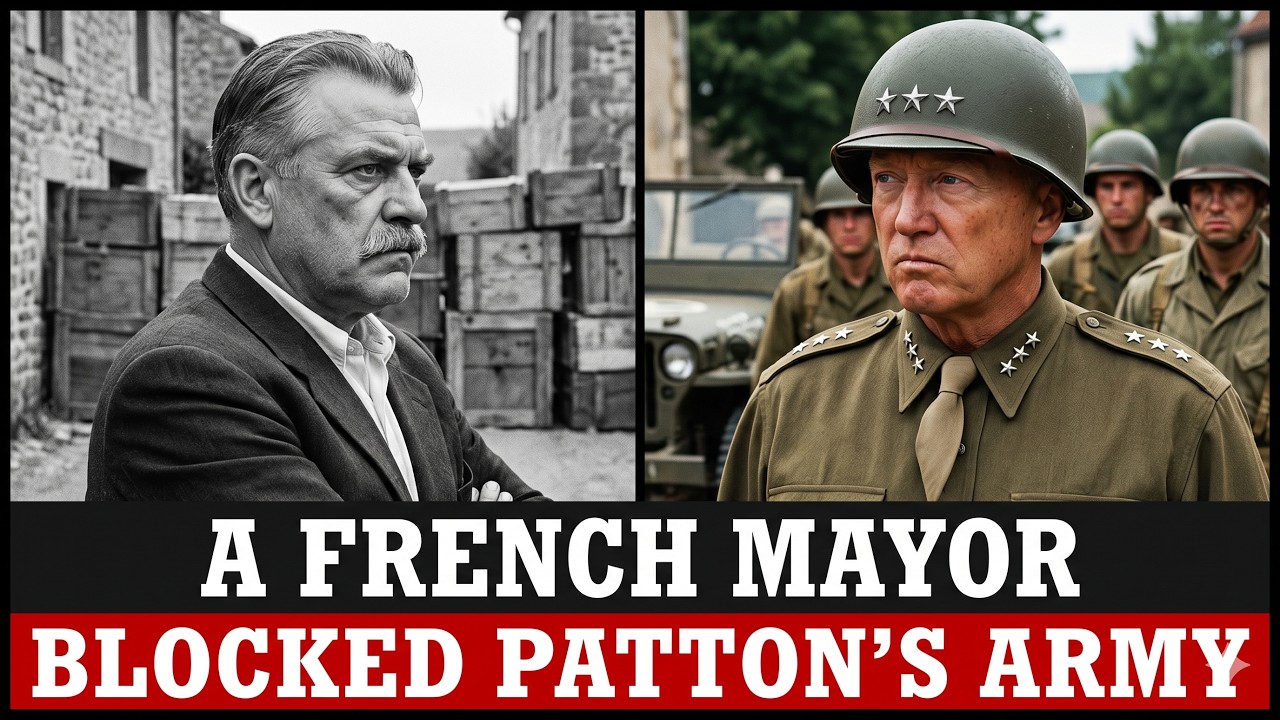
He wore a suit.
He carried no weapon.
Behind him stood a wooden barricade.
Behind the barricade was a small French village.
And according to the story, that one unarmed civilian was about to stop part of Patton’s war machine for six hours.
His name was Maurice Blanchard.
He was the mayor.
And he was not moving.
Corporal James Reed was driving the third truck in the convoy when the column suddenly halted.
He leaned from his cab.
Nothing.
No shooting.
No Germans.
No obvious obstruction.
He climbed down and walked toward the front.
Approximately 200 yards ahead, Lieutenant Frank Briscoe, a 24-year-old officer from Cincinnati according to the source, was already standing at the barricade.
On the other side was Blanchard.
The convoy needed the road.
Blanchard controlled the road.
And neither side initially possessed enough of the other’s language to make the conversation easy.
Briscoe had a phrase book and approximately two weeks of practical French.
Blanchard reportedly knew only the English he had learned in school three decades earlier.
Yet the source makes an interesting observation.
They understood each other perfectly.
The mayor was not confused.
He was not asking what the Americans wanted.
He knew exactly what the convoy intended to do.
It wanted to drive through his village.
His answer was no.
To understand why, the narrative moves four miles east and seven days backward.
Another village.
Trémargat.
An American convoy had passed through there the previous week.
The residents had welcomed it.
Children lined the road.
People waved.
American soldiers waved back.
Nobody intended to damage anything.
Then one truck took a narrow corner too widely.
Its side clipped an old stone wall.
Approximately two feet of masonry collapsed into the road.
The driver stopped.
He looked at the damage.
But he had no practical way to repair a centuries-old stone wall in the middle of a moving military operation.
So he continued.
Three vehicles later, another wheel caught the damaged edge.
More stone came down.
By the time the final vehicle left the village, approximately eight feet of wall had been destroyed.
Only later did the significance become clear.
It was the wall surrounding the village cemetery.
The convoy had not deliberately damaged a French cemetery.
According to the source, most of its drivers did not even know what had happened.
The leading vehicles were already far down the road.
Everyone was focused on the advance.
But the villagers were left with the consequences.
The mayor of Trémargat wrote to the American military.
According to the narrative, no response came.
Maurice Blanchard was that mayor’s cousin.
He visited.
He saw the broken wall.
He helped remove stones from the road.
Then, one week later, he saw another American convoy approaching his own village.
This time he decided not to wait for something to be broken.
Saint-Aubin, as the source initially identifies the village, contained approximately 200 people.
One well.
One principal road in and out.
A church dating to 1647.
A school.
And, most importantly to Blanchard, a water pipe running directly beneath the road.
The narrowest section passed between old stone structures.
Large military vehicles would have little room for error.
So at 6:30 that morning, Blanchard put on his best suit.
He dragged a wooden barricade across the road.
Then he stood in front of it.
Briscoe spent approximately 40 minutes trying to persuade him.
Eventually, through fragments of French, English, gestures and the phrase book, the reason became clear.
Blanchard had seen what happened in the neighboring village.
He was afraid an American truck would damage Saint-Aubin’s water line.
Or the church.
Or the school.
He was not willing to take the risk.
Briscoe proposed a compromise.
The convoy could move slowly.
Single file.
He would personally take responsibility for any damage.
Blanchard refused.
Then Briscoe made the military argument.
There was a war underway.
German forces were retreating.
Every hour the convoy remained motionless was another hour the Germans could use to regroup.
Blanchard understood.
He still said no.
At 9:00, the problem went up the chain of command.
The battalion commander became involved.
No.
The regimental commander tried.
No.
Then division.
Still no.
One French mayor had now stopped the column for hours.
Nobody wanted to arrest him.
Nobody wanted to drive through him.
Nobody wanted to turn a liberated French village into the scene of an American confrontation with civilians.
But the convoy could not remain there indefinitely.
By approximately 1:00 p.m., according to the source, the problem reached Third Army headquarters.
Patton’s operations officer, identified in the narrative as Colonel Arthur Graham, brought him the problem personally.
A French mayor was blocking an American convoy in Brittany.
He had been doing it for six hours.
The convoy commander had negotiated.
Battalion had tried.
Regiment had tried.
Division was now involved.
Nothing had worked.
Patton reportedly looked up from his map.
Six hours?
Then he asked the question that changes the entire tone of the story.
Why?
Graham explained.
The water pipe.
The church.
The school.
The damage in the neighboring village.
According to the source, Patton leaned backward and looked toward the ceiling.
Then he gave an order.
Get my jeep.
Graham reportedly suggested that the matter could continue through normal channels.
Civil affairs personnel could handle it.
Patton stopped him.
It had already been six hours.
Get the jeep.
Forty minutes later, according to the narrative, Patton arrived at the barricade himself.
Nothing had changed.
Blanchard still stood in the road.
Behind the American lieutenant stretched a convoy of hundreds of vehicles and thousands of soldiers.
Some men were eating.
Some had fallen asleep beside their trucks.
The entire column was waiting because one civilian would not move a wooden barricade.
Then Patton stepped from his jeep.
Blanchard saw the three stars on his helmet.
He still did not move.
Patton approached until the two men were separated by only a few feet and a wooden barrier.
The source identifies Patton’s interpreter as Sergeant Paul Devereux, a 26-year-old New Orleans soldier whose parents were French.
Patton told Devereux to introduce him.
Blanchard nodded.
He already knew who stood in front of him.
Then Patton did something the mayor may not have expected.
He did not begin by ordering him to move.
He asked about the pipe.
What would happen if an American vehicle damaged it?
Blanchard answered.
According to the source, replacing it would cost approximately 400 francs.
But money was not the real problem.
Repairs could leave the village without water for two weeks.
Patton immediately proposed a solution.
Eight hundred francs.
Paid immediately.
Double the estimated replacement cost.
And if the pipe was damaged, American engineers would repair it within 24 hours.
Not two weeks.
One day.
Blanchard listened.
Then he rejected the offer.
The money did not matter.
The pipe was only part of the problem.
The church had been standing since 1647.
If an American truck struck one of those walls, francs could not restore three centuries of history.
Patton looked toward the church.
According to the story, this was the moment he stopped treating Blanchard’s refusal as a simple obstruction and began examining the problem from the mayor’s perspective.
The road really was narrow.
The walls really were close.
A large military vehicle making a bad turn really could strike them.
So Patton made another request.
Not an order.
Would Blanchard walk through the village with him?
The mayor was surprised.
Then he agreed.
And this is the image the source treats as the heart of the entire incident.
George Patton, three stars on his helmet, walking slowly down the road of a tiny French village beside a civilian mayor in his best suit.
Devereux followed several feet behind.
They passed the church.
The school.
The well.
The narrow road.
Patton reportedly said almost nothing.
He looked.
At the corners.
At the walls.
At the width of the roadway.
At the places where a truck could drift too far.
At the things Blanchard had spent four years trying to protect while his country was occupied.
They walked all the way to the far end of the village.
Only when the road opened again did Patton speak.
He had a solution.
The biggest American vehicles would not enter the village.
Patton had noticed a farm track to the north while approaching.
According to the story, he believed it could support the heavier trucks.
They would be diverted.
Only lighter vehicles would use the village road.
Those vehicles would travel at walking speed.
Then Patton added another condition.
There would be guides on both sides.
Blanchard asked who would provide them.
Patton’s answer:
The villagers.
American soldiers would not decide how close a truck could come to the church.
Blanchard’s own people would.
A villager would walk on each side of every vehicle.
If either guide believed the truck was getting too close to a wall, he would stop it.
In effect, Patton was giving the village partial control over the movement of his convoy through its streets.
Blanchard listened.
Then he asked another question.
Would Patton give his word?
Yes.
According to the source, Blanchard studied the American general’s face.
This was a man who had lived through four years of occupation.
Promises mattered differently under those conditions.
A person learned to judge whether the man standing opposite him intended to honor an agreement or merely wanted the obstacle removed.
Blanchard was not finished.
He had one final question.
Why had Patton come himself?
The general had a war to run.
Thousands of soldiers depended on him.
There were maps to study.
Units to move.
Fuel to find.
German formations to pursue.
Why spend part of an afternoon arguing over one road in one village with one mayor?
The source attributes an unusually reflective answer to Patton.
Because it was Blanchard’s village.
The mayor had kept it alive for four years.
He had the right to protect it.
And a man unwilling to fight for what belonged to him was not worth fighting for.
Patton had come personally, the story says, because Blanchard deserved an answer from the general rather than another lieutenant.
Devereux translated.
Blanchard listened.
For a moment, he said nothing.
Then he turned around.
He walked back toward the barricade.
And he moved it himself.
The convoy began moving.
Not at normal speed.
Not according to its original plan.
The heavy vehicles diverted north.
The lighter trucks entered the village one at a time.
Slowly.
Walking speed.
And beside them walked the people who lived there.
Farmers.
Shopkeepers.
According to the source, even the schoolteacher participated.
One villager on each side.
Watching the tires.
Watching the mirrors.
Watching the stone.
If a truck moved too close, it stopped.
The convoy took approximately three hours to clear the village.
Not one stone was touched.
No water line was broken.
No church wall was struck.
No American soldier had to drag a French mayor from the road.
The military lost time.
But the village remained intact.
Before the final vehicle left, according to the narrative, Blanchard stood beside the road waiting for Patton’s jeep.
He stopped it.
In his hand was a bottle of wine.
He passed it through the window.
No speech.
No ceremony.
Patton accepted it.
He looked at Blanchard.
Nodded once.
Then the jeep drove away.
The source claims Lieutenant Briscoe wrote his report that evening.
He documented the delay.
The compromise.
The altered route.
Then he supposedly added a final observation:
General Patton had resolved the situation personally.
The source further claims Briscoe recommended that approach for similar situations.
But here the historical caution becomes important.
The file does not reproduce Briscoe’s report.
It does not provide an archive number.
It does not identify a unit diary containing the incident.
And it explicitly says Patton never mentioned the encounter in either his diary or his letters.
Instead, the story supposedly survived through the men who witnessed it.
Briscoe told it.
Reed told it.
Devereux told it.
The account moved informally through the Army.
Soldier to soldier.
And according to the narrative, the detail everyone remembered was not Patton’s offer of money.
It was not the six-hour delay.
It was not even the bottle of wine.
It was the walk.
A three-star American general moving slowly through a French village beside a civilian in a suit.
Neither man talking.
Both looking at the same road.
But seeing it from very different positions.
There is, however, a significant inconsistency inside the supplied account.
The village is initially identified as Saint-Aubin.
Blanchard is described as the mayor of Saint-Aubin.
The barricade stands at its entrance.
The church, school, well and water pipe are all presented as features of that village.
But when the convoy finally moves, the source suddenly says it passed through Saint-Omer-en-Auge.
That is not a minor spelling variation.
It is a different place name.
The source does not explain the change.
Therefore it would be irresponsible to silently select one location and present it as established fact.
The same caution applies to Trémargat, the village allegedly damaged the previous week.
The narrative provides detailed geography and chronology but no military report, civil-affairs record, French municipal source or archival citation establishing the incidents.
Those gaps matter.
So do the unusually polished quotations.
“Because this is his village.”
“He has kept it alive for four years.”
“A man who won’t fight for what’s his isn’t worth fighting for.”
Those lines fit the story beautifully.
Perhaps they reflect genuine recollections.
Perhaps they are reconstructed.
But the supplied material does not contain a contemporary transcript capable of establishing them word for word.
They should therefore remain attributed to the narrative rather than promoted into verified Patton quotations.
The same applies to the claim that the convoy contained hundreds of vehicles and thousands of soldiers.
The source describes the scale visually but supplies no convoy manifest.
Historical storytelling becomes strongest when those distinctions are preserved.
There is no need to pretend uncertainty does not exist.
The story is compelling precisely because the central problem requires no dramatic battlefield enemy.
Nobody is shooting.
Nobody is dying.
No German tank blocks the road.
Instead, the conflict is between two legitimate priorities.
Patton’s priority is speed.
Blanchard’s priority is preservation.
The American general knows German forces are retreating.
Every hour matters.
Fuel must move.
Ammunition must move.
Food must move.
Vehicles must move.
A supply convoy sitting stationary for six hours can have consequences far beyond the village where it stopped.
Blanchard understands none of that less because he is a civilian.
According to the source, Briscoe explained it to him directly.
He still refused.
Because the mayor’s timeline was different.
Patton was thinking about the next 24 hours.
Blanchard was thinking about a church that had survived approximately three centuries.
Patton was thinking about an army moving east.
Blanchard was thinking about 200 residents who needed water.
Patton’s men had entered the village days after German forces withdrew.
Blanchard had spent years living there while France was occupied.
Both men believed they were protecting something.
That is what makes the alleged walk so effective as a narrative device.
Before walking the road, Patton receives information.
The pipe.
The church.
The school.
The mayor’s refusal.
After walking it, he sees the physical problem.
A general looking at a map sees a route.
A mayor standing beside a church sees a home.
Neither view is inherently imaginary.
They simply operate at different scales.
The compromise works because the story allows both scales to remain real.
Patton does not tell the convoy to turn around permanently.
Blanchard does not demand that American forces abandon the route entirely.
Instead, the heavy trucks go around.
The light vehicles pass through.
The Americans accept a slower pace.
The villagers become guides.
The convoy moves.
The village remains untouched.
Neither side receives exactly what it wanted.
Both receive what they actually needed.
That is the strategic lesson buried beneath the sentimental ending.
Good command is not always about imposing maximum authority.
Sometimes it means identifying which part of the other side’s objection is non-negotiable.
Blanchard was not asking Patton to stop the war.
He wanted the church, school and water system protected.
Once Patton supposedly understood that, the conflict became solvable.
Money could not solve it.
An order could have solved it physically, but perhaps at a much higher cost.
Force certainly could have removed one unarmed man from a road.
But removing Blanchard would not remove the narrow church wall.
It would not widen the street.
It would not protect the pipe.
It would merely eliminate the person pointing out the risk.
That distinction is what gives the story its strongest line of logic.
The mayor was an obstacle.
But he was also information.
He knew the village.
He knew the road.
He knew what could be damaged.
He knew what mattered to the residents.
Once the convoy treated him as a source of local knowledge rather than simply a civilian blocking military movement, the solution became visible.
Route the heavy vehicles around.
Let residents guide the lighter ones.
Move slowly.
That is not weakness.
It is adaptation.
And according to the story, the result was measurable.
Not one stone was touched.
Still, one question remains.
Did it actually happen this way?
The source itself gives us reasons to investigate.
Two different village names.
No reproduced military report.
No diary entry from Patton.
No letter.
No identified French municipal document.
No original testimony from Blanchard.
No archival citation for the alleged cemetery-wall incident.
Those are significant gaps.
The claim that Briscoe, Reed and Devereux preserved the story orally may explain why Patton’s papers contain nothing.
But it does not independently prove the details.
If the event can be documented, the strongest evidence would likely come from unit movement records, convoy reports, civil-affairs files, French local archives or veteran testimony recorded close enough to the event to establish the names and location.
The village-name contradiction would need particular attention.
Was Saint-Aubin the correct village?
Was Saint-Omer-en-Auge intended?
Were two separate accounts accidentally combined?
Was one name substituted during later retelling?
The supplied file cannot answer those questions.
So they should remain open.
What the file can support is the story it tells.
An American convoy was stopped.
A mayor refused to move.
The issue climbed through several levels of command.
Patton supposedly decided that after six hours he wanted to see the problem himself.
He listened.
He walked the road.
He recognized the risk.
He changed the movement plan.
The mayor moved the barricade.
And the convoy passed without damaging the village.
If archival evidence eventually confirms that sequence, it would reveal a side of Patton that popular memory often overlooks.
He is remembered for speed.
Aggression.
Profanity.
Armored warfare.
The relentless pursuit of retreating German forces.
Yet this story depends on Patton doing the opposite of what his caricature would predict.
He stops.
He looks.
He walks.
He listens.
Then he moves.
The six-hour delay does not end with the mayor being humiliated.
It ends with his concern being incorporated into the military plan.
And that may explain why, in the source’s telling, the bottle of wine matters.
Blanchard did not surrender his concern.
Patton did not surrender his convoy.
They reached an arrangement each could live with.
Then, when the last vehicles passed and the village remained intact, the mayor handed the general something that required no interpreter.
A bottle.
A nod.
And the road ahead.
But perhaps the most memorable image comes before any of that.
Three stars on a helmet.
A suit worn by a village mayor.
A church supposedly dating to 1647.
And two men walking down a narrow French road while an entire American convoy waited behind them.
Patton had spent the summer trying to move an army faster.
According to this story, one French mayor forced him to spend a few minutes moving at walking speed.
And that may have been exactly what he needed to see the problem.


