For months, the most disturbing evidence surrounding 417 West Chew Avenue has also created the investigation’s biggest problem.
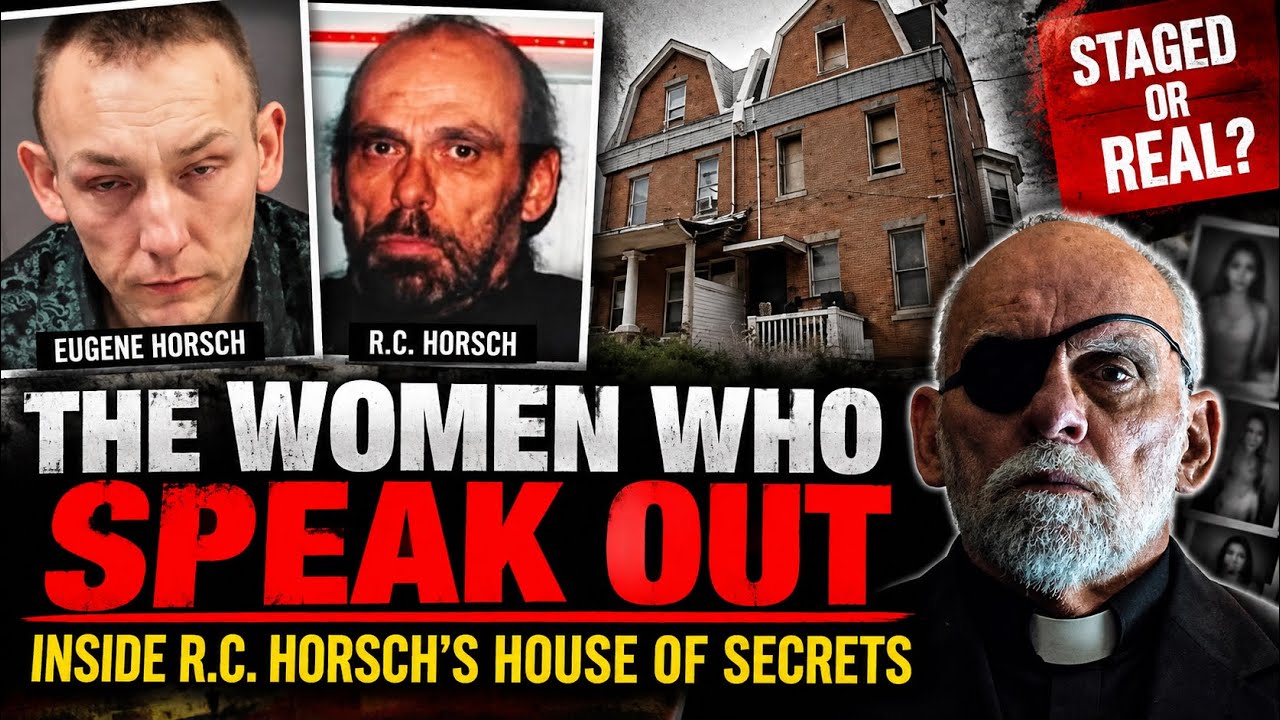
More than one million photographs and videos.
Women restrained.
Women covered in apparent blood.
Women posed in scenes of violence.
Women appearing unconscious.
Women appearing dead.
At first glance, some of those images can look like evidence of horrific crimes.
But two women who actually entered Raymond “RC” Horsch’s world are now describing something investigators cannot afford to ignore.
Some of it really was staged.
Christy says she went to Horsch’s house for a photo shoot and walked back out.
Cassandra Baron says she worked with him more extensively.
She remembers fake blood.
Handcuffs.
Restraints.
Simulated deaths.
Erotic imagery mixed with staged violence.
Neither woman says Horsch murdered anyone in front of her.
Neither says he held her captive.
Neither describes being forced into the house.
And both survived encounters that, viewed only through selected photographs years later, might potentially look far more sinister than they say they actually were.
Their accounts do not clear Raymond Horsch of every suspicion now surrounding his archive.
They do something more complicated.
They provide investigators with a control sample.
A baseline.
A firsthand description of what Horsch’s staged world looked like when the woman in the photograph was alive, participating and able to walk away afterward.
And that baseline may become essential as Philadelphia police and the FBI try to answer the question at the center of the entire investigation:
Which images were fantasy—
and which, if any, captured something real?
The distinction matters because investigators are dealing with an extraordinary digital archive.
According to the supplied account, police and the FBI have identified 58 people in photographs and videos associated with the property.
Some images show women in deeply disturbing circumstances.
Investigators have expressed particular concern about a smaller group of women who appear lifeless or unconscious.
At the same time, authorities know that Horsch deliberately produced violent fantasy material.
His work involved erotic photography and films.
His archived website reportedly described women as imagining and acting out their own deaths.
Fake blood was used.
Restraints were used.
Simulated death was part of the production.
That means appearance alone cannot answer the central question.
A woman lying motionless with apparent blood around her may be a homicide victim.
Or she may be an actor performing a staged death scene.
The image can look nearly identical.
The evidentiary meaning could not be more different.
That is where Christy and Cassandra become important.
They are not merely people commenting on Horsch decades later.
They say they were there.
They posed.
They experienced his production methods firsthand.
And their memories could help investigators identify characteristics separating Horsch’s documented fantasy work from material that cannot be explained so easily.
Christy’s experience appears to have been brief.
According to the supplied account, she believes she initially encountered Raymond through an AOL chat room sometime in the late 2000s.
Eventually, she went to 417 West Chew Avenue.
She agreed to pose.
She remembers Horsch wanting black-and-white photographs because he apparently considered them more artistic.
Her impression was not that she had entered the home of someone who immediately frightened her.
She remembered him behaving as though he knew what he wanted professionally.
Most importantly, Christy reportedly said:
“I didn’t feel like I was in danger.”
She posed once.
She left.
Raymond never contacted her again.
That is a simple story.
But within the current investigation, its simplicity is enormously useful.
It proves, at least according to Christy’s firsthand account, that a woman could enter 417 West Chew, participate in Horsch’s photography and leave without believing that she had been victimized.
That does not tell investigators what happened to other women.
It tells them not to assume every woman who crossed the threshold had the same experience.
Christy also remembers the house itself.
Dark.
Moldy.
Smelling like trash.
None of that made her believe she was in immediate danger.
She remembers a blonde woman working in the kitchen.
That detail could potentially be useful.
But the source provides no basis for identifying the woman.
She should not be retroactively turned into Blair Tenzelli.
Amy McCale.
Christa Kllin.
Or any other woman whose name has subsequently appeared around the investigation.
She may have had nothing whatsoever to do with the current cases.
Investigators, however, can potentially do something the public cannot.
They can show Christy photographs.
They can ask whether she recognizes the woman.
They can compare her memory against dates.
They can examine whether other photographs from the same period place a particular person inside the house.
That is how an apparently minor recollection can become useful without becoming sensationalized.
Christy remembers something else.
Her identification.
According to the account, she says Horsch “took” her ID.
What exactly that means is unclear.
Did he hold it temporarily?
Copy information from it?
Photograph it?
Use it to verify her age?
Keep a copy?
Retain the physical document?
NBC10’s reporting as summarized in the source does not establish the answer.
That uncertainty is especially important because identification documents belonging to multiple women reportedly surfaced during an earlier investigation of another property associated with Horsch.
The temptation is obvious.
Connect the dots.
Declare a system.
Say Horsch collected women’s identities for some hidden purpose.
But the evidence presented does not yet support that conclusion.
There may have been a mundane explanation.
Age verification would be one possibility.
Record keeping would be another.
There could have been a more troubling reason.
Investigators now have an advantage they did not have when dealing only with old documents.
Christy is alive.
They can ask her.
What did Raymond do with the ID?
How long did he have it?
Did she get it back?
Did he photograph it?
Did he explain why he needed it?
Did she see him handling other women’s identification?
Those answers could transform a vague historical detail into something much more useful.
Or they could eliminate the mystery entirely.
That is exactly why living witnesses matter so much in this investigation.
Cassandra Baron’s story gives investigators something even more valuable.
A detailed example of Horsch’s staged death imagery from the perspective of a participant.
Cassandra says Raymond approached her in Kensington in 2013.
She was struggling with addiction at the time.
According to her account, he offered money for photographs and somewhere to stay.
That provides a firsthand example of how Horsch recruited at least one woman.
Not through a professional modeling agency.
Not necessarily through an advertisement.
On the streets of Kensington.
The circumstances raise legitimate questions about vulnerability and power.
But Cassandra does not describe the relationship in the way someone might expect after seeing the images now under investigation.
She remembers Raymond as socially awkward.
She remembers the house having a strange smell.
But she also says he did not pressure her.
According to Cassandra, he did not ask her to do anything she was uncomfortable doing.
She remembers him cooking for her.
Washing her clothes.
Giving her somewhere to stay.
Those memories do not establish that Raymond treated every woman the same way.
They do not disprove allegations or suspicions involving other women.
But they complicate the image of a house where every visitor immediately understood herself to be in danger.
For Cassandra, there was apparently enough normality and trust that she continued working with him.
Then comes the detail that could be critical to the forensic review.
The death scenes were real productions.
The deaths were staged.
Cassandra remembers fake blood.
Handcuffs.
Women bound.
Restraints around the neck.
Simulated death.
Sexualized violence.
She described the work as death scenes mixed with erotica.
Horsch’s archived website apparently supports that general description, presenting women as acting out imagined deaths.
This changes how investigators have to read the archive.
Imagine a photograph showing a woman on the floor.
She is motionless.
Her hands are restrained.
Something is around her neck.
Blood appears beside her head.
The room can be matched to 417 West Chew.
Viewed in isolation, the image may look like documentation of murder.
Cassandra’s account establishes that Horsch deliberately created photographs designed to look exactly like that.
Therefore, appearance cannot be the endpoint.
Investigators need chronology.
What happened before the photograph?
What happened afterward?
Are there sequential images?
Raw video?
Multiple camera angles?
Does the woman get up when the scene ends?
Does she appear in another shoot a week later?
Does she post online afterward?
Make a phone call?
Use a bank account?
Receive medical treatment?
Get arrested?
Enter a shelter?
Speak to family?
Any verified activity after the supposed “death” can radically change the interpretation of the image.
That is why identifying the women in the archive is not merely administrative work.
Every living participant can potentially explain a piece of the evidence.
“That was me.”
“That was fake blood.”
“Those were props.”
“I went home afterward.”
Five sentences could turn what appears to be photographic evidence of homicide into documentation of a staged production.
But the reverse problem is what makes the investigation so serious.
What if investigators cannot find evidence that a woman survived the scene?
What if she disappeared immediately afterward?
What if the image sequence ends differently from known staged productions?
What if raw footage contains something inconsistent with performance?
What if blood is determined to be real?
What if the physical environment matches forensic evidence recovered from the property?
What if the woman’s communications and financial activity abruptly stop?
That is when the baseline supplied by Cassandra becomes potentially powerful.
Investigators can compare.
Known staged scene versus unexplained scene.
Living participant versus missing woman.
Fake blood versus unidentified material.
Performance restraints versus evidence of actual injury.
Edited film versus raw recording.
That is a far stronger investigative method than simply looking at an image and deciding whether it “looks real.”
Cassandra herself illustrates how complicated that process may become.
She reportedly appears in Horsch’s production “Deleted Scenes: A Serial Killer’s Video Journal,” released in 2016.
Yet she says she does not remember filming those particular scenes.
That sounds disturbing.
But it does not prove she was drugged.
It does not prove she was secretly filmed.
It does not establish that Raymond committed a crime against her during that production.
The supplied report says Cassandra does not make those accusations.
There could be many explanations for an incomplete memory, particularly given the circumstances she described from that period of her life.
Investigators can answer questions that public speculation cannot.
When were Cassandra’s scenes recorded?
Do the original files contain metadata?
What other photographs were taken the same day?
Who else appears?
Do raw files show preparation before the scene?
Do they show Cassandra afterward?
Are there emails, releases, messages or other production records?
Was the film assembled years after the underlying footage was recorded?
The archive may preserve the answers.
In that sense, Cassandra is not only a witness.
She can become a reference point investigators use to test their digital-forensic methods.
If investigators can reconstruct her shoot accurately, despite her incomplete memory, they may learn how Raymond organized files, staged scenes, edited footage and preserved raw material.
Those patterns could then be compared with the files involving missing women.
Cassandra also remembers being told not to enter the basement.
That detail will inevitably attract attention because the basement later became one of the most scrutinized areas of 417 West Chew.
But the meaning is not established.
Cassandra remembers a strange smell.
She remembers Raymond telling her not to go downstairs.
She says those details felt creepy in hindsight.
They do not prove a body was hidden there.
They do not prove a homicide occurred in the basement.
They do not prove the odor came from chemicals.
They do not establish why Raymond restricted access.
The supplied material notes that the property was also associated with drug activity.
That could potentially provide another explanation for why someone might restrict access to a basement.
But that too should not simply be assumed to be the answer.
The important historical fact is narrower.
During the period when Cassandra says Raymond was photographing women at 417 West Chew, he reportedly told at least one of those women not to enter the basement.
Investigators can document that.
Why he did it remains unanswered.
Later searches make that memory more interesting.
Authorities reportedly recovered containers containing an unidentified oily substance and chemicals requiring additional testing.
Investigators have reportedly been examining whether any substances could have been capable of destroying evidence or affecting human remains.
But no publicly released laboratory result in the supplied material establishes that those chemicals were actually used for such a purpose.
That distinction cannot be skipped.
A chemical can theoretically perform a function without ever having been used for that function.
Possession is not proof of application.
The source also says portions of the property and pipes were examined, with NBC10 sources reporting that nothing substantial was recovered from the excavation described.
The chemical testing therefore remains important precisely because speculation has moved far ahead of the laboratory results.
What were the substances?
Why were they there?
Were they related to photography?
Drug activity?
Cleaning?
Another legitimate or illegitimate use?
Could they degrade biological material?
Is there evidence they actually did?
Until testing answers those questions, Cassandra’s strange-smell recollection cannot bridge the evidentiary gap.
Another historical discovery pushes in the opposite direction.
Fake blood.
According to the supplied account, law enforcement had entered 417 West Chew in 2025 following a fire and encountered what appeared to be fake blood.
No human remains were reportedly discovered during that entry.
Now combine that with Cassandra.
She independently remembers fake blood being used during Horsch’s productions.
Combine it again with the archived website.
Horsch described women acting out imagined deaths.
Together, those details provide substantial reason for investigators to avoid interpreting apparent blood in old imagery as automatically representing genuine injury.
Again, that does not prove every blood scene was fake.
It establishes that fake blood was part of the production environment.
Every scene therefore requires independent analysis.
This is where the scale of the archive becomes overwhelming.
The supplied account says investigators had identified 58 people.
It also describes a working breakdown in which many have some form of resolution while a smaller group remains the focus of much more serious concern.
The exact categories and counts should be handled carefully because the host himself struggles to reconcile them.
What matters more than the arithmetic is the investigative principle.
Not every person photographed by Raymond is missing.
Not every person depicted as dead was actually dead.
Some identified participants are alive.
Some have reportedly died from unrelated causes.
Some have been located and interviewed.
Some reportedly declined interviews.
Others remain subjects investigators are trying to contact.
And a smaller group remains unresolved under circumstances investigators consider particularly concerning.
Those categories should not be collapsed into one.
The investigation becomes stronger as more women are identified.
Suppose police locate someone in a horrifying image.
She recognizes herself immediately.
She explains the scene.
Investigators verify that she remained alive for years afterward.
That file moves toward the staged category.
Now suppose another woman appears in nearly identical imagery.
But she disappeared shortly afterward.
No verified photograph exists after the date of the scene.
No phone activity.
No financial activity.
No contact with family.
No medical record.
No arrest.
No shelter entry.
No credible sighting.
The visual similarities remain.
The evidentiary context is completely different.
That is why Drexel criminology professor Rob D’Ovidio’s approach, as summarized in the supplied material, is so important.
Build timelines.
Do not begin with the photograph.
Begin with the person.
When was the image actually created?
Not merely copied.
Created.
Where was it recorded?
Can the room be matched to 417 West Chew?
What images come immediately before and after it?
What does the unedited footage show?
Was another camera running?
Did the woman communicate afterward?
Did she make financial transactions?
Receive medical care?
Appear in another image?
Speak to another person?
The question is not simply whether someone looks dead.
The question is whether investigators can prove she was alive afterward.
Metadata will be crucial.
But metadata can also mislead if interpreted carelessly.
The supplied commentary repeatedly raises apparent discrepancies involving 2017 dates and women reportedly missing at other times.
Those discrepancies need forensic explanation.
A file timestamp can reflect creation.
Modification.
Export.
Copying.
Encoding.
Transfer.
Or another digital event depending on the file and system.
Therefore, a date attached to a recovered file should not automatically be treated as the date the underlying scene was filmed without forensic confirmation.
Investigators have the original devices and archive—or at least a large body of recovered digital evidence—so they may be able to reconstruct those histories much more reliably than outside observers can.
The medical examiner’s involvement adds another layer.
According to the source, images involving some of the most concerning women have reportedly been reviewed, with the images considered authentic and unaltered and the women depicted appearing deceased.
That is significant.
But even the source recognizes the limitation.
An authentic photograph can authentically depict a staged scene.
“Unaltered” means the image itself was not digitally fabricated or manipulated in the relevant sense.
It does not automatically establish that the apparent death depicted was genuine.
That requires corroboration.
This is precisely where Cassandra’s testimony matters.
She says authentic photographs were made of staged violence.
Real camera.
Real woman.
Real restraints.
Real room.
Fake death.
Fake blood.
No digital manipulation necessary.
Therefore, investigators need more than image authentication.
They need event authentication.
Did what the image appears to depict actually occur?
That is a much harder question.
It may be the central forensic challenge of the entire case.
There are additional developments in the supplied material that should remain separate from the archive analysis.
One involves a large safe at Raymond’s former Bucks County property.
A prospective buyer identified as Lindsay reportedly toured the property in March 2026 and remembers an enormous safe in the basement or foundation area.
The host asks whether law enforcement examined it during a 2009 investigation.
The source does not answer that question.
It does not establish that anything incriminating was inside.
It does not establish that the safe was hidden for criminal purposes.
It may have been structurally difficult or expensive to remove.
The relevant investigative question is documentary.
Do the 2009 records mention the safe?
Was it opened?
Photographed?
Inventoried?
Was anything removed?
Without those records, the safe is an unanswered architectural detail—not evidence of a hidden crime.
Another development concerns a cremation review reportedly posted by Eugene Horsch.
According to the supplied account, Eugene left a five-star review for Philadelphia Cremations after a young woman believed to have been his girlfriend died at Jefferson Einstein Hospital.
He reportedly described receiving cremains in a temporary black container before transferring them to a marble urn.
The identity of that woman has not been publicly established in the source.
Some people speculate that she was Christa Kllin.
That remains speculation.
Five urns were reportedly recovered from 417 West Chew.
Three have been associated publicly with Raymond, his sister and a friend.
Two remain publicly unidentified.
But there is currently no established connection in the supplied material between Eugene’s cremation review and either unidentified set of cremains.
The existence of a review does not close that gap.
Records from the cremation provider potentially could.
Until then, the identity should remain unknown.
The same evidentiary discipline applies to Raymond’s reported historical access to a Kensington crematorium.
The supplied account says reporting attributed to Fox29 and the Philadelphia Inquirer described sources claiming Raymond exchanged drugs and money for access to photograph or film human remains.
If accurate, that history could explain why his archive contains genuine imagery of dead bodies.
But it does not establish that missing women from the current investigation were taken to that crematorium.
It does not establish that their remains were disposed of there.
And it does not transform every authentic image of a corpse in Raymond’s collection into evidence of a murder committed by Raymond.
Access and causation are different things.
That distinction is especially important in a case where art, pornography, staged violence and potentially authentic postmortem imagery may coexist in the same archive.
Investigators have to classify each piece rather than letting one category contaminate interpretation of another.
Then there is Eugene.
The supplied commentary repeatedly speculates about whether Eugene could have “gone rogue.”
It wonders whether his mother’s reported overdose affected his attitude toward women struggling with addiction.
It notes that some people who knew the family appear more suspicious of Eugene than Raymond.
Those theories are not established evidence.
They should not be transformed into motive.
The source itself says police have been adamant that they do not currently have evidence tying Eugene to the suspected deaths or disappearances in the manner being speculated about.
Eugene has not been charged with killing the missing women.
Any current federal charges against him are separate allegations and he remains presumed innocent unless proven guilty.
The source says his federal trial is now scheduled for March 22, 2027.
Whatever that case involves, it should not be used as a shortcut to establish guilt in an entirely different investigation.
The father and son also should not be treated as interchangeable.
Evidence involving Raymond is evidence involving Raymond.
Evidence involving Eugene is evidence involving Eugene.
Any connection between them must itself be proven.
That becomes even more important as people who knew Raymond begin speaking publicly.
Some describe him as strange.
Some remember disturbing artistic interests.
Some remember vulnerable women coming and going.
But others say they did not see anything they recognized as criminal at the time.
Jeremy Perry, described in the source as a childhood friend of Eugene, reportedly remembers spending significant time around the family property.
He remembers blue 55-gallon barrels.
Photographic equipment.
People coming and going.
Raymond rebuilding after a fire.
A large steel door associated with the rebuilt area.
Yet Perry says he did not find Raymond suspicious at the time.
He also remembers the father-son relationship appearing normal from his childhood perspective.
That testimony does not exonerate Raymond.
Nor does it establish anything about what Raymond may have done outside Perry’s presence.
It provides another historical perspective.
And that is what this investigation increasingly needs.
Perspectives that can be tested.
Not narratives that have already decided the ending.
Christy and Cassandra may be the clearest examples yet.
Neither gives investigators the simple story many people expected.
Neither says:
“I entered the house and immediately knew Raymond was dangerous.”
Instead, Christy says she did not feel endangered.
Cassandra says he did not pressure her.
He cooked.
Washed her clothes.
Provided shelter.
And then photographed her in imagery designed to resemble violence and death.
That combination may feel contradictory from the outside.
For investigators, it is valuable.
It shows how Raymond’s production environment could generate deeply disturbing material without the depicted event necessarily being criminal.
It also shows why vulnerable women might continue returning.
Money.
Shelter.
Drugs.
Photography.
Attention.
A place to stay.
A relationship that could contain ordinary behavior alongside disturbing fantasy material.
None of those facts automatically tells investigators where fantasy ended.
But they help define what fantasy looked like.
That may eventually allow police to create three evidentiary categories.
First:
Clearly staged material.
A living participant identifies herself.
The props are known.
The sequence demonstrates performance.
Later records confirm she survived.
Second:
Unresolved material.
The woman may be identified, but investigators cannot yet determine whether the scene was staged.
Evidence remains incomplete.
Third:
Material involving a woman who disappeared and whose survival after the scene cannot currently be established.
That third category demands the greatest scrutiny.
Not because the photograph itself proves murder.
Because the usual evidence capable of proving performance is missing.
That is where chronology becomes decisive.
If investigators eventually identify a woman alive after the supposedly fatal scene, the interpretation changes.
If they cannot—and every independent record stops around the same period—the concern deepens.
But even then, disappearance alone does not prove Raymond killed her.
Other explanations remain possible.
Kensington was a dangerous environment.
Some women struggled with severe addiction.
Some lived transiently.
Overdose.
Violence by another offender.
Accident.
Medical death.
Voluntary disappearance.
Incarceration under another identity.
Relocation.
Any of those possibilities could complicate a missing-person timeline.
That is why investigators need corroboration linking the scene itself to the disappearance.
The work will be slow.
The source says only a portion of the massive archive had been meaningfully reviewed.
If hundreds of thousands of files remain, investigators may still be far from understanding the complete chronology.
Each newly identified woman could reorganize part of that archive.
Each living participant can potentially label photographs.
Identify rooms.
Recognize props.
Name other women.
Explain routines.
Remember vehicles.
Recall dates.
Identify aliases.
Recognize clothing.
Describe what happened after cameras stopped.
That is why Christy remembering a blonde woman in the kitchen matters.
Why Cassandra remembering fake blood matters.
Why Cassandra’s incomplete memory of “Deleted Scenes” matters.
Why the ID matters.
Why the basement instruction matters.
None is proof of murder.
Each is a possible comparison point.
The investigation needs thousands of those points before investigators can confidently say which images remain unexplained.
And that may be the biggest change produced by these interviews.
Before Christy and Cassandra spoke, the archive could easily be imagined as one enormous collection of potential crime-scene evidence.
Their stories force a more disciplined interpretation.
Some of the horror was manufactured.
Some blood was fake.
Some deaths were performances.
Some restraints were props.
Some women were there voluntarily.
Some left alive.
That does not make the unresolved material less serious.
It may make it more serious.
Because once investigators identify and remove the staged scenes, whatever cannot be explained remains.
If 100 frightening photographs can be matched to living participants who describe acting in them, those files become less mysterious.
If five cannot—
if the women vanished—
if no later record establishes survival—
if the raw footage differs from known productions—
if physical or forensic evidence supports genuine injury—
then investigators are no longer comparing a disturbing photograph against imagination.
They are comparing it against Raymond Horsch’s own documented production methods.
That is a much stronger evidentiary position.
Christy and Cassandra therefore do not answer whether Raymond Horsch killed anyone.
They do not answer what happened to Blair Tenzelli.
They do not explain Amy McCale’s disappearance.
They do not establish what happened to the women investigators consider most concerning.
And they do not implicate Eugene Horsch in homicide.
What they provide is something investigators may have needed just as badly.
A baseline.
Christy walked into 417 West Chew.
She posed.
She walked out.
Cassandra entered Raymond’s world repeatedly.
She participated in scenes involving fake blood, restraints and simulated death.
She walked away alive.
Those experiences show investigators what at least some of Raymond’s fiction looked like from the other side of the camera.
Now police have to compare that fiction with the files they cannot explain.
Look at the timestamps.
Look at the raw footage.
Look at what happened immediately afterward.
Look for the woman days later.
Weeks later.
Years later.
Find her bank activity.
Her phone.
Her family.
Her medical records.
Her arrests.
Her photographs.
Her social media.
Find the props.
Find the fake blood.
Find the production notes.
Find the other participants.
And eliminate every staged death that can be eliminated.
Only then does the most important question become unavoidable.
After investigators remove everything that was performance—
what is left?


