April 14, 1865.
Washington was celebrating.
Five days earlier, Robert E. Lee had surrendered the Army of Northern Virginia at Appomattox Court House.
After four years of civil war, Americans in the capital believed the nightmare might finally be ending.
That evening, President Abraham Lincoln decided to attend a comedy.
The play was Our American Cousin at Ford’s Theatre.
His wife, Mary, would accompany him.
General Ulysses S. Grant and his wife had initially been expected to join the presidential party, but the Grants left Washington instead.
After several others declined invitations, the Lincolns turned to a young couple they knew socially.
Clara Harris.
And Major Henry Reed Rathbone.
Clara was thirty years old, the daughter of Senator Ira Harris of New York.
Henry was twenty-eight, a Union Army officer who had survived the Civil War.
They were engaged.
They were also stepbrother and stepsister: Clara’s father had married Henry’s widowed mother years earlier, bringing the two families together.
That night, the four entered the presidential box at Ford’s Theatre.
Lincoln.
Mary Lincoln.
Clara.
Henry.
Only two of them would escape the consequences of that room alive.
And neither Clara nor Henry would ever truly escape what happened there.
The National Park Service confirms that Clara sat on the far-left side of the presidential box while Rathbone occupied a sofa behind the Lincolns. National Park Service
At approximately 10:15 p.m., actor John Wilkes Booth slipped into the passage behind the box.
Booth was one of the most recognizable actors in America.
Few people watching him move through the theater would have immediately considered him suspicious.
He carried a single-shot Derringer pistol.
And a large knife.
He waited for a moment in the comedy when audience laughter would be especially loud.
Then he opened the door.
Lincoln never saw him.
Booth moved behind the president and fired into the back of his head.
The sound was small enough that some audience members initially thought it was part of the performance.
Inside the box, everything changed instantly.
Lincoln slumped forward.
Mary screamed.
Clara froze.
Henry Rathbone moved.
The Library of Congress records that Rathbone confronted Booth immediately after the shooting. The Library of Congress
He lunged toward the assassin.
Booth turned.
The knife flashed.
Rathbone raised his left arm instinctively to protect himself.
Booth drove the blade into it.
The wound was catastrophic.
The National Park Service says the dagger cut deeply into Rathbone’s upper arm and severed an artery.
Blood began pouring out. National Park Service
Rathbone still tried to stop him.
Booth pulled away, climbed onto the railing of the presidential box and jumped toward the stage below.
Rathbone later testified that the entire sequence—from the gunshot to Booth’s escape from the box—probably lasted no more than thirty seconds.
As Booth fled, Rathbone shouted for someone to stop him.
But the assassin escaped into the night. The Library of Congress
Then Clara turned toward Henry.
His arm was pouring blood.
Not slowly.
Not like a superficial knife wound.
An artery had been cut.
Clara tried to help him.
She pressed fabric against the wound.
She attempted to stop the bleeding.
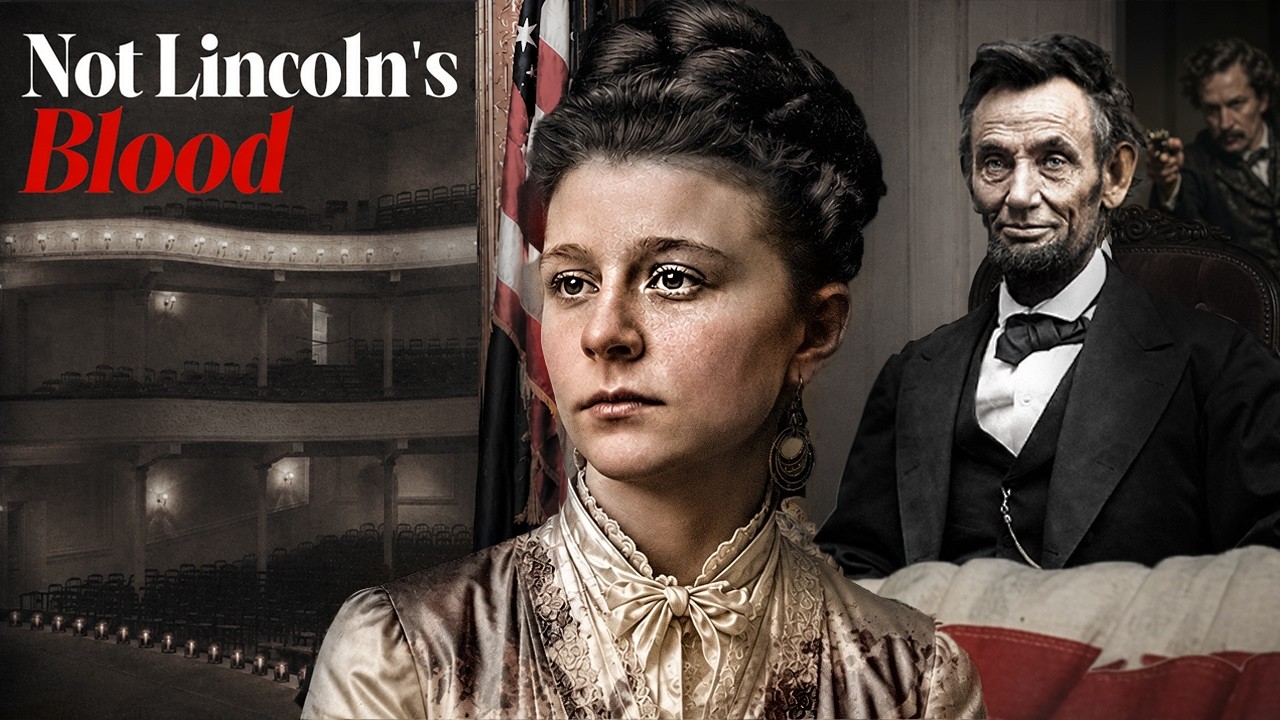
Within minutes her clothing, hands and face were covered with Henry’s blood.
And that blood would become one of the strangest details of the entire Lincoln assassination.
Because Abraham Lincoln himself did not bleed heavily outward.
The bullet had entered his skull.
The terrible injury was internal.
Henry Rathbone, by contrast, was hemorrhaging openly.
The National Park Service notes that much of the visible blood at Ford’s Theatre and later at the Petersen House came from Rathbone rather than Lincoln. National Park Service
Clara described the scene eleven days later in a letter.
She said her clothing had become “saturated literally with blood,” as had her hands and face.
At the time, even Clara did not immediately understand whose blood covered her.
Mary Lincoln certainly did not.
As Clara later remembered, the First Lady repeatedly looked toward her throughout that terrible night and reacted in horror.
Mary believed she was staring at her husband’s blood.
She was not.
It was Henry’s. Chicago History Resources
That image became permanently attached to Clara Harris.
The young woman in the presidential box.
Covered in blood.
Watching America’s president die while her own fiancé nearly bled to death beside her.
Lincoln was carried across Tenth Street to the Petersen boarding house.
Doctors knew immediately that transporting him farther would probably kill him.
Rathbone, despite his own severe injury, accompanied Mary Lincoln across the street.
Then his body gave out.
He collapsed from blood loss inside the Petersen House.
Doctors treated him and eventually sent him home.
Clara stayed.
She remained with Mary Lincoln through the night while physicians crowded around the unconscious president in a small back bedroom.
The National Park Service confirms that Clara remained with the First Lady after Rathbone was removed for medical treatment. National Park Service
Shortly after 7:20 the following morning, Abraham Lincoln died.
Clara had entered Ford’s Theatre as an invited guest.
She left as one of the closest civilian witnesses to the first assassination of an American president.
Her fiancé survived.
But the story did not end when Rathbone’s arm healed.
That is where it became darker.
Henry Rathbone had served honorably during the Civil War.
He had seen combat.
He had survived the conflict.
But friends and relatives later believed the assassination became an obsession.
Rathbone blamed himself for failing to stop Booth.
Objectively, the guilt made little sense.
Booth had surprised everyone.
Rathbone had reacted faster than almost anyone else in the theater.
He had attacked an armed assassin with his bare hands.
He had nearly lost an arm trying to prevent Booth’s escape.
Yet guilt does not necessarily follow logic.
Over the years, Rathbone developed persistent physical complaints, headaches, depression, anxiety and increasingly disturbing behavior.
Later physicians believed the experience at Ford’s Theatre had contributed to his deterioration, although diagnosing a nineteenth-century person retrospectively is inherently uncertain. American Heritage
Clara nevertheless married him.
The wedding took place in 1867, two years after Lincoln’s assassination.
They built a family.
They had three children.
From the outside, the nightmare might have appeared to be receding.
It was not.
Henry became increasingly unstable.
His fears intensified.
He reportedly became convinced people were whispering about him.
He experienced periods of paranoia and delusional thinking.
His health deteriorated.
He worried Clara would abandon him.
At times, he became intensely jealous.
The man who had once thrown himself at John Wilkes Booth increasingly became the person Clara herself had reason to fear.
And hanging over the family was another story.
The dress.
According to one of the most famous legends surrounding the assassination, Clara kept the clothing stained with Henry’s blood.
She could not clean it.
Could not wear it.
Could not destroy it.
So she supposedly placed it inside a closet at the Harris family summer home near Albany.
Later versions of the story say Clara believed Lincoln’s ghost appeared near the closet on an anniversary of the assassination.
Eventually, according to the legend, the closet itself was sealed behind a wall.
Decades later, a son supposedly opened it and destroyed the dress around 1910, believing it had brought a curse upon the family. Union College Museum
It is a chilling story.
It is also where history begins blending with folklore.
The Chicago Historical Society’s research warns that there is no reliable contemporary description of Clara’s assassination-night dress.
The familiar description of a “white satin ball-dress” appears in a 1929 ghost story by writer Mary Shipman Andrews—decades after Clara’s death. Chicago History Resources
A small silk fragment attributed to Clara’s clothing does survive in the Chicago collection.
But the elaborate story about the dress, the apparition and the walled-up closet cannot be treated with the same certainty as Clara’s own 1865 letter or Rathbone’s testimony.
What is certain is much worse than the ghost story.
Henry’s condition continued deteriorating.
In 1882, President Chester A. Arthur appointed Rathbone to a diplomatic post in Hanover, Germany.
Henry, Clara and their children moved overseas.
Perhaps everyone hoped that a new country and new responsibilities would help.
Instead, the situation worsened.
Contemporary and later accounts describe Henry as increasingly erratic, suspicious and frightened by his own thoughts.
He believed Clara was planning to leave him.
He reportedly restricted where she could sit.
He hallucinated.
And, according to accounts collected by The Washington Post, he admitted he was afraid of himself.
Around this period, he acquired a revolver. The Washington Post
The date was December 1883.
Eighteen years after Ford’s Theatre.
Clara was now forty-nine.
Henry was forty-six.
Their children were sleeping nearby.
Before dawn, something happened inside the Rathbone home in Hanover.
Accounts differ on several details.
But the central facts are not disputed.
Henry became violently unstable.
Clara apparently became frightened that he intended to reach the children.
She tried to stop him.
They returned to their bedroom.
Then Henry attacked his wife.
He shot Clara.
He stabbed her.
Clara Harris Rathbone—the woman who had watched Abraham Lincoln receive a fatal bullet—was now dying from gunshot and knife wounds inflicted by the man who had tried to save Lincoln that night.
Henry then turned the knife on himself.
He survived.
Clara did not. The Washington Post
The symmetry is so terrible that later storytellers could hardly resist turning it into fate.
In 1865, Booth shot Lincoln and stabbed Henry.
In 1883, Henry shot Clara and stabbed himself.
A presidential box.
Then a bedroom.
Gunfire.
Then a knife.
The survivor had become the killer.
But history requires caution here.
It would be too simple to say Henry Rathbone murdered Clara because they had sat with Abraham Lincoln.
There is no evidence establishing such a single causal chain.
Rathbone experienced severe psychological deterioration for years.
Accounts describe paranoia, jealousy, hallucinations and fears that Clara would abandon him.
The trauma of Ford’s Theatre may have remained an important part of his mental suffering—his own doctor later believed it had profoundly damaged him—but murder cannot responsibly be reduced to one event eighteen years earlier. American Heritage
Henry was declared insane.
He spent the remainder of his life institutionalized in Germany.
He died in 1911.
Twenty-eight years after killing Clara.
Their three children had been sent back to the United States and raised by relatives. National Park Service
One of them carried the family tragedy into another generation.
Henry Riggs Rathbone was born in 1870.
He eventually became a member of the United States House of Representatives.
And instead of trying to erase his parents’ connection to Lincoln, he worked to preserve it.
As a congressman, he advocated turning Ford’s Theatre into a national memorial and museum.
Although his specific proposal did not succeed during his lifetime, his efforts contributed to the long process by which Ford’s Theatre became a preserved historic site. National Park Service
There is something extraordinary about that.
His father had spent decades tormented by what happened inside the theater.
His mother had lived beneath the shadow of the same night.
Their son tried to preserve the building.
Not destroy it.
Preserve it.
Today visitors can stand inside Ford’s Theatre and look toward the presidential box.
The arrangement is simple enough to understand.
Lincoln near the front.
Mary beside him.
Henry behind.
Clara nearby.
Four people watching a comedy.
Then Booth enters.
The shot.
Rathbone rises.
The knife.
The jump.
And in less than thirty seconds, four lives are permanently altered.
Lincoln dies the next morning.
Mary Lincoln spends much of the rest of her life consumed by grief.
Henry survives physically and deteriorates psychologically.
Clara survives the assassination only to be murdered by Henry eighteen years later.
That is why Clara Harris deserves to be remembered as more than “the other woman in Lincoln’s box.”
Her own words survived.
Her own trauma survived.
She stayed beside Mary Lincoln while the president was dying.
She watched the man she loved nearly bleed to death.
She married him anyway.
She raised their children.
She lived with his worsening condition.
And eventually she became its victim.
The blood on Clara’s dress has become a symbol because it visually connects the two tragedies.
The first blood belonged to Henry.
The final violence came from Henry.
But we should be careful with the mythology.
We do not know that her gown was the famous white satin dress later ghost stories described.
We cannot prove every detail about a sealed closet or supernatural apparition.
And Henry did not kill Clara simply “for sitting beside Lincoln.”
The verified story needs none of those embellishments.
It is tragic enough.
On April 14, 1865, Clara Harris went to the theater with the man she planned to marry.
When the president was shot, Henry Rathbone was the man who stood up.
He fought the assassin.
He was cut nearly to the bone.
Clara held him while his blood soaked her clothing.
Eighteen years later, in another room on another continent, Clara faced that same man during another outbreak of violence.
This time there was nobody beside her capable of stopping it.
Abraham Lincoln’s assassination lasted seconds.
For Clara Harris and Henry Rathbone, its shadow lasted the rest of their lives.


