November 1944.
The Moselle River sector in France.
Patton’s Third Army had been driving east for weeks when one American infantry company reached a river crossing intelligence had assessed as lightly defended.
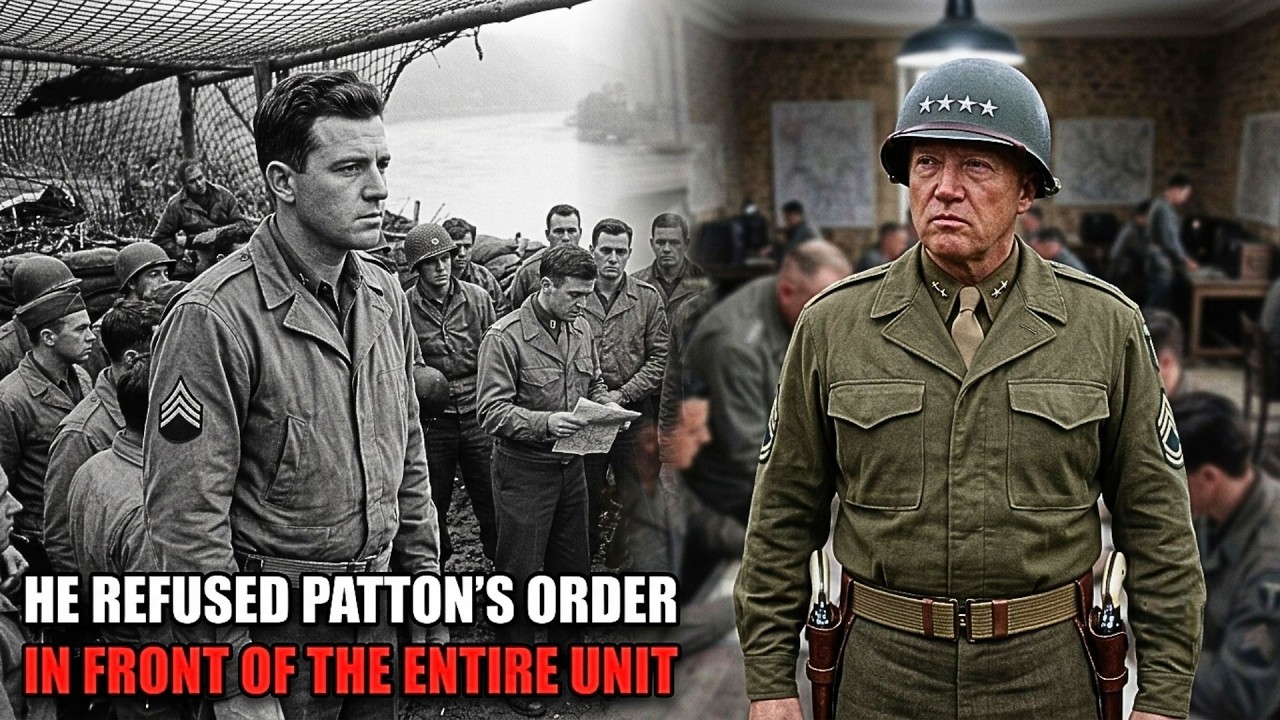
The assessment did not survive first contact.
German resistance was heavier than expected.
The crossing point was exposed.
Three men in Staff Sergeant William Cord’s platoon had already been wounded.
Ammunition was running low.
The supporting armor had failed to arrive on schedule.
The company commander requested permission to withdraw to a stronger position and wait for the tanks.
The request moved upward.
Patton approved it.
The withdrawal order came back down the chain.
Eventually it reached the near bank of the Moselle.
Second Lieutenant Thomas Riley delivered it to Cord.
Pull back.
Cord did not move.
Approximately 30 soldiers were close enough to hear what happened next.
Cord told the lieutenant that withdrawing now would be a mistake.
He had been watching the German positions across the river for approximately 40 minutes.
What he saw did not look like reinforcement.
It looked like withdrawal.
The defenders on the far bank were becoming thinner.
If the Americans abandoned the near bank now, Cord argued, they would surrender a position they might have to fight much harder to regain the following day.
Riley reminded him whose order it was.
Patton’s.
Cord understood.
He still refused to move.
At that moment, the staff sergeant crossed a line that every soldier understood.
He had not questioned the order privately.
He had not asked for clarification.
He had refused a direct withdrawal order in front of his men.
He could be right about the Germans.
He could also be destroying his career.
Lieutenant Riley had seconds to decide what to do.
Arrest Cord immediately for insubordination?
Force the withdrawal?
Or send the sergeant’s battlefield assessment back up the chain and ask someone with greater authority to reconsider an order that had already been approved?
Riley chose the third option.
And the next 18 minutes changed everything.
William Cord was 28 years old.
He came from western Pennsylvania.
His father had been a coal miner and a veteran of the First World War.
According to the narrative, Cord had been a staff sergeant for approximately 14 months and had already received two promotions since arriving in Europe during the summer of 1943.
His officers regarded him as reliable.
That reputation mattered enormously.
Cord was not known as an NCO who challenged orders impulsively.
He did not object merely because he disliked a plan.
When he said the tactical picture had changed, Captain James Holt—the company commander—had more than a year of experience by which to judge the man making the claim.
That did not mean Holt automatically believed him.
It meant Cord had earned enough credibility to justify checking.
Holt was preparing to execute the withdrawal when Riley’s message arrived.
He delayed the order for 20 minutes.
Then he sent an independent forward observer.
That decision preserved the chain of command while testing Cord’s claim.
Cord would not decide whether the company stayed.
The lieutenant would not decide.
The observer would provide another set of eyes.
Then Holt would decide based on the updated information.
The observer moved forward.
Eighteen minutes later, his report came back.
According to the source, Cord had read the far bank correctly.
German positions were being systematically reduced.
Not reinforced.
The original intelligence assessment had apparently been accurate when it described the crossing as lightly defended.
What had changed was the German commander’s reaction after the Americans appeared on the near bank.
For approximately 40 minutes, while Cord watched, the Germans had reportedly been pulling men away from their exposed forward positions.
The German commander was not preparing to hold the river at all costs.
He was withdrawing toward a stronger defensive depth.
Cord had recognized the pattern from the front.
Higher headquarters had not.
Not because headquarters was incompetent.
Because the information available there was already aging.
The battlefield had changed after the report that produced the withdrawal decision.
Cord was standing close enough to see the change happen.
Holt sent the observer’s findings to battalion.
Battalion pushed them higher.
Eventually, according to the narrative, the updated report reached Patton while he was reviewing the withdrawal plan for the broader sector.
Patton read it.
No visible anger.
No dramatic reaction.
He rescinded the withdrawal order.
That afternoon, the company attempted the crossing.
Conditions were far from ideal.
Three soldiers had already been wounded.
Ammunition remained limited.
The supporting armor had still failed to solve the immediate problem that produced the original withdrawal request.
The Americans crossed anyway.
It was not easy.
The source explicitly says they suffered additional casualties during the operation.
That detail matters.
The fact that Cord’s assessment was correct did not transform the crossing into a bloodless tactical triumph.
Men were still hurt.
The decision still carried risk.
The crossing simply succeeded before the Germans could reposition enough forces to make the river substantially harder to cross.
By evening, the company had established itself on the far bank.
The position could now support the broader American advance.
In roughly 40 minutes, Cord’s refusal had traveled through several possible meanings.
Insubordination.
Tactical warning.
Verified intelligence.
Then the basis for reversing an order.
But the most interesting part came afterward.
Nothing happened to him.
At least not immediately.
No arrest.
No court-martial.
No medal.
No battlefield promotion.
No public congratulations from Patton.
Instead, the incident almost disappeared into the paperwork.
The company’s after-action report described what had happened in deliberately neutral language.
The withdrawal had been delayed pending tactical reassessment.
That was accurate.
It was also carefully incomplete.
According to the source, Captain Holt chose the wording.
He did not want to create a permanent record suggesting that NCOs should feel free to refuse orders whenever their personal reading of a battlefield differed from the judgment of senior officers.
Cord had been right.
That did not make the precedent safe.
This is the central tension of the entire story.
An army cannot function if every soldier treats orders as suggestions.
The chain of command exists for a reason.
Individual soldiers rarely possess the complete operational picture.
A sergeant may understand what is happening 300 yards in front of him while knowing almost nothing about what is happening five miles away.
A battalion commander may possess intelligence about neighboring units, artillery availability, enemy movements and operational objectives that the sergeant cannot see.
A corps or army commander sees an even broader picture.
But the advantage works in both directions.
Higher command possesses breadth.
The forward soldier possesses immediacy.
And during fast-moving combat, immediacy can expose something the broader picture has not yet absorbed.
That is what happened in the narrative.
Patton approved the withdrawal based on information that made the decision reasonable.
Cord refused because 40 minutes of direct observation convinced him that one critical assumption behind that decision was no longer true.
Neither perspective was necessarily irrational.
They existed at different distances from the same battlefield.
Cord’s father, according to the source, had taught him a version of exactly that lesson.
The difference between a correct and incorrect decision can depend on what someone can see from where he is standing.
The man farther back may see something the man at the front cannot.
The man at the front may see something the man farther back cannot.
Neither perspective is complete by itself.
That idea explains why Holt’s response matters as much as Cord’s refusal.
Holt did not reward insubordination.
He tested information.
Cord says the Germans are pulling back?
Verify it.
An observer goes forward.
The observer confirms it.
Now the tactical picture changes.
The order changes with it.
That is a very different lesson from telling soldiers to ignore commands whenever instinct tells them otherwise.
The process contained a verification step.
Without it, Cord’s action would be much harder to defend.
Second Lieutenant Thomas Riley understood that uncertainty more personally than anyone.
He had been commissioned only three months earlier.
He was still learning what happened when the clean structure of military doctrine collided with battlefield reality.
According to the account, Riley later described those 20 minutes as one of the most uncertain periods of his early command experience.
He did not know what he was watching.
Was Cord saving the crossing?
Or ending his own career?
Both outcomes were plausible.
If the observer returned and reported German reinforcements pouring into the far bank, Cord’s refusal would look radically different.
Three wounded men.
Low ammunition.
No armor.
An exposed river position.
A withdrawal order personally approved by Patton.
And a staff sergeant publicly refusing to execute it.
If Cord’s battlefield assessment had been wrong, the story would not be remembered as courage.
It might be remembered as recklessness.
That is what makes the incident uncomfortable.
The result changes how people interpret the decision.
Cord was right.
But when he refused the order, he did not yet know that history would prove him right.
He only knew what he believed he had seen.
He had to act before verification arrived.
Approximately two weeks passed.
Cord continued doing his job.
He assumed consequences were coming.
The absence of immediate discipline did not reassure him.
He interpreted the delay as administrative.
Eventually, a staff officer reviewing after-action reports noticed the incident.
The full account reached Patton.
Not the sanitized one-line operational description.
The actual sequence.
Cord had publicly refused the withdrawal order.
His lieutenant had reported the refusal.
Holt had delayed execution.
An independent observer had confirmed Cord’s assessment.
Patton had rescinded his own order.
The crossing had succeeded.
Patton asked to see the sergeant.
Cord arrived at headquarters expecting a court-martial.
According to his later account, he had spent the previous two weeks preparing himself for exactly that possibility.
He had not campaigned for recognition.
He had not tried to justify himself throughout the unit.
He simply continued performing his duties.
Then he stood in front of Patton.
The general asked two questions.
The first:
What exactly did you see?
Cord explained.
For 40 minutes he had watched patterns of movement on the opposite bank.
He described the timing.
The changes in German positions.
The indicators suggesting the defenders were systematically reducing their forward line rather than bringing additional troops into it.
This was not:
“I had a feeling.”
It was an observation-based tactical argument.
Movement.
Timing.
Pattern.
Direction.
Cord explained what he had seen and why he interpreted it as withdrawal.
Then Patton asked the second question.
It was more important than the first.
If the independent observer had reached the river and reported that Cord was wrong—if the Germans were reinforcing instead of withdrawing—would Cord have obeyed the withdrawal order?
Cord answered immediately.
Yes.
Patton ended the meeting.
No promotion.
No commendation.
No punishment.
Return to your unit.
That second question reveals what the story is actually about.
Patton was not merely asking whether Cord happened to be right.
He was testing the logic behind the refusal.
There is a profound difference between:
“I will not obey because I know better than my commanders.”
And:
“I believe the order rests on information that has changed, and I am asking for that information to be checked.”
Cord’s answer placed him in the second category.
Once independent observation resolved the disagreement, he would accept the result.
His refusal was conditional on a factual claim.
It was not a rejection of command authority itself.
That distinction does not automatically erase the insubordination.
A direct order remained a direct order.
Cord had still refused it publicly.
But it helps explain why Patton apparently chose neither punishment nor celebration.
Punishing Cord could send one dangerous message:
Never report that an order has become detached from battlefield reality.
Celebrating him could send another:
Disobey whenever you think you see something your officers missed.
Patton did neither.
Instead, according to the narrative, he changed the information system.
In the weeks following his meeting with Cord, he raised a question with Third Army operations staff.
How were forward NCO observations being incorporated into withdrawal decisions during active contact?
Were reports from soldiers physically observing the enemy reaching decision-makers quickly enough?
Or were higher headquarters making decisions from information that had already become obsolete during the time required to transmit it?
The resulting change was modest.
No “Cord Doctrine.”
No sweeping directive.
No new organization bearing the sergeant’s name.
The reporting process for contested withdrawals was adjusted to provide a faster formal route for position assessments from forward elements.
That is arguably the most intelligent outcome described in the entire source.
Do not tell sergeants to disobey.
Make it easier for them to update the people giving the orders.
The objective was not to weaken the chain of command.
It was to make the information moving through that chain faster.
The authority remained.
The system became more responsive.
Cord’s refusal exposed a gap.
Patton’s alleged response was to narrow the gap rather than romanticize the refusal.
Six months later, Cord was promoted to master sergeant.
The source is careful about this.
There is no notation connecting the promotion to the Moselle incident.
It moved through the normal personnel process.
Therefore, it would be misleading to write that Patton rewarded Cord with a promotion for defying him.
The supplied narrative does not support that claim.
Likewise, the source says no formal commendation for the incident has been identified.
Cord returned to the United States after Germany surrendered.
He reportedly worked for approximately 20 years as a foreman at a steel plant in western Pennsylvania.
He died in 1979.
In 1962, according to the source, he gave a local newspaper interview discussing his wartime service.
He mentioned the Moselle episode briefly.
His explanation remained simple.
He had seen something from his position that the order did not account for.
And he had been prepared to accept whatever consequences followed.
That last part matters.
Cord did not possess a magical exemption from discipline because his judgment eventually proved correct.
When he refused, punishment remained possible.
He accepted that risk.
The source’s closing question is therefore legitimate even if it cannot be answered neatly.
When does firsthand observation justify deviating from an order based on older information?
Military doctrine cannot reduce that to a universal formula.
If every soldier independently decides when information has become outdated, coordinated command becomes impossible.
If soldiers are never permitted to surface rapidly changing conditions before executing an order, command can become dangerously detached from reality.
Both extremes fail.
The answer lies somewhere in the mechanisms connecting observation to authority.
That is why Holt’s 20-minute delay was so important.
Why the independent observer mattered.
Why Cord’s answer to Patton’s second question mattered.
And why the later reporting adjustment mattered.
Every step transformed a personal disagreement into an information problem that could be tested.
The story is therefore less about heroic disobedience than disciplined dissent.
Even that phrase needs caution.
Cord’s conduct was risky.
The source itself acknowledges that everyone involved understood how dangerous the precedent could become.
That is apparently why the after-action report avoided presenting him as a celebrated insubordinate.
The Army needed soldiers capable of initiative.
It also needed orders to mean something.
Cord happened to stand exactly where those requirements collided.
He had three wounded men.
Low ammunition.
No armor.
A direct order to withdraw.
Thirty soldiers listening.
Across the river, German positions were changing.
Cord believed he understood what those changes meant.
He could obey.
The company would pull back.
Perhaps it would cross somewhere else.
Perhaps it would return the following day and discover that the Germans had reinforced the far bank.
Or Cord could refuse.
If he was wrong, he might expose his men to unnecessary casualties and face court-martial.
If he was right, the Americans had a temporary opportunity that would disappear as soon as the Germans reorganized.
Cord chose to refuse.
But the story should not end there.
Because Cord alone did not make the crossing happen.
Riley chose not to arrest him immediately.
Holt chose to take a trusted NCO’s observation seriously.
An independent observer risked moving forward to verify it.
Battalion transmitted the new information upward.
Patton changed his own order when the evidence changed.
Then the company crossed.
That chain of decisions is the real story.
Remove any one of them and the outcome could be different.
If Riley treats the refusal purely as discipline, the information may never travel.
If Holt blindly trusts Cord, the company risks acting on one man’s interpretation.
If the observer’s report is ignored, verification becomes meaningless.
If Patton refuses to reverse himself because he has already approved the withdrawal, the chain becomes rigid.
Instead, according to the narrative, each level did something slightly different.
Cord challenged the information.
Riley transmitted the challenge.
Holt tested it.
The observer verified it.
Patton changed the order.
That is not the collapse of command.
It is command responding to new evidence.
Still, the source deserves the same historical caution as the other highly detailed Patton narratives.
It provides specific names.
William Cord.
Captain James Holt.
Second Lieutenant Thomas Riley.
It describes an after-action report.
It attributes later recollections to Riley and Cord.
It describes a staff review and a change in reporting protocols.
But the supplied material does not reproduce those documents.
It provides no unit designation beyond the broader Third Army context.
It gives no archival reference for the after-action report.
It does not identify the 1962 newspaper containing Cord’s interview.
It provides no personnel record confirming the later promotion.
And it does not identify the aide supposedly present when Patton received the updated report.
Those omissions prevent the narrative from independently proving its most specific details.
Even the operational outcome should be presented carefully.
The file says the crossing succeeded and became useful to the broader advance.
It does not provide the exact crossing location, unit history or operational record needed to match the incident securely against documented Moselle operations.
So the responsible historical formulation remains:
According to the supplied account.
The source says.
The narrative describes.
Those phrases are not weaknesses.
They distinguish storytelling from verification.
And they matter particularly when direct dialogue with Patton is involved.
The file does not provide a transcript of his meeting with Cord.
It says Patton asked two questions.
Those questions are narratively powerful.
But without the underlying record, they should not be converted into authenticated quotations.
Still, the internal logic of the story is unusually strong.
Patton’s first question tests observation.
What did you see?
The second tests discipline.
What would you have done if verification proved you wrong?
Cord’s answers satisfy both.
He can explain his tactical judgment.
And he remains willing to obey once the disputed facts are resolved.
Patton sends him back.
Then quietly addresses the system that allowed information from the front to arrive too slowly.
No medal.
No punishment.
No speech.
No heroic mythology.
Just a reporting adjustment.
That restraint gives the ending its force.
The incident begins with a staff sergeant publicly refusing an order carrying Patton’s authority.
It could have become a story about rebellion.
Instead, it becomes a story about information.
The original withdrawal order was not necessarily foolish.
It was based on the tactical picture available when the request was made.
Cord was not necessarily reckless.
He had spent 40 minutes watching that picture change.
The real enemy was the delay between those two realities.
A report travels upward.
A decision travels downward.
Meanwhile, soldiers keep moving.
Defenders reposition.
Ammunition disappears.
Casualties accumulate.
The battlefield does not wait for paperwork.
That November morning, the order reached the near bank.
Cord looked across the Moselle.
Then he looked at Lieutenant Riley.
He knew Patton had approved the withdrawal.
He knew approximately 30 soldiers could hear him.
He knew refusing could end his career.
He refused anyway.
Eighteen minutes later, another observer looked across the same river.
He saw what Cord had seen.
The Germans were pulling back.
The new information traveled upward.
Patton reversed his order.
The Americans crossed that afternoon.
Two weeks later, Cord stood before the general expecting punishment.
Patton asked what he had seen.
Then he asked what Cord would have done if the observer had proved him wrong.
“I would have withdrawn.”
That answer, according to the narrative, was enough.
Patton sent him back to his unit.
The sergeant received no medal.
He received no documented special promotion.
His refusal was softened into neutral language in the permanent report.
But somewhere between the near bank of the Moselle and Third Army headquarters, the system had revealed a weakness.
Information from the men closest to the enemy could become outdated before the decisions based upon it completed their journey back to the front.
Cord had exposed that weakness in the most dangerous possible way.
By refusing an order.
The Army’s answer, according to the source, was not to make refusal easier.
It was to make fresh information travel faster.


