Eston Hemings entered the world on May 21, 1808, at Monticello, the Virginia plantation of Thomas Jefferson.
His father was the third president of the United States, the principal author of the Declaration of Independence, and the man whose words “all men are created equal” would become inseparable from the American idea of liberty.
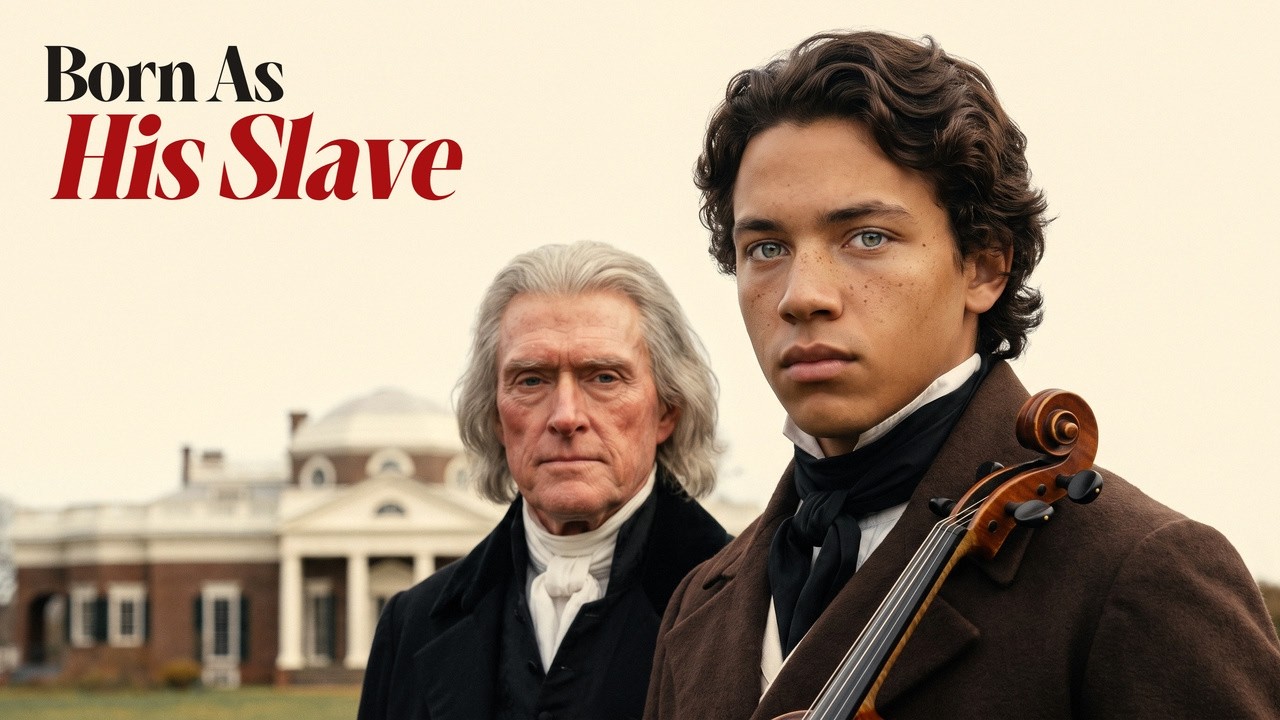
His mother was Sally Hemings.
And because Sally was enslaved, Eston was born enslaved too.
That contradiction followed him for the rest of his life.
Today, Monticello identifies Eston as the youngest surviving son of Sally Hemings and Thomas Jefferson. He would eventually become a carpenter, cabinetmaker, professional violinist, husband and father. Yet during Jefferson’s lifetime, he was never publicly acknowledged as the president’s son.
The tragedy of Eston Hemings is not simply that he was born into slavery.
It is that the circumstances of American slavery eventually forced him to make an extraordinary bargain of his own: in order to give his children opportunities denied to Black Americans, he changed his name, crossed the racial boundary, and allowed part of his family history to disappear.
To understand that decision, it is necessary to begin with his mother.
Sally Hemings had traveled to France with Jefferson’s family in the late 1780s. According to the recollections later published by her son Madison Hemings, Sally understood that remaining in France could potentially give her freedom. Madison said she agreed to return to Virginia after Jefferson promised “extraordinary privileges” and freedom for her children when they reached adulthood. Monticello regards the later treatment of Sally’s children as consistent with the central outline of that family account. [Monticello](https://www.monticello.org/slavery/jefferson-and-sally-hemings/a-brief-account?utm_source=chatgpt.com)
Four of Sally’s children survived to adulthood: Beverly, Harriet, Madison and Eston.
Beverly and Harriet were permitted to leave Monticello in the early 1820s and subsequently disappeared into white society.
Madison and Eston stayed.
Jefferson’s final will made unusual provisions for them.
He ordered that the brothers remain apprenticed to their uncle John Hemmings, an accomplished woodworker, until they reached twenty-one, at which point they were to become free. Jefferson also asked Virginia lawmakers to permit them to remain in the state despite laws restricting the presence of newly emancipated people.
Eston was only eighteen when Jefferson died on July 4, 1826.
Madison later explained that Eston was given “the remainder of his time” shortly afterward, meaning Jefferson’s executors effectively released him before the formal age specified in the will. Monticello’s records consequently describe both 1826 as the beginning of his practical freedom and 1829 as the year he would have reached the age of legal emancipation specified by Jefferson. [Monticello]
The distinction matters because freedom at Monticello was extraordinarily rare.
After Jefferson died deeply in debt, more than one hundred enslaved people from his estate were sold. Families that had lived together for decades were broken apart on the auction block. Only a small number were protected by Jefferson’s will or informal instructions. Madison and Eston were among them.
Their mother was not.
Thomas Jefferson never legally freed Sally Hemings.
After his death, Jefferson’s daughter Martha Randolph allowed Sally to live unofficially as a free woman. Sally then joined Madison and Eston in Charlottesville.
The brothers rented and later established a home there, and Sally spent the remaining years of her life with her sons until her death in 1835.
For Eston, life outside Monticello began with a trade.
He had learned woodworking from his uncle John Hemmings, one of the most skilled artisans enslaved at Monticello. Several documents bearing Eston’s signature survive from the 1830s, although very little is known about his formal education.
Then another talent began defining him.
Music.
Eston became an accomplished violinist.
In 1832, he married Julia Ann Isaacs, a free woman of color. Several years later, the couple left Virginia and moved to Chillicothe, Ohio, with their growing family.
There Eston became something remarkable.
A local celebrity.
The 1850 census listed him professionally as a musician, and later Chillicothe recollections remembered him as a gifted violinist who led a successful dance band. One newspaper described him as a “master of the violin” and an accomplished caller of dances who performed at fashionable social events throughout southern Ohio.
Imagine the transformation.
The boy born as property at Monticello was now being hired to provide the music at elegant gatherings.
People danced when Eston Hemings played.
And people noticed him for another reason.
His appearance.
Accounts preserved by Monticello say contemporaries remarked on his resemblance to Thomas Jefferson. The connection between the Hemings children and Jefferson had circulated publicly since Jefferson’s own presidency, and Madison Hemings would later state openly that Jefferson was the father of himself and his siblings.
But freedom in Ohio did not mean equality.
Eston and Julia were legally free, yet their children were growing up in an America where racial identity could determine access to schooling, employment, political rights and social standing.
By the early 1850s, the family faced a decision that would redefine generations.
Eston and Julia had three children: John Wayles, Anna and Beverly.
Around 1852, they moved from Ohio to Madison, Wisconsin.
Then they changed their surname.
The Hemings family became the Jefferson family.
And from that point onward, Eston, Julia and their children lived publicly as white people. [Getting Word](https://gettingword.monticello.org/families/hemings-elizabeth/hemings-sally/?utm_source=chatgpt.com)
This was what nineteenth-century Americans called “passing.”
But that single word hides the enormity of what the decision required.
Eston did not biologically become someone different when he entered Wisconsin.
His mother was still Sally Hemings.
His brother was still Madison.
His childhood had still taken place at Monticello.
He had still been born enslaved.
What changed was how American society classified him.
That new classification could open doors.
His children could enter institutions that discriminated against Black Americans.
They could pursue professions more freely.
They could participate in public life without carrying the legal and social restrictions that had shaped their parents’ lives.
Monticello’s Getting Word project describes Eston and Julia as deliberately severing their public connection with their African American past at precisely the moment their children were reaching adolescence. One descendant later reflected that Eston may have looked at his educated children and concluded that they deserved the opportunities available to white people.
The decision worked.
In Madison, Eston worked as a cabinetmaker.
His sons entered the city’s white community and eventually became prominent figures.
John Wayles Jefferson joined the Union Army during the Civil War as an officer in Wisconsin’s 8th Infantry. He rose to colonel and at times commanded the regiment during brutal campaigns in the Mississippi Valley.
Yet the success carried a hidden danger.
During the war, John encountered someone who remembered his family from Ohio.
According to a later recollection preserved by Monticello, John begged the man not to reveal that he had African ancestry because the soldiers under his command did not know.
The son of Eston Hemings could command a regiment of white soldiers—but only while one part of his identity remained secret.
That moment reveals the price of the transformation more clearly than almost anything else.
The Jefferson surname offered opportunity.
The Hemings ancestry had to become dangerous information.
Eston did not live long enough to see what his sons would become.
He died in Madison in January 1856, only forty-seven years old.
He had spent fewer than four years publicly living as Eston Jefferson. [Monticello](https://www.monticello.org/encyclopedia/eston-hemings-jefferson?utm_source=chatgpt.com)
Afterward, his family continued deeper into white American society.
Some descendants became businessmen, professionals and community leaders.
Over generations, knowledge of Sally Hemings began to fade.
The family retained a tradition that it descended from Thomas Jefferson, but because Jefferson had no acknowledged legitimate sons who survived to adulthood, that story was difficult to explain without revealing the Hemings connection.
Eventually, according to Monticello’s research, some descendants altered the family account and began saying they descended from one of Jefferson’s relatives instead. By the twentieth century, some family members no longer knew they descended from Sally Hemings at all.
The secret that had protected the family was now erasing part of it.
Then science changed the story.
In 1998, a landmark study published in *Nature* compared Y-chromosome DNA from male-line descendants of the Jefferson family with male-line descendants of Eston Hemings.
The result showed that Eston’s paternal line matched the Jefferson male line.
The test alone could not identify Thomas Jefferson specifically because several Jefferson men shared the same paternal Y chromosome.
But historians combined the DNA with other evidence: Jefferson’s documented presence at Monticello during conception windows, the testimony of Madison Hemings, contemporary beliefs about the children’s paternity and the unusual pattern by which all four surviving Hemings children obtained freedom.
In 2000, the Thomas Jefferson Foundation concluded that the evidence strongly supported Thomas Jefferson as Eston’s father and probably the father of all Sally Hemings’s recorded children.
For descendants of Eston, the DNA results did something else.
They restored a connection that passing had partially erased.
Families that had lived as white for generations suddenly confronted a lineage stretching backward through Eston to Sally Hemings, slavery and Monticello.
A history once concealed for survival had become publicly documented family history.
And in 2026, the genetic story took another remarkable turn.
A Smithsonian-led genomic investigation reported that researchers had recovered roughly one-quarter of Thomas Jefferson’s genome from authenticated hair preserved at Monticello and compared it with living descendants.
According to the Smithsonian account, Eston descendant John Weeks Jefferson shared about **4.2 percent** of his DNA with Thomas Jefferson—an amount strongly consistent with the expected relationship. Researchers described the result as powerful direct genomic evidence that Thomas Jefferson fathered Eston.
Monticello responded cautiously, noting that the new work did not fundamentally change its historical conclusion, which had already rested on decades of documentary, oral-history and genetic evidence. It said peer-reviewed verification of the newer genomic work would further reinforce that conclusion.
There is an irony in how the evidence returned.
Thomas Jefferson left extraordinary quantities of writing behind.
Political correspondence.
Architectural plans.
Farm records.
Account books.
Scientific observations.
Thousands upon thousands of words.
Yet he left no surviving document publicly acknowledging Eston as his son.
Eston himself left relatively little writing.
For much of American history, his existence lived at the edges of Jefferson’s biography.
But Eston’s descendants carried something Jefferson’s papers could not erase.
DNA.
And for nearly two centuries, the Hemings family also carried its own historical testimony.
Madison Hemings stated plainly in 1873 that Thomas Jefferson was their father.
Long before laboratories examined chromosomes, the family had already told the story. [Monticello](https://www.monticello.org/encyclopedia/recollections-of-madison-hemings-1873?utm_source=chatgpt.com)
That is why describing Eston merely as Jefferson’s “hidden son” does not fully capture his life.
He was hidden from one version of American history.
But he was not entirely unknown.
His family knew.
People around Charlottesville discussed Jefferson’s relationship with Sally Hemings.
Residents of Chillicothe remembered Eston.
His descendants preserved pieces of the Jefferson connection.
The disappearance occurred largely in the historical narrative built around Thomas Jefferson.
For generations, Jefferson could be celebrated as the philosopher of liberty while the lives of the people he enslaved remained peripheral.
Eston makes that separation impossible.
His life joins Jefferson’s most famous ideals to slavery in one human being.
His father helped write that human beings possessed unalienable rights.
His father legally owned him.
His father provided for his eventual freedom.
His father never publicly called him his son.
Those facts coexist.
So do the contradictions of Eston’s later life.
He became free, but freedom did not guarantee equality.
He became successful, but success did not remove racial barriers.
He gave his children another future, but doing so required obscuring the woman who had given him life.
The deepest tragedy may therefore lie in the surname.
**Hemings** connected Eston to Sally, Madison, Harriet, Beverly and the enormous enslaved family network of Monticello.
**Jefferson** connected him to the father who never publicly acknowledged him—and simultaneously gave his children access to a society that treated them differently once it believed they were white.
Eston ultimately chose Jefferson.
Not necessarily because he rejected Sally Hemings.
The surviving evidence cannot tell us exactly what thoughts passed through his mind.
But the consequences are clear.
His children received opportunities that would have been much harder to obtain as openly Black Americans.
His son became a Union colonel.
His descendants entered universities and professions.
Some became prosperous.
And eventually some forgot why the family had ever needed to change its identity in the first place. [Getting Word](https://gettingword.monticello.org/families/hemings-elizabeth/hemings-sally/?utm_source=chatgpt.com)
Eston Hemings died before the Civil War.
He never saw slavery abolished in the United States.
He never saw the Thirteenth Amendment.
He never knew that scientists in 1998 would examine his descendants’ Y chromosomes.
He never knew that twenty-first-century researchers would sequence DNA preserved from Thomas Jefferson himself.
And he never knew that museums and historians would eventually place his name openly beside his father’s.
Today his story is no longer a footnote.
It is one of the clearest windows into the central contradiction at Monticello.
Thomas Jefferson imagined liberty in universal language while living inside a society built on hereditary slavery.
Eston Hemings was born precisely where those two Americas collided.
He began life as Thomas Jefferson’s property.
He left Monticello as a free man.
He became a musician whose violin filled Ohio ballrooms.
Then he crossed the color line, took his father’s surname, and built a future his children could inhabit only by keeping their mother’s ancestry quiet.
Nearly two centuries later, the history Eston’s family once had reason to conceal has returned.
And the name that survived is finally complete:
**Eston Hemings Jefferson.**


