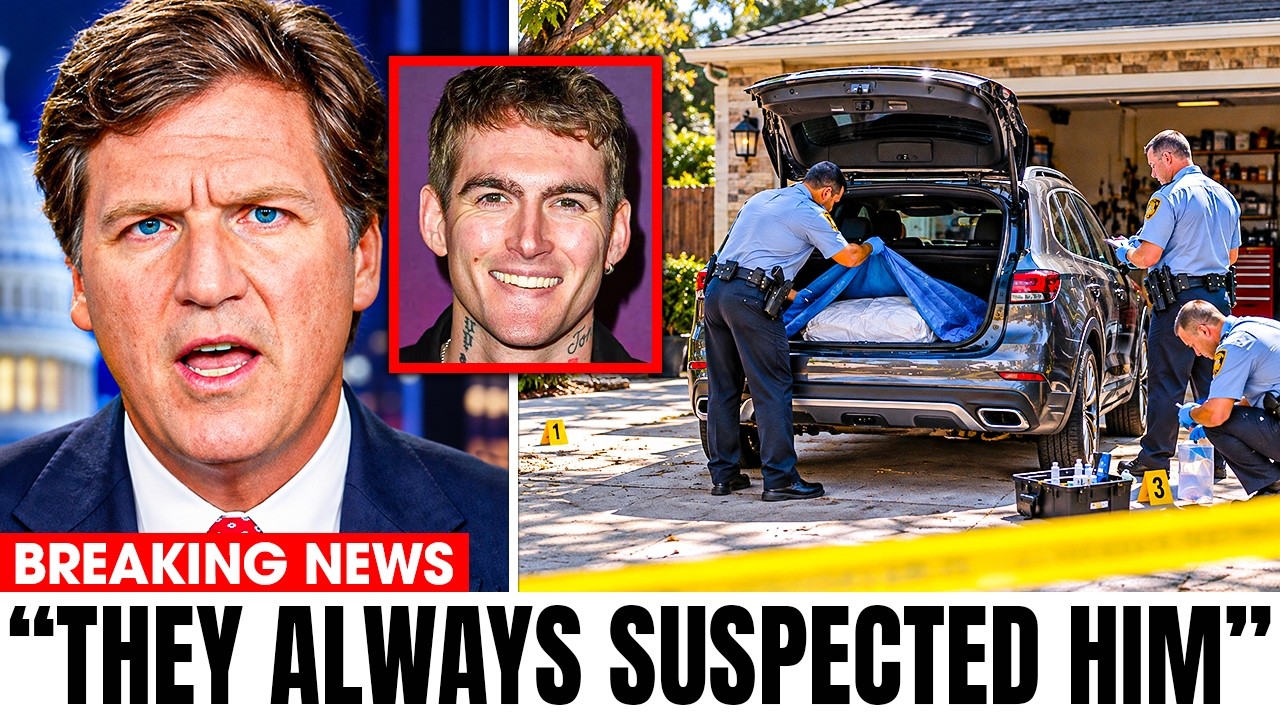
The story spreading online sounds like the opening scene of a Hollywood conspiracy thriller.
A luxury rehabilitation facility.
A vehicle supposedly abandoned miles away.
Its GPS allegedly torn from the dashboard.
Federal agents breaking through electronic locks.
Burner phones hidden inside a fireproof case.
Pharmacy manifests.
An internal dashcam.
And finally, an unidentified Hollywood fixer supposedly handing Presley Gerber a mysterious duffel bag shortly before his death.
If authenticated, evidence like that would transform an apparent-overdose investigation into something vastly larger.
But as of October 1, there is no credible reporting showing that any of those dramatic discoveries actually occurred.
What investigators are dealing with is already serious enough.
Presley Gerber, the 27-year-old son of Cindy Crawford and Rande Gerber, died on September 20 after spending only hours at Resolutions Living, an upscale sober-living residence in Santa Monica.
Police responded that morning after calls involving cardiac arrest and a suspected overdose.
He was pronounced dead at the scene. Los Angeles Times
The case remains under investigation.
But the actual investigative questions currently look very different from the viral version.
Santa Monica police are reportedly trying to determine where the substances involved in the suspected overdose came from.
Investigators have spoken with people connected to the residence and are examining whether the substances were prescribed, supplied by someone else, or obtained through another route.
Authorities have also said there was no indication of foul play at the stage publicly described. Los Angeles Times
That fact alone creates an enormous problem for the supposed federal conspiracy.
No credible source currently reports an FBI raid.
No confirmed federal seizure.
No mysterious vehicle search.
No lockbox.
No burner-phone cache.
No pharmacy manifests.
No named Hollywood fixer.
And no verified dashcam footage documenting a secret handoff.
The investigation that actually exists is local and focused primarily on a far more direct question:
How did Gerber obtain whatever substances contributed to the suspected overdose while he was at a residence intended to support sobriety?
That question has become increasingly uncomfortable because of the nature of the facility itself.
Resolutions Living has often been described in headlines as a luxury “rehab,” but Los Angeles Times reporting found that the property operates as a sober-living or recovery residence rather than a state-licensed substance-use treatment facility.
That distinction matters.
California generally regulates licensed treatment programs differently from sober-living residences, which can operate in a regulatory gray area if they are providing housing rather than clinical treatment.
Following Gerber’s death, California officials began examining whether the residence was performing services that would have required licensing. Los Angeles Times
That is a real investigation.
And it is already consequential without any mysterious parking lot.
The central issue is whether a vulnerable person entered an environment expected to support sobriety and nevertheless had access to dangerous substances within hours.
Gerber reportedly arrived at the property on Saturday evening.
By Sunday morning, emergency responders were there.
The Los Angeles County Medical Examiner conducted an autopsy, but the cause and manner of death were deferred pending toxicology testing, which can require weeks or months. Los Angeles Times
That means even the phrase “fatal overdose” still needs careful wording.
Police have described the incident as a suspected or apparent overdose.
The final medical determination has not yet been released.
Then another piece of the story emerged.
Video footage from inside the residence reportedly shows Gerber during the night before he died.
TMZ said the footage was shot inside the Santa Monica property at around 10 p.m. and showed Gerber moving through the house. TMZ
That is actual footage connected to the case.
But it is not the secret dashcam clip described by viral posts.
There is no verified reporting showing Gerber sitting inside a parked vehicle beside some unnamed fixer.
No authenticated footage shows a duffel-bag exchange.
No federal agency has publicly connected such footage to the investigation.
This distinction is exactly how a true event can mutate into something almost unrecognizable online.
Start with one confirmed fact:
There is video.
Then add another:
Police are investigating the source of suspected drugs.
Then imagination fills the gaps.
Video becomes dashcam footage.
An investigation becomes a federal operation.
A potential supplier becomes a Hollywood fixer.
A search for the source becomes confiscated pharmacy records.
By the time the story reaches its most viral form, almost none of its most dramatic details come from confirmed evidence.
The parking-lot claim presents the same problem.
If Gerber had intentionally hidden a vehicle three miles from the residence and physically removed its factory GPS system, that would be an extremely specific investigative fact.
It should produce evidence.
A vehicle description.
A police inventory.
A location.
A search warrant.
A named agency.
A law-enforcement source.
Surveillance footage.
Something.
Current credible coverage provides none of those things.
Instead, reporting indicates Gerber was taken to the residence by other people associated with his support network rather than secretly abandoning a vehicle nearby.
TMZ reported that he was brought to the facility by a friend and a personal coach. TMZ
That directly complicates the image of Gerber secretly driving himself toward the facility, dumping his car and tearing out its electronics.
The “federal agents” part is equally unsupported.
The agencies publicly connected to the known investigation are the Santa Monica Police Department and the Los Angeles County Medical Examiner.
Los Angeles Times reporting describes detectives attempting to trace the source of the substances and says the inquiry remained in its early stages.
It does not describe a federal task force descending on an abandoned automobile. Los Angeles Times
Could a federal agency theoretically become involved later?
Certainly, depending on what evidence develops.
Drug distribution investigations can cross jurisdictions.
But “could happen” is not the same thing as “already happened.”
There is currently no credible basis for describing this as a federal crisis.
The allegation involving “unredacted pharmacy manifests” is even more consequential.
Such documents would potentially suggest a chain of controlled substances, prescriptions or distribution records.
If authentic, investigators would examine names, dates, prescribing authority, dispensing records and potential criminal exposure.
But no reliable outlet currently reports that investigators recovered such documents from Gerber’s vehicle.
Calling them real before their existence is established would create an unsupported implication that identifiable people or medical providers participated in illegal conduct.
The same caution applies to “burner phones.”
That phrase instantly signals organized crime in a headline.
But inexpensive or prepaid phones are not automatically evidence of criminal conduct.
More importantly, there is no verified report establishing that such phones were recovered from Gerber at all.
The Hollywood-fixer claim is the most explosive—and currently the least supported.
No person has been credibly identified.
No law-enforcement source has confirmed a fixer was present.
No photograph or authenticated frame has been released showing such an encounter.
No verified dashcam recording has been reported.
Without that evidence, naming or implying a particular entertainment-industry figure would be irresponsible.
But there is a legitimate accountability story surrounding the facility.
The Los Angeles Times reported that Resolutions Living was not licensed as a substance-use treatment center and that Gerber’s death intensified existing concerns surrounding oversight of California sober-living residences. Los Angeles Times
Other reporting has examined the history of the facility’s founder and questions surrounding the structure of the operation.
Those issues deserve scrutiny because they are documented.
The bigger regulatory question is uncomfortable:
What protections should exist when someone at high risk enters a sober-living residence that is not operating under the same rules as a licensed medical detox or treatment center?
That debate extends far beyond Presley Gerber.
Recovery residences can serve an important role between clinical treatment and ordinary independent living.
But if a person arrives intoxicated, medically unstable or at risk of withdrawal, housing alone may not provide the monitoring or clinical support a medical treatment program would.
Determining what actually happened in Gerber’s final hours therefore requires answering several concrete questions.
What condition was he in when he arrived?
Who assessed him?
What substances were present?
Where did they come from?
Who had access to the residence?
What did staff members observe?
Were appropriate emergency protocols followed?
Were services being offered that legally required additional licensing?
Those are much more important than an imaginary fireproof lockbox.
And investigators still do not have every answer publicly available.
The toxicology results are especially important.
Until they return, authorities cannot definitively establish what substances were in Gerber’s body or what caused his death.
That information could dramatically redirect the investigation.
One substance may suggest one source.
A mixture may suggest something else.
Prescription medication creates different questions from illicit fentanyl or another street drug.
Speculation before those results risks building an elaborate story around facts investigators themselves do not yet possess. Los Angeles Times
There is also a human reality underneath the investigation.
Gerber had publicly discussed personal struggles and efforts toward recovery, and people close to his family told People that his parents had spent years trying different forms of treatment and support.
His death came shortly after another attempt to enter a recovery environment. People.com
That makes the unanswered question especially painful.
He reached a place intended to represent another attempt at help.
By the following morning, he was dead.
No Hollywood fixer is necessary for that story to demand answers.
Indeed, attaching spectacular conspiracy claims can actually weaken scrutiny of the issues that are real.
If audiences become focused on nonexistent FBI lockboxes, they may overlook regulatory gaps.
If they search for an unnamed celebrity fixer, they may stop asking who supplied the substance police are actually trying to trace.
If they believe the case has already been solved by secret dashcam footage, they may ignore the fact that the medical examiner has not yet even finalized the cause of death.
The strongest investigation is often the least cinematic one.
Phone records.
Interviews.
Toxicology.
Prescription histories.
Facility logs.
Security footage.
Timelines.
Witness statements.
Those pieces are slower than a viral leak.
But they are how investigators establish what happened.
For now, authorities have publicly reached no conclusion involving homicide or a wider criminal conspiracy.
Santa Monica police have specifically said there was no indication of foul play while continuing to examine the circumstances surrounding the apparent overdose. Los Angeles Times
That could change if new evidence appears.
Investigations evolve.
But responsible reporting has to follow evidence rather than race ahead of it.
So the “rehab parking lot cover-up” currently divides into two completely different stories.
One is real.
A 27-year-old man entered a luxury sober-living residence.
Hours later, emergency responders arrived.
He died.
Police began investigating the suspected overdose and the origin of the substances.
The medical examiner is awaiting toxicology.
The facility’s regulatory status has come under scrutiny.
Those facts are serious. Los Angeles Times
The other story remains unsupported.
An abandoned car.
A ripped-out GPS unit.
Federal agents.
A trunk raid.
Burner phones.
Secret pharmacy manifests.
A Hollywood fixer.
A duffel-bag handoff.
No credible source currently establishes those details.
And unless authenticated evidence appears, they should not be presented as discoveries.
The most disturbing mystery does not require them.
It is much simpler.
Presley Gerber entered a place associated with recovery.
Within hours, he was dead from what police suspect was an overdose.
Investigators are still trying to understand how that happened.
And until they answer that question, the real story remains unfinished.


