A confidential memorandum lay at the center of an imagined royal crisis threatening Queen Camilla’s position beside King Charles.
Inside this fictional Buckingham Palace confrontation, an administrative dispute became a deeply personal struggle over loyalty and authority.
The controversy began when ceremonial responsibilities were allegedly reassigned without evidence that the sovereign had approved those changes.
Prince William questioned the instructions, while Princess Anne demanded an explanation that palace officials struggled to provide.
What initially appeared to be a scheduling disagreement soon exposed competing expectations about accountability within the royal household.
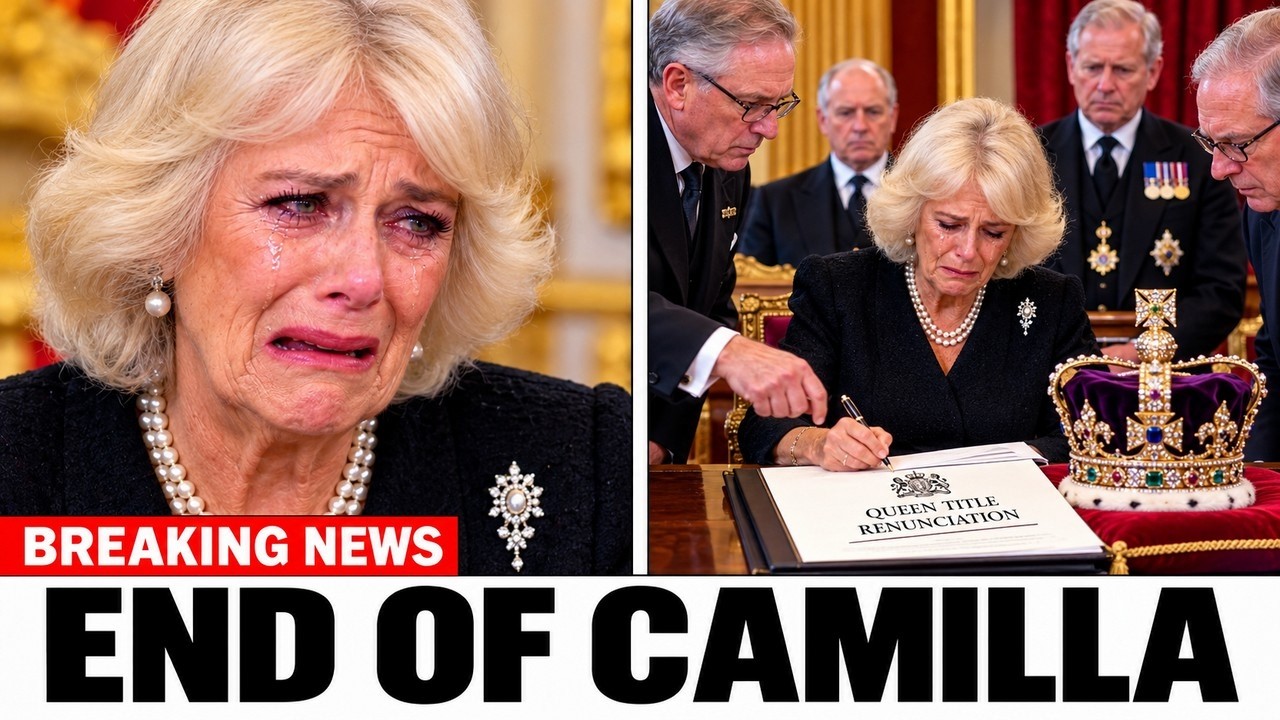
For Camilla, the dispute threatened a public identity established through decades of criticism, perseverance, and eventual acceptance.
For Charles, defending his wife risked undermining the institutional responsibilities that defined his position as Britain’s sovereign.
William saw the matter differently, believing that future monarchs could not inherit administrative arrangements lacking clear constitutional authority.
Anne considered the issue a fundamental question of procedure rather than a contest between competing family loyalties.
Their disagreement created the foundation for a fictional confrontation that would ultimately transform Camilla’s imagined royal future.
The central document emerged during preparations for a national ceremonial service involving several senior members of the monarchy.
Such events require careful coordination because individual assignments reflect established responsibilities and the institution’s public presentation.
Officials had already developed arrangements identifying which royal family members would participate in particular ceremonial activities.
However, a newly circulated memorandum appeared to revise those arrangements without the usual evidence of sovereign approval.
The proposed changes affected duties previously assigned to Catherine, the Princess of Wales, without her apparent prior knowledge.
William discovered the alterations while reviewing the schedule and immediately questioned the origin of the new instructions.
His concern extended beyond Catherine’s responsibilities because the memorandum suggested an authority that nobody could independently verify.
The document appeared to originate from Camilla’s private office, giving the dispute immediate political and personal significance.
In the fictional meeting, William requested written confirmation that Charles had authorized the changes before their implementation.
No such confirmation was available, leaving officials unable to explain why the revised arrangements carried apparent authority.
Anne examined the memorandum and identified language presenting the changes as already approved for immediate administrative implementation.
Her intervention shifted attention away from scheduling preferences toward the legitimacy of instructions issued within the household.
Camilla understood the proposed adjustments as practical improvements intended to simplify the management of a forthcoming ceremony.
She did not initially interpret the memorandum as an attempt to exercise powers reserved for the sovereign.
Nevertheless, Anne insisted that administrative convenience could not substitute for documented authorization when existing decisions were overturned.
William agreed, arguing that unclear approval procedures could create dangerous precedents for the monarchy’s future internal governance.
The fictional exchange placed Camilla in an uncomfortable position because questions about procedure appeared to challenge her credibility.
Her years of public service had strengthened her belief that palace colleagues should recognize her intentions as legitimate.
Yet the disputed wording created uncertainty that personal assurances could not resolve without further examination of the records.
William requested preservation of the original memorandum, preventing the controversy from disappearing through an informal administrative correction.
Anne supported that decision because an official document claiming authority required more than a retrospective verbal explanation.
The preserved record became the foundation for an imagined confidential review of palace correspondence and approval procedures.
Charles initially hoped the disagreement could be resolved privately before creating another damaging controversy surrounding his marriage.
His instinct reflected decades of experience defending Camilla against criticism throughout their long and closely scrutinized relationship.
Their marriage represented personal stability after years of public attention, making renewed controversy particularly painful for Charles.
However, the fictional evidence suggested that the problem extended beyond the wording of one isolated memorandum.
Additional correspondence appeared to contain instructions whose claimed authority could not be matched with documented royal approval.
Those discoveries transformed the dispute into a broader question about whether private offices had exceeded established administrative boundaries.
The review examined the distinction between advising the sovereign and issuing instructions that appeared to represent his decisions.
That distinction mattered because royal households depend upon clearly understood responsibilities and reliable communication between authorized officials.
The narrative connects the investigation with the Privy Council, the historic advisory institution serving the British sovereign.
In reality, the Privy Council cannot independently remove Camilla’s royal title through an ordinary administrative finding.
The fictional scenario instead imagines its conclusions creating pressure for voluntary withdrawal and internal palace restructuring.
Charles receives the confidential findings privately, confronting allegations that his wife’s office had acted without appropriate authorization.
The report presents a difficult choice because defending the disputed instructions would require evidence the review cannot establish.
He reads the conclusions repeatedly, recognizing that the institution’s credibility could suffer if the problem remained unresolved.
Yet accepting the findings threatens Camilla’s standing and the personal relationship he has spent decades protecting.
The king’s imagined dilemma becomes more painful when Camilla enters expecting reassurance that the controversy will remain private.
Instead, Charles acknowledges that the review raises questions he cannot dismiss merely because his wife is involved.
Camilla interprets his hesitation as rejection, reopening insecurities associated with her long struggle for royal acceptance.
The possibility of losing her public position feels especially devastating because it symbolizes years of personal sacrifice.
For decades, Camilla had occupied a controversial place within public discussions about the British monarchy and succession.
Her marriage to Charles eventually brought official recognition and an established role alongside the reigning sovereign.
The Queen title therefore represented more than ceremonial distinction within the emotional structure of this fictional narrative.
It embodied acceptance, continuity, and the expectation that earlier controversies would no longer determine her public identity.
The imagined review threatens to reverse that sense of security through a dispute originating within her own office.
Charles understands her distress but cannot reconcile personal loyalty with an unsupported claim of sovereign authorization.
Their private conversation reveals a central conflict between the responsibilities of marriage and the obligations of monarchy.
Camilla asks whether Charles will defend her position, while he struggles to promise an outcome beyond his control.
His hesitation becomes the emotional turning point because silence communicates uncertainty more powerfully than an immediate refusal.
William receives the findings with concern rather than satisfaction, recognizing that institutional accountability carries personal consequences.
His imagined objections arise from responsibility for the monarchy he expects eventually to inherit from his father.
He believes that unclear administrative boundaries could weaken confidence in decisions made by future sovereigns and households.
Allowing one office to issue unsupported instructions could encourage similar disputes over authority during subsequent royal engagements.
William therefore insists that the review deserves a substantive response rather than another attempt at private reconciliation.
Charles hears his son’s argument but also recognizes how deeply the controversy has affected his wife’s confidence.
The resulting tension exposes differences between generations concerning the balance of personal relationships and institutional expectations.
William considers accountability essential to protecting the monarchy, even when correcting mistakes creates uncomfortable family conversations.
Charles accepts that principle intellectually but resents the possibility that enforcing it might permanently wound his marriage.
Their fictional confrontation becomes increasingly emotional because neither man believes his position deserves to be characterized as betrayal.
Anne attempts to clarify the disagreement by separating questions of personal loyalty from those concerning administrative authorization.
She argues that family affection cannot automatically validate decisions made without the approval required by established procedures.
Her intervention reflects the narrative’s portrayal of the Princess Royal as disciplined, experienced, and committed to duty.
Charles nevertheless feels isolated as his son and sister challenge the legitimacy of instructions associated with Camilla.
The disagreement deepens when Anne explains that concerns existed before William became directly involved in the investigation.
Her account suggests that palace officials had already questioned the memorandum’s wording and requested clarification about authorization.
William had not created the problem, according to the fictional record, but encountered an unresolved administrative dispute.
That distinction matters because Charles initially interprets his son’s intervention as part of a broader personal confrontation.
Anne insists that identifying the original procedural failure is necessary before assigning responsibility for its consequences.
Camilla remains troubled by the possibility that her office’s actions could be interpreted as deliberate institutional interference.
She maintains that the initial proposal concerned practical ceremonial adjustments rather than an attempt to seize authority.
However, the preserved correspondence contains language that reviewers consider incompatible with an ordinary request for scheduling changes.
The fictional findings suggest that administrative intentions cannot override the requirement for legitimate approval and transparent records.
Charles must therefore consider whether correcting the record alone would restore confidence in the household’s decision-making processes.
One possible response involves reorganizing Camilla’s office while allowing her to continue performing established royal duties.
Another would accept her voluntary withdrawal from public engagements and discontinuation of the Queen title in practice.
The second possibility creates a far greater emotional and symbolic consequence than the original administrative dispute.
It would end a public role that Camilla had gradually established through years of official responsibilities.
Charles recognizes that either decision could attract criticism from observers interpreting the controversy through existing royal divisions.
Defending Camilla without meaningful reform might suggest that personal relationships supersede established institutional rules and responsibilities.
Supporting her withdrawal could instead appear to sacrifice his wife to preserve the monarchy’s public reputation.
The narrative places these competing concerns before a private meeting involving Charles, Camilla, William, and Anne.
Without ceremonial formality, the four confront the review’s conclusions and the choices now facing the royal household.
Camilla expects her husband to resolve the matter without demanding that she surrender her established public position.
William seeks confirmation that the disputed instructions will be reversed and future approval arrangements clearly defined.
Anne insists that the documentary evidence must be acknowledged rather than dismissed through personal explanations or family negotiations.
Charles faces the difficult task of addressing those demands without turning the meeting into a personal condemnation.
The conversation becomes increasingly strained as Camilla questions whether her years of loyalty have suddenly lost significance.
She fears that the institution she served is preparing to exclude her when her position becomes inconvenient.
Charles attempts to distinguish his continuing affection from the constitutional responsibilities he cannot simply disregard as sovereign.
William warns that unresolved authority disputes could damage the monarchy long after the immediate controversy has disappeared.
Anne emphasizes that consistent procedures protect everyone involved, including those whose intentions may have been entirely innocent.
Their arguments converge upon a single unresolved question about whether Charles authorized the memorandum’s disputed instructions.
The king finally acknowledges that he never approved the changes in the form presented by the document.
His admission removes the strongest possible defense of the memorandum and changes the emotional atmosphere within the room.
Camilla realizes that Charles cannot validate an instruction simply because defending it would protect her public standing.
Her frustration gives way to uncertainty as the administrative problem becomes impossible to dismiss as misunderstanding alone.
William remains silent, recognizing that his father’s admission has created consequences none of them can easily reverse.
Anne understands that the institution must now respond, although she does not regard humiliation as an appropriate objective.
Charles ends the meeting without requiring Camilla to sign any declaration concerning her future public responsibilities.
However, he authorizes preparations for restructuring the disputed administrative arrangements and reassessing the allocation of royal engagements.
That decision marks the beginning of a painful transition within the fictional royal household and Camilla’s daily life.
Officials receive instructions to restore approved responsibilities and establish clearer procedures for documenting future ceremonial changes.
The restructuring represents a practical response to the disputed memorandum rather than a formal removal of royal status.
Nevertheless, Camilla experiences the administrative changes as an unmistakable signal that her position has become uncertain.
Her scheduled appearances are postponed or reassigned while officials examine the implications of the review’s conclusions.
An amended calendar arrives, revealing the absence of engagements that previously gave structure to her public responsibilities.
The document makes the possibility of withdrawal more tangible than any constitutional argument presented during the investigation.
Camilla studies the revised schedule and confronts the emotional consequences of losing activities central to her identity.
For years, charitable visits and ceremonial appearances had provided opportunities to contribute meaningfully to national public life.
Those engagements also represented evidence that her position within the royal institution had become accepted and established.
Their sudden disappearance creates an unfamiliar silence that leaves Camilla questioning the future she imagined beside Charles.
The fictional narrative emphasizes the ordinary administrative details through which an extraordinary personal loss becomes visible.
There is no dramatic public confrontation when her engagements disappear, only a revised calendar and altered instructions.
That quiet process makes the transition particularly painful because the machinery of the household continues without her involvement.
Charles notices her distress and attempts to reassure her that their marriage remains independent of official responsibilities.
He explains that her personal place beside him cannot be erased by changes to ceremonial arrangements or schedules.
Camilla struggles with the distinction because her public role has become inseparable from her sense of belonging.
She questions whether private companionship can compensate for no longer being expected at the engagements she once attended.
Charles cannot provide a simple answer because his own signature authorized the restructuring responsible for those changes.
Their conversation reveals the emotional limitations of treating a royal household dispute as merely an administrative problem.
The fictional advisers subsequently prepare a declaration allowing Camilla to withdraw voluntarily from official public duties.
The document also records her intention to discontinue using the Queen title publicly within the imagined arrangements.
Camilla refuses to sign immediately, requesting a private conversation with Charles before making such a consequential decision.
Her hesitation reflects more than concern about status because she fears further damage to her husband’s relationships.
She worries that continuing the controversy could deepen tensions between Charles, William, and other senior family members.
The possibility of becoming a lasting source of division troubles her more than the immediate administrative criticism.
Camilla begins considering whether voluntary withdrawal might protect Charles from further institutional and personal conflict.
The prospect introduces a difficult distinction between making a free choice and responding to overwhelming circumstances.
She wants any departure to reflect her own decision rather than an order imposed by the sovereign.
Charles understands that forcing her withdrawal could compound the humiliation already associated with the fictional investigation.
He therefore agrees to meet privately without advisers, family members, or official documents dominating their conversation.
Their meeting becomes the emotional center of the narrative because the constitutional arguments have already been exhausted.
Charles acknowledges that he should have recognized the administrative difficulties before they escalated into a family crisis.
He regrets allowing personal affection and official responsibility to become entangled until neither could be protected easily.
Camilla reflects upon the years when their relationship attracted criticism rather than the acceptance she eventually achieved.
She had believed that becoming queen would finally establish a stable future free from the controversies of earlier decades.
Instead, the imagined dispute places that achievement under renewed scrutiny and threatens the routine she came to value.
Camilla acknowledges that good intentions cannot independently authorize instructions her husband never approved through established procedures.
Charles accepts his own responsibility for ensuring that palace offices operate within clearly defined administrative boundaries.
Neither can undo the disputed correspondence, but both can determine how they respond to its consequences.
Their conversation moves beyond the question of who should be blamed toward what their marriage can withstand.
Camilla asks whether Charles would prefer that she defend her public position or voluntarily relinquish its responsibilities.
The king refuses to make that decision for her because he recognizes the importance of personal dignity.
He explains that an imposed surrender would risk making her feel powerless within the institution she served.
Camilla considers the declaration and understands that signing would end the controversy over her public role.
It would not erase their shared history, although it would fundamentally change the way their marriage appeared publicly.
She also recognizes that remaining in office could prolong questions about authority and deepen tensions among relatives.
The fictional story presents her eventual decision as a personal sacrifice made under extraordinary emotional pressure.
Camilla signs the declaration confirming her voluntary withdrawal from official duties and discontinuation of the public title.
Charles reaches for her hand, acknowledging the loss without treating her decision as a political victory.
The moment emphasizes companionship rather than ceremonial status, suggesting that their relationship can survive institutional change.
However, the narrative leaves unresolved whether the public will interpret the surrender as accountability or humiliation.
By morning, the fictional palace announces Camilla’s withdrawal and explains the administrative restructuring that preceded her decision.
The statement attributes the changes to the review of disputed instructions and subsequent clarification of approval procedures.
It does not establish that the Privy Council independently possessed authority to remove a queen consort.
Instead, the fictional announcement presents Camilla’s decision as voluntary, even though the surrounding pressure was substantial.
Public reaction is imagined as divided between those demanding accountability and those expressing sympathy for her circumstances.
Some observers welcome the apparent commitment to clear institutional boundaries and consistent procedures within royal administration.
Others consider the outcome unnecessarily harsh for someone whose public acceptance required years of perseverance and service.
The fictional controversy becomes a national discussion about whether institutions can enforce rules without destroying personal dignity.
Charles finds the public interpretation particularly painful because commentators reduce his wife’s decision to competing political victories.
He regards the surrender as a personal loss that cannot be adequately explained through arguments about winners.
William receives the announcement with relief that administrative boundaries have been restored, but without personal satisfaction.
He recognizes that correcting an institutional problem has caused emotional suffering within his father’s marriage and family.
Catherine reminds him that necessary decisions do not require indifference toward the individuals affected by their consequences.
Anne similarly emphasizes that accountability should not become an excuse for continued hostility after procedures are corrected.
Their responses introduce the possibility of reconciliation once the original administrative dispute has been formally resolved.
The fictional household establishes clearer reporting arrangements intended to prevent private offices from issuing unsupported instructions.
Those reforms distinguish recommendations requiring approval from decisions already authorized by the sovereign or appropriate officials.
William regards the changes as necessary safeguards for the monarchy’s future credibility and internal administrative consistency.
Charles accepts their importance while continuing to struggle with the personal consequences of the controversy surrounding Camilla.
Father and son eventually meet privately to discuss the misunderstandings that intensified their earlier confrontation over authority.
Charles acknowledges that he interpreted William’s procedural concerns as hostility toward his wife and their relationship.
William explains that protecting institutional boundaries never required him to celebrate the suffering caused by their enforcement.
Their exchange creates a foundation for rebuilding trust without denying the seriousness of the original administrative questions.
Anne accepts that the fictional review has achieved its purpose and sees no justification for prolonging family divisions.
Camilla, meanwhile, begins confronting a future without the official engagements that previously structured her public identity.
She returns to the room where she once prepared for ceremonies and charitable appearances across the country.
The familiar decorations and ceremonial objects now symbolize responsibilities she has voluntarily relinquished within the imagined crisis.
She carefully puts away an insignia associated with formal engagements, acknowledging the end of an important chapter.
The gesture carries emotional significance because the loss of public responsibilities does not erase her personal history.
Charles remains king, and the fictional narrative does not suggest that his own reign is ending prematurely.
William continues preparing for future responsibilities, while Catherine assumes additional engagements under the revised ceremonial arrangements.
Anne maintains her emphasis on proper authority, but accepts that the administrative controversy has reached its conclusion.
The family has not escaped emotional consequences, although the story portrays reconciliation as possible after difficult decisions.
Camilla’s withdrawal is presented as the end of an institutional struggle rather than the end of her marriage.
Charles continues supporting her privately, recognizing that personal dignity cannot depend entirely upon ceremonial titles or public recognition.
The imagined resolution suggests that institutional accountability and personal compassion need not remain permanently opposed to each other.
Nevertheless, the story’s constitutional premise requires careful separation from the actual status of Britain’s royal household.
No verified announcement in the supplied material demonstrates that Camilla has surrendered her title in real life.
The memorandum, confidential review, family confrontations, and signed declaration are elements of the fictional narrative provided.
The Privy Council’s actual constitutional role does not include independently stripping a queen consort of royal status.
Likewise, ceasing public engagements would not automatically produce the legal consequences implied by a dramatic title surrender.
Royal styles, titles, and constitutional positions operate within established legal arrangements rather than ordinary administrative employment procedures.
Those distinctions are essential because fictional entertainment can resemble breaking news when presented without appropriate contextual explanation.
The narrative itself repeatedly identifies the central crisis as fictional, confirming that its events are imagined.
Its dramatic opening should therefore be understood as storytelling rather than evidence of an actual Buckingham Palace decision.
The fictional scenario nevertheless explores recognizable tensions surrounding authority, family relationships, and the demands of public office.
Charles represents the difficulty of balancing personal loyalty with responsibilities that extend beyond his immediate household.
William represents concern for future precedents and the importance of maintaining clearly documented institutional decision-making procedures.
Anne embodies the belief that consistent standards protect institutions even when their enforcement creates personal discomfort.
Camilla represents the emotional vulnerability of someone whose public identity has become closely connected with ceremonial recognition.
Their fictional disagreements demonstrate how administrative uncertainty can intensify existing personal tensions within highly visible institutions.
The story also distinguishes the exercise of influence from the possession of legitimate authority to issue instructions.
That distinction matters beyond monarchy because organizations depend upon reliable records and clearly defined approval processes.
The narrative suggests that personal confidence cannot replace documented authorization when decisions affect established institutional responsibilities.
At the same time, correcting mistakes need not require unnecessary cruelty toward those affected by the consequences.
Its imagined reconciliation emphasizes that accountability can coexist with compassion after the underlying problem has been addressed.
Camilla’s fictional surrender therefore becomes a broader meditation on identity, sacrifice, public responsibility, and personal dignity.
The conclusion does not depict the destruction of the monarchy, but the emotional costs of institutional correction.
Charles retains his throne, William continues preparing for succession, and Anne remains committed to established administrative standards.
Camilla leaves official life within the story, but retains the personal relationships that shaped her journey.
Her imagined decision closes a controversy that began with a memorandum and expanded into a royal family crisis.
The narrative ultimately asks whether protecting an institution must always require sacrificing the people serving within it.
Its answer is deliberately complicated because the fictional characters achieve stability only after enduring significant personal loss.
The alleged surrender is not a verified historical event, and the purported Privy Council bombshell remains fictional.
What endures is a dramatic exploration of how authority, trust, and family loyalty can collide under pressure.
In this imagined royal reckoning, the Crown survives, but every participant discovers that accountability carries a human cost.


