The Elves and the Shoemaker: The Ancient Secret Behind Europe’s Mysterious Household Spirits
A poor shoemaker on the brink of ruin. Two mysterious little figures who appear after midnight. A miraculous transformation that saves a struggling family. For generations, The Elves and the Shoemaker has been remembered as a charming fairy tale about kindness and unexpected fortune. Yet beneath its comforting surface lies a much older world of supernatural beliefs, household rituals, and mysterious beings that people once believed shared their homes.
First published by the Brothers Grimm in 1812, the story belongs to a long tradition of European folklore. Its origins cannot be traced to a single ancient civilization, but its central figures resemble supernatural household helpers described in stories across Germany, Britain, and Scandinavia. These beings were not simply miniature craftsmen. In the imaginations of earlier generations, they could be protectors, sources of prosperity, and sometimes dangerous presences whose goodwill had to be carefully maintained.
The familiar tale begins with a shoemaker who has fallen into desperate poverty. With only enough leather left to make one final pair of shoes, he cuts the material into pieces and leaves it on his workbench overnight. When he returns the following morning, he discovers that someone has transformed the leather into an exquisite pair of shoes.
A customer purchases them for a generous price, allowing the shoemaker to buy more leather. The same miracle happens again the next night, and then again. Every morning, perfectly finished shoes appear on the workbench, and the shoemaker’s business grows until his financial troubles disappear.
Eventually, curiosity overwhelms the couple. They hide in the workshop one night and discover two tiny naked men arriving after midnight. With extraordinary speed and skill, the little craftsmen transform the prepared leather into beautiful shoes before disappearing into the darkness.
Moved by gratitude, the shoemaker’s wife decides that their mysterious benefactors deserve something in return. She sews them tiny shirts, coats, trousers, and stockings, while her husband makes two miniature pairs of shoes. That night, the couple leaves the gifts on the workbench instead of leather.
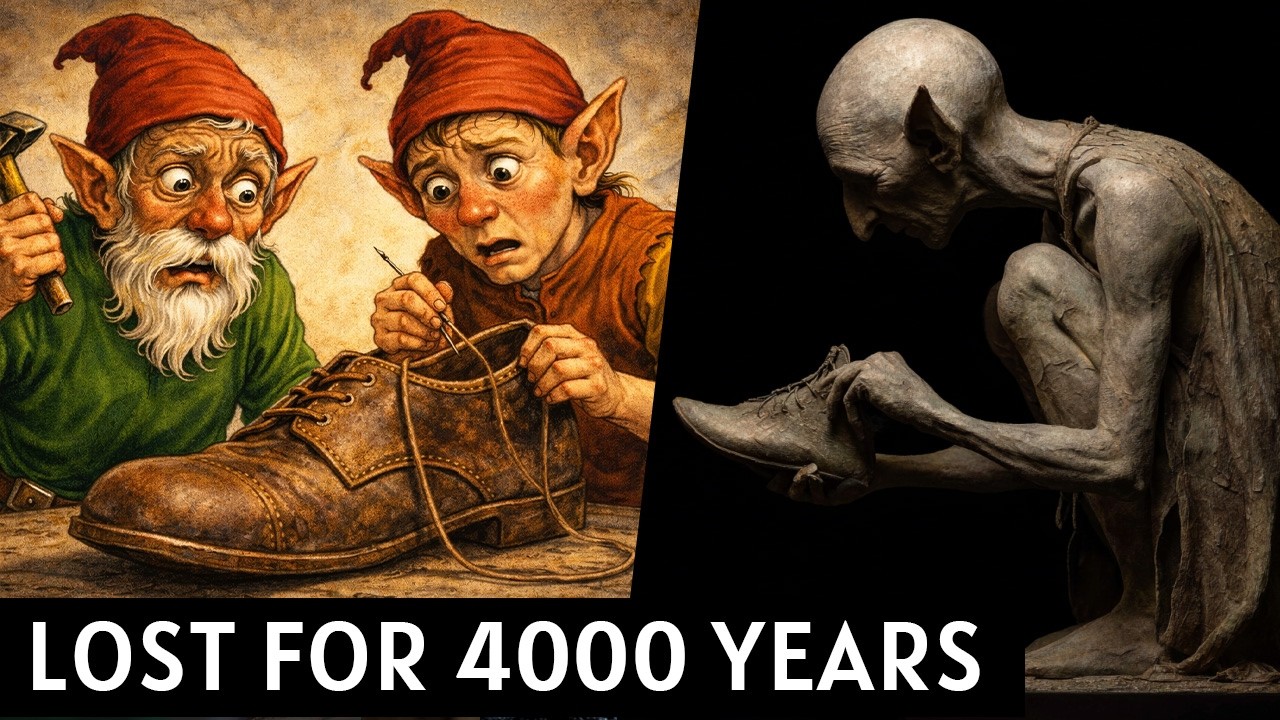
When the little men discover the clothing, they are delighted. They dress themselves, sing joyfully, dance around the workshop, and leave, never to return. The shoemaker and his wife continue to prosper, remembering the mysterious visitors who helped them when they needed it most.
The ending seems simple: generosity is rewarded, and kindness creates happiness. But the moment the elves receive clothing and disappear is also the story’s most revealing detail. Across European folklore, supernatural household helpers often followed an unusual rule. They might work tirelessly for a family, yet giving them clothes could bring the entire arrangement to an end.
In Scotland and northern England, such beings were commonly known as brownies. German folklore included household spirits and little people associated with hidden work, while Scandinavian traditions featured the nisse or tomte, supernatural figures connected with farms and domestic life. Their characteristics varied between regions, but they shared a recognizable role: helping human households through work performed when ordinary people were asleep.
A brownie might clean a kitchen, churn butter, tend animals, or complete unfinished chores. In return, a household could leave a small offering of food, such as milk, cream, or bread. The relationship was not necessarily one of ownership or control. The spirit’s assistance depended on a delicate understanding between the human family and its unseen companion.
Clothing could disrupt that understanding. In some versions of the tradition, a brownie accepted a garment with delight and departed because it no longer needed to remain in service. In others, the gift offended the creature, which interpreted it as criticism of its appearance or as a declaration that its services were no longer wanted.
The elves in the shoemaker’s tale follow the more cheerful version. Their new clothes provide freedom, allowing them to leave on their own terms. The couple loses its supernatural assistance, but the shoemaker’s business has already become successful enough to survive without it.
A related legend comes from Cologne, Germany, where the Heinzelmännchen were said to be little hidden craftsmen who completed household and commercial tasks during the night. According to the popular story, they performed work for the townspeople until a curious tailor’s wife attempted to reveal them by scattering peas and trying to catch them. The offended creatures disappeared, and the townspeople had to perform their own work again.
Like the shoemaker’s elves, these mysterious workers were valued for their generosity but could not simply be commanded to reveal themselves. Their stories reflect an older folkloric idea: human prosperity might depend on forces that remained beyond human understanding.
The connection between hidden craftsmen and supernatural power also appears in ancient mythology. In Norse traditions, dwarves forged extraordinary objects for the gods, including Thor’s hammer, Mjölnir, and Odin’s spear, Gungnir. These artisans were associated with the earth and its hidden riches, and their skills surpassed those of ordinary craftsmen.
Greek mythology also imagined Hephaestus, the divine smith, working with golden mechanical attendants. In the Sumerian myth of Inanna’s descent into the underworld, two small beings are created to enter the realm of the dead and help secure the goddess’s return. These figures are not equivalent to European household elves, but their stories demonstrate how supernatural helpers could accomplish tasks beyond the reach of ordinary people.
Such parallels do not establish that the shoemaker’s tale directly originated in Norse, Greek, or Sumerian mythology. They instead reveal a recurring narrative pattern: small or hidden beings perform extraordinary work, often intervening when a powerful or desperate figure cannot succeed alone.
Yet the story’s deeper significance may extend beyond fairy folklore into the history of household religion.
In ancient Rome, families honored protective household deities known as the Lares. Small shrines called lararia could be found in Roman homes, and offerings were made to divine powers associated with the household and family. The hearth also held religious significance, with Vesta representing the sacred fire that sustained domestic life.
These beliefs differed from later traditions about brownies and elves. The Roman Lares were recognized within an established religious system, while household spirits belonged to a changing world of regional folklore. Nevertheless, both traditions reflect the importance people attached to unseen powers believed to protect domestic life.
The idea that the dead might continue to influence the living also has deep historical roots. Archaeological discoveries from some Neolithic and Bronze Age communities show that human remains were sometimes buried beneath houses or near domestic spaces. Such practices varied considerably, and burial alone cannot establish what people believed about the dead. Still, they demonstrate that ancestors and the household could occupy closely connected places in certain ancient societies.
Over centuries, religious traditions changed, and older practices were reinterpreted. It is tempting to imagine that household spirits evolved directly from ancestral worship, with the elves becoming disguised versions of deceased family members. However, the available evidence does not prove such a straightforward transformation. European folklore developed through many influences, and its supernatural beings cannot all be reduced to a single origin.
Even so, the ancestral interpretation offers a haunting way to read the shoemaker’s story. What if the invisible helpers represent the comforting possibility that a family is supported by forces it cannot see? The story never identifies the little men, explains where they came from, or reveals why they chose to help. Their mystery is essential to their role.
The timing adds another layer of atmosphere. The story takes place as Christmas approaches, during the darkest period of the European winter. Seasonal customs in several regions included offerings to household spirits. Scandinavian traditions, for example, associated the nisse or tomte with farms and the care of livestock, and some customs involved leaving food for these beings during the winter season.
But the shoemaker’s tale does not explicitly identify the elves as ancestral spirits or state that their appearance is part of a solstice ritual. Its winter setting may reflect the atmosphere of a traditional Christmas story as much as any surviving ancient religious practice. The connection is suggestive rather than conclusive.
What makes the tale endure is its combination of wonder and uncertainty. The shoemaker never discovers the true identity of his helpers. He witnesses their work, offers them gratitude, and accepts that they have chosen to leave. The story never requires him to solve the mystery before he can benefit from it.
Beneath its cheerful ending, The Elves and the Shoemaker preserves a world in which human life was imagined as part of a larger, partially invisible order. Good fortune might arrive unexpectedly. A household could be protected by forces beyond its understanding. And a small act of gratitude could determine whether a mysterious relationship continued or came to an end.
We cannot know whether the story preserves memories of ancient household worship, reflects medieval beliefs about supernatural helpers, or combines several traditions that evolved over generations. What we can recognize is its enduring fascination with the unseen forces people imagine working alongside them.
The shoemaker’s greatest miracle is not simply that two tiny figures make him rich. It is that, at his lowest point, help arrives from a source he never expected. Perhaps that is why the story has survived for centuries: it gives shape to the hope that even when the world seems to have abandoned us, something beyond our sight may still be working through the darkness.


