In the summer of 1959, a magnificent white yacht sailed across the Mediterranean carrying some of the world’s most recognizable personalities.
Among its passengers were Winston Churchill, legendary opera singer Maria Callas, and Greek shipping billionaire Aristotle Onassis.
Also aboard were their spouses.
The voyage was supposed to be an extravagant holiday filled with sunshine, elegant dinners, and visits to beautiful Mediterranean destinations. Instead, it became the beginning of a scandal that would destroy two marriages and transform the private lives of everyone involved.
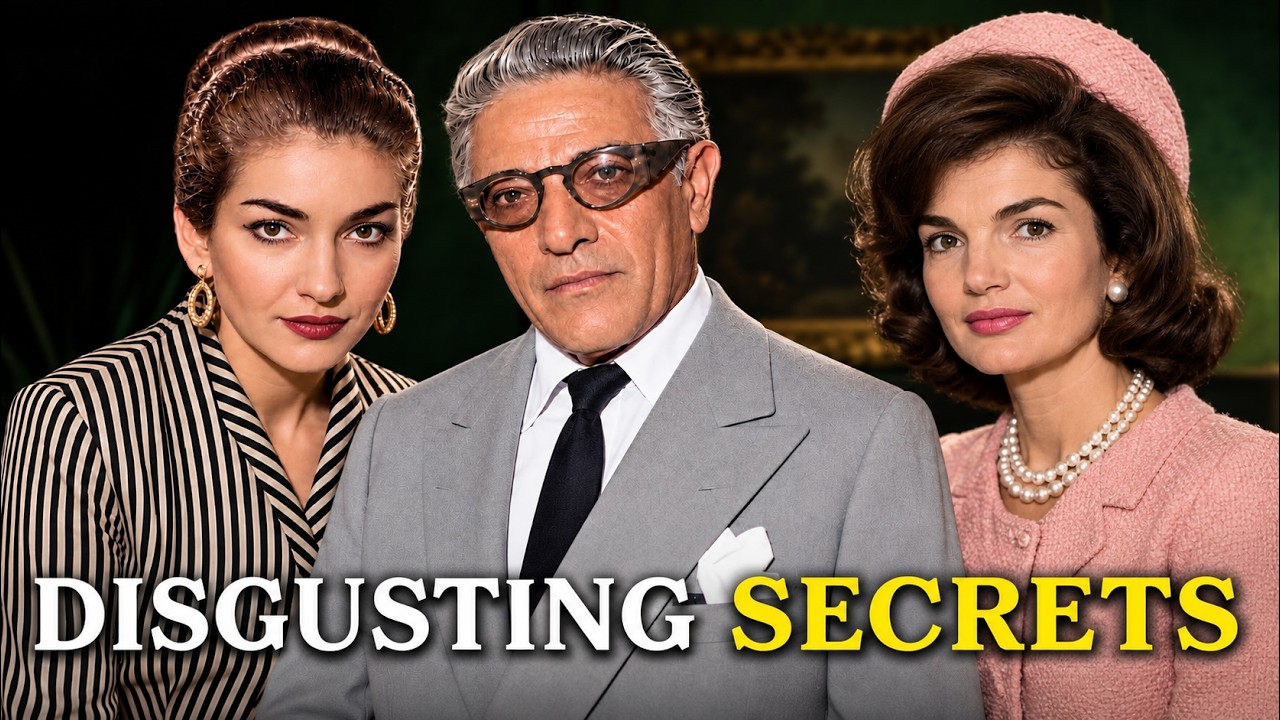
By the time the yacht returned, Callas and Onassis had begun a relationship that would dominate international gossip for nearly a decade.
But the opera singer was not the first woman whose life became entangled with the ambitious Greek tycoon.
Before her came Ingeborg Dedichen, his longtime companion during the years when he was building his fortune, and Tina Livanos, the teenage daughter of a shipping dynasty who became his first wife.
After Callas came Jacqueline Kennedy, the widowed former First Lady of the United States, whose marriage to Onassis shocked the world in 1968.
Each woman experienced a different side of the man who seemed capable of acquiring almost anything he wanted.
For some, he offered extraordinary glamour, affection, and opportunity. For others, the relationship brought painful separation, jealousy, and disappointment.
Behind the enormous fortune stood a man whose determination to control his business empire did not always translate into happiness within his family.
And by the end of his life, tragedy had overtaken the billionaire who once appeared to possess everything.
The Boy from Smyrna Who Lost His World
Aristotle Socrates Onassis was born on January 20, 1906, in Smyrna, then part of the Ottoman Empire and now known as İzmir, Turkey.
His father, Socrates Onassis, was a successful tobacco merchant, and the family enjoyed a relatively comfortable existence within Smyrna’s substantial Greek community.
That stability disappeared in 1922.
Following the Greco-Turkish War, Smyrna experienced catastrophic destruction as fire devastated much of the city and enormous numbers of residents fled.
The Onassis family suffered severe losses.
Aristotle was still a teenager when the world he had known collapsed.
Family accounts later described his efforts to help relatives escape and secure his father’s release from detention.
Those experiences became central to the mythology surrounding his determination and independence.
In 1923, he traveled to Argentina, seeking opportunities far from the eastern Mediterranean.
Buenos Aires offered a new beginning.
Onassis worked various jobs, including employment connected to telecommunications, while establishing a tobacco-importing business.
He recognized commercial opportunities among affluent customers interested in distinctive imported tobacco products.
His business activities expanded, and he eventually accumulated enough capital to enter the shipping industry.
During the Great Depression, he acquired vessels at relatively favorable prices.
He subsequently recognized the enormous commercial possibilities created by oil transportation.
The oil tanker business became the foundation of his fortune.
By the postwar period, he had established himself as one of the world’s most powerful independent shipowners.
He acquired luxurious residences, developed influential political relationships, and became a familiar presence in international high society.
Yet the story of his personal relationships had begun before he achieved such prominence.
Ingeborg Dedichen: The Woman Who Knew Onassis Before His Fortune
Before Tina Livanos, Maria Callas, or Jacqueline Kennedy entered his life, Aristotle Onassis shared a lengthy relationship with Norwegian socialite Ingeborg Dedichen.
She came from a prosperous family with connections to international shipping.
They became involved during the 1930s, when Onassis was still establishing himself among Europe’s powerful maritime businessmen.
Their relationship continued through much of the period in which his business empire expanded.
Dedichen occupied a position quite different from the women who would later become associated with him.
She knew him before his enormous fortune made him an international celebrity.
She witnessed his relentless pursuit of commercial success, his negotiations, and his growing confidence.
According to later accounts, the couple shared considerable affection but also experienced serious conflict.
Dedichen eventually wrote about their relationship in Onassis, mon amour, published in the 1970s.
Her account described a man capable of charm, tenderness, generosity, and sudden anger.
She also alleged episodes of abusive behavior.
Those allegations belong to her personal testimony and cannot all be independently verified.
Nevertheless, they complicate the glamorous image that surrounded Onassis in later decades.
He and Dedichen never married.
Their relationship eventually ended as his wealth and ambitions expanded.
By the mid-1940s, Onassis was moving increasingly confidently among the established Greek shipping dynasties.
His next major relationship would connect him to one of the wealthiest families in that world.
Tina Livanos: The Teenage Bride Who Entered a Billionaire’s World
Athina Mary Livanos, known as Tina, was born in London in 1929.
Her father, Stavros Livanos, was a powerful Greek shipowner whose family occupied an established position within international shipping.
Onassis belonged to a newer generation of ambitious maritime entrepreneurs.
He had built his reputation through bold acquisitions and commercial risk-taking rather than inherited standing.
His marriage to Tina would unite those two worlds.
On December 28, 1946, the couple married in New York.
Tina was seventeen.
Onassis was forty.
The twenty-three-year age difference was striking, even among wealthy international families.
Their union brought together substantial economic interests and established important personal connections between shipping dynasties.
Tina’s sister, Eugenia Livanos, married another successful Greek shipowner, Stavros Niarchos.
Onassis and Niarchos became famous rivals.
Their competition extended beyond shipping contracts into yachts, art, property, and social prestige.
For the Livanos sisters, the rivalry created a complicated family environment.
Their husbands competed for influence, but the women remained connected through their shared family background.
Tina and Onassis had two children.
Their son, Alexander, was born in April 1948.
Their daughter, Christina, followed in December 1950.
The children became central figures in the family’s later history.
For a time, the marriage appeared to offer everything associated with extraordinary wealth.
The family maintained residences in several countries, traveled extensively, and entertained famous political and cultural personalities.
But behind the lavish lifestyle, the marriage faced growing difficulties.
Onassis devoted enormous energy to business.
His social life brought him into contact with prominent women, and reports of extramarital relationships became persistent.
Tina’s position was increasingly difficult.
She had married while still a teenager and become the mother of two children before reaching her early twenties.
Her husband’s enormous fortune gave her material security, but it could not resolve the emotional strains of their relationship.
By the late 1950s, those difficulties had become impossible to conceal.
The Christina: A Floating Palace Built for Power and Pleasure
In 1954, Onassis acquired a former Canadian naval vessel and transformed it into an extraordinary luxury yacht.
He named the ship Christina after his daughter.
The vessel became one of the most recognizable symbols of his wealth.
It featured luxurious guest accommodations, elegant dining spaces, lavish furnishings, and an elaborate swimming pool.
The yacht attracted royalty, politicians, actors, artists, and international business leaders.
Winston Churchill became a particularly famous guest.
The former British prime minister enjoyed spending time aboard the vessel, appreciating both its comforts and the opportunity to relax away from ordinary political obligations.
Onassis also cultivated relationships within Monaco.
His business interests there placed him among the influential personalities of the French Riviera.
The Christina was therefore far more than a private pleasure boat.
It served as a floating center of social and commercial influence.
On its decks, Onassis could entertain people who would otherwise remain separated by politics, geography, and status.
But the yacht also became the setting for one of the most consequential romantic scandals of his life.
In July 1959, Maria Callas boarded the vessel with her husband.
What followed would change two marriages forever.
Maria Callas: The Opera Legend Who Fell in Love with a Shipping Tycoon
Maria Callas was born in New York City on December 2, 1923, to Greek immigrant parents.
She spent important years of her childhood and youth in Greece, where her musical education helped establish the foundation of an extraordinary career.
By the 1950s, she had become one of the world’s most celebrated opera singers.
Her performances combined dramatic intensity with remarkable vocal expression.
Audiences admired her portrayals of characters in Norma, Tosca, La Traviata, and many other works.
Her reputation extended far beyond opera houses.
Callas had become an international cultural figure whose personal style and public image attracted widespread attention.
She was married to Giovanni Battista Meneghini, an Italian businessman who had played an important managerial role in her career.
But the marriage faced difficulties.
Onassis and Callas had met before the 1959 cruise.
Their shared Greek heritage provided an immediate cultural connection.
During the voyage aboard the Christina, their relationship became increasingly intimate.
Meneghini was present.
Tina Onassis was also aboard.
Churchill and other guests witnessed the developing tension.
By the end of the holiday, the attraction between the shipping magnate and the singer had become difficult to deny.
Their relationship soon became public.
The international press followed the story enthusiastically.
The celebrated opera singer and the immensely wealthy shipping tycoon represented two very different forms of fame.
Their romance seemed to combine artistic glamour with extraordinary financial power.
But the consequences for their existing marriages were severe.
The Divorce That Ended Tina’s Marriage
Tina Onassis did not remain in the marriage indefinitely.
Following the public emergence of her husband’s relationship with Callas, she pursued divorce.
The marriage formally ended in 1960.
Tina received a financial settlement and continued caring for the couple’s children.
The divorce attracted enormous attention because of the family’s wealth and public prominence.
For Onassis, the separation represented the end of a marriage that had linked him to one of Greece’s major shipping families.
For Tina, it marked the beginning of a new and complicated chapter.
Their children remained connected to both parents.
Alexander and Christina would later become involved in disagreements surrounding their father’s subsequent relationships.
Their reactions were especially important when Onassis married again in 1968.
By then, the woman he chose would be even more internationally famous than Maria Callas.
Nine Years with Maria Callas: Love Without Marriage
After leaving their respective marriages, Onassis and Callas maintained a relationship that lasted through much of the 1960s.
They traveled together and appeared at fashionable European destinations.
Callas spent time aboard the Christina and on Skorpios, the private Greek island Onassis acquired in 1963.
For a woman whose career had involved relentless rehearsals, demanding performances, and intense public scrutiny, the relationship offered a different lifestyle.
She was able to spend extended periods away from the opera stage.
But that change also contributed to continuing debates about her artistic career.
Callas had already experienced vocal difficulties before becoming involved with Onassis.
Her performances became less frequent during the 1960s.
In July 1965, she made her final staged operatic appearance, performing Tosca at London’s Royal Opera House.
Some biographers have argued that her relationship with Onassis contributed to her withdrawal from performance.
Others emphasize the vocal and professional challenges that preceded their romance.
The precise balance between those factors remains debated.
Callas never married Onassis.
Despite the length of their relationship, he did not offer the formal commitment that many biographical accounts suggest she desired.
Claims that Callas secretly gave birth to Onassis’ child have appeared in later publications, but the evidence remains disputed and does not establish the story as fact.
Their relationship continued to generate intense fascination.
Yet as the 1960s approached their conclusion, Onassis’ attention shifted toward another famous woman.
This time, the consequences would reach beyond the world of entertainment into American political history.
Jacqueline Kennedy: The Widow Who Wanted a Different Life
Jacqueline Bouvier Kennedy had become one of the world’s most admired public figures during her years as First Lady of the United States.
Her marriage to President John F. Kennedy placed her at the center of American political life.
She became associated with elegance, cultural refinement, and the restoration of the White House.
But her life changed catastrophically on November 22, 1963.
President Kennedy was assassinated in Dallas while Jacqueline sat beside him.
The images of the grieving First Lady became inseparable from the national tragedy.
She subsequently devoted herself to raising Caroline and John while living under extraordinary public attention.
Onassis had known members of the Kennedy family before the assassination.
Jacqueline had traveled aboard his yacht in October 1963.
Their acquaintance continued during the following years.
Then another tragedy struck.
On June 5, 1968, Senator Robert F. Kennedy was shot in Los Angeles and died the following day.
Jacqueline had already lost her husband to political violence.
Now another major member of the Kennedy family had been killed.
Biographical accounts describe her increasing concern for her children’s safety and her desire for greater privacy.
Onassis offered wealth, international residences, private transportation, and security.
Their relationship developed rapidly.
On October 20, 1968, the couple married on Skorpios.
Jacqueline was thirty-nine.
Onassis was sixty-two.
The ceremony attracted worldwide attention.
The former First Lady had married a Greek shipping magnate whose personal history was already associated with extraordinary wealth and scandal.
The union created one of the most famous celebrity couples of the twentieth century.
But the public response was deeply divided.
The Marriage That Devastated Maria Callas
For Maria Callas, Onassis’ marriage to Jacqueline Kennedy was a devastating personal development.
The singer had spent much of the previous decade in a relationship with him.
Now he was marrying another woman.
Biographers have described Callas as deeply distressed by the news.
Stories about precisely when she learned of the wedding and how Onassis communicated his decision vary.
Some accounts suggest she discovered his intentions through reports rather than a direct conversation.
Others describe subsequent meetings between the former lovers.
The exact details of those private encounters remain difficult to verify.
What is clear is that the marriage transformed Callas’ relationship with Onassis.
She was no longer his publicly acknowledged companion.
The man with whom she had shared years of her life had chosen a different future.
But their connection did not entirely disappear.
Reports of later meetings contributed to renewed gossip about the state of Onassis’ marriage.
For Callas, the situation became part of an increasingly painful personal history.
She remained internationally admired for her artistry, yet her private life continued attracting intense scrutiny.
Jackie O: A Marriage Surrounded by Wealth and Resentment
Jacqueline Kennedy Onassis entered a world of extraordinary luxury.
The family’s residences, yacht, private island, and extensive staff offered a lifestyle unlike almost anything available to ordinary people.
But comfort did not guarantee marital happiness.
Jacqueline maintained strong connections to New York, where her children attended school.
Onassis continued traveling between business interests in Europe and the Mediterranean.
Their different priorities contributed to periods of physical separation.
Reports also circulated about disagreements over spending and family relationships.
Onassis was famously willing to invest enormous sums in ships, property, and personal luxury.
Yet accounts from employees and biographers describe his objections to some of Jacqueline’s expenditures.
Their personalities also differed.
Jacqueline valued privacy, refined cultural pursuits, and the ability to protect her children from unwanted attention.
Onassis enjoyed highly visible displays of influence, international business negotiations, and the company of powerful associates.
Another source of tension involved his children.
Alexander and Christina had endured their parents’ divorce and remained deeply attached to their mother.
Their relationship with Jacqueline was complicated.
Later accounts portray Christina as particularly resistant to her stepmother’s presence.
Nevertheless, claims about specific private arguments must be treated carefully.
Much of the surviving narrative comes from interviews, biographies, and retrospective recollections rather than direct records of the couple’s conversations.
The marriage remained a subject of fascination throughout the early 1970s.
In 1972, unauthorized photographs of Jacqueline on Skorpios created another international controversy.
Rumors that Onassis himself had helped arrange the intrusion have circulated for decades.
Those allegations have not been conclusively established.
The incident nonetheless demonstrated that even the privacy afforded by extraordinary wealth could be breached.
Alexander Onassis: The Son Whose Death Changed Everything
On January 22, 1973, Alexander Onassis was involved in an aviation accident near Athens.
He was twenty-four years old.
Alexander had developed a serious interest in aviation and worked in activities connected with his father’s airline interests.
The aircraft crashed shortly after takeoff.
He suffered catastrophic injuries.
Alexander died on January 23, 1973, according to contemporary accounts, although some institutional biographies list January 24.
His death devastated the family.
Onassis had built an enormous business empire partly with the expectation that his children would inherit its future.
Now his only son was gone.
Reports describe Onassis struggling to accept the accident.
He reportedly suspected sabotage and pursued inquiries into the crash.
But accusations of deliberate interference were never conclusively established.
His grief became one of the defining experiences of his final years.
Friends and associates described a marked deterioration in his emotional and physical condition.
The death also placed additional strain on already complicated family relationships.
His marriage to Jacqueline continued, but the atmosphere surrounding the household had changed profoundly.
The billionaire who had once seemed capable of overcoming almost any commercial obstacle could do nothing to reverse the loss of his son.
Tina Livanos and the Tragedy of the Shipping Dynasties
After divorcing Onassis, Tina Livanos rebuilt her personal life.
In 1961, she married John Spencer-Churchill, Marquess of Blandford.
That marriage subsequently ended.
Meanwhile, her sister Eugenia had remained married to shipping magnate Stavros Niarchos.
In May 1970, Eugenia died under circumstances that attracted considerable public speculation.
Her death was associated with the use of barbiturates.
Despite rumors surrounding the circumstances, allegations of criminal responsibility were not established.
In October 1971, Tina married her former brother-in-law, Stavros Niarchos.
The marriage created an extraordinary new connection between Onassis and his longtime business rival.
Tina was now married to the widower of her own sister.
The situation attracted considerable attention within international society.
But the family’s greatest tragedy was still to come.
Alexander’s death in January 1973 deeply affected Tina.
She had already experienced the loss of her sister, the end of previous marriages, and years of family conflict.
On October 10, 1974, Tina was found dead in Paris.
She was forty-five years old.
Reports attributed her death to pulmonary edema, although speculation about medication and associated circumstances continued.
There was no established finding of homicide.
Her death came less than two years after Alexander’s fatal accident.
For Christina Onassis, the losses were devastating.
She had lost her brother and mother within a remarkably short period.
Her father was also experiencing serious health problems.
The enormous wealth surrounding the family had provided no defense against successive tragedies.
The Final Months of Aristotle Onassis
By late 1974, Aristotle Onassis was seriously ill.
He suffered from myasthenia gravis, a neuromuscular disorder that causes muscle weakness.
The condition affected his physical strength and contributed to a growing decline in his health.
He had also endured overwhelming personal grief.
His son was dead.
His former wife Tina had died.
His marriage to Jacqueline was increasingly troubled.
Accounts suggest he considered divorce, although descriptions of his intentions and legal preparations vary between biographers.
In early 1975, his condition deteriorated further.
He received medical treatment in France at the American Hospital of Paris in Neuilly-sur-Seine.
On March 15, 1975, Aristotle Onassis died.
He was sixty-nine years old.
Christina remained closely involved during his final illness.
Jacqueline was in New York when he died.
Onassis was buried on Skorpios, the island that had symbolized so much of his extraordinary lifestyle.
His grave was placed near that of Alexander.
The father and son were reunited in death on the private island where Onassis had entertained presidents, royalty, and international celebrities.
But the family conflicts did not end with his funeral.
The Inheritance That Divided Jackie and Christina
Onassis left behind an immense fortune.
His estate included extensive business interests and financial assets.
The central beneficiaries were Christina and a charitable foundation established in Alexander’s memory.
The Alexander S. Onassis Public Benefit Foundation became one of the enduring institutional legacies of the family.
Jacqueline’s inheritance became the subject of negotiations.
The precise value of the eventual settlement has been reported differently in various accounts.
A surviving legal settlement document identifies an arrangement worth approximately $20.5 million, while later reporting has cited higher figures.
The disagreement illustrates why commonly repeated claims about a $26 million payment should not be treated as exact without specifying the source.
Whatever the final calculation, Jacqueline emerged with substantial financial resources and relinquished further claims against the estate.
The negotiations also revealed the difficult relationship between Jacqueline and Christina.
Both women occupied important positions within the family, but their interests were not identical.
Christina became responsible for preserving a significant portion of her father’s legacy.
Jacqueline returned increasingly to an independent life in New York.
The fortune Onassis had spent decades creating survived him.
The family relationships surrounding it remained complicated.
Maria Callas After Onassis: The Final Years of a Legendary Voice
Maria Callas continued living primarily in Paris following the collapse of her relationship with Onassis.
Her operatic career had already become less active.
During 1973 and 1974, she undertook a concert tour with tenor Giuseppe di Stefano.
The performances attracted considerable attention from audiences who still regarded her as one of opera’s greatest interpreters.
Critics sometimes noted the deterioration of her voice.
But her artistic reputation remained secure.
Callas was more than a singer admired for technical ability.
She had transformed operatic performance through her extraordinary commitment to dramatic expression and characterization.
Her influence endured even when her performing career had declined.
On September 16, 1977, she died in Paris at fifty-three.
Her death certificate cited a heart attack, although no autopsy was performed, leaving some uncertainty about the precise medical circumstances.
Later retellings often describe her death primarily as the final consequence of heartbreak.
Such interpretations reflect the enduring legend surrounding her relationship with Onassis.
They do not establish that emotional distress caused her death.
Her greatest legacy remains her extraordinary contribution to twentieth-century opera.
Jacqueline Kennedy Onassis: A New Identity Beyond Marriage
After Onassis’ death, Jacqueline returned to a more independent professional life.
She settled in New York and eventually established herself in publishing.
She worked first at Viking Press and later at Doubleday.
Her editorial career demonstrated interests that had long been overshadowed by her status as First Lady and celebrity spouse.
Jacqueline had always valued art, literature, history, and cultural preservation.
Publishing allowed her to pursue those interests through sustained professional work.
She maintained a relatively private life while continuing to support her children.
Her public identity gradually expanded beyond the two famous marriages that had shaped so much of her international reputation.
She died on May 19, 1994, at sixty-four.
By then, she was remembered not only as the widow of John F. Kennedy and the wife of Aristotle Onassis, but also as a cultural figure who had exercised considerable personal influence across several decades.
Christina Onassis: The Daughter Who Inherited the Empire
Christina Onassis inherited extraordinary wealth, but her adult life was also marked by personal upheaval.
She became involved in the management of the family’s financial interests and maintained an international lifestyle.
Her private relationships attracted considerable media attention.
Christina married four times.
In January 1985, she gave birth to a daughter, Athina.
For a time, motherhood offered an important new focus in her life.
But Christina’s health and personal difficulties continued.
On November 19, 1988, she died in Argentina at thirty-seven.
Her death attracted worldwide attention because of the enormous fortune she controlled and the tragedies that had already affected her family.
Her daughter Athina became the surviving direct descendant through whom much of the Onassis family’s private legacy continued.
The Alexander S. Onassis Public Benefit Foundation, meanwhile, preserved another major part of the family’s inheritance through its cultural, educational, and public-benefit activities.
The Yacht That Outlived Everyone
The vessel once known simply as Christina eventually became Christina O.
After passing through different ownership arrangements, it underwent extensive restoration.
The famous yacht has continued operating as a luxury charter vessel, preserving much of the visual character associated with its original owner.
Its rooms still evoke the era when Churchill, Callas, film stars, and international business figures gathered aboard.
Few objects symbolize the Onassis story more vividly.
The vessel represented the commercial success that allowed its owner to move effortlessly among the world’s wealthiest and most influential people.
It also witnessed the beginning of the relationship that ended his first marriage.
On its decks, personal emotions collided with extraordinary privilege.
The yacht survived while the people who made it famous gradually disappeared.
Why the Onassis Love Stories Still Fascinate the World
Aristotle Onassis possessed wealth that few individuals could imagine.
He transformed the opportunities of international shipping into a global business empire.
He entertained heads of government and cultural celebrities.
He owned a celebrated yacht and a private island.
He married into a powerful shipping family, maintained a highly publicized relationship with one of opera’s greatest singers, and eventually married the widow of an American president.
But his family history was marked by an extraordinary succession of losses.
Ingeborg Dedichen remembered a complicated relationship from the years before his fame.
Tina Livanos experienced the collapse of their marriage and later endured profound family tragedy.
Maria Callas spent years in a relationship that ended without marriage and became central to the mythology of her personal life.
Jacqueline Kennedy Onassis found a new marriage after national tragedy but later developed a largely independent existence.
Christina Onassis inherited exceptional wealth while confronting the deaths of her closest family members.
Their experiences cannot be reduced to a simple claim that every woman who loved Onassis hated him.
The relationships contained affection, ambition, conflicting expectations, resentment, and profound emotional complexity.
Nor is there enough evidence to reconstruct every private argument, promise, or betrayal described in sensational biographies.
What the historical record does reveal is a man whose financial achievements were extraordinary but whose personal life remained turbulent.
For Onassis, money could purchase ships, property, security, and access to the world’s most exclusive circles.
It could not guarantee loyalty, preserve a marriage, or protect his children from tragedy.
The man who conquered the shipping world left behind an extraordinary fortune, but the relationships surrounding that fortune proved far more difficult to control than any business empire he created.


