The Supreme Court Did Reject Christa Pike’s Emergency Appeal—but It Was Not the End of Her Litigation, and the “Leaked Defense Audio” Is Unverified
Christa Pike did receive a devastating Supreme Court ruling immediately before Tennessee’s attempt to execute her.
That part is true.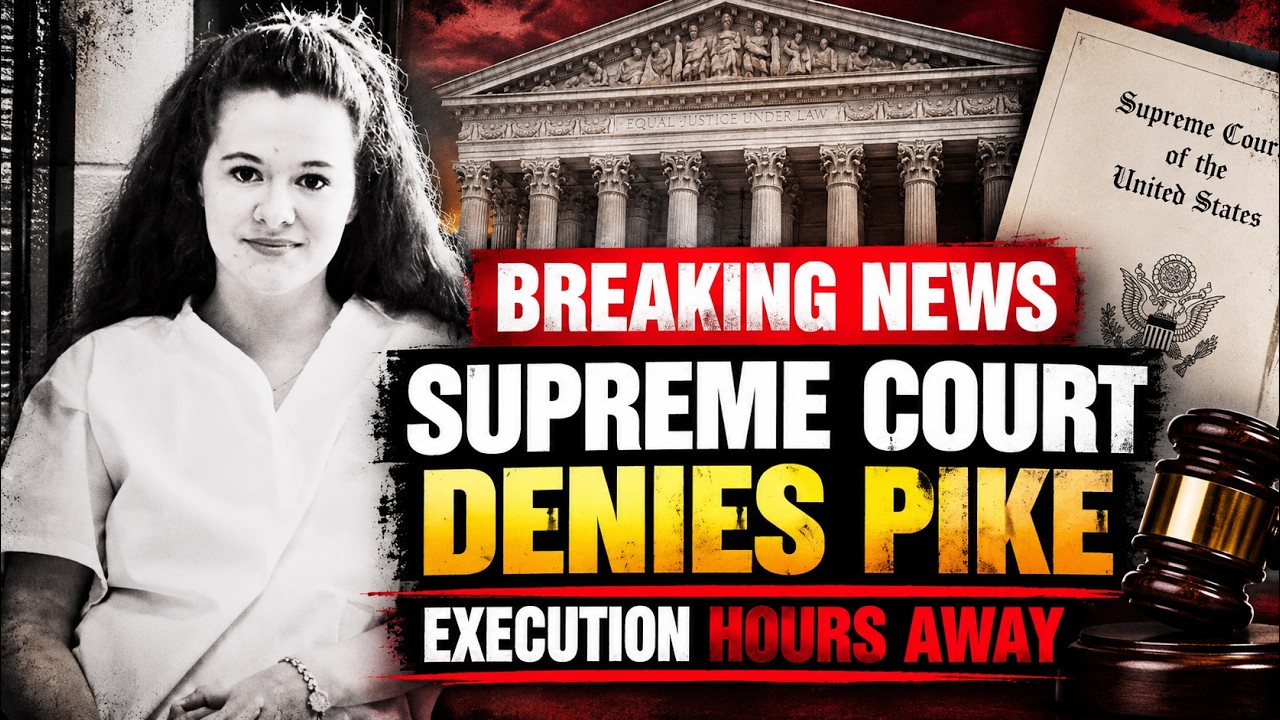
On September 29, 2026, the United States Supreme Court denied Pike’s application for a stay of execution.
The Court also denied her petition for a writ of certiorari.
The order was extremely brief.
It stated that Pike’s application for a stay, which had initially been presented to Justice Brett Kavanaugh and then referred to the full Court, was denied.
It then stated that the petition for certiorari was denied.
There was no lengthy majority opinion.
There was no dramatic declaration that Pike’s claims were frivolous.
There was no language saying every constitutional argument she could ever raise had been permanently exhausted.
And there was no secret longer version of the ruling hidden from the public.
The September 29 order is publicly available on the Supreme Court’s own website.
That makes the promise of an “unredacted Supreme Court order” misleading.
The operative order is already public.
Its wording is short.
Its legal effect was serious.
But it was not a hidden document that needed to be obtained through private messages.
The viral account also creates a false sense of finality.
The September 29 denial did not actually end Pike’s litigation.
Less than a day later, she obtained new relief from another federal court.
On September 30, the United States Court of Appeals for the Sixth Circuit issued a temporary stay of execution in separate federal habeas litigation.
That stay was entered so the Sixth Circuit could adequately consider unresolved issues concerning Pike’s Rule 60(b) motion.
The underlying dispute involved her ineffective-assistance claim and evidence concerning severe sexual abuse she suffered as a minor.
That fact alone disproves the viral statement that the September 29 Supreme Court order “permanently exhausted” every constitutional avenue.
If every judicial avenue had been permanently closed on September 29, a federal appellate court could not have issued another stay on September 30.
But that is exactly what happened.
Tennessee then filed a new emergency application at the Supreme Court.
This second Supreme Court matter carried docket number 26A428.
The state asked the justices to vacate the Sixth Circuit stay and allow the execution to proceed.
Pike’s lawyers opposed that request.
Their filing was submitted by Federal Defender Services of Eastern Tennessee.
The Supreme Court docket identifies Luke P. Ihnen as counsel of record and also lists Stephen Ferrell on Pike’s September 30 filing.
Tennessee then filed a reply.
Later on September 30, the Supreme Court granted the state’s application.
The Court vacated the Sixth Circuit’s stay.
That September 30 order was considerably more consequential than simply repeating the September 29 denial.
It directly removed a stay that was then preventing Tennessee from executing Pike.
The Supreme Court’s order says the application to vacate the stay was granted.
It specifically identifies the September 30 Sixth Circuit order in case number 26-5864 and states that the stay was vacated.
Three justices dissented.
Justice Sonia Sotomayor wrote the dissent, joined by Justices Elena Kagan and Ketanji Brown Jackson.
Sotomayor explained that the Sixth Circuit had issued its stay solely to give itself time to adequately address Pike’s pending application.
She criticized the Supreme Court majority for allowing Tennessee to proceed before that litigation could be properly considered.
That is important for understanding what the Supreme Court actually did.
The Court did not issue a detailed ruling rejecting every factual allegation Pike had ever raised.
It vacated a temporary stay.
The practical effect was to clear the way for Tennessee to proceed with the execution.
But that is different from a comprehensive judgment declaring every imaginable legal claim permanently extinguished.
In capital litigation, new legal disputes can arise even after the Supreme Court denies one petition.
That is exactly what Pike’s case demonstrated.
The September 29 denial was followed by a September 30 Sixth Circuit stay.
The Sixth Circuit stay was followed by a second Supreme Court proceeding.
And later that evening, Pike’s attorneys filed additional emergency litigation during the execution attempt itself after she remained alive following administration of the lethal drugs.
The sequence therefore looks nothing like a single door slamming permanently shut.
Instead, it involved multiple overlapping emergency proceedings.
September 29: the Supreme Court denied Pike’s stay application and certiorari petition.
September 30 morning: the Sixth Circuit entered another stay.
September 30 later: Tennessee asked the Supreme Court to vacate it.
September 30 later still: the Supreme Court granted Tennessee’s request.
Then Tennessee proceeded with the execution attempt.
That attempt failed to kill Pike.
Reuters reported that Pike remained alive after Tennessee administered two syringes of lethal-injection chemicals.
She was ultimately transported away from Riverbend to a medical facility.
Governor Bill Lee then suspended Tennessee’s remaining executions for the year and ordered an independent investigation.
That later development makes the viral claim especially outdated.
The caption presents the Supreme Court’s denial as the final chapter immediately before Pike’s death.
But Pike did not die.
The state attempted to execute her, and the procedure did not result in her death.
As of October 1, she remains alive according to the latest reporting.
Therefore any article saying the Court’s order “cleared Tennessee to carry out her execution” must add what happened afterward.
Tennessee was legally permitted to proceed.
Tennessee did proceed.
But the execution attempt was unsuccessful.
The phrase “execution warrant remains active” also requires precision.
The Supreme Court did remove federal judicial barriers that were then preventing the execution.
That is legally significant.
But the viral story implies that an attorney secretly delivered a simple final message inside Riverbend: no appeals remain, the warrant is active, and death is imminent.
No authenticated evidence establishes that scene.
There is no verified recording of Pike’s defense team having that conversation with her.
No major news organization has published a complete audio file.
No attorney on Pike’s team has authenticated the alleged ten-second clip.
No court filing cites it.
No prison official has acknowledged it.
The supposed audio therefore remains unverified.
The description of attorneys being in “complete despair” is also subjective.
Lawyers can be disappointed by a ruling.
They can become emotional.
They can urgently prepare additional filings.
But a factual report should describe observable or documented actions rather than assign an internal emotional state without evidence.
What is documented is that Pike’s lawyers continued litigating.
That behavior itself contradicts the idea that they viewed the September 29 decision as the absolute end of every possible legal path.
The following morning, separate litigation succeeded temporarily in stopping the execution.
That is not speculation.
The Supreme Court’s own September 30 opinion says the Sixth Circuit had issued a stay earlier that day.
The phrase “lethal injection teams move into final staging” is another unverified detail.
Tennessee certainly had an execution scheduled.
Officials were preparing Riverbend to carry it out.
The state had established media procedures and execution-day security.
But “final staging” is not language contained in the September 29 Supreme Court order.
It is not a quoted operational phrase in the Court’s docket.
And I found no authenticated prison communication using those words.
That does not mean preparations were not happening.
They obviously were.
It means a specific dramatic phrase should not be presented as though it came from an official record.
The same distinction applies to the phrase “brutal summary order.”
The order was a summary order.
That is accurate as a description of its brevity.
Calling it “brutal” is rhetoric.
The Court gave no explanation for its September 29 denial.
That is common in certiorari and emergency-order practice.
A denial of certiorari also does not mean the Supreme Court affirmatively endorsed every statement made by the lower courts.
It means the Court declined to take that particular case.
The September 29 order simply says the stay application and certiorari petition were denied.
That distinction is legally important.
A certiorari denial is not a merits opinion explaining why every claim fails.
It does not create a comprehensive factual finding.
And it does not necessarily prevent different litigation raising different procedural or constitutional questions.
Again, Pike’s next-day Sixth Circuit stay demonstrates that reality in unusually dramatic fashion.
The viral caption also combines clemency and judicial appeals as though they are one legal process.
They are separate.
Pike had sought clemency from Tennessee Governor Bill Lee.
Lee denied that request before the execution date.
That was an executive decision.
The Supreme Court proceedings involved judicial review.
One does not automatically control the other.
Pike’s clemency arguments emphasized her age at the time of the crime, severe childhood abuse, mental illness and the sentencing disparity between her and her co-defendants.
Those arguments were rejected by the governor.
Her court litigation involved constitutional and procedural claims.
Those arguments moved through state and federal courts.
Combining them into “every constitutional avenue and clemency maneuver permanently exhausted” may sound dramatic, but it obscures how the system actually works.
The clemency request had been denied.
A particular Supreme Court stay request had been denied.
Yet additional federal litigation remained active enough for the Sixth Circuit to grant relief the following morning.
The September 30 Supreme Court dispute makes this even clearer.
Tennessee’s application to vacate the Sixth Circuit stay expressly described the execution as scheduled for September 30 at 10:00 a.m. Central time.
Pike’s lawyers filed opposition papers.
Tennessee replied.
The Supreme Court then acted.
That was an entirely new emergency Supreme Court proceeding after the September 29 denial.
The viral description therefore collapses two different Supreme Court actions.
First came case 26A414, linked with case 26-5696.
That was Pike’s own application for a stay and petition for certiorari.
The Court denied both on September 29.
Then came case 26A428.
That was Tennessee Warden Kenneth Nelsen’s application asking the Supreme Court to vacate the Sixth Circuit’s new September 30 stay.
The Court granted that request.
Those proceedings should not be blended into a single supposed “last legal lifeline.”
They involved different applications.
They arose from different procedural postures.
They occurred on different dates.
And the second one existed precisely because legal proceedings continued after the first denial.
The identity of the lawyers is also publicly available.
The Supreme Court docket lists Luke Parker Ihnen of Federal Defender Services of Eastern Tennessee as counsel of record for Pike in the September 29 case.
The docket lists Tennessee Attorney General’s office counsel for the state.
That information is not hidden inside leaked audio.
The filings themselves reveal who was arguing what.
This matters because the alleged recording is being presented as though it provides secret confirmation of a legal reality already available from official records.
It does not.
If a lawyer told Pike that the Supreme Court had denied relief, that would be unsurprising.
But an unsurprising hypothetical conversation is not proof that a specific recording exists.
Authentication still matters.
The fact that something likely happened does not authenticate audio supposedly capturing it.
There is also no evidence that the Supreme Court secretly ordered Tennessee’s execution team into action.
The Court does not operate Riverbend.
Its role was judicial.
When it denied Pike’s September 29 application, an existing state execution order remained unobstructed by that particular Supreme Court proceeding.
When it vacated the Sixth Circuit stay on September 30, it removed a federal court order that had blocked Tennessee from proceeding.
Operational decisions inside Riverbend belonged to Tennessee corrections officials.
That is another reason the phrase “the high court put the death team into final staging” would be misleading.
The Court altered the legal landscape.
Tennessee officials controlled the operational response.
The failed execution later created entirely new legal questions.
Pike’s attorneys argued that the prolonged attempt inflicted unconstitutional suffering.
Witnesses described gasping and snoring after the drugs were administered.
Pike was eventually taken to a hospital.
Those events could support new litigation that did not exist before the September 29 Supreme Court order.
That further demonstrates why the phrase “permanently exhausted” is inappropriate.
Legal rights can depend on new facts.
A failed execution is a major new fact.
Whether Tennessee may constitutionally attempt another execution has not been finally resolved.
Governor Lee’s suspension of executions gives the state time to investigate the procedure.
Pike’s death sentence remains a separate issue.
The failure of the September 30 execution attempt does not automatically commute her sentence.
Nor does it automatically authorize Tennessee to try again immediately.
Future litigation is highly likely if the state seeks another execution date.
That is the opposite of a case with no possible legal questions remaining.
The current factual record can therefore be separated clearly.
The Supreme Court denied Pike’s September 29 application for a stay.
Verified.
The Court also denied her September 29 petition for certiorari.
Verified.
The order was brief.
Verified.
The order was publicly available.
Verified.
It did not contain a detailed merits explanation.
Verified by the text of the order.
Pike’s litigation ended permanently at that moment.
False.
The Sixth Circuit issued another stay the following day, creating a new Supreme Court proceeding.
The Supreme Court later vacated the Sixth Circuit’s September 30 stay.
Verified.
Justices Sotomayor, Kagan and Jackson dissented from that action.
Verified.
The Supreme Court’s September 30 action cleared the federal judicial barrier then preventing Tennessee from proceeding.
Verified.
Tennessee subsequently attempted to execute Pike.
Verified.
The attempt did not kill her.
Verified.
She was transported to a medical facility.
Verified.
Governor Lee then halted Tennessee’s remaining executions for 2026.
Verified.
A leaked defense recording captures Pike’s lawyers telling her the September 29 ruling ended everything.
Not verified.
The audio was recorded inside Riverbend.
Not verified.
Pike’s attorneys were heard in “complete despair.”
Not established.
An authenticated recording says lethal-injection teams were entering “final staging.”
Not verified.
There is an “unredacted” secret Supreme Court order different from the public September 29 order.
No evidence supports that claim.
The real sequence is more complex than the viral caption.
The Supreme Court did deny Pike emergency relief on September 29.
But litigation continued.
The Sixth Circuit stopped the execution on September 30.
The Supreme Court then removed that stay.
Tennessee attempted to execute Pike.
The execution attempt failed.
Pike survived.
And new constitutional litigation is now possible because the state’s attempt to carry out the sentence created facts that did not exist when the Supreme Court acted on September 29.
That is the current story.
The Supreme Court denial was real.
The later Supreme Court intervention was real.
The claim that every legal avenue was permanently extinguished by the first order is wrong.
And the supposed ten-second defense-team recording remains unverified.


